Running Shoe Sourcing Quality Control Inspection for United States Buyers
By Vincent Xi, Editorial Author
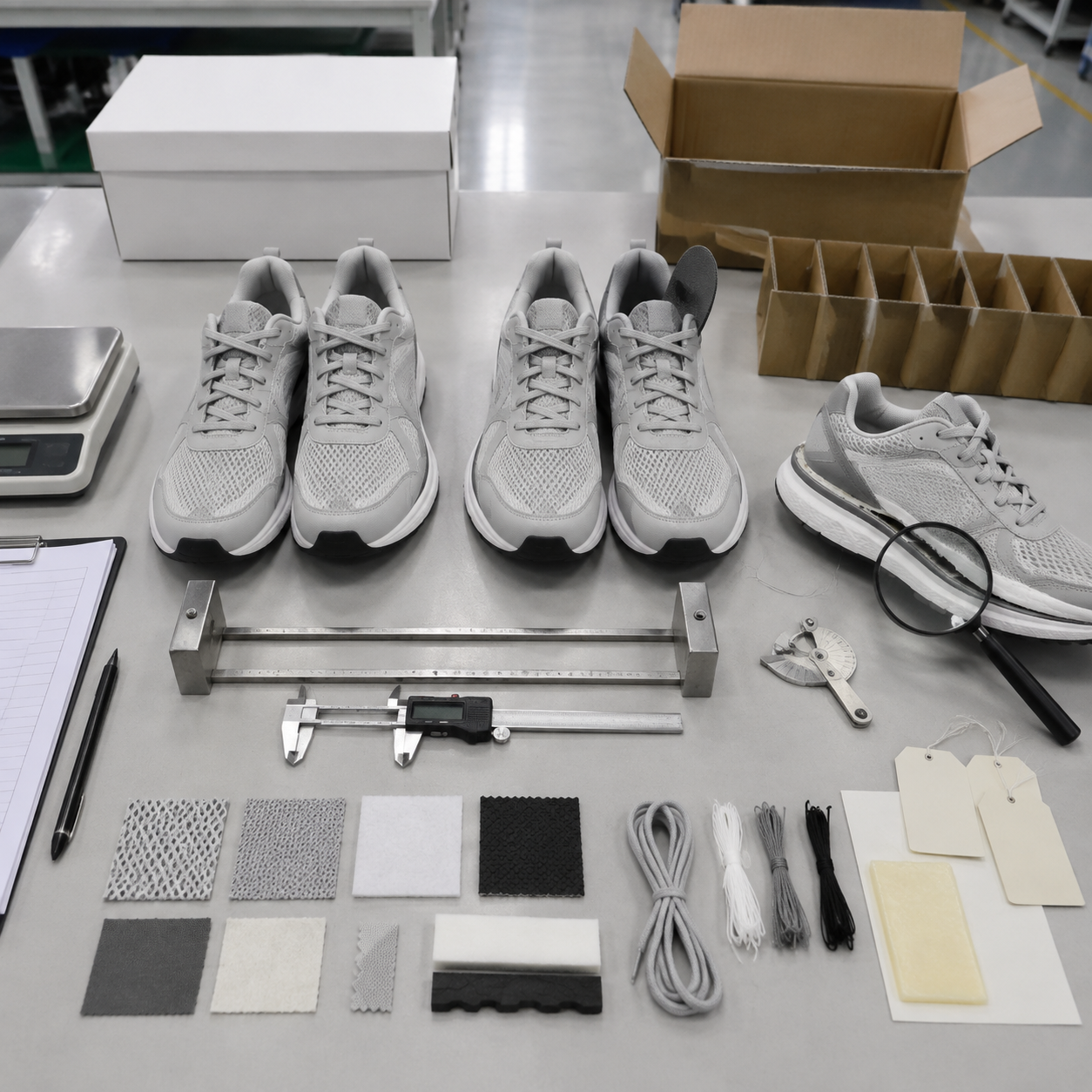
For a United States athletic footwear procurement team, running shoe sourcing quality control inspection should answer the shipment-release question: what evidence must be accepted before a production lot can ship? The RFQ and purchase order should freeze the product specification, identify the lot, define measurable acceptance criteria, and connect every inspection or test record to the same style, colorway, size run, production site, lot, and revision.
Ask the supplier to quote material approval, pre-production review, in-line inspection, finished-lot inspection, targeted laboratory work, reinspection, and packing or loading checks as separate scopes. Define who selects samples, who can authorize release, what happens after a failed result, who bears the resulting cost, and how schedule changes are documented.
The cited footwear pages support staged control categories. They do not establish a universal sampling plan, running shoe tolerance, defect threshold, United States labeling determination, tariff rate, price, or delivery promise. Those order-specific values must come from the approved specification, current supplier quote, applicable test method, lot-linked evidence, and current compliance review.
Author evidence note: The Vincent Xi author profile identifies Vincent Xi as an Editorial Author. No first-hand product use, factory visit, testing, or inspection claim is made.
United States running shoe quality control inspection release gate
Use the same release matrix in the RFQ, purchase order, inspection booking, corrective-action record, and shipment authorization.
| Release decision | RFQ or purchase-order control | Required evidence | Hold trigger |
|---|---|---|---|
| Product baseline | Approved tech pack, bill of materials, reference pair, artwork revision, size system, colorway, and substitution rule | Matching identifiers across the quote, control plan, samples, reports, and packing records | A component, construction detail, dimension, color, or artwork revision is missing or changed without written approval |
| Production lot | Declared lot boundary, production site, production window, size and color quantities, and required material or batch references | Lot and sample identifiers that connect the inspected units and test specimens to the declared production scope | The inspected units or test specimens cannot be traced to the declared lot |
| Measurable acceptance | Selection method, sample allocation, measurement points, units, tolerances, defect classes, and release rule | Individual measurements, defect findings, photographs, quantity reconciliation, and disposition | The report gives only a summary pass or an unexplained AQL reference |
| Test-dependent characteristics | Named attribute, method and edition, specimen scope, conditioning, result unit, pass criterion, report timing, and change rule | A current report linked to the relevant product, material, colorway, site, and lot | Visual inspection is presented as evidence of an untested chemical, durability, grip, impact, flex, abrasion, or strength characteristic |
| Labels and packing | Buyer-approved artwork, applicability decision, placement and packout requirements, proof stage, and change control | Production evidence, barcode checks where required, carton data, and reconciled packing records | The produced revision differs from the approved revision or an applicability decision remains open |
| Commercial release | Itemized quote, currency, delivery basis, named destination, landed-cost assumptions, milestone dates, and release authority | Closed inspection and test holds, accepted documents, and written shipment authorization | A cost input, responsibility boundary, date trigger, release document, or exception remains unresolved |
A report marked pass is not sufficient when the underlying results, lot link, or acceptance rule is missing. Record an exception with the affected lot, supporting evidence, commercial and schedule effects, approval boundary, and named buyer approver.
Evidence base, methodology, and limits
Source-supported data points
The following figures describe the cited pages only. They are not product tolerances, sampling values, supplier-performance results, or requirements for a buyer's order.
- As published on July 8, 2025, the Inductus page organizes its supplier discussion into 3 quality-control tiers: raw-material performance, in-process checks, and final audits (Inductus).
- As published on March 4, 2025, the Tetra article organizes its sneaker discussion into 4 quality-control stages: pre-production, during production, pre-shipment, and laboratory testing (Tetra Inspection).
- Within the March 4, 2025 Tetra article, 4 defect-example contexts are named: weak bonding, material defects, asymmetry, and sizing inconsistency (Tetra Inspection).
TIC discusses footwear inspection topics involving materials, stitching, color, sizing, comfort, and durability (TIC). Testcoo presents production inspection, final inspection, loading supervision, and full-inspection services as separate service contexts (Testcoo). These pages support separating requested inspection scopes in the RFQ. They do not prove that any inspection or test has been completed for a buyer's running shoe lot.
Methodology
This article extracts only the attributed footwear-control categories from the supplied TIC, Inductus, Tetra, and Testcoo pages. Those categories were mapped to running shoe procurement decisions involving the product baseline, production hold points, measurable acceptance, targeted testing, labels and packing, landed-cost inputs, delivery milestones, and shipment release. No source stage count was converted into a universal requirement, and no tolerance, sampling value, test threshold, price, tariff rate, or delivery duration was inferred.
Limitations and verification
The cited pages are editorial or service-page contexts, not buyer-specific inspection reports, legal authorities, laboratory-scope documents, supplier certifications, prices, or delivery commitments. They do not determine the buyer's last, bill of materials, material composition, size grading, intended claims, measurement tolerances, defect definitions, sampling plan, test methods, United States labeling obligations, tariff classification, supplier capacity, or delivery dates.
Verify those items against the signed specification, current supplier quote, current edition of any invoked standard, applicable laboratory scope, lot-linked reports, and current United States broker or compliance advice. Treat a certification claim as unverified until a current document identifies the issuer, status, relevant product or material, site where applicable, and covered scope. Keep a named standard's requirements separate from buyer-authored contractual controls and from a supplier's stated operating practice.
Put measurable running shoe criteria in the RFQ
Build each requirement around a characteristic, product scope, observation or measurement method, unit, target and limits or pass rule, inspection gate, required record, and failure disposition. Require the supplier to mark each line compliant, deviating, or not offered and to explain every deviation.
| Running shoe control | Buyer-defined requirement | Supplier return and inspection record | Release blocker |
|---|---|---|---|
| Order identity | Style or SKU, intended running use, colorway, size system, size run, quantity by size and color, approved revisions, and lot boundary | Quote, control plan, samples, and reports carrying matching identifiers | Conflicting identifiers or an undefined lot |
| Materials and components | Applicable requirements for the upper, overlays, lining, tongue, sockliner, midsole, outsole, laces, thread, adhesive, trims, and packaging under the approved bill of materials | Proposed identity and composition where specified, source or batch reference where required, approved color reference, and deviation schedule | An unapproved substitution or missing traceability required by the RFQ |
| Dimensions and mass | Buyer-marked measurement points, measurement condition, chosen unit, size-grading rule, target, tolerance, mass basis per shoe or pair, and permitted pair difference | Instrument, sampled size and color identifiers, individual results, calculated pair comparison where required, and disposition | A point, condition, unit, target, tolerance, or denominator is undefined |
| Stitching and assembly | Observable rules for stitch condition, panel placement, lasting, heel alignment, outsole positioning, bond-line appearance, adhesive contamination, and pair matching | Viewing or measurement method, actual findings, defect classification, photographs, and correction record | Acceptance relies on subjective wording without an observable rule |
| Appearance and color | Approved reference, viewing conditions, finish, contamination and surface-damage rules, and left-right matching criteria | Reference identity, comparison method, instrument result where specified, photographs, and disposition | The reference or viewing condition is uncontrolled |
| Test-dependent attributes | The buyer-approved grip, flex, abrasion, impact, strength, material, chemical, or other attribute that requires evidence | Method and edition, specimen identity, sampling source, conditioning, equipment or laboratory, result unit, pass criterion, report date, and lot link | The result cannot be linked to the specified attribute, material, colorway, construction, or lot |
| Packaging | Pair configuration, internal packing, shoe-box or bag requirement, carton configuration, artwork revision, marks, barcode checks where applicable, and quantity-reconciliation rule | Proof, production evidence, carton data, packing-list format, and deviation statement | Packaging, quantities, or records do not match the approved revision |
Candidate dimensional points can include heel-to-toe length, forefoot width, heel width, or stack-related points, but only when the buyer marks the exact locations and defines the measurement condition. Do not import a point, tolerance, or threshold from another style, source page, material, or prior order without documented applicability.
Terms such as lightweight, supportive, durable, premium, consistent, and high grip are not release criteria by themselves. Connect each commercial description to a buyer-approved observation, measurement, or test.
Define sampling and defect decisions before inspection
Freeze the finished-lot boundary before units are selected. The RFQ should state who selects units, how selection is randomized, how sizes and colorways are represented, which characteristics are checked, and how each defect class affects shipment release.
If a supplier proposes AQL terminology, require the exact sampling standard and edition, declared lot size, inspection level, resulting sample size, defect definitions, and acceptance and rejection values. Identify which settings come from the named standard and which are buyer-authored classifications, tolerances, or release rules. Merely naming a standard does not establish certification of the supplier, inspector, laboratory, facility, or product.
Require the finished-lot report to show:
- Purchase order, style, colorway, size, production site, lot, and sample identifiers.
- Selection method and actual sample allocation.
- Measurement point, condition, instrument, unit, target, limits, and individual result.
- Defect description, class, affected unit, photograph, and quantity found within the inspected scope.
- Quantity reconciliation by size and color.
- Open corrective actions, reinspection status, and final hold or release decision.
When the buyer requires full-unit screening for selected attributes, name those attributes, the recording level, disposition, and quantity-reconciliation method. Screening every unit for a visual or dimensional characteristic does not prove an untested chemical or performance characteristic.
Separate evidence by production hold point
Material and pre-production review
Require the approved bill of materials revision, component identities, color references, promised material records, artwork, and comparison between the approved reference and the pre-production pair. State whether bulk production may begin before each required approval closes.
A proposed change to a material, last, outsole, adhesive, construction, label, packaging format, production site, or subcontracted process should trigger written notice. The buyer should decide whether the change requires a revised sample, repeated measurement or testing, an updated landed-cost calculation, or a revised delivery commitment.
In-line and finished-lot inspection
Define the production trigger for the in-line review, the processes visible at that point, and the required size and color coverage. Relevant buyer-selected observations can include panel placement, stitch condition, lasting, heel alignment, outsole positioning, open bond lines, adhesive contamination, symmetry, size marking, and pair matching. TIC and Tetra provide source context for footwear and sneaker inspection categories (TIC; Tetra Inspection).
The nonconformance record should identify the affected lot, evidence, quantity found within the inspected scope, disposition, correction owner, and reinspection result. The finished-lot inspection should then apply the frozen specification and predefined sampling decision. A failed characteristic should trigger the purchase-order disposition, such as hold, defined sorting, rework, replacement, concession, retesting, reinspection, or rejection.
Targeted laboratory evidence
Use laboratory evidence only for an attribute required by the buyer's specification or current compliance determination. Tetra discusses grip, impact absorption, abrasion, flex, and chemical-compliance testing, while Inductus gives upper-material tensile and color testing as examples (Tetra Inspection; Inductus). Those examples do not make every test applicable to every running shoe.
For each selected test, require the product or material identity, colorway or batch scope, sampling source, method and edition, conditioning, equipment or laboratory, result unit, pass criterion, report date, and production-lot link. State which material, color, construction, process, or site changes require new evidence. Do not extend a result beyond the specimen and scope covered by the report without a documented buyer rationale.
Packing, documents, and loading
Before release, reconcile pair quantity, size and color mix, approved packaging, carton count, carton dimensions and weights, marks, packing list, invoice, and shipping instructions. Testcoo supports treating production, final, loading, and full-inspection services as separately defined quote contexts; it does not prove completion for the buyer's order (Testcoo).
The purchase order should name the release authority and state whether loading remains on hold until the final report, applicable test evidence, label approval, quantity reconciliation, and commercial documents are accepted.
Verify United States labels before production
The supplied footwear inspection pages are not United States legal authorities and do not establish a universal running shoe labeling checklist. The buyer's designated compliance owner, current counsel, or customs broker should determine which requirements apply to the actual materials, importer, claims, sales channel, and shipment route.
For every field found applicable in that review, the RFQ label matrix should record:
- The applicability basis and current authority or source.
- Approved content, artwork revision, placement, and attachment or permanence rule where applicable.
- Proof stage, production evidence, and approval owner.
- Barcode or channel validation where required by the buyer.
- Change-notice and reapproval requirements.
- The product, packaging level, colorway, size range, and lot covered by the approval.
Potential review topics can include product identification, size notation, material or fiber statements, care information, country-of-origin marking, importer or responsible-party information, warnings, barcodes, and channel-specific marks. This list is a prompt for product-specific review, not a determination that every field is legally required for every running shoe.
Require the supplier to return a proof before production printing or application and prohibit unapproved changes to content, placement, material, or format. Request a current scope document for every claimed test, certification, or standard. An inspector can record whether produced labels match buyer-approved artwork when that comparison is in scope; treat the result as an artwork-conformity record, not a legal opinion, government approval, or product certification.
Compare landed cost on matched inspection scope
Use a common cost structure across bids. The following is an example buyer calculation structure to verify against the supplier quote and current broker inputs:
example landed cost per accepted pair = (product charge + packaging + allocated tooling + origin charges + freight + insurance + duties or tariffs + brokerage + inspection + laboratory testing + reinspection or sorting + agreed rework or shortage allowance + destination charges + United States inland delivery) / accepted sellable-pair quantity
This is not a price estimate and does not mean every line applies. Mark each input included, excluded, not applicable, buyer-paid, or supplier-paid. Prevent duplicate counting where the quoted delivery basis already includes a charge.
Require each quote to state:
- Currency, quote date, validity, payment milestones, and minimum-order assumptions.
- Product charge by style, colorway, size scope, and packaging configuration.
- Tooling ownership, allocation, maintenance, replacement, and refund treatment where applicable.
- Inspection, testing, reporting, travel, reinspection, sorting, rework, disposal, and cancellation charges.
- Delivery rule, named place, responsibility boundary, and applicable edition where a trade rule is invoked.
- Freight mode, shipment assumptions, carton dimensions and weights, booking responsibility, and freight-quote validity.
- Proposed tariff classification, origin basis, rate assumption, effective date, and source for current broker verification.
- Brokerage, destination handling, inland delivery, storage, demurrage, and other conditional charges where applicable.
- Accepted-pair denominator and the treatment of shortages, rejects, replacements, and samples.
Have the buyer's current United States broker verify classification, origin treatment, and applicable rates as of the quote date. Do not compare supplier unit charges until inspection coverage, testing, packaging, delivery responsibility, and exclusions use the same basis.
Tie delivery dates to inspection evidence
Replace unsupported lead-time assurances with a milestone schedule. State whether each duration uses calendar days or business days and define the event that starts it.
| Milestone | Required supplier entry | Evidence and decision control |
|---|---|---|
| Specification freeze | Planned date, dependencies, and buyer-response assumptions | Approved tech pack, bill of materials, reference pair, artwork, and closed deviations |
| Material readiness | Planned date, batch scope, and change status | Material records and approvals required by the RFQ |
| Pre-production review | Submission date, buyer-response dependency, and revised-sample allowance | Comparison report, measurements, photographs, test status, and buyer decision |
| Bulk-production start | Planned date and prerequisite approvals | Written confirmation that applicable hold points are closed |
| In-line inspection | Production trigger, booking date, and report deadline | Lot-linked results, nonconformance status, and correction plan |
| Finished-lot inspection | Ready date, booking responsibility, and report deadline | Inspection results, quantity status, reinspection status, and release decision |
| Laboratory report | Sample-dispatch date, expected report date, and dependency | Final report tied to the specified product or material scope |
| Packing and document close | Artwork, carton-data, packing-list, and invoice deadlines | Approved production evidence and reconciled documents |
| Shipment release | Requested ship window and release owner | Written buyer authorization after all applicable holds close |
Require the supplier to identify material constraints, shutdowns, capacity assumptions, inspection-booking constraints, test-turnaround assumptions, and the schedule consequence of a failed result. Define the controls for partial shipment, split lots, delayed documents, rework, retesting, and revised shipping dates. Photographs of packed goods should not override an unmet evidence requirement.
Require a decision-ready RFQ return
The supplier's completed return should include:
- A signed specification response identifying compliance, deviations, exclusions, substitutions, and alternatives.
- A lot-based control plan covering material approval, pre-production, in-line, finished-lot, laboratory, packing, loading, correction, and reinspection scopes requested by the buyer.
- The proposed selection method, size and color allocation, defect definitions, measurement plan, and release rule.
- A test matrix linking each required attribute to the method, specimen scope, result unit, pass criterion, report timing, and change rule.
- Buyer-cleared United States label and packaging revisions with proof and production-evidence stages.
- An itemized landed-cost return using a common currency basis, named destination, responsibility boundary, accepted-pair denominator, and dated classification assumptions.
- A milestone schedule showing triggers, dependencies, evidence deadlines, responsible parties, and failure consequences.
- Report templates that expose lot identifiers, actual measurements, defect evidence, quantity reconciliation, corrective actions, and release status.
- A named shipment-release authority, exception approver, record-retention rule, and retain-sample requirement where applicable.
Release the running shoe lot only when the approved baseline, lot-linked inspection results, applicable test evidence, United States label approval, packing and quantity reconciliation, landed-cost basis, delivery status, and commercial documents agree. Record every unresolved item as a hold or an approved written exception.
Discuss Your Requirements
Review our manufacturing capabilities, then share your specifications for a supplier-fit review.