Dress Shoe Sourcing Product Development Capability for Europe
By Vincent Xi, Editorial Author Author profile
Vincent Xi is named Editorial Author on the publisher’s author profile. This brief adds no credentials, years of experience, factory visits, wear trials, laboratory work, client names, awards, or certifications beyond that profile.
Award rule for Europe. Treat dress shoe sourcing product development capability as a file set, not a factory slogan. A European procurement team should award only when four gates are complete: a frozen last and pattern; a physical construction cross-section that matches the named method; a leather specification with dye-lot control; and a dated sampling calendar that separates ODM library work from new-last work. “Goodyear,” “Italian leather,” and “full OEM/ODM” remain marketing until they appear in a sealed sample, a bill of materials, and the purchase order.
Choose one development path before scoring quotes. ODM library last: fastest calendar, frozen toe shape and instep. OEM tech pack on a known last: buyer geometry, factory grading risk. New last: highest fit control, extra engineering time. Do not mix the three paths in one line item.
This is a dress-shoe procurement aid for programmes destined for Europe. It does not describe SoleForge factory capacity, prices, certifications, named customers, or tests. Figures below are attributed to the cited commercial pages and must be re-validated in the supplier quote. The named author does not claim first-hand factory visits, wear trials, or laboratory work.
Product development capability gates a European dress-shoe RFQ should score
For leather dress shoes, product development capability is the manufacturer’s ability to turn a tech pack or a co-developed brief into a repeatable last, pattern, construction, and material package, then hold that package across sizes and lots. Score the file, not a factory-count slogan.
Hold the bid if any gate is a slide deck, a showroom shoe from another line, or an undated promise.
Reject the bid if the supplier will not name one construction method per style, will not cut a cross-section of that method, will not define dye-lot rules, or will not state last identity (library ID versus new last).
Ask for:
- Last identity: library last ID versus a new last, with size run and grading system
- Pattern set for the live style (Oxford, Derby, monk strap, loafer), not a generic trainer block
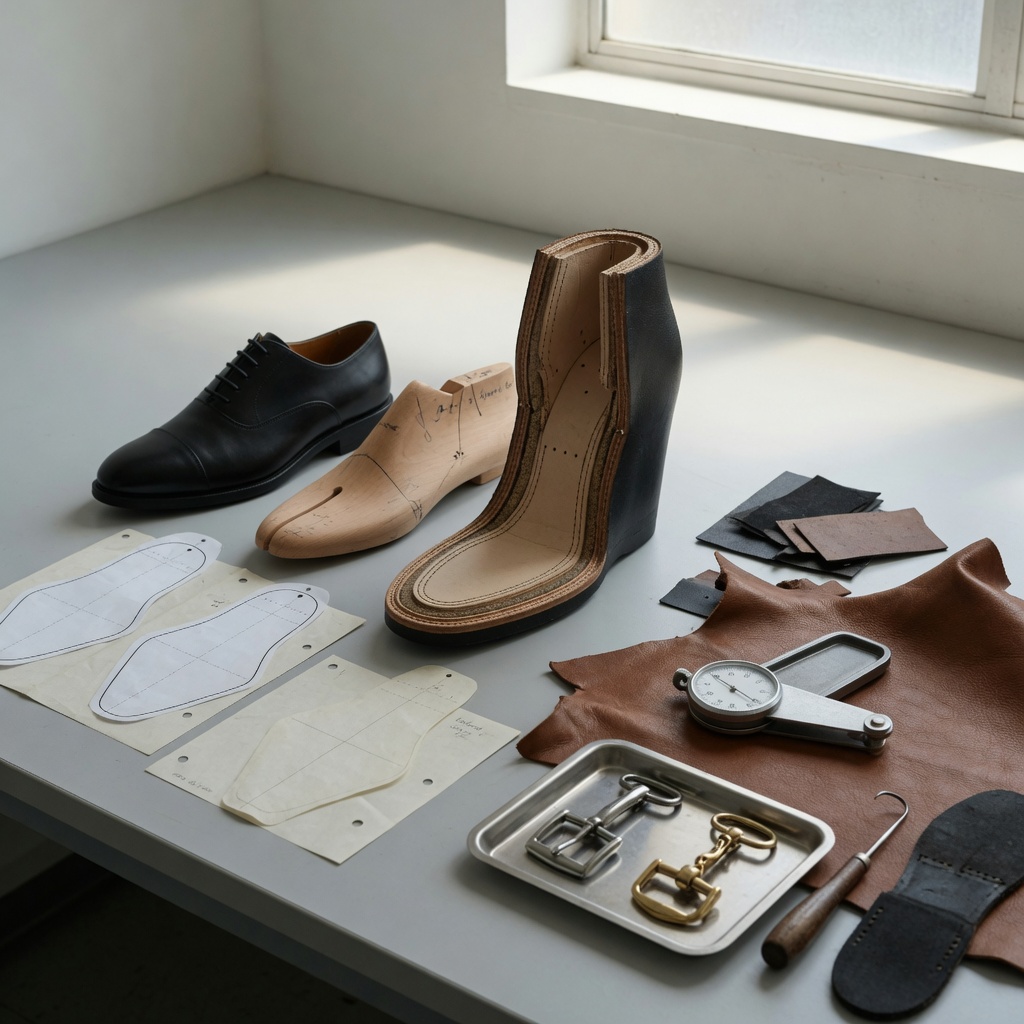
- Construction name plus a cut sample of that construction
- Leather substance, tannage family, colour standard, and lot-code rule
- Prototype, confirmation sample, and pre-production gates with calendar dates
- Tooling ownership for lasts, dies, and moulds
- Written path: OEM from the buyer’s tech pack, ODM from the factory last/pattern library, or a separate new-last engineering project
A published OEM/ODM leather-shoe process description states that full development spans 4–9 months from concept to delivery (unit: months; scope: full OEM/ODM leather shoe development as described on that page; as-of date not stated on the cited page; source: the Wincheer OEM/ODM process page) and that custom last development adds 8–12 weeks and determines fit and proportions (unit: weeks; scope: custom last add-on on that page; as-of date not stated on the cited page; source: the same process page) (The Complete OEM/ODM Shoe Development Process). Treat both ranges as source-reported planning bands to verify in the quotation, not as a committed lead time.
A library last shortens calendar time and tooling cost but freezes toe shape, instep volume, and grading. A new last increases control and typically adds that source-reported 8–12 week band (unit: weeks; example band to verify in the supplier quote). For a European warehouse-in date, treat a slipped last freeze as a launch miss until the supplier re-issues the Gantt.
Construction verification: cemented, Blake stitch, and Goodyear welt
Cemented construction, Blake stitch, and Goodyear welt change flexibility, repairability, weight, and line skill. They are not grades of the same product. Name one primary method per style and ban silent substitution. Construction proof is a product-development deliverable, not a catalogue adjective.
A Vietnam dress-shoe manufacturing overview states that factories in Binh Duong and Dong Nai handle full-grain leather cutting, Goodyear welt and Blake stitch construction, and that buyers should always request cross-section samples because some factories claim welt capability that is actually cemented construction with a decorative welt strip (Dress Shoes Manufacturers in Vietnam). Treat that provincial construction list as source-reported context, not as an audited factory roster. Photo reviews miss substitution. A cut-away pair does not. Vietnam, including Binh Duong and Dong Nai as cited, is a manufacturing-origin context, not a sales-market target for this page.
Require in the RFQ:
- A physical cross-section of the bulk construction, not a showroom shoe from another line
- BOM lines for insole, welt, filler, outsole, thread, and adhesive family
- Stitch density for Blake and welt seams (buyer-stated stitches per unit length; do not accept an unnamed density)
- A statement whether the welt is structural or decorative
- Whether resoling in a destination-country cobbler channel is a product requirement
- Fail action: decorative welt sold as Goodyear is rejectable before pre-production sign-off
Do not rank constructions in place of the cut sample. If the supplier will not cut the offered construction, treat the method as unverified.
The same overview states that premium leather is often imported from Italy and Brazil. Origin is a BOM field. It is not construction proof and it is not a market-access certificate for any EU member state, EEA state, or the UK.
Last, pattern, OEM tech packs, and ODM libraries
Do not accept “we make all formal styles” without a last list. Record whether the factory will pull a library last and adapt trims (ODM), grade the buyer’s existing last and patterns (OEM), or model a new last (fit project).
Specify style geometry, punch patterns, strap width for monks, bit or apron design for loafers, heel height, and the size system. State which grading system the last uses and which sizes will be warehoused for the named European destinations. Do not treat EU sizing and UK sizing as interchangeable without a written conversion and a fit sample in each system the buyer will sell.
A China footwear buyer guide states that Wenzhou specialises in men’s and women’s leather dress shoes with over 4,000 factories and vertical integration of tanneries, hardware and production (unit: factories; scope: Wenzhou agglomeration as stated on that page; as-of date not stated in the source excerpt; source: the China footwear buyer guide). It reports typical MOQs of 600–2,000 pairs per style for leather (unit: pairs per style; scope: leather footwear as stated there; as-of date not stated in the source excerpt; source: the same guide) and says premium export factories offer genuine leather, Goodyear welt construction, ISO 9001, material testing labs and co-development at FOB $18–40 (unit: US dollars per pair; Incoterm: FOB; scope: “premium export factories” as defined by that guide; as-of date not stated in the source excerpt; source: the same guide) (Sourcing Footwear from China). China, including Wenzhou as cited, is a manufacturing-origin context, not a sales-market target for this page.
Use that cluster only as a sourcing-map context. Factory count is not a capability score. ISO 9001 is a quality-management standard; it is not a Goodyear welt test and it is not a product mark for EU, EEA, or UK placement. If ISO 9001 is cited, request the current certificate PDF, certified site, scope text, certification body, and expiry. Do not treat a website badge as a current document. Distinguish the standard’s QMS requirement from any factory’s claimed practice.
A 600–2,000 pair leather-style band (unit: pairs per style; example band to verify in the supplier quote) may exceed a European multi-SKU first buy. Ask whether MOQ is per last, per colour, per leather article, or per purchase order, and whether size-run imbalance counts toward MOQ. Label the FOB USD 18–40 band (unit: US dollars per pair; Incoterm: FOB; example band to verify in the supplier quote) as a third-party example—not as a SoleForge price and not as landed cost into an EU, EEA, or UK port.
Leather substance, tannery relationships, and dye-lot rules
Control shade, crocking, hand-feel, and thickness mismatch in the RFQ before they become first-shipment defects. The same OEM/ODM process page states that leather sourcing requires specifying 1.2–1.6 mm thickness (unit: millimetres; scope: leather for leather-shoe development on that page; as-of date not stated on the cited page; source: the Wincheer OEM/ODM process page), plus tensile strength, tear resistance and colourfastness, and that established manufacturers maintain tannery relationships in Italy and Spain for premium dress shoes.
RFQ leather block:
- Substance window (1.2–1.6 mm as the source-reported working window, or a tighter buyer window) and whether it is measured after finishing
- Hide and tannage allowed (for example full-grain calf versus corrected grain)
- Physical shade standard and a numeric tolerance the buyer will measure
- One dye lot per colourway per order unless a split is pre-approved in writing
- Tensile, tear, colourfastness, and flex tests—methods to be named after the buyer’s appointed lab confirms them
- Tannery identity if the buyer requires it; “Italian leather” without a mill is not a specification
- Ticket, batch, leftover-hide, and leftover-cut policy
Italy, Spain, and Brazil appear in the commercial guides as premium-upper origins. Origin does not prove chemical or labelling compliance in any EU member state, EEA state, or the UK.
Sampling calendar and measurable time trade-offs
Work backward from the named European warehouse-in date. Using the same process source: plan 4–9 months for full concept-to-delivery leather development (unit: months; example band to verify in the supplier quote), and add 8–12 weeks when the last does not already exist (unit: weeks; example band to verify in the supplier quote). Those bands overlap poorly with late last changes.
Minimum gates:
- Last freeze (library confirmation or last model sign-off)
- Pattern freeze and material board
- Prototype for fit and construction
- Second prototype if the last is new
- Confirmation / salesman sample
- Pre-production pair from bulk leather and bulk construction
- Bulk release only after a signed PP pair and sealed trims
Each gate needs a measurand (last length, ball girth, heel slip, sole build, shade) and a fail action (re-cut, cost, days). Skipping the pre-production pair is how decorative welts and mixed dye lots enter the first shipment. State which sample sizes will be fitted (name EU and/or UK sizes), who owns samples and lasts if the programme is cancelled, and which proto rounds are included versus chargeable.
Buyer decision table for dress-shoe development paths
| Buyer task | ODM library last | OEM tech pack on known last | New last plus full development | Specify in RFQ | Verify before approval or order |
|---|---|---|---|---|---|
| Fit | Fast if the library last matches the destination size run | Depends on grading accuracy | Highest control; source-reported 8–12 extra weeks (unit: weeks; custom last add-on; example band to verify in the supplier quote) | Last ID or last brief; EU vs UK size system; size run | Physical last or scan; trial pairs in two sizes; written last freeze |
| Style (Oxford, Derby, monk, loafer) | Limited to library patterns | High if patterns exist for that bottom | High, with pattern cost | Punch/strap/hardware drawings | Pattern checklist vs sealed sample |
| Construction | Only if the library shoe already uses the named method | Must match the tech pack | Must be engineered into the bottom | Cemented vs Blake vs Goodyear welt | Cut-away cross-section; reject decorative welt sold as Goodyear |
| Leather | Often factory-nominated articles | Buyer-nominated articles possible | Buyer-nominated, tannery lead time | Thickness in mm; lot rule; shade | Gauge reading; lot tickets; colourfastness reports |
| Calendar | Shortest if materials exist | Medium | Longest: source-reported 4–9 months concept to delivery (unit: months; example band to verify in the supplier quote) | Named sample types and dates | Gantt with hold points |
| Volume | Still subject to leather MOQ practice | Same | Same, plus last cost recovery | Pairs per style/colour; test the 600–2,000 pairs/style guide band (unit: pairs per style; example band to verify in the supplier quote) | Written MOQ definition |
| Price context | Lower development fee typical | Medium engineering fee | Highest tooling | Currency and Incoterm; do not import the FOB USD 18–40 guide band as landed European cost (unit: US dollars per pair; Incoterm: FOB; example band to verify in the supplier quote) | Supplier quote only |
| QMS claim | May cite ISO 9001 | Same | Same | Certificate scope and site | Current certificate; ISO 9001 is not construction proof |
| Destination file | Still required | Still required | Still required | Country list, not “Europe” | Separate EU / EEA / UK packs as needed |
Europe destination files: EU, EEA, and UK procurement packs
Write ship-to countries, not “Europe.” The European Union, the European Economic Area, and the United Kingdom are not one product-rule area. Do not assume that a document accepted for an EU member state is sufficient for the UK, or that every EEA state matches EU footwear labelling and chemical practice. The three commercial sources used here do not publish legal limit values, so this page does not invent marking thresholds, chemical ppm limits, or label templates.
Procurement practice that stays inside the evidence:
- List each destination country in the RFQ
- Require the supplier to state what chemical and labelling evidence they will hand over for each country
- Keep UK deliveries on a separate evidence pack from EU member-state deliveries unless the buyer’s counsel instructs otherwise
- Do not treat an EEA destination as automatically covered by an EU member-state pack
- Do not treat Italy/Spain/Brazil leather origin as chemical clearance
- Do not treat ISO 9001 as a market-access mark
- Record Incoterm and importer of record; origin FOB is not duty-paid delivery into the EU, EEA, or UK
RFQ checklist: specify, compare, verify, approve, order
Send one pack: path choice (ODM / OEM / new last), style board, last brief, construction name, leather window, destination-country list, sample calendar, MOQ definition, tooling ownership, and per-country evidence list. Compare quotes only against that pack.
- Countries: Name EU member states, EEA states, and the UK separately; forbid a single “Europe compliant” line.
- Style board: Oxford, Derby, monk strap, loafer; photos; forbidden substitutes.
- Last path: Library ID, buyer last, or new last; if new, plan the source-reported 8–12 week add-on (unit: weeks; example band to verify in the supplier quote).
- Size system: EU and/or UK grading; pairs per size; fit-sample sizes.
- Construction: Cemented, Blake stitch, or Goodyear welt—one primary per style.
- Cross-section: Physical cut sample of the bulk method before PP sign-off.
- BOM freeze: Insole, welt, filler, outsole, adhesive, thread, counter, puff, lining.
- Leather mm: 1.2–1.6 mm working window from the process source (unit: millimetres; example window to verify in the supplier quote), or a tighter buyer window; state gauge method.
- Dye lot: One lot per colourway per order unless a split is approved.
- Tannery: Mill name if required; ticket and leftover-hide rule.
- Tests: Tensile, tear, colourfastness, flex—methods confirmed by the buyer’s lab, not assumed from a factory brochure.
- Calendar: Prototype, revised proto, confirmation sample, PP, bulk; stress-test against 4–9 months concept-to-delivery (unit: months; example band to verify in the supplier quote).
- Sample commercial terms: Included rounds versus chargeable rounds; who pays freight; who owns rejected lasts and dies.
- MOQ: Per style, colour, last, and PO; treat 600–2,000 pairs/style as a guide-reported leather assumption to verify (unit: pairs per style).
- Price basis: Currency, Incoterm, port of loading; FOB USD 18–40 is a third-party band (unit: US dollars per pair; Incoterm: FOB; example band to verify in the supplier quote), not the order price.
- Tooling: Ownership, storage, exclusivity, and transfer of lasts, dies, and brand tools.
- ISO 9001 (if claimed): Current certificate, site, scope, expiry—or delete the claim from the bid.
- Inspection: Named plan; right to cut a bulk shoe for construction audit.
- Change control: Written approval for last, leather article, adhesive, or construction; silent change is rejectable.
- Payment gates: Tied to last freeze, cut-sample, and PP signature—not only to deposit and bill of lading.
- Award file: Sealed sample, signed BOM, lot tickets, certificates, and per-country evidence list stored with the PO.
Methodology, source contexts, and limitations
Methodology. Figures are compiled from three published commercial pages. This is documentary compilation, not a factory audit, not a laboratory programme, and not keyword-demand research. Editorial RFQ gates, hold/reject rules, and payment-hold points are procurement controls for scoring files; they are not measurements taken from a named factory.
Claim-to-source map.
- 4–9 month concept-to-delivery band; 8–12 week custom-last add-on; 1.2–1.6 mm leather substance; Italy/Spain tannery-relationship claim → The Complete OEM/ODM Shoe Development Process.
- Binh Duong/Dong Nai dress-shoe construction notes; decorative-welt substitution warning; Italy/Brazil leather-origin note; 2025 Vietnam leather and footwear export-value figure used only in limitations below → Dress Shoes Manufacturers in Vietnam.
- Wenzhou factory-count context; 600–2,000 pairs/style leather MOQ band; FOB USD 18–40 premium-export band; Goodyear/ISO 9001/co-development claims as published by that guide → Sourcing Footwear from China.
Source contexts. (1) Vietnam export manufacturing of dress shoes, with provincial production notes. (2) China, Wenzhou leather-dress-shoe agglomeration and published MOQ/FOB planning bands. Leather-origin context additionally names Italy, Spain, and Brazil as commercial-guide associations for premium uppers. Those origin names are BOM fields, not sales-market targets for this page.
Limitations / what to verify. The $28.8 billion Vietnam leather and footwear export figure (unit: US dollars; scope: Vietnam leather and footwear exports; period: 2025 as stated by Cosmosourcing; source: the Vietnam dress-shoe overview) should be checked against official Vietnamese trade releases before use in an internal market study. Factory counts, MOQs, FOB bands, and month-ranges are not statistically sampled and may mix constructions and grades. ISO 9001 and in-house lab claims require current documents. Chemical, labelling, and marking rules for EU member states, EEA states, and the UK are out of scope of the three sources and are not given as numeric limits here. Construction names require a cut sample. Third-party price bands are not SoleForge quotations and are not landed European costs. Obtain a supplier-specific quote, a sealed pre-production pair, and destination-country legal review before order.
Discuss Your Requirements
Review our manufacturing capabilities, then share your specifications for a supplier-fit review.