Dress Shoe Sourcing Sample Approval for United States RFQs
By Vincent Xi, Editorial Author
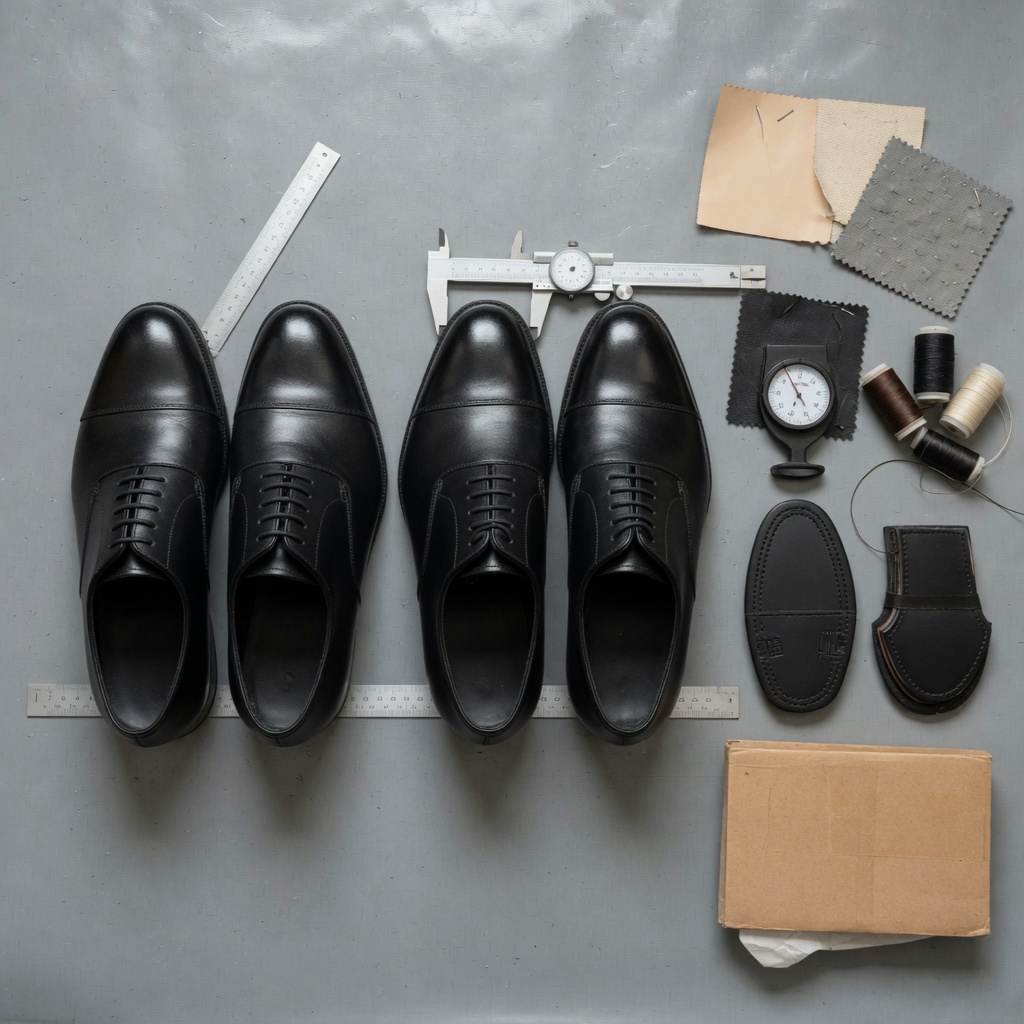
For a United States B2B buyer, dress shoe sourcing sample approval is the point at which an identified development pair becomes the controlled reference for a procurement decision. It is not a general visual signoff. The approval record should connect the physical pair and its revision to the current RFQ, last, size and width, colorway, material schedule, construction, artwork, requested test evidence, packaging specification, quotation boundary, and delivery schedule.
Bulk production should remain unreleased until every release-critical field passes or an authorized buyer accepts a documented deviation. Use the physical pair for characteristics that require direct evaluation, including fit, internal feel, material character, flexibility, form, and paired symmetry. Use revision-linked photographs only for corrections that the RFQ has already defined as visually verifiable. Sample approval does not by itself establish legal compliance, tariff classification, certification, or supplier capability.
United States dress shoe sample approval decision
Assign a single disposition to the identified sample revision. These dispositions are buyer-defined procurement controls, not certifications or endorsements.
| Disposition | When it applies | Bulk-release effect | Required record |
|---|---|---|---|
| Approve for bulk | Release-critical specifications pass, required evidence covers the approved article, and no substitution or deviation remains unresolved | Authorized buyer may issue the separate written bulk release | Signed approval sheet, physical-pair identifier, sample revision, controlling document revisions, evidence disposition, quotation reference, and delivery trigger |
| Hold pending correction | A correctable field is outside the signed specification or lacks applicable evidence | No bulk release | Deviation, affected requirement, corrective action, closure evidence, responsible party, reviewer, and due date |
| Reject and resample | A change affects fit, last shape, material identity, construction, or another characteristic that cannot be closed under the approved evidence protocol | Revised physical sample required before reconsideration | Rejection record, required revision, resample instruction, updated charge, and updated schedule |
The RFQ should state which document controls when the purchase order, signed specification, material schedule, artwork, physical sample, deviation approval, and later correspondence conflict. Do not assume that the physical pair silently overrides a written requirement.
Dress shoe sample approval evidence matrix
The cited supplier-authored articles provide practical review context, but they do not establish universal dimensions, tolerances, test methods, or acceptance limits. The buyer must define those controls in the RFQ.
| Approval field | Evidence to retain | Release stop | Source context |
|---|---|---|---|
| Sample identity | Style or SKU, last identifier, construction, colorway, sample stage, size, width, physical-pair identifier, and revision | Hold if the pair cannot be matched unambiguously to the current specification and quotation | Buyer-created document control |
| Form and style geometry | Side, top, rear, and outsole views; toe and vamp shape; topline; heel position; outsole edge; buyer-defined datums; measured results | Hold a result outside the signed buyer limits | Bulk-production sample article; Oxford sample-approval article when the cited Oxford details apply |
| Fit | Last, size, width, evaluation protocol, hosiery condition, evaluator criteria, pressure observations, heel-retention observations, and disposition | Require physical evaluation; do not close fit from photographs | Bulk-production sample article; wholesale footwear buying article |
| Upper, lining, and internal materials | Supplier article identifiers, color references, thickness specification, measurement method, finish, swatches, lining, sock, and reinforcement identities | Hold if the pair, material schedule, swatches, or supporting evidence do not match | Bulk-production sample article; Oxford sample-approval article |
| Construction and workmanship | Construction method, seam paths, thread identity, outsole and heel identities, attachment details, reinforcement, edge distance, alignment, skipped stitches, loose ends, and visible bond condition | Apply the buyer's stated defect definitions and acceptance limits; hold undocumented changes | Bulk-production sample article; wholesale footwear buying article |
| Finish and paired symmetry | Polish or burnish zones, gloss reference, edge color, finish coverage, leather-character reference, and matched views of both shoes | Hold finish or symmetry outside the signed specification | Bulk-production sample article; Oxford sample-approval article |
| Branding and packaging | Artwork revision, application method, placement dimensions, size marking, proposed country-of-origin treatment, packaging label, carton mark, and packing configuration | Separate execution approval from legal review | Wholesale footwear buying article; applicable United States government sources below |
| Requested test evidence | Test method, specimen identity, acceptance criterion, report issuer, report date, result, and connection to the sampled material and construction | Hold when required evidence does not cover the approved article or intended production | Wholesale footwear buying article; buyer-defined test requirement |
Measurable RFQ syntax for sample approval
The following figures are illustrative buyer assumptions for a hypothetical cap-toe Oxford. They are not industry averages, source requirements, observed results, or recommended tolerances. Their scope is the designated sample size and width under the buyer's dated RFQ issue revision. Replace every value with the buyer's design requirement and verify it in the supplier quotation, signed specification, and measured physical sample before bulk release.
| Characteristic | Illustrative criterion | Scope and method | Source, as-of context, and verification |
|---|---|---|---|
| Facing gap | 8.0 mm target with a +/-1.0 mm tolerance | Distance between the specified inside facing edges at the named eyelet position, using the RFQ-defined lacing and tension condition for the designated sample size and width | Hypothetical buyer assumption created for this article, as of the buyer's dated RFQ issue revision; verify with the supplier quotation, signed dimension sheet, and measured physical sample |
| Cap-seam position | 70.0 mm target with a +/-1.5 mm tolerance | Distance from the buyer-defined toe datum to the cap seam along the centerline for the designated sample size and width | Hypothetical buyer assumption created for this article, as of the buyer's dated RFQ issue revision; verify with the supplier quotation, approved pattern or drawing, and measured physical sample |
| Upper leather thickness | 1.20-1.40 mm acceptance range | Thickness at each buyer-defined upper-material location under the agreed gauge method and conditioning state | Hypothetical buyer assumption created for this article, as of the buyer's dated RFQ issue revision; verify with the supplier quotation, signed material schedule, applicable swatch, and measured physical sample |
| Left-right cap-position difference | 2.0 mm maximum | Absolute paired difference measured from the same toe datum and centerline method for the designated sample size and width | Hypothetical buyer assumption created for this article, as of the buyer's dated RFQ issue revision; verify with the supplier quotation, signed symmetry requirement, and measured physical pair |
A usable specification also names the measurement location, datum, instrument or method, inspection condition, tolerance, and decision authority. A dimension without those controls is difficult to reproduce across sample review and bulk inspection.
Physical pair, photo closure, and change control
Record the retained physical pair's identifier, revision, disposition, approval date, and custodian. Require the supplier-held reference pair to use the same identification convention and to remain linked to the represented specification, material-schedule, artwork, and quotation revisions.
Photo closure should be limited to a named correction that the RFQ defines as visually assessable. Require consistent orientation, lighting, camera distance, paired views, detail views, and revision-linked filenames. The closure record should identify the issue resolved and any characteristics that were not rechecked.
Require a revised physical sample when a proposed change may affect:
- Last shape, fit, internal volume, pressure, or heel retention.
- Upper or lining identity, thickness, temper, tactile character, reinforcement, or sock material.
- Construction method, outsole attachment, heel structure, flexibility, or underfoot feel.
- Form, material character, or paired symmetry that the approved photo protocol cannot measure.
The RFQ should prohibit unapproved changes to the last, upper, lining, reinforcement, thread, outsole, heel, adhesive system, finish, branding method, packaging configuration, and cited supplier article identifiers. A substitution request should state the reason, technical difference, affected documents, price effect, schedule effect, evidence offered, and whether a physical resample is required.
United States labeling checks within sample approval
Legal review and execution review are separate. Correct placement does not prove that wording is supported, and approved wording does not prove that the production application will match the sample.
| Review area | Evidence-bound RFQ action | Release stop |
|---|---|---|
| Tariff inputs | Provide the approved material, construction, and article facts requested by the importer or customs broker for review against the current Harmonized Tariff Schedule | Do not treat a generic dress shoe description or signed sample as a tariff determination |
| Country-of-origin marking | Submit the proposed article and container treatment for review against the current United States country-of-origin marking regulations | Hold artwork while wording, location, permanence, legibility, or any claimed exception remains unresolved |
| Leather-related representations | Match proposed leather or imitation-leather wording to the approved material identity and review it against the current FTC Leather Guides | Hold a claim that is not supported by the material schedule and current legal review |
| Buyer-controlled labels and packing | Control size data, barcode data, packaging labels, carton marks, placement, print method, packing configuration, and artwork revision in the RFQ | Do not present a buyer-created requirement as law unless a cited current legal source independently requires it |
These release stops are recommended procurement controls; they are not statements that United States law requires this exact workflow. If the RFQ names a test method, standard, or certification, record the applicable edition, scope, specimen, acceptance criterion, issuer, report date, and document validity. Do not describe a supplier, factory, material, or dress shoe as certified without a current document that clearly covers the approved article and intended production.
Landed cost controls at sample release
Compare quotations only after confirming that their materials, construction, packing, quantity, and delivery boundaries match the sample revision under review. Record the quotation date, currency, named delivery location, delivery term, validity, payment assumptions, and every inclusion or exclusion.
| Landed-cost input | Evidence to request | Link to sample approval |
|---|---|---|
| Merchandise | Approved order quantity, unit price, quantity breaks, included components, and quotation boundary | Requote if the approved material, construction, finish, or quantity changes |
| Development and setup | Sample charges, revision charges, tooling, molds, artwork setup, and any stated credit treatment | Attach charges to the applicable sample stage and revision |
| Packing and export movement | Packing configuration, carton dimensions and weight, inland movement, export handling, freight, and insurance assumptions | Recalculate after any approved packing or shipment-plan change |
| United States import planning | Current classification analysis, value basis, duty and fee treatment, and broker assumptions | Obtain from the responsible importer or customs broker for the actual article and transaction |
| Domestic delivery | Brokerage, entry handling, port or terminal charges, storage exposure, and delivery to the named destination | Use current written quotations and state excluded contingencies |
Use a traceable normalization formula such as estimated landed total = merchandise + approved setup + packing and export movement + freight and insurance + import planning amounts + brokerage and domestic delivery. Divide only by the approved order quantity to obtain an estimated unit figure. Keep the supplier quote, forwarder quote, and broker calculation dates as the as-of context for each input.
This calculation supports quotation comparison; it does not determine customs value, admissibility, tariff classification, duty, fees, or final delivered cost. Reopen the calculation whenever sample approval changes materials, construction, packing dimensions, packing weight, order quantity, shipment plan, or quotation boundary.
Delivery triggers tied to sample approval
A delivery period is usable only when the RFQ identifies its start event, time convention, responsible party, and evidence of completion.
| Delivery field | RFQ definition | Approval record |
|---|---|---|
| Sample dispatch | Dispatch date, shipment responsibility, named destination, and tracking evidence | Dispatch record linked to the sample identifier and revision |
| Buyer review | Start event, business-day or calendar-day convention, reviewer, and required disposition | Recorded receipt and dated approval, hold, or rejection |
| Correction or resample | Start event, lead time, charge, freight responsibility, and closure evidence | Written correction notice and supplier-confirmed revised schedule |
| Material commitment | Materials allowed before approval, financial exposure, and required written authority | Buyer authorization and supplier acknowledgement |
| Bulk lead time | Complete start condition, including any required purchase order, payment, material confirmation, and written sample release | Dated evidence that every named condition was satisfied |
| Inspection readiness | Completion definition, notice requirement, inspection location, and required documents | Supplier notice tied to the approved style, quantity, and revision |
| Shipment handover and requested arrival | Named handover event, destination, required date fields, and allocation of schedule responsibility | Current supplier schedule and shipment document set |
Do not accept a schedule described only as lead time after approval. Define which approval starts the period, who may issue it, which documents must be closed, and how an accepted revision changes price and timing.
Sample approval RFQ release checklist
- [ ] Identify the style or SKU, last, construction, colorway, sample stage, size, width, physical-pair identifier, and revision.
- [ ] Match the buyer-held and supplier-held reference pairs to the same controlled documents.
- [ ] Attach dimensioned upper, outsole, heel, branding, label, and packaging specifications.
- [ ] Define datums, measurement methods, inspection conditions, tolerances, defect definitions, and decision authority.
- [ ] Define the fit protocol, evaluation conditions, required sizes and widths, disposition record, and resample trigger.
- [ ] Attach a revision-controlled material schedule for the upper, lining, sock, reinforcement, thread, outsole, heel, adhesive system, and finish.
- [ ] Require supplier article identifiers, color references, thickness specifications, measurement methods, finishes, and applicable swatches.
- [ ] Define which corrections may close through revision-linked photographs and which require a physical resample.
- [ ] Prohibit undocumented substitutions and require written technical, price, schedule, and evidence disposition for proposed changes.
- [ ] Attach controlled artwork and assign responsibility for United States tariff inputs, marking review, and leather-related representations.
- [ ] Name required test methods, specimens, acceptance criteria, timing, payer, and disposition authority before quotation acceptance.
- [ ] Request comparable pricing with inclusions, exclusions, currency, named location, delivery boundary, and validity.
- [ ] Tie bulk timing to a named release event and require an updated schedule after an accepted change.
- [ ] Define document precedence, deviation authority, bulk inspection references, and reference-pair retention in the purchase order.
- [ ] Require dated written release from the authorized buyer before bulk production begins.
Methodology, source boundaries, and limitations
The editorial method mapped subjects explicitly discussed by the cited practical sources to buyer-controlled evidence fields, release conditions, and RFQ records. Government pages are used only as current research points for United States tariff and labeling review. The illustrative dimensions were created solely to demonstrate measurable RFQ syntax; they were not derived from the cited sources.
| Source context | Use in this article | Limitation |
|---|---|---|
| SoleForge author profile | Supports the visible author name, role, and profile URL | Does not support a first-hand manufacturing, inspection, testing, or purchasing claim |
| Bulk-production sample article | Supports practical review contexts for design, fit, materials, construction, polish, edge treatment, and leather character before bulk production | Supplier-authored context, not an independent standard, laboratory report, or proof of supplier capability |
| Oxford sample-approval article | Supports style-specific review fields such as facing gap, toe proportion, cap placement, polish, pair symmetry, and leather identity for an applicable Oxford | Does not establish universal tolerances or acceptance for another style, last, size, width, or material |
| Wholesale footwear buying article | Supports checking upper shape, stitching, outsole bonding, branding, size fitting, balance, packaging labels, carton marks, and requested testing before bulk production | Supplier-authored checklist context, not a certification, legal opinion, or substitute for buyer-defined methods and limits |
| Harmonized Tariff Schedule | Official reference point for current United States tariff research | Does not automatically classify the approved shoe or transaction |
| United States country-of-origin marking regulations | Official source for reviewing current marking requirements and potentially applicable exceptions | Sample approval does not establish legal compliance for the article or container |
| FTC Leather Guides | Official source for reviewing leather and imitation-leather representations before artwork release | Visual artwork approval does not establish that a material claim is accurate or legally adequate |
Author basis: Vincent Xi's SoleForge profile identifies him as Editorial Author. The approved profile does not document first-hand factory, laboratory, inspection, or purchasing experience, so no such experience claim is made here.
No physical sample, buyer specification, supplier quotation, material declaration, artwork file, laboratory report, production lot, customs ruling, shipment record, or current certification was reviewed for this article. The cited supplier-authored pages do not provide universal dress shoe dimensions, tolerances, test requirements, costs, or delivery periods. Buyers must verify the actual last, fit criteria, materials, construction, dimensions, test coverage, labeling, quotation terms, tariff treatment, landed-cost inputs, dates, and document validity for the approved sample and transaction. Recheck dynamic government sources on the documented quotation-review, import-review, and entry dates.
Discuss Your Requirements
Review our manufacturing capabilities, then share your specifications for a supplier-fit review.