Kid Footwear OEM Communication Workflow Review for RFQs in Australia
By Vincent Xi, Editorial Author
Author basis. The Vincent Xi profile confirms the byline and role of Editorial Author. Product and process statements are limited to the cited sources; no personal testing, factory-visit, or supplier-performance claim is made.
Award view. Buyers in Australia should advance a kids footwear manufacturing bidder only when the OEM can produce a controlled record connecting the active specification to named owners, response stages, approvals, changes, issue closure, and shipment release. Fast or friendly contact is not enough if decisions remain in personal chat, the controlling revision is unclear, or a shipment can move without recorded authority.
This kid footwear OEM communication workflow review is deliberately limited to RFQ communication controls. Ask each bidder for a marked-up tech pack, contact and escalation matrix, channel rules, question and decision log, routine status report, deviation record, issue-closure example, and release checklist. Price, capacity, quality, and schedule matter here only where the workflow must record their assumptions, effects, and approval status.
The TL Stage guide recommends messaging for urgent visual updates, video calls for complex questions, email for formal recaps, and simple English supported by diagrams and summaries (TL Stage). These are source-reported practices, not evidence that a bidder follows them. For an RFQ managed in Australia, state the buyer-nominated time zone, internal approvers, receiving point, and document-handover expectations. The supplied sources do not establish Australian legal, labelling, customs, or freight requirements.
Evidence boundary. Cited statements describe source content. The pass, hold, and fail controls below are buyer-defined RFQ recommendations, not claims of law, certification, or supplier capability.
Communication workflow review for Australia: RFQ award controls
| Control | Evidence to request | Pass signal | Hold or fail signal |
|---|---|---|---|
| Controlled product record | Marked-up tech pack, revision history, and links between the specification, quotation, sample, and report set | Every product record identifies the active revision | The bidder cannot identify which file controls manufacturing |
| Ownership and continuity | Named commercial, technical, quality, and shipment contacts, with backups and escalation order | Responsibilities and absence cover are explicit | Critical knowledge depends on an unavailable personal contact |
| Channel governance | Rules for email, messaging, meetings, file sharing, and the controlled decision log | Product-changing discussions are formally recapped | Price, quantity, construction, material, or schedule changes can remain outside the record |
| Response stages | Separate commitments for acknowledgement, containment, substantive answer, decision support, and verified closure | The bidder distinguishes response from resolution | The bidder promises only to reply quickly |
| Questions and approvals | Question log, decision owner, authorised approver, due gate, and closure evidence | Every decision is linked to its source requirement and affected files | Silence or an unidentified role can approve a change |
| Changes and substitutions | Written deviation and impact record covering specification, sample, price, quantity, quality, and schedule effects | Implementation waits for recorded buyer approval | A material, construction, process, or quantity can change without authorisation |
| Manufacturing updates | Report format identifying the order, style, colour, affected size scope, revision, stage, quantity, blocker, and forecast | Updates reconcile to the affected product and revision | Status cannot be matched to the controlling record |
| Shipment release | Named release authority, evidence index, packing record, document handover, and recorded approval | Release is explicit and traceable | Shipment can proceed through silence, assumption, or incomplete evidence |
Pass: The bidder provides usable evidence for every mandatory control and accepts the stated hold points.
Conditional pass: A correctable gap has a named owner, closure record, and hold point that prevents affected work from proceeding.
Fail: The bidder will not provide controlled records, cannot identify approval authority, permits unapproved substitutions, or relies on informal communication for shipment release.
Tech pack and decision-log control
Joe's Footwear describes a footwear tech pack as a communication contract and identifies dimensions, materials, construction, colourways, hardware, branding placement, and grading rules among its contents (Joe's Footwear). Treat that phrase as an operational description rather than a legal conclusion. Legal precedence should be established separately in the executed commercial documents.
For this kids footwear manufacturing RFQ, the controlled pack should state:
- style identity, colourway, affected size scope, owner, issue status, and revision history;
- drawings, dimensional values, units, tolerances, grading rules, reference points, and measurement methods;
- bill of materials with approved references, colours, finishes, component sources, and substitution status;
- last, mould, outsole, upper, lining, insole, closure, hardware, and construction requirements where applicable;
- buyer-defined branding, label, packaging, carton, and document requirements;
- sample stage, inspection points, approval status, evidence requirements, and unresolved deviations.
The bidder's marked-up return should identify each source requirement, supplier interpretation, missing input, assumption, proposed option, commercial or schedule effect, decision owner, affected manufacturing gate, and closure status. An approved change should update the tech pack, quotation assumptions, sample reference, decision log, and affected manufacturing report together.
Any chat, call, or meeting that changes the product or order should be recapped in the controlled record. The recap should state what changed, why it changed, which files are affected, who approved it, and whether price, schedule, quantity, or quality is affected.
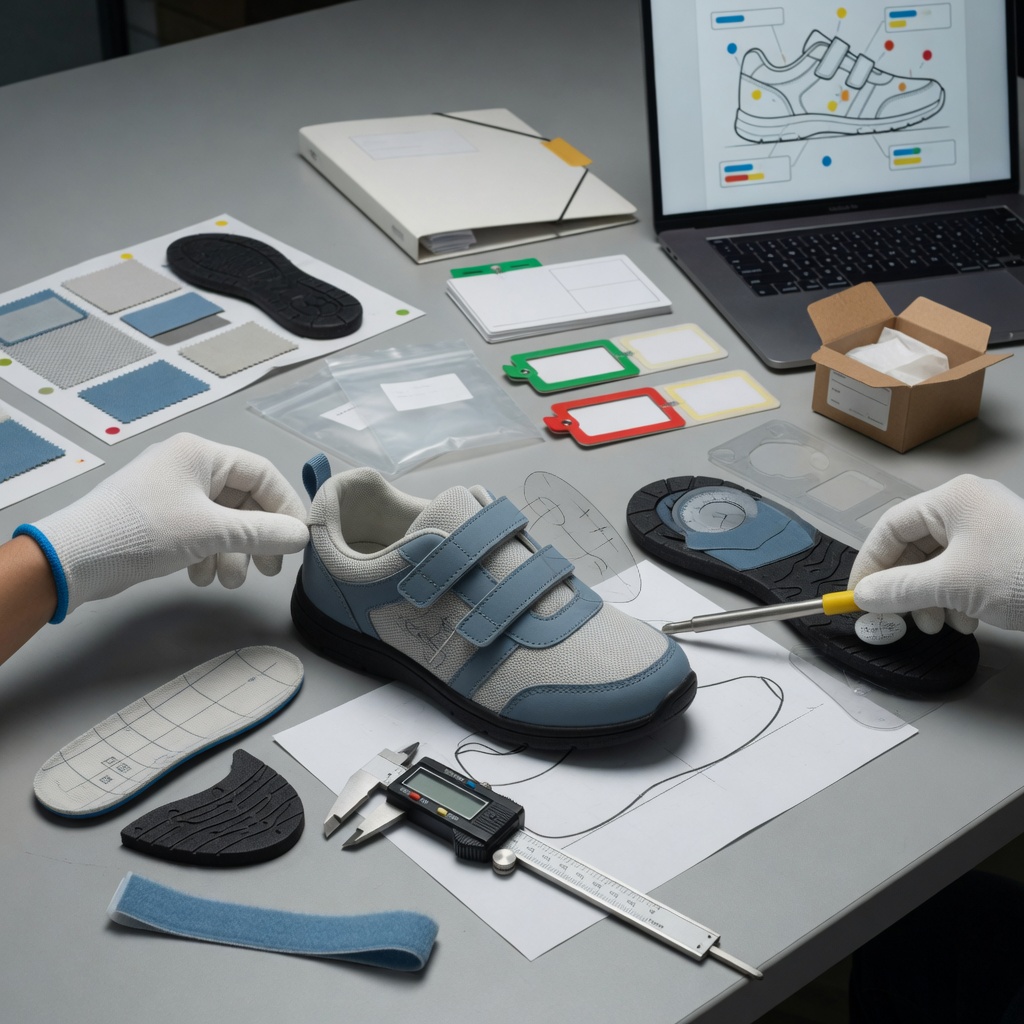
Example assumption to verify in the supplier quote. For bidder comparison, the buyer may issue an unbranded low-top children's shoe with a textile-mesh upper, synthetic overlays, hook-and-loop closure, soft lining, removable insole, and moulded rubber outsole. The bidder must return the actual material codes, measurable values, units, tolerances, grading, construction details, inspection points, and substitution controls. This configuration is an RFQ assumption, not evidence of any supplier's capability.
Useful communication references for that example may include forefoot width at a marked reference line, outsole-edge thickness at marked inspection locations, closure placement and overlap against an approved template, insole length and width under an agreed method, grading by affected size, and bond-line inspection points. The RFQ must provide or request the actual values and methods rather than leaving the bidder to infer them.
Measurable communication records
A communication claim becomes reviewable only when the supplier returns the raw fields needed to derive elapsed time, completeness, and traceability.
| Review measure | Required raw fields | Buyer-derived review | Decision rule |
|---|---|---|---|
| Record identity completeness | Project, order, style, colour, affected size scope, revision, timestamp, time zone, owner, and status | Complete or missing field status | Hold the affected gate when the record cannot be reconciled to the product |
| Acknowledgement elapsed time | Raised-at timestamp, acknowledged-at timestamp, declared business calendar, and pause reason | Acknowledged-at time compared with raised-at time under the declared calendar | Do not treat acknowledgement as containment or resolution |
| Containment elapsed time | Issue-reported timestamp, containment timestamp, affected-work status, and containment owner | Containment time compared with issue-reported time | Hold affected work when containment is absent or unverified |
| Substantive-answer status | Question, source requirement, missing input, supplier interpretation, evidence, and decision requested | Complete, partial, or not provided | A greeting or status promise is not a technical answer |
| Open-item age | Raised-at timestamp, status history, due gate, review timestamp, and closure timestamp | Time open under the declared business calendar | Escalate items that threaten an approaching manufacturing gate |
| Decision traceability | Decision ID, source requirement, approver, approval record, and affected file revisions | Linked or unlinked decision status | Do not implement an unlinked or unauthorised decision |
| Change implementation chain | Approved deviation, revised pack, quotation effect, sample reference, production report, and verification record | Present or missing links | Maintain the hold until all required links are present |
| Release-evidence completeness | Buyer-required record list and supplier-submitted evidence index | Received records compared with mandatory records | Do not release shipment while required evidence is missing |
Every timestamp should state its time zone and business-calendar basis. Every reported measurement should identify the unit, affected size, reference point, method, tool, sample identity, and controlling revision. Acceptance thresholds and clock-pause rules belong in the RFQ; a source-reported figure should not silently become a contractual target.
Communication gates through kids footwear manufacturing
DOING Shoes describes its own workflow as including design review, prototypes, production, in-line quality control, and final inspection (DOING Shoes). This is a provider-described sequence, not a universal manufacturing requirement or independent audit result. The buyer should define the communication record, decision owner, and hold condition for every applicable gate.
| Manufacturing gate | Supplier record | Buyer decision | Hold condition |
|---|---|---|---|
| RFQ and feasibility | Marked-up specification, feasibility matrix, quotation revision, assumptions, exclusions, and unresolved questions | Clarify, reject, or release development | An unresolved requirement affects feasibility, cost, quality, or timing |
| Sample development | Sample identity, specification revision, materials used, dimensional report, known deviations, visual evidence, and decisions requested | Approve, conditionally approve, revise, or reject | Sample identity, measurement method, or deviation status is unclear |
| Pre-production freeze | Readiness record reconciling the approved sample, tech pack, bill of materials, grading, labels, packaging, and quotation assumptions | Release production or maintain the hold | Controlled files conflict or approval remains open |
| Production and quality status | Planned stage, actual stage, affected quantity, blocked work, material constraints, deviations, corrective action, and forecast effect | Continue, contain, or request further evidence | The update cannot be linked to the affected product and revision |
| Exception and deviation | Required condition, actual condition, affected scope, containment, cause status, options, and commercial effects | Accept, reject, rework, or request analysis | A change is used before written approval |
| Final release and handover | Final inspection record, deviation closure, packing evidence, document index, freight milestone, and authorised release request | Release or hold shipment | Evidence is incomplete or release authority is unclear |
The same provider page states that its own process includes final AQL inspection (DOING Shoes). This does not establish an Australian requirement, prove certification, or make the practice universal. If a bidder proposes AQL-based acceptance, request the named sampling standard and revision, lot definition, inspection level, sample-size derivation, acceptance and rejection criteria, defect classifications, and signed report. Verify any standard, test report, or certification against a current document identifying the relevant product, facility, scope, and validity.
Issue escalation and documented closure
Use a buyer-defined status path such as open, acknowledged, contained, decision required, approved or rejected, implemented, verified, and closed. A quick reply is not closure.
Each escalation record should contain:
- order, style, colour, affected size scope, and controlling revision;
- required condition compared with actual condition, with values and units where measurable;
- measurement location, method, tool, and sample identity where dimensions are involved;
- affected quantity and current manufacturing status;
- photographs, video, or measurement evidence with clear orientation and references;
- immediate containment and treatment of completed or in-process work;
- suspected cause, verification status, and corrective action;
- options with price, schedule, quantity, and quality implications;
- supplier recommendation, decision owner, and authorised approver;
- implementation evidence, verification result, and files requiring revision.
A measurement is insufficient for approval when the record omits its unit, affected size, reference point, method, tool, sample identity, or controlling revision. For language ambiguity, request simple English, labelled visuals, and summary lists, consistent with the communication practices described by TL Stage.
Source-reported figures for bidder screening
These figures are retained only as source-reported screening references. They are not market averages, Australia-specific requirements, current supplier promises, or contractual targets.
| Source-reported figure | Unit and source scope | Date or as-of context and source | RFQ use |
|---|---|---|---|
| 8–12 sections per footwear tech pack | Sections per pack in the source's general description of footwear tech-pack structure | Publication date: not stated in the cited page context. Source: Joe's Footwear | Use as a completeness prompt, not a mandatory section count |
| 2–4 weeks for prototypes when lasts and moulds are ready | Weeks for the prototype stage in the provider's stated workflow; transit and business-versus-calendar basis are not defined | Publication date: not stated in the cited page context. Source: DOING Shoes | Ask the quote to define tooling readiness, clock start, approval dependencies, and excluded transit |
| 30–60 days for production | Days for production in the provider's stated workflow; start, finish, and business-versus-calendar basis are not defined | Publication date: not stated in the cited page context. Source: DOING Shoes | Request timing by manufacturing gate, with capacity assumptions, dependencies, and exclusions |
| 300–600 pairs per colour | Pairs per colour as the provider's stated minimum order quantity | Publication date: not stated in the cited page context. Source: DOING Shoes | Obtain current minimums by style, colour, material, size breakdown, packaging, and reorder condition |
| 24 hours for a reply | Hours per reply as a reliability indicator in the manufacturing communication guide; clock start and business-versus-calendar basis are not defined | Publication date: not stated in the cited page context. Source: TL Stage | Treat as a negotiable acknowledgement reference and set separate containment, answer, and closure commitments |
Pre-award controlled clarification test
Send each bidder the same marked-up product image and unresolved specification item. Ask for a response that states:
- the supplier's interpretation of the requested condition;
- missing inputs and assumptions that will not be made without approval;
- the controlling specification and affected file revisions;
- affected materials, tooling, and manufacturing gates;
- effects on price, schedule, quantity, and quality;
- recommended action and the authorised decision required;
- the proposed question-log or decision-log entry;
- the evidence that would verify implementation and closure.
Review interpretation accuracy, assumption disclosure, traceability, impact analysis, and closure discipline as well as response time. Pass when the answer is technically coherent and enters a controlled record. Use a conditional pass when the control exists but its template, ownership, or hold point needs correction before development. Fail when the bidder guesses, omits impact analysis, cannot identify the controlling revision, or leaves the decision in an informal channel.
Australian RFQ award checklist
- [ ] Identify the active tech pack revision and require every quotation, sample, report, and decision to cite it.
- [ ] State the buyer-nominated Australian time zone, business calendar, working language, and required overlap window.
- [ ] Name commercial, technical, quality, and shipment owners, backups, and escalation order.
- [ ] Define the roles of email, messaging, meetings, file sharing, and the decision log.
- [ ] Separate acknowledgement, containment, substantive answer, decision support, implementation, verification, and closure.
- [ ] Require a marked-up completeness and feasibility review rather than an unqualified acceptance statement.
- [ ] Make the quotation disclose its controlling revision, costing assumptions, timing basis, and exclusions.
- [ ] Define units, tolerances, grading, reference points, measurement methods, and sample identity rules.
- [ ] Name approval authority for samples, materials, colour, packaging, substitutions, and deviations.
- [ ] Request current timing and minimum-order terms by style, colour, material, size breakdown, packaging, and reorder condition.
- [ ] Obtain the proposed production-report, issue-record, inspection-report, and release-checklist formats.
- [ ] Require current supporting documents for any standard, test report, or certification cited by the bidder.
- [ ] Name the receiving point, freight milestone notices, document owners, and shipment-release authority.
- [ ] Convert independently verified Australian obligations for the exact product into explicit supplier deliverables.
- [ ] Prohibit shipment without the required evidence index and recorded release.
Methodology, source context, and limitations
Methodology. Explicit statements from the cited pages were separated into general product-information claims, provider-specific process or commercial claims, and communication-practice recommendations. Each retained statement was mapped to an RFQ record, decision gate, evidence request, or hold condition. Figures remain in their source-reported units and scope; they were not averaged, extrapolated, or presented as market norms or Australia-specific requirements.
Source contexts. Joe's Footwear is used for its description of tech-pack communication and structure. DOING Shoes is a supplier page and is used only for that provider's stated workflow, prototype timing, production timing, minimum order quantity, and quality-control practices. TL Stage is used for channel selection, language practices, formal recaps, and its reply-time reference. The Vincent Xi author profile supports the visible author name, role, and URL only.
Limitations. The supplied citation context does not provide publication dates for the external pages. The sources do not provide independent audit evidence or complete current commercial conditions. Provider-stated timing and order-quantity figures do not establish industry norms or current quoted terms. The supplied sources do not establish current Australian compliance, labelling, importer, customs, or freight obligations.
What to verify before ordering. Confirm the current supplier quote, contact ownership, business-time definitions, capacity assumptions, tooling readiness, bill of materials, dimensional methods, sample approvals, production-report format, deviation process, inspection plan, packaging specifications, document list, receiving point, and freight responsibilities. Obtain qualified advice on current Australian requirements for the exact product. Check every named standard, test report, or certification against a current document identifying the applicable product, facility, scope, and validity.
Discuss Your Requirements
Review our manufacturing capabilities, then share your specifications for a supplier-fit review.