Kid Footwear Sourcing Product Development Capability for Australian Procurement
Kid Footwear Sourcing Product Development Capability
By Vincent Xi, Editorial Author
Australian procurement teams should treat kid footwear sourcing product development capability as a pass/fail purchase-order gate, not a brochure line. Before bulk is released, require a named owner for last geometry, a dated sample ladder on bulk-intent materials, restricted-substance qualification before pre-production (PP), and a signed PP sample that freezes construction, materials, and label positions. Use the decision table and RFQ checklist below to specify, compare, verify, approve, or reject a partner on that capability rather than on catalogue photos.
Public OEM/ODM and sourcing-coordinator pages that describe children’s footwear programs are comparison examples only. One factory page states in-house development of over 1,000 new designs a year (unit: new designs per year; scope: children’s designs inside that factory’s stated in-house cell; as-of: undated self-report on the cited public page), sample cycles of 2–4 weeks, and bulk windows of 30–60 days (units: weeks for sampling, days for bulk; scope: that factory’s published OEM/ODM kids workflow; as-of: undated self-report) (DOING kids shoe manufacturer). A sourcing-coordinator page states 27+ years of factory relationships in India (unit: years; scope: stated factory relationships in India, a manufacturing origin, not a sales-market target; as-of: undated self-report on the cited public page), coordination of 1.5 million units per season, and a 98% QC pass rate (units: pairs/units per season, and percent of units passing the publisher’s QC; scope: that coordinator’s published children’s footwear workflow; as-of: undated self-report; no AQL level or measurement period stated on the cited page) (Source India footwear). Those figures are not performance guarantees for any Australian kids footwear program. Replace each number with the bidder’s signed, dated quote.
Evidence and method. The quantitative anchors and process steps below are taken only from three public pages describing children’s or kids shoe OEM/ODM work, last development, sampling, testing, and QC: DOING kids shoe manufacturer, Source India footwear, and How to choose a children shoes manufacturer. No unpublished factory visit, wear trial, or laboratory report is used. Figures are copied as published, then labelled with unit, scope, and as-of context.
Limitations / what to verify. Lead times, design volumes, and pass rates change with season, factory loading, and the buyer’s last and material requirements. The cited pages do not publish a measurement window for the volume or pass-rate claims. Australian importers still need current lot-tied test reports, their own fit trials, and counsel on destination labelling and consumer-goods rules. The cited pages name CPSIA, EN 71, and REACH as examples of how some factories fold compliance into development; they are not Australia-specific certificates and they do not replace the buyer’s restricted-substance list.
Procurement decision (release bulk only when all are signed). (1) Named legal entity that owns last CAD, physical last, and grading rules. (2) Sample tracker with T0–PP dates; T1/T2 uses nominated bulk materials or a signed deviation sheet. (3) Development-stage test plan, nominated lab, and fail-cannot-proceed-to-PP rule. (4) PP sample that locks construction, bill of materials, and label positions the buyer specifies. (5) QC plan with AQL or first-season 100% inspection, a kids-specific critical-defect list, and the right to insert a third-party inspector. Score last-cutting ability separately from ODM styling speed.
Why product development capability is the first procurement filter
Kids footwear fails when the last does not match the age band, when upper or lining materials are not locked before cutting dies are committed, or when a size run cannot be repeated from the PP standard. Product development capability is the set of in-house or tightly controlled activities that prevent those failures: tech-pack translation; last design or last selection and grading; material recommendation and restricted-substance screening; prototype and fit-sample loops; PP lock; and in-line plus final QC against a stated AQL. A trading desk that only places the order after the buyer has already frozen the last and materials is not offering the same capability as a partner that runs those steps under one quality system (DOING kids shoe manufacturer).
For Australian buyers the practical implication is documentation, not an assumed country-specific last library. The RFQ should require the partner to state whether last CAD, physical last, and grading rules stay inside their own development cell or are subcontracted, because ownership and traceability of the last must be clear if a size run is later rejected. Apply the same test to material labs: ask whether a children’s restricted-substance workflow already exists. Published examples name CPSIA and EN 71, and another published workflow names REACH (How to choose a children shoes manufacturer). Absence of that workflow is a product development capability gap, not a price advantage.
OEM versus ODM: who owns the last and the risk
OEM to a buyer’s tech pack still requires product development capability when the pack is incomplete, which is common on first-season kids programs. The partner must interpret age, gender, climate-of-use, and closure type into last geometry, toe spring, and sole unit. ODM from concept adds design origination: the factory or sourcing office proposes silhouettes, then the buyer selects and refines. One published factory positions both paths—OEM-to-spec and ODM-from-concept—and cites in-house development of over 1,000 new children’s designs a year, samples in 2–4 weeks, and production in 30–60 days (all three figures: examples to verify in the supplier quote; undated self-reports on the cited public page) (DOING kids shoe manufacturer).
The measurable trade-off is control versus calendar. OEM with a buyer-owned last and already-qualified materials can compress sampling if the last already exists. A new last for a buyer-specified age-band last family is a planning assumption that usually adds at least one extra sample round; treat that extra round as a quote line to verify, not as a published factory SLA. ODM can be faster to first visual sample when moulds and patterns already exist, but the buyer then inherits the factory’s last, which may not match the last and fit protocol the Australian buyer specifies for school or play shoes. Score two separate fields: (1) ability to cut or modify a last, and (2) willingness to freeze that last as a buyer-controlled asset after PP approval. Neither field is a certification; both are contractual statements to check against sample records.
A second published model is the sourcing coordinator that does not own every factory. That page claims 27+ years of factory relationships in India, full development-to-shipment coverage for children’s footwear including school shoes, last development, prototyping, material sourcing, testing, in-line and final QC, and AQL sampling, plus 1.5 million units per season at a 98% QC pass rate (all figures: examples to verify in the supplier quote; India is a manufacturing origin, not a sales-market target; undated self-report, with no AQL level or measurement period on the cited page) (Source India footwear). The trade-off is network scale versus single-roof control. High seasonal volume may support component pricing, but that is not a published price and must be quoted. The buyer must still name which legal entity issues the last drawing, which entity holds the material test reports, and which entity signs the AQL records. For an Australian program that needs repeatable size grading across two seasons, require a single named development owner even if production is multi-factory.
Last development, sampling windows, and calendar trade-offs
Published sample windows of 2–4 weeks and production windows of 30–60 days are planning fences, not promises (both ranges: examples to verify in the supplier quote; units: weeks for sampling, days for bulk; undated self-report on the cited OEM/ODM page). They assume the buyer returns comments inside the factory’s revision SLA and that materials are already on the approved list. A new last, a new outsole mould, or a material that must be re-tested against a children’s restricted-substance list will push the first sample beyond that four-week example. Split the calendar in the RFQ:
- Last and pattern: days from signed last brief to first 3D or physical last.
- Prototype (T0/T1): days from last freeze to first wearable sample.
- Fit and material revision (T2): gated only after the buyer’s fit-trial protocol is run on named sizes in the grade.
- PP sample: the sample that locks construction, materials, and labelling positions.
- Bulk: 30–60 days as a cited example to verify in the supplier quote, to be replaced by the factory’s current loading letter for the intended season.
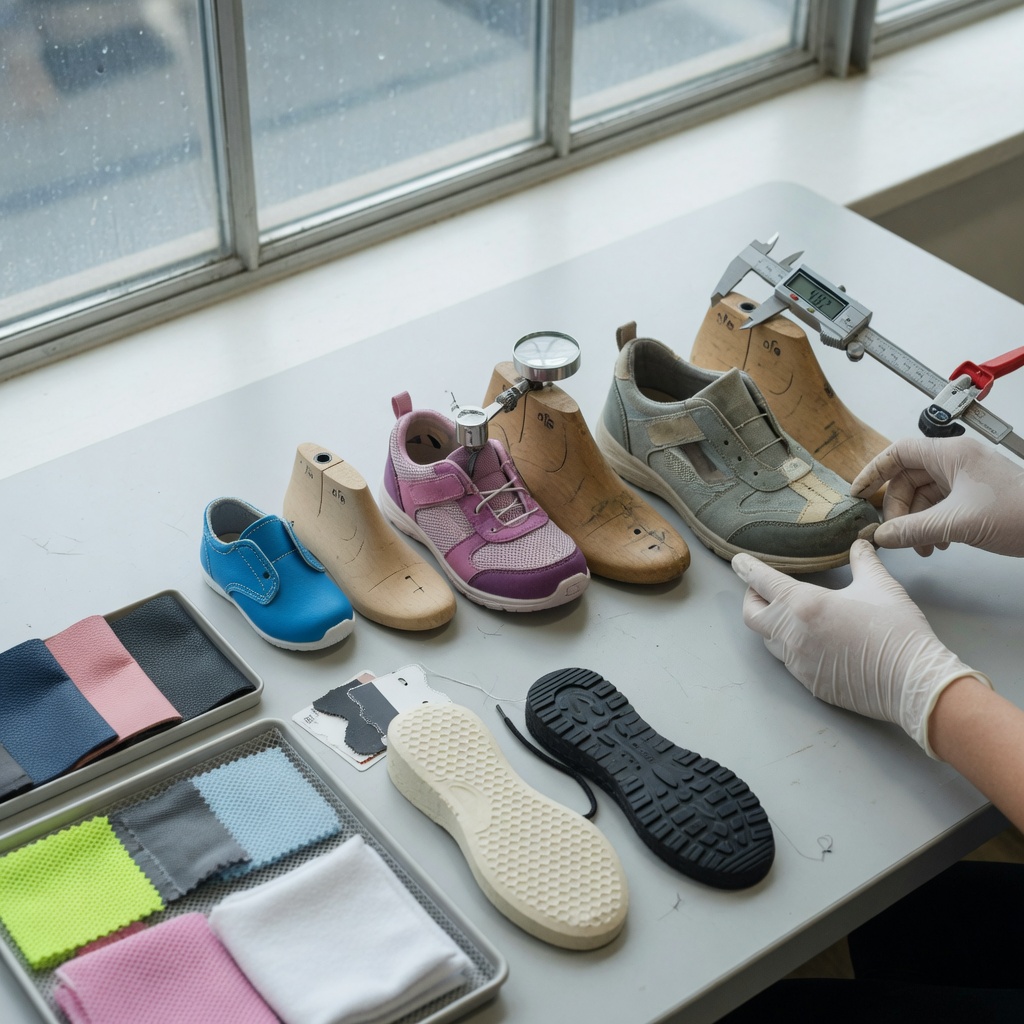
Kids lasts are not scaled-down adult lasts. Age-band geometry (toddler, pre-school, junior), toe-box volume, and heel stiffness change the tooling set. A partner that already maintains specialised last design for different ages reduces the number of failed fit rounds (How to choose a children shoes manufacturer). The trade-off is MOQ and mould amortisation: opening a dedicated last family for a small Australian pilot is a cost and calendar item the bidder must quote. State in the RFQ whether the program will accept an existing last with documented grading, or will pay development and then own the last. Either choice belongs in the RFQ, not in a later email.
Sampling quality is as important as sampling speed. A two-week sample built on substitute foam or untested lining fabric teaches little about the bulk shoe. Require that T1 or T2 already uses the nominated upper, lining, insole, and outsole compounds, or that any substitute is listed on a deviation sheet the buyer must sign. That single rule converts fast samples from a marketing claim into a verifiable development control.
Materials, safety integration, and QC inside the development loop
Children’s footwear product development that treats compliance as a packing-list afterthought is incomplete. Published manufacturer guidance describes integrating safety into development: design refinement for safety and fit, material recommendations aligned to REACH and CPSIA, sampling, custom branding, specialised last design, and continuous quality control (How to choose a children shoes manufacturer). Another factory states that it uses safe materials compliant with CPSIA and EN 71 while handling product development, QC, and export in-house (DOING kids shoe manufacturer). Those named regulations are the factories’ stated practice frames; they are not Australian certificates and they are not a substitute for the buyer’s own restricted-substance list and test plan.
A practical procurement split is:
- Standard or regulation (external): CPSIA (children’s product chemical and mechanical rules in the US context), EN 71 (toy-safety methods sometimes applied to small parts and coatings on children’s articles), REACH (substance restrictions in the EU context). The factory may already test to these because many export programs demand them.
- Buyer practice (contractual): the exact test methods, labs, and pass/fail limits the Australian importer requires, plus any labelling, size marking, and traceability marks the buyer’s legal team specifies. The development partner’s job is to build those tests into the material-approval and PP gates, not to invent a new mark.
QC must sit inside development, not only at final inspection. Source India’s published footwear workflow names last development, prototyping, material sourcing, testing, in-line and final QC, and AQL sampling, and cites a 98% QC pass rate on 1.5 million units per season (both figures: examples to verify in the supplier quote; undated self-report on the cited page) (Source India footwear). Ask for the AQL level, the defect classification (critical/major/minor for kids products), the in-line frequency, and whether last and material changes trigger a new capability study. Paying for a tighter AQL or for 100% inspection on first-season kids colourways is a contractual trade-off against a cheaper, looser plan that then produces size-run rejects after shipment.
Compare product development capability for Australian kids footwear programs
The table below is a specification and verification tool. Every row is something an Australian buyer can put in an RFQ, score in a supplier comparison, or use as a PP-sample gate. Numbers in the published-example column are taken only from the cited pages and must be replaced by the bidder’s current, signed figures. The cited manufacturers and coordinators are process-claim examples, not nominated vendors and not sales-market targets.
| Capability to specify | What the RFQ should demand | How to verify before PO | Trade-off the buyer must accept |
|---|---|---|---|
| Last development and grading | Named last family or new last CAD for stated age bands; buyer ownership of last after PP; grading table across the size run | Last drawing or photo set, grading table, first-fit sample against the buyer’s foot-form protocol | New last adds time and cost; existing last is faster but may miss the specified fit |
| Prototype / sample calendar | Dated T0–PP gates; T1/T2 materials must match bulk or be listed as signed deviations; named sizes in the fit set | Sample tracker with revision reasons; physical samples retained against PP | 2–4 week sample example (verify in the supplier quote) vs a longer loop if last or compound is new |
| Design origination volume (ODM) | Whether silhouettes are created in-house; who owns patterns after selection | Design calendar or recent kids line list (do not require a 1,000-design claim unless the bidder restates it in writing) | High in-house design count (example to verify in the supplier quote: over 1,000 new designs a year) can speed ODM but may lock the buyer to factory lasts |
| Material and chemical plan | Restricted-substance list, nominated labs, CPSIA/EN 71/REACH or buyer-equivalent tests at development stage | Valid test reports tied to the actual lots used in PP, not generic certificates | Broader testing raises sample cost; skipping it raises rejection and recall risk |
| In-line and final QC | AQL (or 100% on first season), in-line frequency, kids-specific critical defects (small parts, sharp edges, pull strength) | QC SOP, recent AQL records, right to third-party inspection | Stated 98% pass rate on 1.5 million units/season is historical (example to verify in the supplier quote); tighter AQL costs more per pair |
| Development ownership | Single named entity for last, tests, and PP sign-off even if production is networked | Organisation chart plus a previous PP file sample | Network scale (example to verify in the supplier quote: 27+ years of factory relationships) vs single-factory control |
| Production window after PP | Current loading letter for the intended season, not catalogue 30–60 days | Capacity letter dated for the Australian program’s season | Faster production may require higher MOQ or fewer colourways |
Use the table in a two-pass review: first pass is completeness (every cell answered); second pass is evidence (documents, not slides). A partner that cannot populate the verification column is not yet offering measurable product development capability.
RFQ checklist for kid footwear sourcing product development capability
Issue the following as a single RFQ pack. Each item is a specify / compare / verify / approve / order action. Do not accept a catalogue or a verbal “we do OEM/ODM” as a substitute.
- Program identity: Product family (kids footwear), age bands, gender, end use (school, play, sport), destination (Australia), target season, and whether the program is OEM (buyer last/tech pack) or ODM (factory concept then buyer lock).
- Last brief: Age-grade last or request for new last; toe-spring, heel height, width system; who pays for last and who owns it after PP; grading rules across the size run; which sizes are cut for fit samples.
- Tech pack completeness: Construction, bill of materials, stitch types, reinforcement, insole and sockliner, outsole compound, colourways, packaging. Flag every “TBD” as a development task with an owner and date.
- Sample ladder and materials lock: Required sample stages (T0/T1/T2/PP), maximum calendar days for each, rule that T1/T2 use bulk-intent materials or a signed deviation list; number of revision rounds included in the development fee; wearable fit sample versus photo or confirmation sample.
- Fit-trial protocol: Who runs the fit trial (buyer or factory), against which foot forms or wearers, on which sizes, and what pass/fail geometry the last must meet before PP.
- Test plan at development, not only at shipment: Restricted substances, mechanical tests relevant to children’s articles (as the buyer’s counsel defines them), colour fastness, abrasion, bond strength; nominated lab; samples that fail cannot proceed to PP.
- Compliance documentation requested: Any CPSIA, EN 71, REACH, or equivalent reports the bidder already runs, clearly labelled as factory practice—not as Australian certification—plus the buyer’s own required marks, size marking, and label positions.
- QC plan: AQL or alternative, defect list for kids products, in-line frequency, PP audit, final random inspection, and whether the buyer may insert a third-party inspector. Ask the bidder to restate any historical pass-rate claim with the exact period and AQL used.
- Capacity, MOQ, and calendar: Current sample slot, current bulk slot, MOQ by colour and by size run (bidder to state; do not assume a number), and what happens if the Australian order is a pilot quantity.
- Traceability and change control: How last ID, material lot, and PP sample ID follow the bulk cartons so a later size-run complaint can be isolated; written rule that last, BOM, or process changes after PP re-open sampling and tests.
- Commercial lock: Development fees, last and mould amortisation, sample charges, payment of development versus bulk, PP sample retention, and the written rule that bulk PO is released only after signed PP.
A complete response to this checklist is the minimum bar for opening commercial negotiation. Incomplete answers should be treated as a product development capability gap, not as a pricing opportunity.
Australian buyers who keep last ownership, material tests, and PP gates inside the RFQ—and who treat published 2–4 week sample, 30–60 day production, 1,000-design, 1.5-million-unit, and 98% pass-rate figures as examples to re-validate in the supplier quote—will specify, compare, and approve kid footwear partners on product development capability rather than on unaudited claims. Replace every example number with the bidder’s signed, dated equivalent before any order is placed.
Discuss Your Requirements
Review our manufacturing capabilities, then share your specifications for a supplier-fit review.