Safety Shoe Wholesale Supplier Consignment Stocking Program for United Arab Emirates Buyers
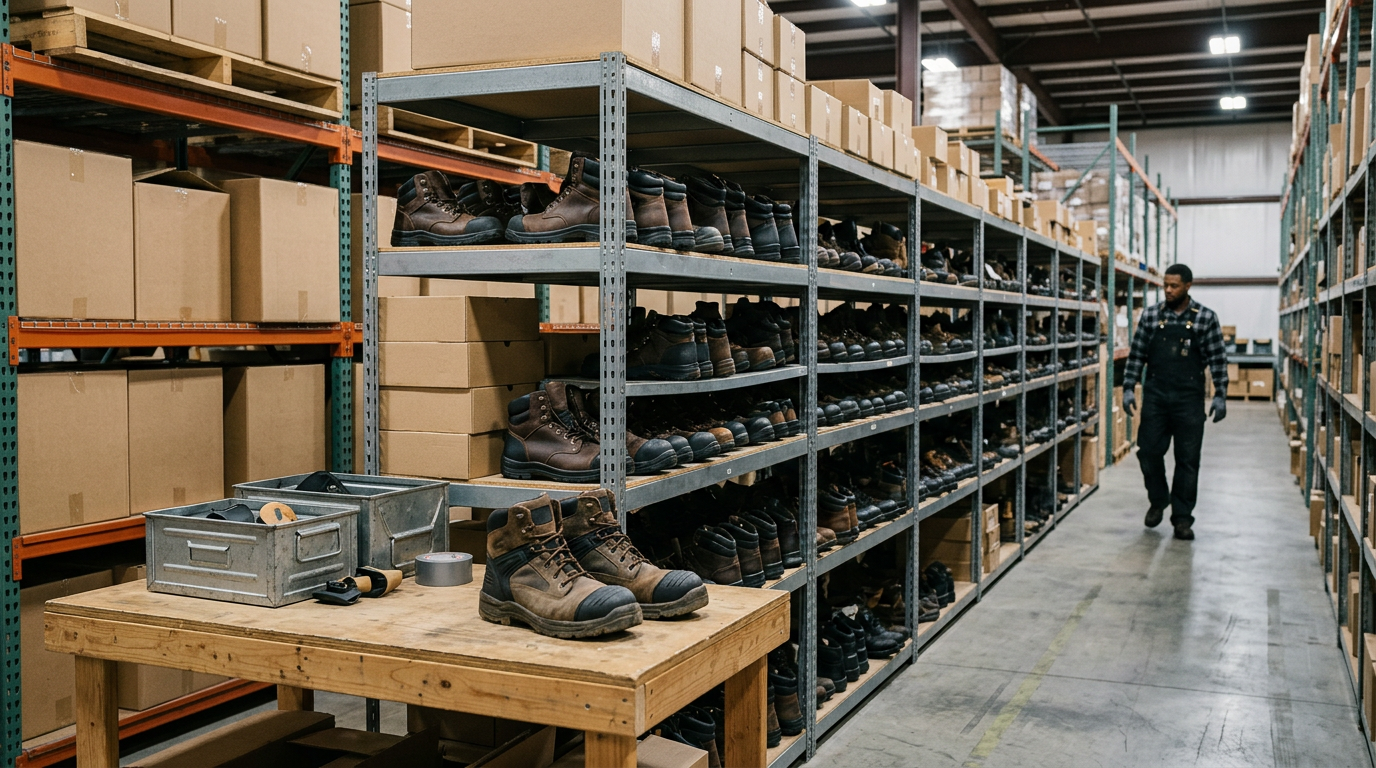
A safety shoe wholesale supplier consignment stocking program lets a buyer hold agreed stock locally while ownership, payment timing, replenishment, and reporting are defined in advance between buyer and supplier. For buyers in the United Arab Emirates sourcing safety shoe products through wholesale supply, the value of the model depends entirely on clarity before any pairs are placed in a warehouse, store, or site store. Without written definitions for assortment, size curve, ownership, stock counts, and what happens to slow-moving or damaged pairs, consignment can create disputes rather than flexibility.
This guide keeps the focus on process. It sets out the decisions a buyer should make, the questions to ask a supplier, and the fields to agree in an RFQ so that a consignment arrangement can be compared fairly against outright wholesale purchase. It does not assume a single assortment, specification, or commercial term fits every buyer. Each element below should be defined for the buyer's own workforce profile, storage conditions, and replenishment pattern, and then confirmed in writing before stock is delivered.
How a Consignment Stocking Program Works for Safety Shoe Wholesale Supply
In a consignment model, stock is physically held by the buyer or at an agreed location, but the point at which ownership transfers and payment becomes due is agreed separately from delivery. That separation is the central feature to document. Buyers should define when a pair counts as sold, issued, or consumed, how that event is recorded, and what evidence triggers invoicing. If the trigger is unclear, both sides may count stock differently.
A workable program normally moves through a small number of agreed steps. First, the buyer and supplier agree the initial assortment and size range. Second, they agree how stock will be stored, identified, and counted. Third, they agree the replenishment signal, such as a buyer-issued report, a minimum stock level set by the buyer, or a scheduled review. Fourth, they agree how unsold, damaged, or end-of-range pairs are handled at review or at the end of the term. Writing these steps into the supply agreement, rather than relying on verbal understanding, protects both sides when staff, demand, or storage locations change.
Buyers should also decide who can release stock, who authorises replenishment, and who is responsible for discrepancies found during counts. Naming roles, not just companies, reduces delay. For multi-site buyers, confirm whether the program covers one location or several, and whether stock can be transferred between locations without breaching the agreement.
Buyer Decision Table for United Arab Emirates Stocking
Use the table below as a working checklist when comparing suppliers. Each row is a decision the buyer defines first, then confirms with the supplier. No row assumes a specification or commercial term in advance. Complete every row before approving an initial consignment delivery, and attach the completed table to the RFQ or supply agreement so there is a single reference point.
| Decision area | What the buyer defines | What to confirm with the supplier | How to record agreement |
|---|---|---|---|
| Assortment and use case | Which safety shoe styles are needed for each work task and environment | Whether the supplier can supply each agreed style consistently under the program | List each style by buyer reference in the agreement schedule |
| Size curve and fit range | Which sizes to stock and in what relative proportion based on buyer issue records | How size exchanges or additions will be handled after the first review | Record the agreed size curve as a separate schedule |
| Ownership and payment trigger | The exact event that counts as a sale or issue for payment purposes | Whether the supplier invoices on that same trigger and what evidence is required | Define the trigger and evidence in the commercial terms |
| Storage and identification | Where stock will be held and how pairs will be labelled by style and size | How the supplier will pack and identify cartons to match buyer storage | Attach packing and labelling requirements to the RFQ |
| Counting and reporting | How often stock will be counted and who prepares the report | What report format the supplier accepts and how discrepancies are resolved | Agree a reporting template and discrepancy process in writing |
| Replenishment method | The signal that authorises more stock and who may approve it | Whether replenishment uses the same assortment or a revised assortment | Document the approval role and replenishment signal |
| Slow-moving and damaged stock | How unsold, slow-moving, or damaged pairs will be identified at review | Whether such pairs are returned, replaced, or otherwise settled by agreement | Record the review process and settlement route for each case |
| End of term handling | What happens to remaining stock if the program ends or changes | The notice and stock reconciliation steps the supplier requires | Include an end-of-term reconciliation clause in the agreement |
Completing the table forces early agreement on points that are often left vague, especially the payment trigger and end-of-term handling. If a supplier cannot confirm a row in writing, treat that row as unresolved and do not proceed on assumption.
Specification and Assortment Decisions to Agree Before Stocking
Consignment does not remove the need for a clear product specification. In fact, because stock sits with the buyer for longer, specification clarity matters more. Buyers should describe each safety shoe by its intended use, upper material, sole type, closure type, and any protective features the buyer requires, then ask the supplier to confirm in writing what will be supplied against that description. Where a feature requires supporting documentation, ask the supplier to provide that documentation for buyer review before stocking, rather than accepting a verbal assurance.
Avoid mixing specifications within a single stock line. If two styles look similar but differ in a protective feature or material, give them separate buyer references and separate storage identification. This prevents incorrect issue to workers and simplifies counting. Samples support this process. Ask for samples of each agreed style and size representation the buyer needs to assess fit and appearance, and record which sample was approved and when. Retain the approval record with the agreement so later deliveries can be compared against it.
Packaging should also be specified. Confirm carton quantity, pair packaging, size marking on the outer carton, and whether mixed-size cartons are acceptable. For United Arab Emirates deliveries, confirm labelling language and product information requirements with the supplier for the buyer's own compliance review, and agree who prepares and checks labels before dispatch. Do not assume a previous wholesale order used the same labelling.
Inventory, Replenishment, and Ownership Controls
Strong controls keep a consignment program auditable. Buyers should maintain a simple stock record by style, size, and location, updated whenever stock is received, issued, transferred, damaged, or returned. The supplier should receive reports in the agreed format and frequency, and both sides should reconcile the same figures. Agree in advance how a discrepancy is investigated, what counts as supporting evidence, and within what process a correction is recorded.
Replenishment should never be automatic without an agreed signal. Define whether replenishment follows a buyer purchase order, a stock report showing an agreed level, or a scheduled joint review. Also define whether the supplier may propose assortment changes, for example to replace a discontinued style, and confirm that no substitute is stocked until the buyer approves it in writing against the specification and approved sample process.
Risk and responsibility need explicit agreement. Confirm who bears responsibility for loss, theft, or damage while stock is in buyer storage, and what storage conditions the buyer is expected to maintain. Confirm how damaged pairs are segregated, reported, and photographed or inspected if required by the agreement. These points are commercial decisions for the buyer and supplier to settle together. They should not be left to assumption based on how outright purchase orders were handled in the past, because ownership timing is different under consignment.
RFQ Checklist
Use this checklist when issuing an RFQ for a consignment arrangement. Each item asks for a written response that can be compared across suppliers.
- Ask the supplier to confirm the full assortment, size curve, and specification it can supply under the consignment stocking program.
- Require the supplier to state in writing when ownership transfers and what event triggers payment under the proposed program.
- Specify the storage location, stock identification method, and counting frequency the supplier must support and report against.
- Ask the supplier to describe its proposed replenishment signal, approval process, and method for handling assortment changes.
- Require the supplier to provide documentation for each protective feature the buyer specifies, for buyer review before any stock is approved.
- Specify the packing, carton marking, and labelling information the supplier must apply so deliveries match buyer storage and records.
- Ask the supplier to confirm how slow-moving, damaged, and unsold pairs will be reviewed, returned, replaced, or settled at term end.
- Require the supplier to confirm the landed cost components it includes in its quotation, separated into agreed fields for buyer comparison.
- Ask the supplier to confirm the delivery, reconciliation, and end-of-term stock count process it will follow if the program ends.
Keep RFQ responses in the suppliers' own written format attached to their quotations. If a response is verbal only, ask for it to be confirmed in writing before evaluation is completed.
Approval, Delivery, and Ongoing Review
Before the first consignment delivery, complete a final approval pass. Check that the specification, approved samples, size curve, packing requirements, payment trigger, and reporting template are all recorded in one agreement pack. Confirm the delivery address, receiving contact, and inspection steps the buyer will use on arrival. On receipt, count cartons and pairs against the delivery note, check style and size identification, segregate any damaged cartons, and record discrepancies before stock enters general storage.
Ongoing review keeps the assortment relevant. Schedule joint reviews where buyer and supplier examine issue rates by style and size, identify slow-moving lines, and agree assortment or size curve adjustments in writing. Reviews are also the point to address recurring damage, labelling errors, or reporting discrepancies, and to confirm whether storage arrangements still suit the volume held. Any change agreed at review should be added to the agreement schedule rather than handled by informal message alone.
A consignment stocking program can suit buyers who need local availability without committing to outright purchase of every pair upfront, but only when the process controls above are agreed first. Buyers in the United Arab Emirates evaluating safety shoe wholesale supply should compare suppliers on the completeness and clarity of their written responses to the decision table and RFQ checklist, not on assortment alone. The supplier that defines ownership, replenishment, and end-of-term handling most clearly on paper is usually the easiest to audit in practice, and that auditability is the real test of whether the program is ready to start.
Discuss Your Requirements
Review our manufacturing capabilities, then share your specifications for a supplier-fit review.