Safety Shoe Wholesale Supplier Quality Control Inspection for Malaysia
By Vincent Xi, Editorial Author
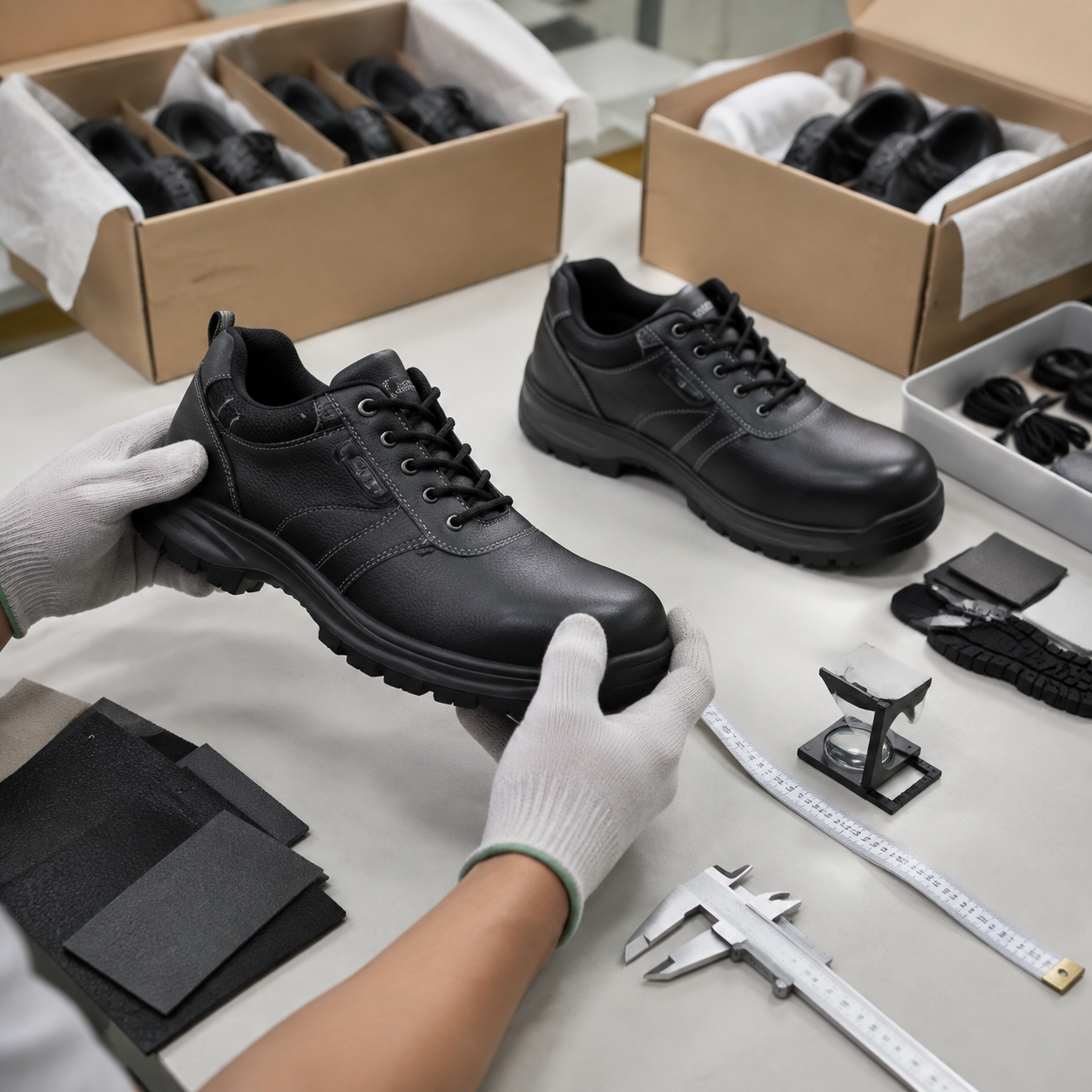
For a Malaysian B2B buyer, a safety shoe wholesale supplier quality control inspection should operate as a purchasing and shipment-release process. Before comparing quotations, require each supplier to respond against the same product revision, materials, protective claims, size schedule, evidence scope, inspection protocol, packing specification, and delivery requirement.
Shortlist a supplier only when its quotation, sample status, deviations, supporting documents, and inspection responsibilities are explicit and internally consistent. Keep shipment on hold until product identity, inspection results, corrective-action status, packed quantity, and buyer authorization are documented.
The supplied evidence does not establish a Malaysian conformity route, tropical-climate specification, import-document requirement, or local certification requirement. The buyer's Malaysian compliance owner, importer, customer, or another qualified source must confirm those obligations before they become RFQ or purchase-order terms.
Malaysia Safety Shoe Quality Control Inspection Gates
A workable RFQ links every requirement to evidence and a release consequence. Use the following gates to produce an approve, hold, or reject decision.
| Decision gate | Buyer defines | Supplier returns | Hold condition |
|---|---|---|---|
| Intended use and claims | Workplace use, identified hazards, required protective claims, and buyer-confirmed applicable requirements | A claim-by-claim response showing what is offered and which document supports it | A requested claim is unsupported, qualified differently, or outside the cited evidence scope |
| Product identity | Buyer SKU, construction, materials, colorway, size schedule, branding, packing, and revision | Supplier style code, quoted revision, component schedule, substitutions, and deviations | The quote, sample, evidence, or inspection plan identifies conflicting products or revisions |
| Reference sample | Sample purpose, required production equivalence, approver, and change-control method | Sample record covering materials, components, tooling, construction, and known differences | Sample status is unclear or a difference remains unapproved |
| Inspection protocol | Lot definition, selection method, checks, defect definitions, decision rules, reporting, and access | Written acceptance, proposed inspection date, available records, and exclusions | Selection, defect classification, or release rules remain undefined |
| Evidence review | Required document type, product scope, acceptable status, and review owner | Current report or certificate showing the covered model, construction, materials, sizes, test date, standard edition, issuer, scope, and status | The document covers another product, is incomplete, has uncertain status, or is used beyond its stated scope |
| Packing and delivery | Pair preparation, assortment, carton specification, marks, named delivery point, delivery basis, and buyer-required documents | Packing proposal, carton data, reconciliation method, delivery assumptions, and document list | Packing or delivery assumptions conflict with the RFQ or required documents remain unconfirmed |
| Shipment release | Corrective-action process, reinspection rule, release package, and authorized buyer role | Final report, disposition of findings, reinspection evidence where applicable, packed quantity record, and release request | Findings remain open, quantities do not reconcile, or the named buyer authority has not released the goods |
Lock the Quoted Product Before Inspection
The supplied Safety Shoes MOQ Guide states that material, outsole, color, size spread, logo method, packaging, and customization can affect MOQ, price, lead time, and quality risk. This is attributed commercial context, not an independent market benchmark or a commitment from a prospective supplier.
Attach a controlled product-definition schedule to the RFQ. It should cover:
- Buyer SKU, supplier style code, colorway, and revision identifier.
- Intended use and each buyer-required protective claim.
- Upper, lining, insole, outsole, lace, eyelet, protective component, and other specified material descriptions.
- Construction method, buyer-controlled component sources, and prohibited substitutions.
- Quantity by size and colorway, including pair-matching requirements.
- Size chart, measuring points, measurement conditions, and tolerances.
- Appearance references for color, finish, stitching, component alignment, branding, labels, and artwork.
- Sample type, approval status, production-equivalence status, and recorded differences.
- Pair preparation, inner packing, assortment, carton configuration, marks, and shipment data.
- Required test, report, certificate, inspection, and traceability records.
Require the supplier to identify every deviation in its quotation. Silence should not be treated as approval for a changed material, component, process, dimension, protective claim, packing method, or other substitution.
An appearance sample should remain an appearance reference unless its materials, protective components, tooling, construction, and relationship to performance evidence are documented. Where substitute materials or non-production tooling were used, record the differences and require buyer approval of a production-equivalent reference before shipment release.
Set the Claim and Evidence Scope
The supplied Bulkchi guide cites the standard designation EN ISO 20345:2022. In that cited designation, 20345 is the standard identifier and 2022 is the edition-year context reported by the source. The citation does not establish that the standard governs a Malaysian order, that an offered shoe conforms to it, or that a supplier holds a current certification.
Keep the following categories separate during quotation review:
- Applicable requirement: The buyer's Malaysian compliance owner or another qualified source determines which legal, workplace, customer, or standard requirements apply.
- Supplier practice: Incoming checks, production controls, factory tests, and inspection routines remain supplier practices unless a current controlled document gives them another status.
- Product evidence: A report or certificate is relevant only to the model, construction, materials, sizes, test scope, test date, standard edition, issuer, and status shown in that document.
- Purchasing decision: The buyer determines whether the evidence covers the ordered revision and required claim. A similar style, earlier revision, or different material combination is a scope gap pending technical review.
Do not infer certification from a logo, catalogue entry, inspection checklist, or standard reference. When certification or test evidence is required, request the current document and have the designated reviewer verify authenticity, status, product scope, and Malaysian applicability.
Choose the Quality Control Inspection Stage
The supplied Testcoo footwear inspection overview lists initial production checks, during-production checks, final random inspection, loading supervision, full inspection, and sample-picking services as separate categories. That commercial page supports the existence of those service categories; it does not select the appropriate stage or decision rule for a Malaysia-bound order.
| Inspection stage | RFQ scope to define | Required output |
|---|---|---|
| Initial or pre-production check | Approved materials, components, tooling, instructions, product identifiers, and sample status | Checked items, mismatches, unavailable inputs, photographs, and hold actions |
| During-production check | Product revision, workmanship, dimensions, assembly, molding, bonding, sizing, repeated findings, and production status | Findings, affected scope, containment action, corrective-action owner, and follow-up date |
| Final random inspection | Finished-lot definition, carton and pair selection, measurements, defect rules, packing checks, and decision method | Selection record, findings by defined class, measurements, photographs, packing result, and decision |
| Full inspection, if contracted | Included units, checks applied to each unit, treatment of reworked goods, and reconciliation method | Checked, segregated, accepted, and unresolved quantities with a reconciliation record |
| Sample picking | Selection authority, selection method, sealing, identifiers, destination, and custody record | Sealed sample identity, selection record, and dispatch record |
| Loading supervision | Released carton identifiers, carton count, visible vehicle or container condition, seal process, and loading record | Loaded-quantity reconciliation, visible-condition record, seal information where used, and exceptions |
| Laboratory or document review | Required claim, sample identity, test scope, method or standard, issuing body, report status, and review authority | Scoped report or certificate and the buyer's documented review decision |
The supplied The Inspection Company footwear overview identifies stitching, color consistency, material composition, sizing, comfort, and durability-related characteristics as footwear inspection areas. Use these as prompts, not ready-made acceptance criteria. The RFQ should identify the stitching location, approved color reference, measuring points, material document, or other method relevant to the ordered shoe. If comfort is included, define the evaluation method and decision owner rather than relying on an undefined opinion.
Visual inspection can record product identity, workmanship, measurements, component presence, and packing condition. It should not be presented as a substitute for specialized evidence supporting a performance claim.
Define Lot, Sampling, Defect, and Closure Rules
An instruction to use standard inspection is incomplete unless the scheme, edition, lot definition, selection method, and decision rules are identified and accepted by the buyer. The inspection attachment should state:
- What forms the inspection lot and whether styles, colors, sizes, production lines, or shipment batches are separated.
- Who selects cartons and pairs, how selection is made, and how it represents the ordered size and color distribution.
- Which visual, measurement, component, functional, packing, and document checks apply.
- Controlled definitions and examples for each defect class used in the decision rule.
- The sample size and approve, hold, or reject rule for each defined defect class.
- Whether repeated findings trigger expanded inspection, containment, rework, replacement, or technical review.
- How repaired or replaced goods are identified, reconciled, and presented for reinspection.
- How inspection, testing, rework, replacement, and reinspection costs are allocated under the agreed commercial terms.
- Which records must close before the named buyer authority may release shipment.
Buyer-drafted clause to adapt and verify in the RFQ, inspection agreement, and purchase order:
> The supplier shall not ship until the buyer's named release authority has accepted the required product-identity records, inspection report, disposition of findings, reinspection evidence where applicable, packing reconciliation, and shipment documents. Inspection or payment does not authorize an unapproved product, material, component, claim, revision, substitution, or deviation.
RFQ Response Schedule for Malaysia Wholesale Supply
Use a structured response schedule so prospective suppliers answer the same questions. Treat a blank field, catalogue link, or general assurance as an open item rather than evidence of compliance.
| RFQ line | Buyer enters | Supplier must return |
|---|---|---|
| Destination and delivery | Malaysia, named delivery point, buyer-defined delivery basis, requested timing, and consignee instructions | Quoted delivery basis, production and dispatch assumptions, routing assumptions, and exclusions |
| Product and quantity | Buyer SKU, revision, colorway, construction, intended use, quantity by size, and pair-matching rules | Supplier style, quoted revision, accepted quantity, MOQ conditions, production split, and deviations |
| Materials and components | Required descriptions, approved references, protective components, and prohibited substitutions | Component schedule, requested source or specification details, proposed substitutions, and traceability method |
| Protective claims | Claim-by-claim requirement and buyer-confirmed applicable basis | Offered claim, covered product, evidence identifier, scope limitations, and unsupported items |
| Reports and certificates | Required document type, scope, status, reviewer, and submission deadline | Current document showing the covered product, test date, standard edition, issuer, scope, and status |
| Samples | Required sequence, purpose, production-equivalence rule, approver, and deadline | Cost, timing, materials, tooling status, production differences, and revision record |
| Inspection | Stage, inspector, notice process, lot definition, selection method, checks, defect rules, reporting, and access | Written acceptance, available records, inspection-date process, and exclusions |
| Corrective action | Containment, rework, replacement, reinspection, closure evidence, and cost allocation | Responsible role, response timing, segregation method, closure process, and commercial exceptions |
| Packing | Pair preparation, assortment, carton construction, dimension or weight limits, marks, and buyer-supported moisture controls | Packing proposal, carton data, net and gross weights, assortment method, and deviations |
| Documents and delivery | Buyer- or importer-provided document list, required data fields, named delivery point, and delivery basis | Available documents, issuing party, timing, draft-review process, delivery assumptions, and gaps |
| Commercial comparison | Product price, development, samples, buyer-requested testing, inspection support, packing, tooling, and delivery | Separate values, currency, validity, payment terms, assumptions, exclusions, and change triggers |
| Release and change control | Buyer approver, controlled changes, required release package, and shipment hold | Change-request method, affected records, revised evidence needs, final reconciliation, and release request |
The supplied evidence does not support a Malaysia-specific carton specification, moisture-control method, label, import document, or routing rule. Add one only when the buyer, importer, customer, or qualified compliance source provides the requirement. Require the supplier to price and confirm it rather than treating it as an unstated local default.
Example Calculations to Verify in the Supplier Quote
Every figure below is a buyer-created example assumption, not supplier data, market data, a standard, a recommended acceptance level, or a SoleForge commercial term. The figures apply only to one illustrative Malaysia-bound RFQ lot as of the issue date printed on that RFQ. Replace or verify every assumption in the supplier quotation, inspection agreement, and purchase order.
| Planning item | Example assumption and calculation | Verification required |
|---|---|---|
| Size allocation | Assume 1,200 pairs across 6 ordered sizes for the illustrative RFQ lot as of its issue date. An equal example allocation gives 1,200 pairs divided by 6 sizes = 200 pairs per size. | Replace the equal allocation with buyer-approved demand and obtain the supplier's size-specific MOQ response. |
| Carton planning | Assume 12 pairs per carton for the same 1,200-pair illustrative lot as of its RFQ issue date. The example requirement is 1,200 pairs divided by 12 pairs per carton = 100 cartons. | Confirm actual assortment, carton construction, dimensions, net weight, gross weight, and supplier packing limits. |
| Inspection distribution | Assume 80 inspected pairs selected from 20 cartons at 4 pairs per carton for the same 1,200-pair illustrative lot as of its RFQ issue date. The proposed coverage is approximately 6.7% of that lot. | The buyer or appointed inspector must replace or approve the sample size, carton selection, defect rules, and decision method. |
The inspection example demonstrates quantity reconciliation only. It does not establish that the assumed selection is statistically justified or suitable for an order.
Award and Shipment Release Decisions
Shortlist or award only when:
- The supplier has quoted the controlled product revision and listed every deviation.
- Material, construction, size, claim, sample, evidence, inspection, packing, delivery, and document responses are reviewable on the same scope.
- Required reports or certificates have been checked for product scope and status rather than accepted by title alone.
- Price, MOQ, samples, testing, inspection support, packing, delivery, and change assumptions are separated clearly enough for comparison.
- Open technical or Malaysian-applicability questions have named owners and are resolved before becoming order claims.
Release shipment only when:
- Finished and packed goods carry the approved product and revision identifiers.
- Inspection records identify the lot, selection method, checks, findings, measurements, packing result, and decision.
- Nonconforming goods are segregated and their rework, replacement, concession, or rejection status is recorded.
- Required reinspection and evidence review are complete.
- Packed quantities and assortments reconcile with the approved order or documented buyer authorization.
- The named buyer authority has issued the required release record.
Evidence Method and Limitations
Methodology: Each supplied source was assigned a limited role. Commercial source pages were used only to identify quotation variables, inspection-service categories, inspection areas, or an attributed standard reference. Those categories were then converted into buyer-controlled RFQ fields, evidence requests, hold conditions, and release decisions. The example figures were derived through the arithmetic shown in the table and were explicitly separated from sourced facts.
No supplied page was treated as proof of a specific shoe's construction, performance, conformity, certification, inspection result, supplier capability, or suitability for Malaysia.
Limitations and items to verify: No Malaysian regulatory publication, official standard text, supplier quotation, purchase specification, approved production sample, controlled material schedule, laboratory report, current certificate, inspection protocol, completed inspection report, packing specification, shipping-document list, or release record was supplied. Before award or shipment, the responsible buyer roles must verify legal applicability, document authenticity and status, evidence scope, product revision, quantities, tolerances, sampling rules, test methods, inspection access, packing, delivery terms, production timing, corrective-action responsibility, and release authority.
Author scope: The supplied author profile identifies Vincent Xi as Editorial Author. It does not support claims of factory visits, product testing, certification review, customer outcomes, or first-hand product use; no such claim is made.
Discuss Your Requirements
Review our manufacturing capabilities, then share your specifications for a supplier-fit review.