Sandal OEM Quality Control Inspection for Manufacturing RFQs in Europe
By Vincent Xi, Editorial Author
A sandal OEM quality control inspection for goods intended for sale in Europe should be quoted as a defined manufacturing deliverable. Before accepting a supplier quote, connect the inspection scope to the identified style, controlled revision, production lot, European destination allocation, measurable criteria, inspection gates, sampling method, evidence package, remedies, and shipment authority.
> RFQ release rule: Release only the identified sandal lot when every contracted gate has a supported result, required order-linked evidence is complete, and the named buyer authority has approved any deviation. Otherwise, hold the affected lot for containment, correction, replacement, or reinspection.
The hold points, evidence requirements, and remedies below are proposed buyer contract controls. They are not presented as legal requirements or as the documented practice of SoleForge, a supplier, or an inspection provider.
Europe RFQ scope for sandal quality control inspection
The supplied sources support limited procurement and inspection context. They do not establish universal sandal specifications, destination rules, supplier capabilities, or legal conclusions.
| Source context | Supported use | Evidence boundary |
|---|---|---|
| Footwear buying guidelines | The commercial page identifies product reference, quantity, size range, materials, packaging, and market requirements as footwear buying or quotation inputs. | It does not establish sandal dimensions, tolerances, defect limits, legal requirements, or supplier capability. |
| Footwear inspection guide | The commercial page presents initial-production, during-production, final-random, loading, full-inspection, and sample-picking formats. | It does not choose the correct gate, sample plan, acceptance rule, remedy, or release authority for a particular order. |
| Vincent Xi author profile | The profile identifies Vincent Xi as an Editorial Author. | It supports authorship attribution only. It is not evidence of factory visits, product tests, certifications, or manufacturing outcomes. |
Use those source contexts to structure the decisions that must be resolved in the RFQ and supplier quote:
| RFQ decision | Required buyer instruction | Contract hold point |
|---|---|---|
| Order identity | State the sandal style, colorway, ordered sizes, size ratio, quantity, purchase-order reference, production-batch definition, packing status, and manufacturing site covered by inspection. | Hold goods that cannot be traced to the quoted order and defined lot. |
| Controlled product basis | Identify the technical-pack revision, component schedule, artwork revision, approved reference-sample status, test instructions, and document-precedence rule. | Hold production made to an obsolete, conflicting, or unapproved reference. |
| European destination allocation | Separate EU allocations, EEA allocations outside the EU, UK allocations, and country-specific instructions in a buyer-approved destination matrix. | Hold an allocation whose approved evidence, artwork, labeling, or packaging instruction does not match its actual destination. |
| Measurable acceptance | Define measurement locations, methods, units, tolerances, workmanship boundaries, functional criteria, defect categories, and acceptance rules. | Hold when a controlled characteristic cannot be judged against a written criterion. |
| Inspection timing | Select the manufacturing and dispatch gates needed for the identified construction, material, packaging, and delivery risks. | Hold when a mandatory gate was missed or occurred too late to examine its intended production stage. |
| Lot and sampling rule | Define the lot boundary, random-selection procedure, carton selection, sample distribution, sample size, defect categories, and acceptance and rejection counts. | Hold when the sample source is untraceable or the contracted selection method was not followed. |
| Inspection evidence | Require raw measurements, defect counts, sample distribution, photographs, test records, packing reconciliation, document references, and corrective-action evidence. | Treat a pass statement without the contracted evidence as incomplete. |
| Remedy and authority | Name who may contain, sort, rework, replace, reinspect, accept a deviation, or release the affected goods, and allocate the related costs. | Prevent dispatch until the named buyer authority releases the identified lot in writing. |
Practical sandal quality control inspection RFQ checklist for Europe
Copy this checklist into the RFQ and require the supplier or inspection provider to mark each line as Included, Excluded, or Exception, identify the corresponding quote section, and name the evidence that will be returned. A blank response remains unresolved and should not be treated as included.
- [ ] Order identity: Confirm the purchase-order reference, sandal style, revision, colorway, ordered sizes, quantity, manufacturing site, packing status, and lot boundary.
- [ ] European allocation: Separate EU, EEA outside the EU, UK, and actual country-specific allocations; identify the approved destination file for each.
- [ ] Controlled references: List the technical pack, component schedule, artwork, approved reference sample, test instructions, packing specification, revisions, and document precedence.
- [ ] Measurable criteria: Quote the measurement landmarks, methods, units, tolerances, workmanship boundaries, functional thresholds, and pair-matching rules for every controlled characteristic.
- [ ] Inspection gates: Mark each required pre-production, initial-production, during-production, final-random, full-lot, or dispatch gate and state its scheduling trigger.
- [ ] Sampling and access: Define random-selection control, carton and pair selection, size and colorway distribution, sample traceability, sample size, and acceptance and rejection counts.
- [ ] Defect schedule: Attach buyer-approved defect definitions, categories, counting rules, boundary photographs or samples, containment scope, and rework eligibility.
- [ ] Evidence package: Require raw measurements, defect counts, sample identifiers, photographs, test records, document references, packing reconciliation, and corrective-action closure evidence.
- [ ] Destination evidence: Identify who approves current destination-specific legal, labeling, traceability, artwork, laboratory, and packaging criteria before inspection.
- [ ] Remedies: Allocate responsibility for containment, sorting, rework, replacement, repacking, storage, reinspection, and shipment changes after a failed or incomplete result.
- [ ] Commercial terms: State inspection fees, travel treatment, notice period, site access, report timing, destructive-sample costs, cancellation terms, and failed-lot charges.
- [ ] Release authority: Name the buyer representative authorized to approve deviations and release the identified lot, and require written release before dispatch.
Return the completed checklist with the dated supplier quote. Record exceptions as specific proposed deviations rather than general statements such as standard inspection included or Europe compliant.
Build measurable sandal acceptance criteria
An approved reference sample can support appearance comparison, but it should not replace measurable criteria. The purchase order should also state which controlled document prevails if the technical pack, component schedule, sample, artwork, test instruction, or packing specification conflicts.
| Controlled area | RFQ specification | Inspection record and hold trigger |
|---|---|---|
| Product identity | Style reference, current revision, colorway, ordered size, destination, component identifiers, and approved-sample status. | Record the order and sample identifiers with photographs. Hold if identity, revision, or destination cannot be confirmed. |
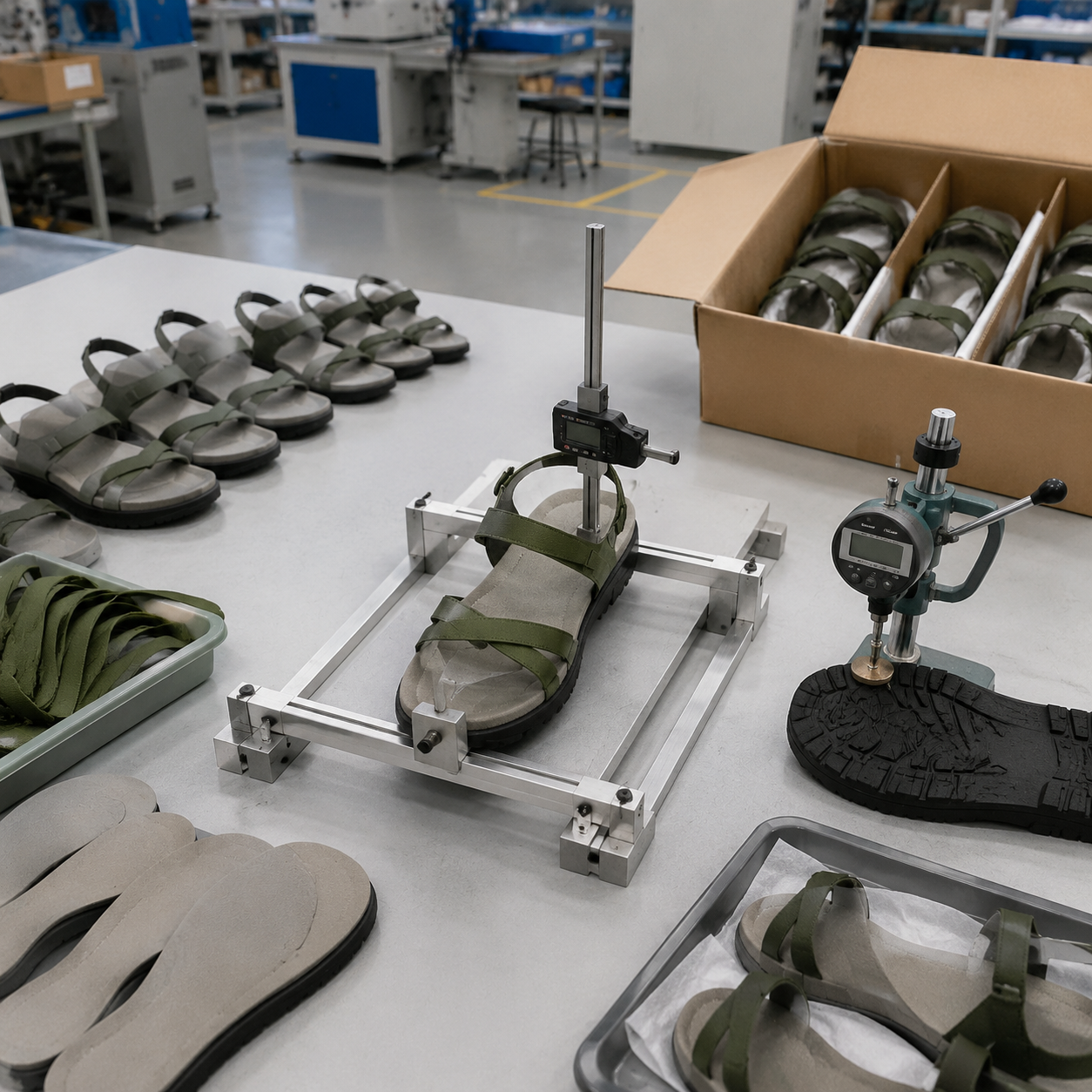
| Strap, footbed, and outsole geometry | Define landmarks, measurement orientation, nominal values, units, size-specific tolerances, and left-right comparison rules. | Record raw results by sample, ordered size, side, method, and instrument. Hold an omitted, unmeasurable, or out-of-tolerance characteristic. |
| Assembly and workmanship | Set written boundaries for open bonding, excess adhesive, loose threads, uneven stitching, rough edges, deformation, contamination, component damage, and asymmetry. | Record the defect category, sample identifier, location, close photograph, and context photograph. Hold findings outside the approved boundary. |
| Fastening and functional performance | Identify the component, placement, alignment, operating protocol, test method where applicable, and buyer-selected threshold. | Record the component check and raw functional result. Hold the wrong component, incomplete operation, missing method link, or failed threshold. |
| Pair and size controls | Define left-right matching, size marks, color reference, component alignment, and checks across the ordered size range. | Record pair-level and size-level findings. Hold mismatched pairs, incorrect marks, or unapproved variation. |
| Materials, components, and changes | List approved material and component identifiers and require approval before substitutions or changes to tooling, construction, process, packaging, or subcontracted production. | Record identifiers and approved change references. Hold an unapproved or untraceable change. |
| Packaging | Define pair protection, inserts, individual packaging, barcode-data source, carton assortment, marks, packing orientation, and packing-list reconciliation. | Record sampled-pack and carton findings. Hold wrong allocation, assortment, protection, data, or carton identity. |
For instrument-based measurements, specify the landmarks, specimen orientation, applied pressure where compression can affect the result, instrument type, required resolution, and calibration-status evidence. Treat calibration evidence as instrument-specific; do not use it as proof that a company or manufacturing site is certified.
Example RFQ values to replace before order
Every figure below is an example calculation and buyer assumption to verify in the supplier quote. The cited pages are not the source of these dimensions, tolerances, quantities, or results. Each example applies only to the stated sandal scope as of the date shown on the supplier quote and must be replaced or confirmed in the controlled technical pack and purchase order.
| RFQ use | Scope, as-of context, and source status | Example calculation and evidence |
|---|---|---|
| Draft a strap-width criterion | Quoted sandal style and buyer-designated sample size, as of the date shown on the supplier quote. Source status: buyer example assumption to verify. Nominal width: 30 mm with a bilateral tolerance of +/- 1 mm. | Draft lower bound: 30 mm - 1 mm = 29 mm. Draft upper bound: 30 mm + 1 mm = 31 mm. Record the raw width at the buyer-defined strap midpoint with the caliper jaws perpendicular to the strap edges. |
| Draft a footbed-length criterion | Quoted sandal style and buyer-designated sample size, as of the date shown on the supplier quote. Source status: buyer example assumption to verify. Nominal heel-to-toe length: 270 mm with a bilateral tolerance of +/- 2 mm. | Draft lower bound: 270 mm - 2 mm = 268 mm. Draft upper bound: 270 mm + 2 mm = 272 mm. Define the heel tangent, toe endpoint, specimen orientation, and measurement path. |
| Draft an outsole-thickness criterion | Quoted sandal style and buyer-defined forefoot measurement point, as of the date shown on the supplier quote. Source status: buyer example assumption to verify. Nominal thickness: 12 mm with a bilateral tolerance of +/- 0.5 mm. | Draft lower bound: 12 mm - 0.5 mm = 11.5 mm. Draft upper bound: 12 mm + 0.5 mm = 12.5 mm. Record the exact point, method, raw result, and sample identifier. |
| Reconcile a packed shipment | Quoted sandal shipment, as of the date shown on the supplier quote and subject to the verified final packing list. Source status: buyer planning assumption to verify. Shipment scope: 120 export cartons packed at 12 pairs per carton. | Draft reconciliation: 120 cartons x 12 pairs per carton = 1,440 pairs. Do not use this result if verified carton quantities, mixed packing, or destination splits differ. |
These values demonstrate specification format and arithmetic only. They do not establish suitable dimensions, tolerances, sample sizes, defect limits, or remedies for another sandal style or order.
Select sandal manufacturing inspection gates
The footwear inspection guide supplies the inspection-stage vocabulary used here. Gate selection, scope, evidence, hold conditions, and shipment decisions remain buyer-drafted RFQ terms.
| Gate | Contracted sandal scope | Evidence and decision |
|---|---|---|
| Pre-production specification review | Buyer-added document gate, not a stage attributed to the inspection source. Confirm that product identity, components, measurements, tolerances, defect rules, testing, packaging, and document precedence are inspectable. | Require a controlled-document list, revision status, approvals, and unresolved-item log. Do not authorize bulk manufacturing while acceptance criteria remain missing or contradictory. |
| Initial-production check | Apply the source-identified stage format to early production materials, tooling output, size marks, strap placement, stitching, assembly setup, and initial output specified by the buyer. | Require component identifiers, measurements, photographs, test records, and discrepancies. Decide whether to continue, adjust, contain, or pause the affected output. |
| During-production check | Apply the source-identified stage format across the buyer-defined sizes, colorways, material batches, production lines, and earlier corrective actions. | Require the sample-selection record, raw findings, production status, defect locations, and corrective-action verification. Decide whether to continue, contain, expand screening, or reinspect. |
| Final-random inspection | Apply the source-identified stage format to random selection from the buyer-defined finished and packed lot. Compare the sample with the written acceptance schedule. | Require lot identity, selection trail, sample distribution, raw measurements, defect counts, photographs, packing checks, and the calculated result. Apply the contracted release or hold rule. |
| Full-lot screening | Apply the source-identified full-inspection format only after defining the exact lot, defect list, unit-handling rule, segregation method, rework status, and completion evidence. | Require unit disposition, findings by defect category, segregation records, and reinspection status. Release only traceable goods meeting the buyer rule. |
| Dispatch or loading check | Apply the source-identified loading-stage format to the released-lot identity, carton condition, assortment, count, marks, contracted seal controls, and approved shipping documents. | Require carton reconciliation, released-lot reference, loading record, and document comparison. Do not use this gate as a substitute for workmanship inspection or laboratory testing. |
The supplier quote should price each selected gate separately and state scheduling notice, site access, inspector-time basis, travel treatment, report timing, destructive-sample cost, failed-lot handling, and reinspection responsibility. These are requested commercial fields, not claims about a supplier's current prices or capability.
Define the lot, sampling rule, and defect schedule
Lot boundary. Define whether the inspection lot is separated by style, colorway, ordered size, component or material batch, production line, packing status, or European destination allocation. Use the same boundary in the quote, inspection instruction, report, corrective-action record, and shipment release.
Random selection. State who controls sample access, how cartons and pairs are selected, how selection is distributed across the defined lot, and how each sample is traced to its carton, size, colorway, batch, and line where applicable. Any departure from the contracted method should require written buyer approval.
Defect schedule. Define every category in the purchase order. A buyer may draft an exposed sharp component or a material prohibited by the approved specification as a safety or compliance defect. A detached strap, open sole bond, wrong size mark, or mismatched pair may be drafted as a major functional or saleability defect. An appearance finding outside an approved boundary may be drafted as a minor defect. These are drafting examples, not universal classifications or acceptance thresholds.
For each category, specify the defect definition, comparison photographs or boundary samples, counting rule, sample size, acceptance and rejection counts, containment scope, corrective evidence, rework eligibility, and reinspection identification method.
If a sampling or test standard is incorporated, state its exact title, edition, selected provisions, lot rule, and buyer acceptance criterion. A standard's requirements do not automatically describe SoleForge's, a supplier's, or an inspector's manufacturing practice. Use of a standard or test method does not establish certification. Check any certification claim against a current document showing the holder, site, scope, issuer, and validity status.
Keep Europe destination evidence separate from inspection evidence
Do not use Europe compliant as a sandal inspection criterion. The supplied citations are commercial process sources, not legal authorities for the EU, EEA, UK, or any individual European country. Assign current legal and regulatory determinations to a qualified owner, then give the inspector approved destination-specific criteria for the allocated goods.
| Destination allocation | Buyer-approved RFQ input | Inspection control |
|---|---|---|
| EU allocation | Name the actual country of sale and attach the approved evidence, artwork, declaration, test criteria, traceability instructions, and packaging requirements selected for that sandal allocation. | Compare sampled goods and identified order documents with the approved destination file. Report observations without making an uncontracted legal conclusion. |
| EEA allocation outside the EU | Maintain a separate destination entry and obtain current approval for the documents, labels, tests, and administrative instructions applicable to that allocation. | Do not assume the EU destination file applies unchanged. Hold missing or mismatched instructions for buyer review. |
| UK allocation | Maintain a separate UK review for evidence, artwork, labeling, traceability, and packaging assigned to the allocated goods. | Do not treat an EU-oriented inspection report or artwork approval as automatic evidence for the UK allocation. |
| Country-specific instruction | Record current language, labeling, packaging, registration, retailer, or document instructions identified by the buyer's qualified compliance owner for the actual country of sale. | Inspect against the approved instruction and escalate missing, conflicting, or obsolete criteria before release. |
Do not use visual inspection as a substitute for legal review or laboratory work. When a laboratory report contributes to release, require the tested sample, material, method, edition where relevant, criterion, report date, issuing body, and documented connection to the ordered style and production batch.
Require release-ready inspection evidence
The RFQ report specification should require:
- Purchase-order, sandal style, revision, lot, European destination, manufacturing site, inspection scope, and inspection-date identifiers.
- Production and packing status for the defined lot.
- The sample-selection trail and distribution across contracted sizes, colorways, batches, lines, and carton locations.
- Raw measurements and test results with units, tolerances, methods, instrument identifiers, calibration-status evidence, and sample identifiers.
- Defect counts under the buyer's categories, affected sample identifiers, locations, and clear close and context photographs.
- Component, size-mark, pair-matching, artwork, packaging, assortment, and carton-reconciliation findings.
- References to laboratory reports and other documents used for the decision, including their connection to the actual order and lot.
- Corrective actions, observed closure evidence, remaining nonconformities, and reinspection status.
- A result calculated under the contractual acceptance rule rather than an inspector-selected substitute.
| Event | Immediate control | Evidence required before release |
|---|---|---|
| Lot or revision mismatch | Stop the affected inspection decision and segregate unidentified goods. | Reconciled order, style, revision, batch, packing, and destination records. |
| Missing raw evidence | Treat the result as incomplete rather than converting it to a pass. | Completed measurements, sample trail, photographs, records, and document links required by the RFQ. |
| Acceptance-rule failure | Hold and contain the defined affected scope. | Buyer-approved disposition and completed sorting, rework, replacement, or reinspection evidence as applicable. |
| Unapproved component or process change | Prevent release and open a controlled change review. | Written approval linked to the change, order, affected lot, destination, and supporting evidence. |
| Destination-file mismatch | Segregate the affected allocation. | Approval from the named compliance owner and corrected destination-specific evidence or goods. |
| Missed mandatory gate | Record the missed control and prevent automatic release. | Buyer-approved alternative evidence or a feasible replacement inspection, with residual risk documented. |
A pass is an inspection result, not shipment authority unless the purchase order gives it that effect. Keep inspection disposition and shipment release as separate contract fields. Any conditional acceptance or defect waiver should be written, limited to the identified lot and destination, and issued by the named buyer representative.
For quote comparison, allocate responsibility for inspection, travel, laboratory work, destructive samples, containment, sorting, rework, replacement goods, repacking, storage, reinspection, and shipment changes. The dated supplier quote should also state the notice and evidence required before corrective action can be treated as complete.
Methodology, limitations, and author basis
Methodology. The quotation inputs identified by the footwear buying guidelines were mapped to the stage formats presented by the footwear inspection guide. The resulting acceptance fields, inspection records, hold points, remedies, destination controls, and release terms are editorial recommendations for buyer-drafted manufacturing RFQs. The worked figures are labeled buyer assumptions, and their arithmetic is shown; neither commercial source is cited as the origin of those values.
Limitations and what to verify. The cited commercial pages are process contexts, not independent legal authorities, laboratory standards, factory audits, certifications, or evidence of current supplier capability. They do not establish universal sandal tolerances, sample sizes, defect limits, performance thresholds, destination rules, remedies, pricing, or lead times. Before release, verify the dated supplier quote, purchase order, controlled technical pack, approved reference sample, production-lot identity, European destination allocation, inspection access, sampling rule, test method and edition, instrument status, laboratory scope, report applicability, current destination requirements, document validity, packing list, corrective actions, cost allocation, and shipment authority.
Author basis. The Vincent Xi author profile identifies Vincent Xi as an Editorial Author. The profile is used only for authorship attribution.
Discuss Your Requirements
Review our manufacturing capabilities, then share your specifications for a supplier-fit review.