Sandal OEM Sustainability Sourcing Criteria for Malaysia RFQs
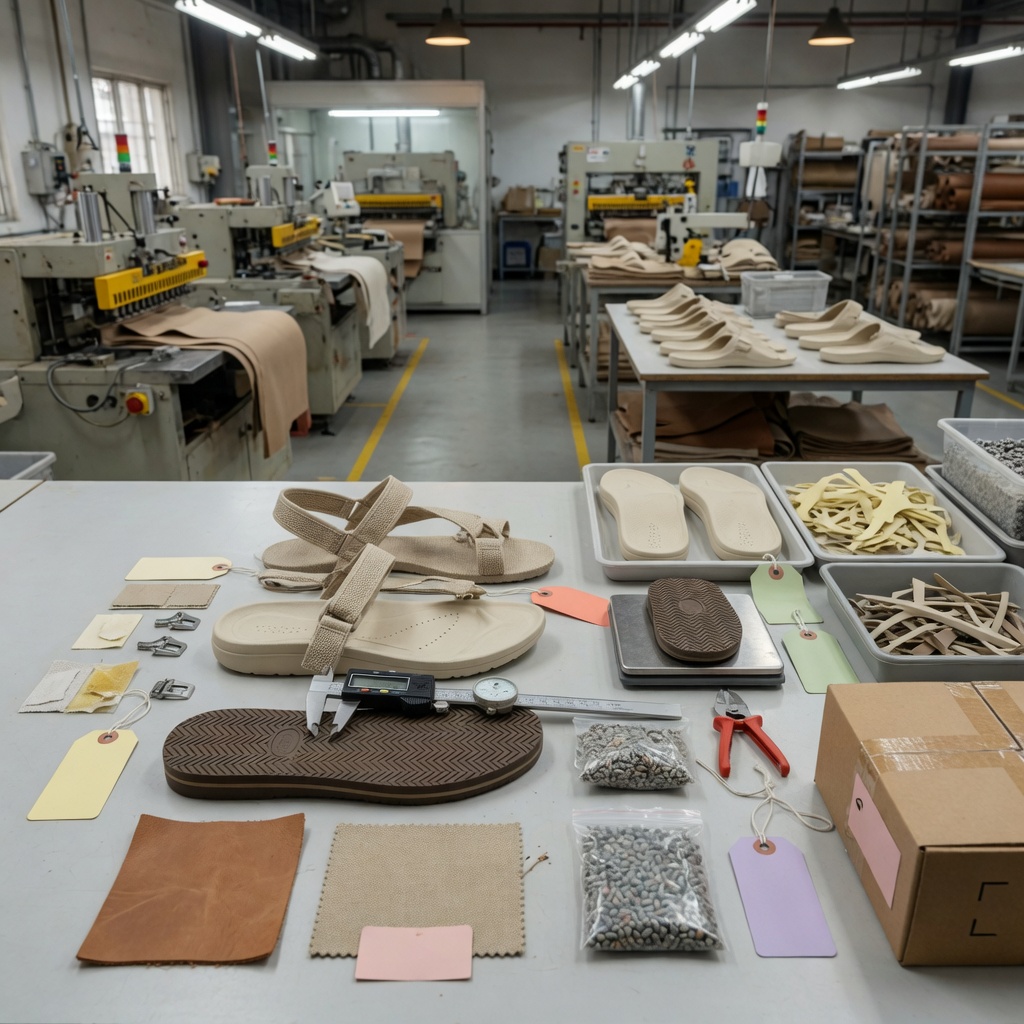
By Vincent Xi, Editorial Author
For a Malaysia-bound sandal manufacturing RFQ, sustainability sourcing criteria should convert each environmental claim into a commercial decision field. Malaysian sourcing and procurement teams can compare a quotation only when it ties the claim to a named component or process, defines the measurement basis and denominator, identifies the proposed production site and subcontractor boundary, lists scope-matched evidence, and assigns a release gate with a failure action. This is a buyer-defined control, not a statement that a manufacturer already meets the criterion.
The evidence base is deliberately narrow. HERRAINS discusses leather, vegan leather, EVA midsoles, rubber outsoles, and recycled or plant-based material options, and associates material selection with comfort, durability, and brand perception (HERRAINS). NLD Shoe presents recycled or renewable sourcing, low-VOC or water-based systems, production transparency, digital traceability, and waste-reducing automation as sourcing checkpoints (NLD Shoe). These sources support RFQ question categories; they do not establish preferred materials, universal thresholds, factory performance, or supplier capability.
Malaysia is the sole sale-market scope. The supplied evidence does not establish Malaysian legal thresholds, mandatory product tests, duty rates, customs procedures, transit times, or required shipment documents. Treat destination and document fields below as buyer-entered quotation inputs and verify applicable requirements separately.
Sandal OEM sustainability sourcing criteria for Malaysia quotations
Build the evidence matrix before requesting final prices. Keep site-level, product-level, component-level, process-level, and production-lot evidence separate so that each document answers only the question covered by its stated scope.
| Criterion | Required RFQ definition | Scope-matched evidence | Buyer decision rule |
|---|---|---|---|
| Component and claim boundary | Where present, separate the upper, lining, footbed or midsole, outsole, adhesive, thread, and hardware. Record the controlled style identifier, bill-of-materials revision, exact claim wording, material family, supplier or processor reference, color and finish, buyer-marked dimensions and tolerances, mass basis, and permitted substitutions. | Signed bill of materials, controlled component specification or drawing, material declaration, and approved sample. | Hold generic whole-sandal wording, conflicting revisions, undefined measurement points, or open-ended substitutions. The HERRAINS material examples support component-level questions, not a preferred material or threshold (HERRAINS). |
| Recycled or renewable input | State whether the claim covers the complete sandal, a named component, or a feedstock. Define the percentage by mass, numerator, denominator, and treatment of virgin input, regrind, recoverable scrap, rejects, and process loss. | Purchase records, inbound material identification, batch sheets, material reconciliation, supplier declarations, and any current scope-matched supporting document. | Pass the claim only when the records reconcile to the quoted component and ordered production lot. NLD Shoe identifies recycled or renewable sourcing as a checkpoint but supplies no universal percentage threshold (NLD Shoe). |
| Adhesive and chemical wording | Name the adhesive, application stage, and exact proposed wording. Keep water-based and low-VOC as separate fields. Define the reporting basis, buyer-approved chemical specification, bond-test method, sample condition, result unit, acceptance rule, and failure responsibility. | Technical and safety data, chemical declarations, application or batch records, and scope-matched finished-product test reports. | Hold wording without a defined basis. Require chemical-document scope and finished-product bond performance to meet their separate buyer-defined gates. The cited source provides no universal chemical or bond threshold (NLD Shoe). |
| Production-lot traceability | Define the required links among incoming material batch, component batch, assembly lot, inspection record, packed-lot identifier, production site, and subcontractor. | A trace exercise supported by matching purchase, batch, production, inspection, and packing records. | Hold the affected claim when the selected incoming batch or packed lot cannot be traced through the required stages. NLD Shoe identifies production transparency and digital traceability as sourcing checkpoints (NLD Shoe). |
| Process waste and mass yield | Record material input, accepted output, cutting or molding scrap, rejects, rework, and work in process in kilograms per production lot. Define the reporting period, process boundary, scale basis, and classification rules. | Production summaries, batch records, scrap and reject logs, rework records, and input-to-output reconciliation. | Compare suppliers only after their records use matching boundaries. Do not award credit for an equipment description alone; NLD Shoe presents waste-reducing automation as a checkpoint but does not report a universal operating result (NLD Shoe). |
| Manufacturing site and subcontractor control | Identify the legal manufacturing entity, physical production site, process allocation, material processors, component factories, and assembly subcontractors. Define advance notice and approval rules for changes. | Site list, process-allocation record, subcontract records, quotation declarations, and controlled change notices. | Hold undisclosed locations and unapproved changes to sites, processors, formulas, materials, or subcontractors. Do not transfer site-level evidence to another location. |
| Document or certificate scope | Record the document title or scheme, decision purpose, holder, physical site, material or product scope, covered color and finish where relevant, issuing body, issue date, expiry or status date, exclusions, and verification route. | Current scope-matched document and issuer verification where available. | Use the document only for its stated scope. The VinaSources overview supports requesting management-system, material, and chemical document categories; it does not prove that a supplier holds a current certification or that the document applies to Malaysia (VinaSources). |
| Product-performance non-offset | State buyer-defined requirements for dimensions, bond performance, durability, comfort, and appearance. Name the method, sample condition, sample count, result unit, tolerance, and failure action. | Approved reference sample, controlled product specification, inspection report, and relevant test report. | Do not use a sustainability claim to offset a mandatory product-performance failure. HERRAINS associates material selection with comfort and durability but provides no numerical acceptance threshold (HERRAINS). |
Apply these decision states consistently:
- Eligible for commercial comparison: Mandatory claims have defined scope, measurement basis, site boundary, evidence, release timing, and change control.
- Hold the claim: Evidence is missing, generic, expired, promised after the required gate, or mismatched to the component, site, process, or lot. Exclude the claim and associated premium until the gap is closed.
- Remove the claim or stop the affected award scope: The supplier cannot identify the claimed input or process, will not control substitutions, cannot provide the requested traceability, or uses certification wording without a current scope-matched document.
Malaysia sandal manufacturing RFQ fields for comparable quotations
| RFQ field | Required buyer entry | Comparison purpose |
|---|---|---|
| Product boundary | Controlled sandal style identifier, intended use, bill-of-materials revision, approved sample status, colorways, size range, order quantity, and buyer-defined performance specification. | Keeps material, construction, testing, and price comparisons on the same product scope. |
| Malaysia destination boundary | Malaysia as the sole sale market, a buyer-approved named delivery point, and the requested trade term and named place. | Prevents an origin quotation or general export statement from being treated as destination-specific evidence. Verify applicable Malaysian requirements separately. |
| Manufacturing boundary | Proposed legal entity, physical site, component processors, component factories, assembly subcontractors, and process allocation. | Shows which facility and supply-chain scope each document must cover. |
| Commercial basis | Quotation issue date, validity period, currency, minimum order quantity in pairs, unit price per pair, and lead time in calendar days from a defined start event. | Allows quotations to be normalized before an award decision. |
| Evidence timing | Evidence due with the quotation, approved sample, pre-production confirmation, bulk-lot release, or another buyer-defined gate. | Prevents a promise of future documentation from being treated as current proof. |
| Change control | Advance-notice period and approval rule for changes to materials, formulas, processors, sites, subcontractors, evidence, or claim wording. | Keeps the approved claim aligned with the construction that is actually produced. |
| Failure disposition | Hold, corrective action, retest, replacement, rework, price adjustment, claim removal, or stop-award action for each mandatory failure. | Makes the consequence of incomplete evidence clear before purchase-order placement. |
Use a separate claim-schedule row for every proposed sustainability statement. Include the exact wording, affected component or process, measurement unit, calculation method, numerator, denominator, material supplier or processor, manufacturing site, evidence file, document holder and status, production-lot link, verification gate, cost or lead-time effect, and current decision status.
Compare quotations on the same controlled construction. Separate the base unit price from tooling, molds, sampling, testing, traceability, documentation, and claim-related material costs. If mandatory evidence is incomplete, the underlying construction may remain available for technical review, but the unsupported claim and related premium should not receive sustainability credit.
Verify evidence through sandal manufacturing release gates
| Release gate | Verification focus | Required output |
|---|---|---|
| Quotation screen | Product scope, proposed claim wording, measurement basis, factory and subcontractor identity, evidence list, commercial effect, quotation validity, and unresolved gaps. | Eligible, hold, or remove decision for each claim. |
| Sample validation | Match the sample to the proposed bill of materials and apply buyer-defined dimensional, construction, performance, appearance, and chemical checks. | Approved result, corrective action, or rejected claim or construction. |
| Purchase-order transfer | Move approved materials, sites, claims, evidence deadlines, test duties, change controls, and failure actions into controlled order documents. | Contractual record of the approved sustainability conditions. |
| Pre-production confirmation | Reconfirm material batches, processors, adhesive system, subcontractors, traceability fields, document status, and approved changes. | Documented authorization to begin the affected production scope. |
| Bulk-lot release | Reconcile material records, process data, inspections, test evidence, and packed-lot identity before shipment authorization. | Release, hold, corrective action, or claim removal for the ordered lot. |
| Order record | Retain the approved bill of materials, claim schedule, supplier documents, reports, exceptions, corrective actions, and final disposition. | Substantiation record for the completed order and any reorder comparison. |
Example calculation: specify the recycled-content denominator
All values below are buyer-created example assumptions or calculations for the same named outsole compound, sandal style, and Malaysia-bound production lot, as of the buyer-entered RFQ issue date. No supplied source reports these values. Each value must be verified in the supplier quotation, approved component specification, purchase order, material records, and production-lot reconciliation.
| Data point | Unit and scope | As-of context, basis, and verification |
|---|---|---|
| 5,000 pairs | Example order quantity for the named sandal style and Malaysia-bound production lot. | As of the buyer-entered RFQ issue date; buyer-created assumption; verify in the supplier quotation and purchase order. |
| 0.24 kg per finished pair | Example accepted outsole mass for the named style, buyer-designated size basis, and production lot. | As of the buyer-entered RFQ issue date; buyer-created mass assumption; verify in the controlled component specification and weighed approved sample. |
| 1,250 kg of process input | Example outsole-compound input for the same lot and defined process boundary. | As of the buyer-entered RFQ issue date; buyer-created process assumption; verify in batch and scale records. |
| 1,200 kg of accepted output | Calculated accepted outsole mass for the same style and lot. | As of the buyer-entered RFQ issue date; example calculation using order quantity multiplied by accepted outsole mass per pair; verify against accepted production records. |
| 96% mass yield | Calculated accepted-output-to-process-input ratio for the same outsole process and lot. | As of the buyer-entered RFQ issue date; example calculation using accepted output divided by process input; verify through lot reconciliation. |
| 30% by mass | Example recycled-feedstock target for the named outsole compound; the denominator must be stated as accepted output or total process input. | As of the buyer-entered RFQ issue date; buyer-created claim assumption; verify the quotation wording, numerator, denominator, and material records. |
| 360 kg of recycled material | Calculated target for the same lot when accepted output is the denominator. | As of the buyer-entered RFQ issue date; example calculation using the target percentage multiplied by accepted output; verify against component and lot records. |
| 375 kg of recycled feedstock | Calculated target for the same lot when total process input is the denominator. | As of the buyer-entered RFQ issue date; example calculation using the target percentage multiplied by process input; verify against purchase and batch records. |
| 15 kg arithmetic difference | Difference between the accepted-output and process-input denominator results for the same lot. | As of the buyer-entered RFQ issue date; example calculation only; verify actual allocation among accepted product, scrap, rejects, regrind, and work in process. |
The results based on accepted output and total process input are not interchangeable. Require the supplier to state which denominator supports the proposed claim and how recycled material in accepted product, scrap, rejects, regrind, and work in process is treated. A factory-wide purchasing summary does not by itself establish the composition of the ordered lot.
Scope supplier documents to the quoted sandal
The VinaSources supplier-sourcing overview concerns a Vietnam manufacturing-origin context. It is used here only because the supplied excerpt identifies management-system, material, and chemical document categories that a buyer may request. It is not a Malaysia market source and does not prove that a supplier holds a current certification.
For every offered document, record and verify:
- The document title or exact scheme.
- The holder and physical production site.
- The covered activity, material, component, or finished product.
- The covered color and finish where these affect scope.
- The issuing body, issue date, expiry or status date, and exclusions.
- The available issuer-verification route.
- The decision question the document can answer.
- Any required link to the quoted component or ordered production lot.
A site-level management document supports only its stated holder, site, activity, validity, and exclusions. It should not be substituted for component-composition records, adhesive data, finished-product test results, process-yield records, or production-lot traceability. No certification or compliance status should be accepted without a current scope-matched document.
Evidence method, author basis, and limitations
| Retained theme | Supplied source context | Permitted use in this RFQ framework | Inference excluded |
|---|---|---|---|
| Leather, vegan leather, EVA midsoles, rubber outsoles, recycled or plant-based options, and the relationship between material selection, comfort, durability, and brand perception. | HERRAINS manufacturer-selection article | Define component-level material, construction, and performance fields. | No preferred material, numerical threshold, supplier capability, test result, or customer outcome. |
| Recycled or renewable sourcing, low-VOC or water-based systems, production transparency, digital traceability, and waste-reducing automation as sourcing checkpoints. | NLD Shoe sustainable-material article | Define evidence fields for material claims, adhesive claims, traceability, and process records. | No universal percentage, chemical threshold, verified factory practice, lot result, or certification. |
| Management-system, material, and chemical document categories that buyers may request. | VinaSources supplier-sourcing overview | Build a document-discovery and scope-verification checklist. | No Malaysian legal requirement, current supplier certification, product approval, or lot substantiation. |
| Vincent Xi's name, role, and author-profile URL. | SoleForge author profile | Support the visible byline and structured-data author identity. | No factory visit, product test, certification, client work, customer result, or other personal experience claim. |
Methodology and data derivation: Only factual themes represented in the supplied source contexts were retained. Each theme was converted into buyer-defined RFQ fields covering claim scope, measurement basis, manufacturing boundary, document scope, release timing, commercial effect, and failure action. The mass, yield, and denominator values are derived solely from the explicitly labeled buyer-created assumptions in the calculation table; they are not factory or product performance data.
Limitations and verification: The supplied evidence does not provide publication-date context, primary standards text, laboratory datasets, lifecycle assessments, Malaysia-specific legal thresholds, customs requirements, transit assumptions, mandatory shipment documents, or proof of a particular factory's capability. Verify current documents with their issuers, confirm laboratory and report scope, obtain qualified Malaysian compliance advice where required, and validate every numerical assumption against the supplier quotation and production-lot records.
Author basis: The SoleForge profile identifies Vincent Xi as an Editorial Author. That source supports the byline and role only; no factory visit, product test, certification, client result, or customer outcome is attributed to the author.
Discuss Your Requirements
Review our manufacturing capabilities, then share your specifications for a supplier-fit review.