Sandal Sourcing Product Development Capability for United Arab Emirates Buyers
By Vincent Xi, Editorial Author, SoleForge Role: Editorial Author Author profile: https://www.soleforgefootwear.com/authors/vincent-xi/
United Arab Emirates buying offices should award sandal sourcing product development capability only when the quote is a gated path from brief to a repeatable bulk standard. That path is a revision-controlled tech pack, a wearable production-intent sample, a written test-and-feedback loop, a dual-retained golden sample, a pre-production sample (PPS), and a bulk start that reviews materials and the order against the approved sample. Do not award the RFQ if the vendor quotes from photos, skips tech pack lock, or plans to cut bulk from the first prototype.
Private-label sandal programs are described as moving through initial concept, tech pack creation, sample production, testing and feedback, and iteration before scale-up (Herrains). Treat those gates as quote line items: named owners, sample quantities in pairs, and calendar lead times. This page is a sandal procurement brief for product development capability. It does not estimate keyword demand, rank factories, or present unaudited certifications, factory tours, or customer outcomes. Exact numbers that are not counted from the cited process lists are labeled as example calculations or quote assumptions to verify with the supplier.
Minimum artifacts before PO: revision-controlled tech pack; wearable sample with measurement chart; closed comment log; sealed golden sample retained by the factory and by the United Arab Emirates buying office; PPS including packed pairs; bulk process sheet that operators will follow; in-process and final inspection plan; packing artwork for the named ship-to party.
What sandal sourcing product development capability means on an RFQ
For a sandal RFQ, product development capability is the supplier’s ability to convert a buyer brief into a signed golden sample and a bulk work instruction that other operators can follow. It is not the same as cut-make-trim capacity. A factory can run EVA or TPR outsole lines and still fail development if last geometry, strap length, buckle placement, foam density, or bond-line alignment change between sample and bulk.
A working definition for United Arab Emirates buyers is four locked outputs:
- A complete tech pack (last, size set, bill of materials, construction, hardware, color standard, packing).
- A wearable prototype that matches the pack, not a “close” showroom pair.
- A written test-and-feedback loop with named fail points (fit, peel, strap pull, color, bottom wear).
- A bulk path that starts from material checking and order review against the approved sample, not from a new interpretation of a photo (Sandals Manufacturers).
Published count, not a SoleForge factory measurement. One OEM/ODM guide lists five prototyping stages: initial concept, tech pack creation, sample production, testing and feedback, and iteration (Herrains). Unit: named stages. Scope: that published private-label sandal sequence. As-of: undated public page in the research file. Count those stages on the supplier’s own Gantt. If the quote skips tech pack lock or treats photos as the spec, development risk stays with the buyer.
Published count, not a SoleForge factory measurement. A factory-process description groups work as design and concept development from sketches to prototypes, material sourcing, prototyping, production, quality control, and packaging—six named phases (Doing Footwear). Unit: named phases. Scope: that published factory-facing list. As-of: undated public page in the research file. Use the list as a comparison template, not as proof that any one vendor performs all six phases well.
Concept-to-bulk path to map before the award
Ask the vendor to map the path in the same order a bulk auditor will later follow. For B2B sandal orders, one process write-up starts production with material checking and order review against the approved sample, then upper processing and outsole preparation, assembly and bonding with alignment checks, in-process and final inspection for consistency, and packing to buyer specifications (Sandals Manufacturers).
Derived count from that published sequence, not a measured line audit. Treating material checking and order review as one opening gate, then counting upper processing, outsole preparation, assembly and bonding, in-process inspection, final inspection, and packing, yields seven named bulk steps. Unit: counted steps. Scope: that B2B manufacturing write-up. As-of: undated public page in the research file. If the supplier’s map drops a named step, record the gap in the RFQ scorecard instead of assuming the blog sequence is the factory’s current practice.
Procurement should force a one-page map with owners:
| Stage | Buyer-owned input | Supplier-owned output | Approval artifact |
|---|---|---|---|
| Concept | Wear occasion, price band, size run, photo or sketch | Feasibility note, last proposal, construction options | Signed concept sheet |
| Tech pack | Brand construction rules, restricted substances list, packing | BOM, 2D/3D, stitch and bond specs, hardware spec | Revision-controlled pack |
| Sample | Size to sample first, fit-model notes | Wearable prototype, measurement chart | Sample comment form |
| Test and iteration | Pass/fail criteria | Lab or in-house test record, revised pack | Iteration log |
| Golden sample | Sign-off authority | Sealed sample, photo set, retained pair | Dual-retained golden sample |
| Pre-production | Carton marks, barcode rules, destination packing | PPS lot, process sheet | PPS approval |
| Bulk | Inspection windows and defect list | In-process and final reports, packed goods | Ship-release file |
Do not treat “we have designers” as a substitute for the tech pack. The OEM/ODM guide frames tech pack creation as a distinct step between concept and sample production (Herrains). If the pack is late, sample comments stay subjective, and bulk bonding alignment is argued from memory.
Example calculation to verify in the supplier quote (not a measured factory result): if the buyer samples 1 size (example last size to confirm in the pack, written by the buyer) and then grades 6 sizes, the first wearable sample is one development object; the graded size set is a second object. Units: pairs and sizes. Scope: one sandal style. As-of: quote date. Ask the quote to split calendar days and sample pairs for (a) first prototype, (b) revised prototype, (c) size-set confirmation. An example assumption to verify: 10–21 calendar days from a complete, accepted tech pack to the first wearable sample for one style, one colorway, one size, as of the quote date.
Example assumption to verify in the supplier quote: 2–4 prototype iterations before golden-sample sign-off when a new last or new outsole tool is involved; 1–2 iterations when the last and outsole are already running. Unit: iterations. Scope: one sandal style. As-of: quote date. Confirm in writing.
Buyer decision table: development partner versus cut-make-trim vendor
Use the table to specify, compare, and reject vendors on product development capability. Every row is a buying action.
| Capability signal | What to specify in the RFQ | How to compare quotes | How to verify before PO | Fail result | Buyer action |
|---|---|---|---|---|---|
| Tech pack ownership | Named pack owner, revision IDs, last code, BOM units | Pack completeness vs photo-only quotes | Redline one construction callout and watch whether the next sample follows it | Sample made from a mood board only | Do not release tooling until revision 1 of the pack is accepted |
| Concept-to-prototype path | The five stages: concept, tech pack, sample, test/feedback, iteration (Herrains) | Calendar days and sample pairs per stage | Written Gantt with stage gates | “About 2 weeks” with no stage split | Score the quote as incomplete |
| Material lock | Leather, lining, foam, outsole compound, adhesive system, hardware finish sourced against the pack (Doing Footwear) | Named materials vs “equivalent” | Retain swatches with lot IDs | Substitute foam after PPS | Freeze BOM; any substitute needs a new sample |
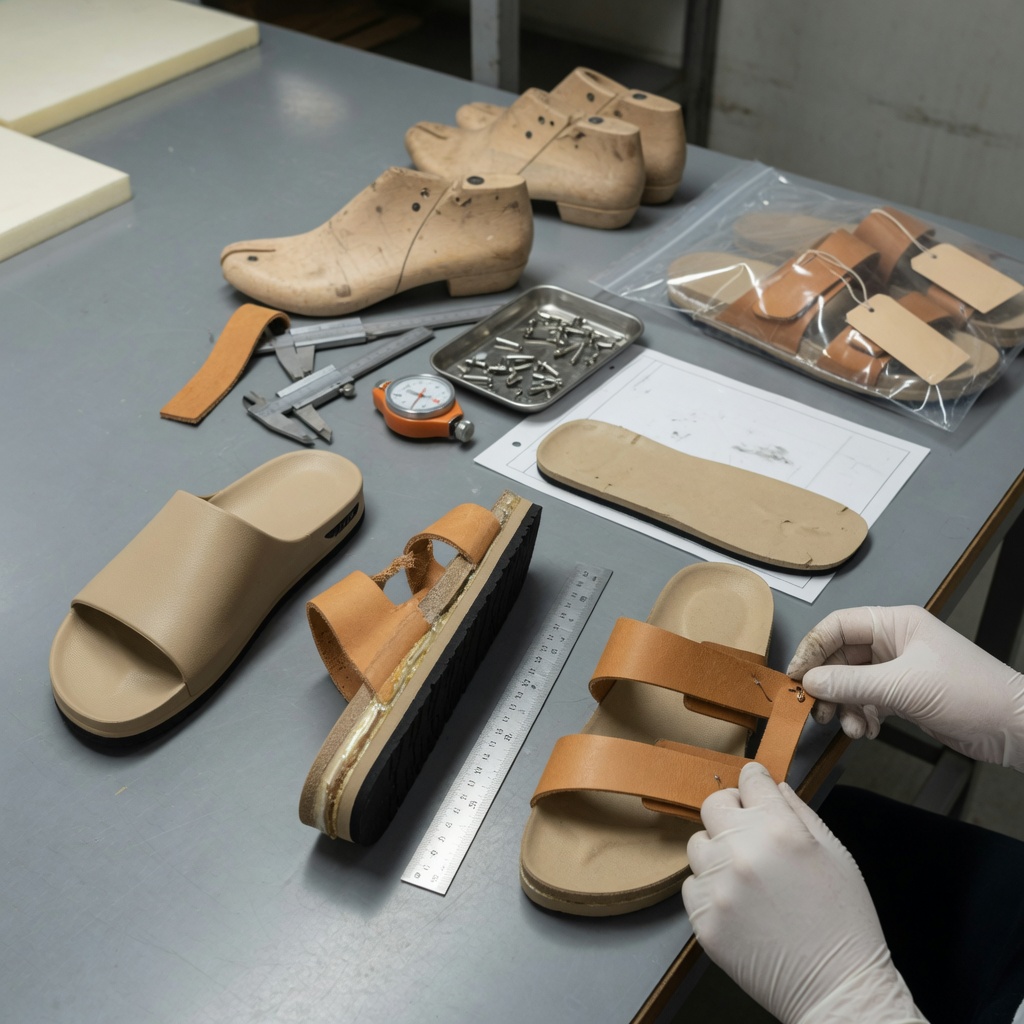
| Prototype fidelity | Wearable sample in production construction, not a hand-glued showroom pair | Construction match to bulk method | Cross-section the midsole–outsole bond on a destruct pair | Hand sample that cannot be repeated on the line | Reject as development evidence |
| Alignment and bonding | Assembly and bonding with alignment checks (Sandals Manufacturers) | Stated jig/fixture use vs freehand | Measure strap offset and heel-seat on an example 5 pairs (verify the pair count in the inspection plan; unit: pairs; scope: one style; as-of: quote date) | Visible left/right drift | Hold golden sample |
| Inspection repeatability | In-process plus final inspection for consistency, then packing to buyer spec (Sandals Manufacturers) | Named hold points, defect list, photo standard | Pilot inspection on PPS | Final-only inspection | Add in-process hold points to the PO |
| Iteration control | Written feedback loop after testing (Herrains) | Number of included revisions | Comment form with close-out dates | Verbal chat comments only | Require a sample comment log as a contract exhibit |
| Bulk start condition | Order review against the approved sample before cutting (Sandals Manufacturers) | PPS required vs skip-to-bulk | Buyer sign-off on PPS | Cutting from the first prototype | No bulk cut ticket without PPS approval |
| Packing as a spec | Carton marks, polybag, silica, size stickers, inner packing (Doing Footwear) | Packing included in development or treated as afterthought | Photo of packed PPS pair | Retail packing invented at ex-factory | Approve packing during PPS, not at the pier |
Material lock, prototyping, and inspection gates
Treat strap-to-footbed stitch or rivet, footbed-to-midsole glue, midsole-to-outsole bond, and hardware bite on webbing as measurement points in the sample comment log. A process description that names material sourcing of leather and other options, then prototyping, production, quality control, and packaging, is useful because it separates sourcing from making (Doing Footwear). Copy that separation into the RFQ. That page’s wording is a process narrative, not a certificate and not a SoleForge production claim.
Specify materials as measurable items:
- Upper: material family, thickness in millimetres, color standard (physical swatch, not a screen hex), edge paint or fold.
- Footbed: foam type, hardness method (ask the supplier which durometer scale they use), cover stock, sock-print method.
- Outsole: compound family (EVA, TPR, rubber, PU), density or hardness, tread depth in millimetres, logo-free mould if required.
- Bonding: adhesive system, open time, press time, and whether heat activation is used. The bulk write-up treats assembly and bonding with alignment checks as a controlled step (Sandals Manufacturers).
- Hardware: metal or plastic; nickel-release or pull-strength only if the buyer writes the method and pass/fail number into the pack. Do not assume a factory is certified to a standard unless a current document is attached to the quote.
Example assumption to verify in the supplier quote: destruct 1 sample pair per approved colorway to inspect the bond line; retain 2 golden-sample pairs (buyer and factory); make a PPS lot of 5–20 pairs per color for fit, alignment, and packing checks. Scope: one style. Units: pairs. As-of: quote date. This is an example, not a lab result.
Inspection should be staged. The bulk process description sequences in-process inspection and final inspection before packing (Sandals Manufacturers). A buyer who only inspects finished cartons will discover strap offset after the foam has already been tooled and cut. Put hold points after upper cutting, after outsole moulding or sourcing, after bonding, and after packing.
If the buyer needs a named test method (peel, strap pull, colorfastness, hydrolysis for PU, compression set for EVA), write the method and the pass/fail number in the tech pack. A cited process page can describe QC without proving ISO registration, SATRA membership, or any mark. Never treat a blog process list as a certificate. Never treat SoleForge editorial text as a factory certificate.
United Arab Emirates fields that change the sandal RFQ file
Keep the product and RFQ decision primary. United Arab Emirates destination details belong in the development file because they change packing, labeling, size breaks, and who may approve a sample—not because this page is a country manual.
The supplied process sources do not publish United Arab Emirates customs schedules, labeling statutes, or duty rates. Do not copy unofficial rates into the PO. Require the supplier to work from buyer-provided destination fields:
- Ship-to party, notify party, and Incoterm as the buyer’s finance team defines them.
- Language and content of hangtags, size labels, and carton marks, supplied as artwork in the tech pack.
- Inner packing that will survive the buyer’s warehouse handling, specified in millimetres and material, not as “export standard.”
- Size assortment as pairs per size, per carton, per colorway.
- Sample routing: who in the United Arab Emirates buying office signs the golden sample, and whether a local fit session is required before PPS.
- Commercial document templates required at ship-release (invoice description, packing list, and carton mark layout), attached as exhibits rather than left to ex-factory improvisation.
Because this article’s sources do not include climate-chamber data, treat heat, UV, and dust as buyer-stated wear and storage conditions to capture in the brief (for example, outdoor garden use versus indoor retail display). Ask the supplier which foam and adhesive system they propose for those conditions, then verify with a test the buyer names. Do not accept “suitable for the United Arab Emirates” as a specification.
Example landed-cost structure to verify with the buyer’s broker and the supplier quote (not a published tariff): unit FOB price per pair + freight per pair + insurance + destination charges + local tax as advised by the buyer’s United Arab Emirates broker. Leave every currency amount blank until the quote and broker file exist. The development decision still comes first: an incomplete golden sample makes any landed-cost model false.
Practical RFQ checklist for sandal product development capability
Every item is something a buyer can specify, compare, verify, approve, or order.
- Specify the style scope. One sandal construction (for example slide, two-strap, or ankle-strap), not a mixed assortment hidden inside one development fee.
- Specify the size set. List each size and the first sample size. State whether grading is included and in which size system the last is graded.
- Attach a tech pack or pay for pack creation as a line item. Require last code, BOM with units, construction, and packing (Herrains). Name the pack file format and the revision ID that freezes sampling.
- Name materials; do not write “or equivalent.” Leather, lining, foam, outsole, adhesive, and hardware each need a named item or swatch ID (Doing Footwear).
- State sample quantities in pairs. Example assumption to verify: 1–3 first prototypes, then 2 revised pairs, then golden samples. Confirm in the quote.
- State sample calendar days from pack acceptance. Example assumption to verify: 10–21 calendar days to first wearable sample for one style/one size/one color, as of quote date.
- Split the Gantt by the five published stages (concept, tech pack, sample, test/feedback, iteration) so “sample lead time” cannot hide a missing pack (Herrains).
- Require a test-and-feedback form. Close each comment with pass, fail, or defer, plus the pack revision that implements it (Herrains).
- Require golden-sample dual retention. One pair sealed at the factory, one pair with the United Arab Emirates buying office, plus a photo set of medial, lateral, top, bottom, and heel.
- Forbid bulk cutting until order review against the approved sample is signed (Sandals Manufacturers).
- Require PPS. Example assumption to verify: 5–20 pairs per colorway, including packed pairs.
- Specify alignment checks. Strap offset, buckle hole position, and heel-seat, measured in millimetres on left and right (Sandals Manufacturers).
- Specify in-process and final inspection. Name hold points after upper, outsole, bonding, and packing.
- Specify packing as a development deliverable, not a shipping afterthought (Doing Footwear).
- State included iteration count. Extra iterations as a priced option, not an argument later.
- State tooling ownership, amortization, and storage. Lasts, cutting dies, and outsole moulds listed with who pays, who keeps CAD/last data, and who may reuse the tool.
- State color and material substitution rules. Any substitute requires a new sample and a new sign-off.
- Price sample fees, couriers, and destruct pairs. State whether sample cost is deductible from the first bulk invoice.
- Attach destination labeling artwork for the United Arab Emirates receiving party, including hangtag language, size stickers, and carton marks.
- Name the approver. Title and email of the person who can freeze the golden sample.
- Ask for the bulk process sheet that operators will use, matching the approved sample, including adhesive open time and alignment-check method.
- Attach RFQ exhibits: pack PDF, BOM spreadsheet, measurement chart, comment log, PPS photos, inspection plan, and packing dieline.
- Order only after the PPS pack photos, measurement chart, and inspection plan are filed with the PO number.
Time, tooling, MOQ, and repeatability trade-offs
Development speed and bulk repeatability pull in opposite directions. A faster sample that is hand-lasted, hand-skived, or adhesively “helped” will not survive the bulk sequence of upper processing, outsole preparation, and bonded assembly (Sandals Manufacturers). Buyers who need a photo for a launch deck should label that sample “presentation only” and keep a separate production-intent prototype.
Tooling is the other trade-off. A new outsole mould can stabilize the bottom and the alignment jigs, but it raises the cost of changing the design after sample three. Example assumption to verify in the supplier quote: amortize mould cost across the first bulk order by dividing tooling cost by pairs in that order; if the first order is too small, either raise the order, reuse an existing mould, or accept a higher pair cost. Do not treat that arithmetic as a market price.
MOQ interacts with color and size. A factory may quote a low pair count that is actually “per last, per color, per outsole cavity.” Split the RFQ so each constraint is visible. Flexible MOQ is listed as a selection factor in one OEM/ODM guide, without a number in the excerpt (Herrains). Therefore any pair count in a sales email is a quote term to verify, not a published industry law.
Example assumption to verify in the supplier quote: 300–1,000 pairs per colorway for a new moulded outsole style, or higher if multiple cavities must be opened; open pair count for a stock-bottom program. Scope: one style. Unit: pairs. As-of: quote date. Label it as an assumption until the factory writes it.
Material lock versus cost is a third trade-off. Sourcing “premium leather and eco-friendly options” is described as part of one factory’s process narrative (Doing Footwear). That is a process claim on that page, not a certificate and not a SoleForge production claim. If the buyer wants a named leather grade or a named recycled content, put the test-report requirement in the pack. If the buyer accepts a substitute to hit a price, schedule a new sample; do not hide the substitute in bulk.
Inspection intensity is a fourth trade-off. In-process plus final inspection costs time and pairs. Final-only inspection is cheaper and late. The bulk process description treats both in-process and final inspection as part of repeatability (Sandals Manufacturers). For a first bulk of a new sandal, pay for the extra hold points.
Evidence, method, and limitations
Author note. This brief is published under the SoleForge Editorial Author byline for Vincent Xi. It does not claim factory visits, years of production experience, lab testing by the author, awards, certifications, or named customer results.
Source contexts.
- OEM/ODM private-label sandal launch guidance describing concept, tech pack, sample production, testing and feedback, and iteration (Herrains).
- Factory-facing description of design and concept development, material sourcing, prototyping, production, quality control, and packaging (Doing Footwear).
- B2B sandal manufacturing sequence from material checking and approved-sample review through upper and outsole work, bonded assembly with alignment checks, in-process and final inspection, and packing (Sandals Manufacturers).
How the data was derived. Stage counts (five prototyping stages; six named factory phases; seven bulk steps when listed operations are counted separately) are taken from those published lists. Pair counts, calendar days, millimetre tolerances, and MOQ figures in this article are example calculations or quote assumptions for United Arab Emirates buyers to verify in a supplier quote. They are not measurements from a named factory run. No keyword-demand evidence is used.
What to verify. The source pages are public marketing or process articles; excerpts used here are undated in the research file and may change. They do not include current certificates, lab reports, capacity, or United Arab Emirates import documents. Confirm tech pack revision control, sample lead time, iteration allowances, tooling ownership, inspection plan, packing artwork, and destination compliance with the supplier and the buyer’s own customs broker before approving a golden sample or releasing a bulk PO. If a capability is not in the quote and the retained sample file, treat it as absent.
Discuss Your Requirements
Review our manufacturing capabilities, then share your specifications for a supplier-fit review.