Shoe OEM Production Scalability Planning for European Brands
By Vincent Xi, Editorial Author https://www.soleforgefootwear.com/authors/vincent-xi/
European procurement teams should treat shoe OEM production scalability planning as a manufacturing RFQ constraint map, not as a volume forecast. Unconstrained MRP or a spreadsheet of seasonal pairs will not survive a style family that Kearney’s footwear and apparel planning analysis puts above 400 SKUs when one style is offered across genders, 12–15 sizes, and 7 colorways (unit: SKUs; scope: one style family as described by Kearney; as-of: the cited Kearney article, publication date not given in the excerpt used here; source: Kearney). The same analysis cites manufacturer minimum order quantities in the thousands of pairs (unit: pairs; scope: contract-manufacturer MOQs as stated by Kearney; as-of: the same Kearney article; source: Kearney) and 12–16 week leads that must include throughput times, not only an ex-factory date (unit: weeks; scope: typical contract-manufacturer leads as stated by Kearney; as-of: the same Kearney article; source: Kearney). Award the programme only when the OEM also documents last-and-cutting maps, written batching rules, and a named multi-factory reallocation test for peak mix.
Those figures are industry illustrations, not a factory audit. Re-validate them against each supplier quote, the current tooling list, and the buyer’s SKU file. Retail size runs are not identical across destinations even inside Europe: an EU-size run, a UK-size run, and any EEA-specific labelling or documentation pack can sit on the same last family while still creating separate packing streams. The Kearney, cpa.ShoeFactory, and o9 excerpts do not define EU, EEA, UK, or country-specific chemical, labelling, or origin rules; attach those packs separately and ask whether they share capacity buckets.
This page restates cited planning methods for RFQ use. It does not report factory visits, client names, tests, certifications, or first-person production experience.
SKU explosion: how 12–15 sizes and colorways push one style past 400 units
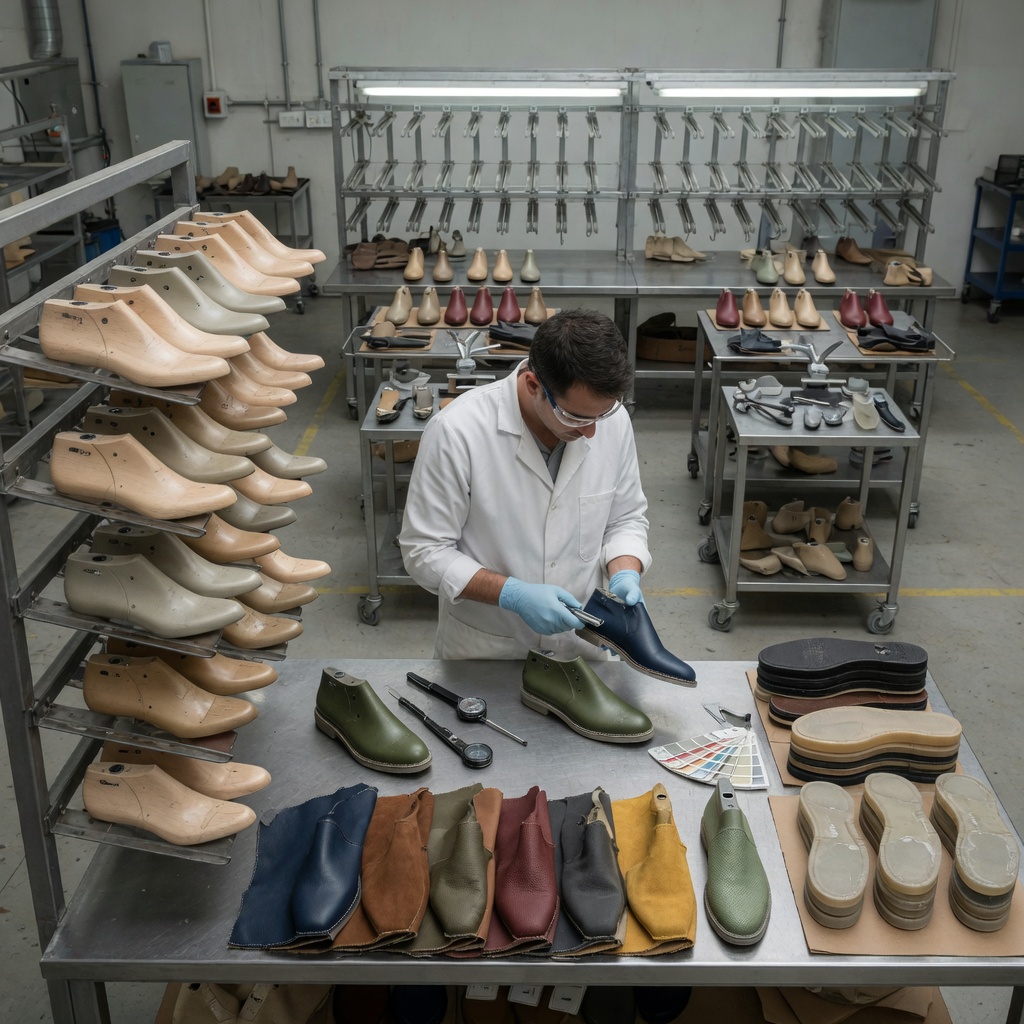
SKU count is not linear with style count. Kearney’s analysis of footwear and apparel planning states that one style across genders, 12–15 sizes, and 7 colorways exceeds 400 SKUs (unit: SKUs; scope: one style family as described in that article; as-of: the cited Kearney article, publication date not given in the excerpt used here; source: Kearney). Add width fittings or a second seasonal colour drop and the planning object is no longer a style; it is a matrix of lasts, cutting patterns, and packing configurations. Production is further concentrated by specialised tooling, so that family cannot be freely loaded onto every available line.
For a European buyer the operational risk is destination mix. An EU-size run, a UK-size run, and any EEA documentation pack may share a last family while still creating separate packing and labelling streams. Kearney’s SKU arithmetic describes SKU and tooling physics; it does not itself distinguish EU, EEA, and UK rules. Attach the destination-market size and labelling matrix to the RFQ and require the OEM to state whether those streams share tooling or need separate capacity buckets. Ignoring the 400-plus SKU threshold (same unit, style-family scope, as-of context, and Kearney source as above) typically shows up as inflated MOQs, with colorways batched together, or as chronic shortages on long-tail sizes.
Trade-off: richer size and colour coverage raises forecast error on the tails and increases changeover minutes. The counter-measure is a contract rule on which SKUs share a last family, which colorways can nest in one cutting lay, and which sizes the OEM may postpone or drop when a bottleneck appears.
Production scalability planning for seasonal peaks in European shoe manufacturing
cpa.ShoeFactory, a production-planning system described for shoe manufacturers, covers requirements from forecasts, customer orders, and warehouse orders while taking throughput times into account. It supports capacity and bottleneck planning for seasonal fluctuations, planning in pairs or in working minutes, global multi-site production, and spontaneous rescheduling of orders between facilities during busy seasons with automated adjustments (scope: methods as described on the cited cpa.ShoeFactory page; as-of: that page, publication date not given in the excerpt used here; source: cpa.ShoeFactory).
European drop calendars often concentrate volume into few shipping windows. Put the buyer’s actual calendar—not a generic “peak”—into the quote. A factory planned only in weekly pairs, without a working-minutes view, can look full on paper while a lasting or stitching work-centre overflows. A minutes-based bottleneck plan can show whether mix can move if two colorways share a last and one order is pulled forward. Example assumption to verify in the supplier quote, not a cited factory result: whether a 20 percent volume spike (unit: pairs; scope: one buyer-defined peak week on the European drop calendar) is absorbable under those rules.
The RFQ decision is to demand the planning unit (pairs versus working minutes), the frozen horizon in working days, and the rules for moving an order to another site when a bottleneck is detected.
Trade-off: a short frozen horizon and easier inter-factory moves can protect on-time delivery in peak months but raise quality variation and extra first-article cost. A long freeze protects efficiency and consistency but can leave the European retailer with air freight or lost sales if a colorway oversells. Price and test both extremes in a scenario the OEM actually runs.
Constraint-aware multi-factory shifts versus specialized tooling
Kearney notes that constraint-aware planning and scenario tests enable reallocating volumes and shifting work between factories. That capability exists only if the second factory already has, or can quickly receive, the last set, cutting dies, and approved component sources for that construction. Specialised tooling is why many OEMs quote 12–16 week leads (unit: weeks; scope: typical contract-manufacturer leads as stated by Kearney, not a named-factory audit; as-of: the cited Kearney article, publication date not given in the excerpt used here; source: Kearney) even when sewing minutes appear open: the constraint is a specific last and a qualified outsole mould, not generic labour.
Buyers who split volume for dual-source resilience should ask two questions the sources make unavoidable. First, which SKUs share tooling so a shift is a true capacity move rather than a new development. Second, what is the documented time and cost to duplicate a last family at a second site, including first-article gates. A “multi-site” claim that cannot name shared last codes is not production scalability planning.
Trade-off: one highly tooled site maximises utilisation and repeatability but creates a single peak-season bottleneck. Spreading volume without duplicated tooling creates phantom capacity. Measurable test (example assumption to verify in the supplier quote, not historical output): “Move 8,000 pairs (unit: pairs) of style family X from Factory A to Factory B in week 14 of the buyer’s European calendar; list the tooling that must travel, the first-article samples required, and the resulting change to the original 12–16 week lead (unit: weeks; same Kearney lead-time scope, as-of context, and source as above).”
Capacity utilisation, inventory, and agility in contract manufacturing
A published footwear case study from o9 Solutions describes a large producer unifying top-down financial goals with bottom-up sales, using a digital twin of the supply chain. Reported benefits include increased inventory turns, reduced lost sales from stock-outs, more efficient capacity utilisation, and faster delivery of more personalised products (scope: qualitative outcomes as described in that case excerpt; as-of: the cited o9 page, publication date not given in the excerpt used here; source: o9 Solutions). The excerpt does not publish audited percentages.
For the OEM RFQ this translates into three artefacts. (1) A finite-capacity view that shows utilisation by work-centre (lasting, stitching, sole attach), not only by factory headcount. (2) An inventory policy that states which SKUs are make-to-order versus make-to-stock at pair level, because a 400-plus SKU family (unit: SKUs; scope: one style family as described by Kearney; as-of: the cited Kearney article, publication date not given in the excerpt used here; source: Kearney) cannot all be held. (3) A rescheduling protocol that matches the cpa description: which orders can move between sites when a seasonal bottleneck is detected, and who approves the quality implication.
Trade-off: higher utilisation usually means less slack for mix changes; reserved peak capacity raises the pair cost paid in quiet months. A digital-twin or APS run is useful only if the OEM will process the buyer’s actual SKU file and European seasonal calendar during quoting. A generic “advanced planning” statement does not substitute for that test.
Risk controls to score before a European shoe OEM award
Score risk before award. Each control below is a quote artefact, not a claim about any named factory.
- Delivery-path risk: a 12–16 week ex-factory date (unit: weeks; scope: typical contract-manufacturer leads as stated by Kearney; as-of: the cited Kearney article, publication date not given in the excerpt used here; source: Kearney) with no cutting-to-pack throughput stages hides where a European drop will slip (method basis: cpa throughput-time planning).
- Mix risk: a 400-plus SKU family (unit: SKUs; scope: one style family as described by Kearney; as-of: the cited Kearney article, publication date not given in the excerpt used here; source: Kearney) without last-sharing and nested-cutting rules produces inflated MOQs and missing tail sizes.
- Bottleneck risk: a pairs-only factory load can look open while lasting, stitching, or sole-attach minutes overflow (source basis: cpa planning in pairs or working minutes).
- Dual-source risk: a second factory without duplicated lasts, cutting dies, and approved components is phantom capacity (source basis: Kearney constraint-aware reallocation; specialised tooling).
- Quality-shift risk: spontaneous multi-site moves without a first-article gate trade on-time delivery for construction drift (source basis: cpa multi-site rescheduling method; buyer-defined sample quantity in pairs).
- Inventory risk: make-to-stock across the full SKU matrix creates leftover seasonal pairs; make-to-order on high-velocity colorways creates stock-outs (source basis: o9 qualitative inventory-turns and lost-sales outcomes, no audited percentages).
- Destination-pack risk: EU-size, UK-size, and any EEA or country-specific documentation streams can consume extra packing capacity even when they share a last family. The cited planning articles do not define those rules; the OEM must answer a yes/no on shared capacity buckets.
Do not treat a UK pack as an EU pack, an EEA pack as automatically identical to an EU pack, or one EU destination’s labelling file as valid for every other EU destination. Price the extra planning object before the first seasonal peak.
Decision table: OEM artefacts for scalable shoe production
Score suppliers on the same artefacts. Every row is a specification, comparison, verification, or approval item.
| Decision factor | What to specify in the RFQ | How to verify before award | Trade-off if ignored | Illustration from cited sources |
|---|---|---|---|---|
| SKU / last-family handling | Full size × colour × gender matrix; which SKUs share lasts and cutting lays | OEM returns a last-code mapping and a nested-cutting example for one style family | Inflated MOQs or chronic tail-size shortages | One style, 12–15 sizes, 7 colorways exceeds 400 SKUs (Kearney) |
| MOQ and batching rules | MOQ per colorway vs per last family; allowed combining of sizes | Written exception process and historical examples of sub-MOQ colorways | Forced overbuy of slow sizes or missed colour drops | Kearney cites manufacturer MOQs in the thousands of pairs (Kearney) |
| Lead time and freeze | Standard 12–16 week path; frozen horizon in working days; expedite path and cost | Calendar that shows throughput times from cutting to pack, not only “ex-factory” | Seasonal air freight or cancelled drops | 12–16 week leads typical; planning must include throughput times (Kearney; cpa.ShoeFactory) |
| Planning unit | Pairs and working minutes at each bottleneck work-centre | Export of a seasonal bottleneck plan for the buyer’s European calendar | Factory looks full while a single lasting line is the real constraint | Planning in pairs or working minutes; bottleneck planning for seasonal fluctuations (cpa.ShoeFactory) |
| Multi-site shift | Named second factory, shared last codes, first-article protocol, extra days | Live scenario: move a defined pair quantity in a named peak week | Phantom dual-source; quality drift | Constraint-aware tests enable reallocating volumes between factories; multi-site rescheduling with automated adjustments (Kearney; cpa.ShoeFactory) |
| Inventory vs lost-sales policy | Which SKUs are MTO vs MTS; target turns; who owns excess | APS or digital-twin run on the buyer’s forecast file | Excess seasonal stock or stock-outs on high-velocity colorways | Unifying demand and supply planning linked to capacity utilisation, inventory turns, and fewer stock-outs (o9 footwear case) |
| Destination-market streams (EU / EEA / UK) | Whether EU-size, UK-size, and any EEA or country-specific documentation share capacity buckets | OEM yes/no on shared last family vs separate planning objects | Hidden extra SKUs and delayed UK, EU, or EEA packs | Planning sources cited here do not define customs or labelling rules; buyer must attach the pack and require a yes/no on shared capacity |
Score each cell as documented, partially documented, or not evidenced. Do not award “scalable” on a factory tour alone.
RFQ checklist for production scalability requirements
Every item is something the buyer should attach, require, compare, or use as an approval gate. Omit an item only if the programme is a single-factory, single-season, low-SKU test that will never be repeated.
- Attach the complete SKU file: style, gender, EU size run, UK size run if used, colorways, and last code. Ask the OEM to mark which codes share tooling.
- State the planning unit required: weekly pairs and working minutes at lasting, stitching, and sole-attach. Reject a quote that only shows factory-level headcount.
- Quote MOQ both per colorway and per last family, plus the written rule for combining leftover sizes. Record the unit (pairs) and the season to which it applies.
- Require a standard lead-time calendar of 12–16 weeks (unit: weeks; scope: typical contract-manufacturer leads as stated by Kearney; as-of: the cited Kearney article, publication date not given in the excerpt used here; source: Kearney) broken into throughput stages, plus the frozen horizon in working days and the priced expedite path.
- Name every factory that may run the programme. For each, list last sets already on site versus lasts that must be duplicated, with first-article sample quantity (pairs) and days.
- Demand one seasonal bottleneck scenario using the buyer’s European drop calendar (not a generic peak). The OEM must show which orders would move, to which site, and what quality gate applies.
- Specify whether planning may reschedule between sites during busy weeks, who is notified, and how component allocations are adjusted.
- Define inventory ownership: which SKUs may be built to stock, maximum weeks of cover, and who pays for leftover seasonal pairs if the forecast is cut.
- Require a finite-capacity utilisation report by work-centre for the quoted volume, not a single factory utilisation percentage.
- Attach destination compliance as a separate pack (labelling, chemical, origin documentation for EU, EEA, UK, and any country-specific file as applicable). Do not treat UK rules as EU rules, EEA documentation as automatically identical to EU packs, or one country’s file as valid for every European destination. Ask a binary question: do these streams consume the same capacity buckets as the production plan? The planning articles cited here do not answer that question; the OEM must.
- Ask for the system of record (APS, MES, or equivalent) and whether a digital-twin or scenario run on the buyer’s file is included in the quoting fee.
- Set approval gates: pre-production samples after any factory shift; construction checks on the moved style family; written sign-off before the first seasonal peak shipment.
- State the data the OEM must return with the quote: last-code mapping, nested-cutting example, bottleneck plan extract, and the pair quantity used in the multi-site move test. Treat missing artefacts as a no-bid on scalability.
- Record assumptions the buyer will verify in the supplier quote (example calculation only): if one style × 13 sizes × 7 colorways = 91 SKUs before gender split, confirm the OEM’s actual count and whether it matches the Kearney-style 400-plus illustration once genders and drops are added (unit: SKUs; scope: one style family as described by Kearney; as-of: the cited Kearney article, publication date not given in the excerpt used here; source: Kearney).
Source context, methodology, and what still must be verified
Source context 1: Kearney’s article on why footwear and apparel planning breaks when sizes, styles, and seasons multiply. It supplies the SKU arithmetic (one style, 12–15 sizes, 7 colorways, more than 400 SKUs), typical manufacturer MOQs in the thousands of pairs, 12–16 week leads, concentration around specialised tooling, and the role of constraint-aware scenario tests in reallocating volume between factories.
Source context 2: cpa.ShoeFactory’s description of production planning and control for shoe manufacturers. It supplies the methods: requirements from forecasts, customer and warehouse orders, throughput times, seasonal bottleneck planning, planning in pairs or working minutes, global multi-site production, and spontaneous rescheduling between facilities with automated adjustments.
Source context 3: o9 Solutions’ case study of demand and supply planning at a large footwear company. It supplies the architectural pattern—unifying financial and sales plans, a digital twin, and qualitative outcomes of higher inventory turns, fewer stock-outs, better capacity utilisation, and faster personalised delivery—without audited numeric deltas in the excerpt used here.
Methodology: the data points and methods above are taken only from the three cited public articles and restated with their original units (SKUs per style family, pairs, weeks, working minutes). No factory was audited for this page, no SoleForge production figures are used, and no search-demand or ranking metrics are claimed. Where an example SKU multiplication or pair-move quantity is shown, it is labelled as an assumption to verify in the supplier quote.
Limitations and what to verify: the excerpts do not state article publication dates or sample sizes, so treat 400 SKUs, thousand-pair MOQs, and 12–16 week leads as typical illustrations, not dated certified factory data. They do not define EU, EEA, UK, or country-specific chemical, labelling, or origin rules; those remain the buyer’s pack and the OEM’s written confirmation, and one destination’s pack must not be assumed to apply across all of Europe. They do not name SoleForge capabilities, prices, certifications, or customers. Before award, replace every illustration with the OEM’s last list, current utilisation by work-centre, and a scenario run on the actual European seasonal calendar.
Author: Vincent Xi, Editorial Author. Profile: https://www.soleforgefootwear.com/authors/vincent-xi/
Discuss Your Requirements
Review our manufacturing capabilities, then share your specifications for a supplier-fit review.