Shoe Sourcing Product Development Capability for United States Procurement
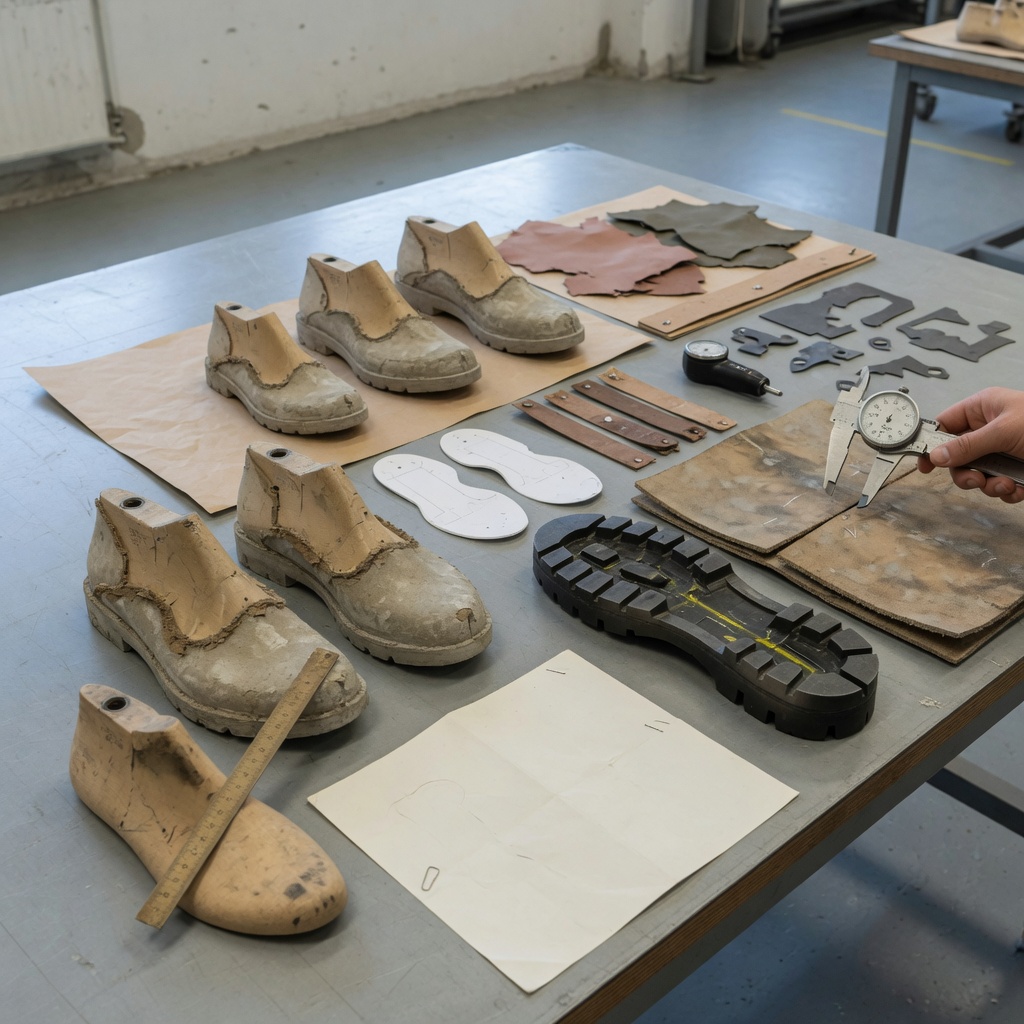
When United States B2B buyers source a shoe, FOB unit price is the wrong first filter. Do not award until shoe sourcing product development capability is evidenced as a gated specification: last or mold geometry, construction method, tech pack, size grading, written sample approvals, tooling ownership, and a named producing site. Capability is the supplier’s ability to convert a brief into controlled production information before bulk materials are purchased and production tooling is locked. A lower FOB that cannot hold last fit, outsole bond, or size-set consistency can create delay, relabel, or chargeback risk after goods are already moving toward a United States DC.
This page is a procurement brief for United States buyers, not a catalog. It shows how to specify, compare, and verify product development capability on a shoe RFQ, including published OEM/ODM calendar ranges, five written sample-approval gates, and the labeling, classification, landed-cost, and delivery controls that belong in the file before award. Editorial byline: Vincent Xi, Editorial Author (author profile). Attribution is limited to that Editorial Author profile. This article does not claim factory visits, laboratory tests, named customers, or first-person wear trials, and it does not use those as evidence.
Hold unit price until these objects exist. Freeze construction and last; freeze the tech pack owner and file format; freeze the five written confirmation points as spend hold points; freeze the producing factory plus last and outsole shops; freeze tooling NRE and ownership; then compare unit cost and landed cost. If any of those objects is still “as sample,” you are not yet scoring the same shoe.
Minimum evidence pack before you compare FOB
Place these artifacts in the RFQ file before scoring quotes:
- Named construction (cement, PU injection, waterproof, or other) and a ban on silent substitution.
- Last proposal: existing / modified / custom; last code; last maker; exclusivity; owner and storage location.
- Tech pack owner, measurement system (US sizes versus last millimetres), and a PPS freeze rule, including CAD delivery to the buyer.
- Material and color standards with units and test methods, not photos alone.
- Sample path: which proto type is allowed at each gate; size-set; pre-production sample (PPS) with United States labels and packing.
- Tooling plan: who pays, who owns molds and lasts, where they are stored, and transfer rights if the style moves.
- Named producing factory plus last, mold, and outsole subcontractors.
- Dated Gantt from brief to ex-factory, including United States transit and DC appointment buffers.
If the supplier cannot name the last source, the mold shop, the material mill, and the person who signs each approval, the quote prices an undefined shoe.
What product development capability means in shoe sourcing
Manufacturer-selection guidance for footwear states that buyers should check development capability before comparing prices, because an OEM or ODM factory must translate product ideas into controlled production information such as tech packs, last proposals, and mold plans (how to find a shoe manufacturer). That translation is the capability being purchased. The statement is from that published page; it is not a factory audit and not a SoleForge performance result.
Ask the supplier to map, in writing, who owns construction choice; last or mold proposal; tech-pack creation (bill of materials, stitch specs, last code, outsole code, packing); material sourcing versus buyer-nominated materials; the sample path from 3D or form prototype to wear-testable proto, size-set, and PPS; tooling ownership; and quality-control gates tied to written approvals, not only a final AQL on bulk.
Lock construction before you score anything else. A published sourcing-and-development overview lists cementing, PU injection, and waterproof builds as distinct constructions with distinct factory and supplier networks, and it treats last makers, material suppliers, and outsole factories as separate nodes that must be selected, not assumed (sourcing and development). A factory that can cement a fashion sneaker is not automatically qualified for PU injection or a sealed waterproof boot. Score evidence on the named construction, not a generic “full development” claim.
Name the operating model in the RFQ. One published sourcing overview treats factories, last makers, material suppliers, and outsole factories as a network used with tech packs, testing specs, and full-size run trials. An OEM/ODM factory process page describes stages inside a manufacturing path from brief to mass production (OEM/ODM shoe development process). Neither page certifies any other company. Freeze the producing site, last shop, and outsole shop in the PO before award. Site changes after PPS are a new development program.
Process windows, last development, and measurable sample trade-offs
Published OEM/ODM process literature describes shoe development as a multi-month path with several long-lead objects. One OEM/ODM process overview states a 4–9 month span from concept to mass production (unit: calendar months; scope: the OEM/ODM shoe development path as written on that page; as-of: the range as published on the cited page, not a dated factory commitment; reconfirm in the supplier quote) (OEM/ODM shoe development process).
The same overview publishes these stage windows (same unit, scope, and as-of rule: published ranges on that page, not an audited factory calendar):
- Custom last selection or development: 8–12 weeks (calendar weeks; custom last as written on that page; verify as a dated quote line).
- Proto sample iterations: 2–3 weeks per cycle (calendar weeks per iteration; proto cycles as written on that page; verify in the quote).
- Component tooling: 6–12 weeks (calendar weeks; component tooling as written on that page; verify).
- Production tooling: 4–10 weeks (calendar weeks; production tooling as written on that page; verify).
- Example leather thickness on that page: 1.2–1.6 mm (millimetres; leather-sourcing example, not a universal spec; verify in the material standard and incoming QC).
Those figures are planning ranges for RFQ design, not measurements taken for this article.
An 8–12 week custom last can protect fit and reduce later size-set failure, but it consumes a large share of a 4–9 month program. An existing last can compress calendar and tooling cash, at the cost of inheriting that last’s toe spring, heel pitch, girth, and last-maker IP terms. Require the last code, last maker, exclusivity, ownership, and storage location in the purchase agreement.
A 2–3 week proto cycle is only as valuable as the approval criteria attached to it. A 3D-printed form prototype can check volume and style quickly; the sourcing overview cited above includes 3D printing prototypes among development tools (sourcing and development). It is not a substitute for a cemented or injected sample built on the production last with production-intent materials. If United States wear testing, retailer line review, or a photo sample sits on the critical path, name which sample type is allowed at each gate.
Example calculation, labeled as an assumption to verify in the supplier quote: two extra proto cycles at the published 2–3 weeks per cycle add 4–6 weeks before shipping and reviewer lag. That window can push a program out of a United States in-season receipt even when bulk production lead time looks acceptable. Cap proto rounds, set a stop-clock for buyer comments, and state what happens if last, outsole, or material changes after first-sample approval.
Component tooling at 6–12 weeks and production tooling at 4–10 weeks are often the real constraint, not cutting and stitching. Low-volume sampling or a trial order is feasible only if the RFQ says who pays for molds, what happens if the style is cancelled, and whether trial pairs may use surrogate outsoles. Do not assume a trial MOQ can ship on production tooling that does not yet exist. The 1.2–1.6 mm leather example is a reminder that material must be a number, a method, and a location on the shoe. Specify thickness, test method, and whether the measurement is at the vamp, quarter, or insole board.
Written approval gates before you compare price
The manufacturer-selection guidance describes development as proceeding through five written confirmation points: material and color approval, last or mold approval, first-sample approval, size-set approval, and pre-production sample approval (unit: count of confirmation points as listed on that page; scope: the manufacturer-selection process described there; as-of: the list as published on that page) (how to find a shoe manufacturer). Write those five points into the RFQ as contractual hold points, not as a factory’s internal checklist and not as a certification.
For each gate, the RFQ should state the artifact (swatch card, last scan or last sample, proto, size-set, PPS); who signs (buyer product, buyer quality, and, if needed, the United States retailer or licensor); what “approved” means (measurements, photos, and any lab tests); whether the gate is a hold point for tooling spend and fabric/leather cutting; and how deviations are written (waivers expire; they do not silently become the new standard).
Size-set approval is a high-risk gate for United States programs: a first sample in a sample size does not prove grading. Require a size-set that matches the selling curve, a measurement chart against the last, and a rule for half-sizes if they are sold. The sourcing overview includes full-size run trials as a distinct commercialization step after development (sourcing and development). Skipping that step bets bulk on a single-size proto.
Staged quality control belongs next to those gates. The OEM/ODM process overview describes staged quality control as part of the path into mass production (OEM/ODM shoe development process). That is a process claim on that page, not a certification. Distinguish it from any named standard the buyer may require (for example a buyer-specified AQL on bulk, a restricted-substance list, or a children’s product rule). A factory’s internal QC practice is not a current certificate. A website process article is not proof of ISO registration, laboratory accreditation, or a completed factory audit.
United States specification, labeling, landed cost, and delivery controls
Keep the product and RFQ decision primary. The United States is the sales market this brief is written for; origin of manufacture is a classification and marking input, not a second sales territory.
Classification and importer-of-record control. United States footwear classification for entry is fact-specific to the finished shoe. Require the supplier to propose an HTS subheading and a construction description that matches the tech pack, and require a licensed customs broker to confirm it. Do not accept a duty rate in a sales deck as a landed-cost fact. Any duty, merchandise processing fee, or freight figure used in an internal model is an example calculation until the broker and the quote lock numbers, units, and Incoterms.
Country-of-origin marking and fiber/leather claims. United States origin marking and advertising claims are legal controls, not hangtag decoration. Specify where the origin mark will appear and whether it is on the shoe, the box, or both. Leather, split, or coated callouts on the shoe and in digital copy must match the approved material standard. If selling into California, treat Proposition 65 as a separate warning and formulation control. Verify current CBP, FTC, and (where applicable) state-warning texts with counsel and the broker; this page is not a legal opinion.
Children’s versus adult programs. If any SKU is children’s footwear, add CPSC-related questions (age grade, small parts, surface coatings, tracking labels) as development inputs. If the line is adult-only, say so in the RFQ so last and hardware from a children’s run are not mixed. A process article is not proof of a current children’s-product certificate.
Labeling, barcodes, and packing. United States DC receiving risk includes wrong carton marks, missing UPC/EAN, mixed sizes, or polybags that do not match the routing guide. Attach the routing guide and packing standard to the PPS gate. PPS should include the production-intent insole stamp, size label, origin mark, and carton.
Landed cost beyond FOB. Ask for a cost breakdown that separates last/mold amortization, upper materials, outsole, labor, packing, and rejected-pair assumptions. Build landed cost with named Incoterms (FOB or FCA and port, as terms to specify—not as a default), freight, insurance, duty, broker, drayage, and failed-PPS cost. Start the inventory plan from first-sample date against the 4–9 month published path, not from an optimistic ex-factory date on the PO.
Delivery is a gate calendar, not a single lead time. Require a dated Gantt covering last approval, material approval, proto, size-set, PPS, tooling completion, bulk material in-house, and ex-factory, aligned with United States ISF (where ocean cargo applies), carrier cutoff, and DC appointment constraints. Decide at RFQ whether PPS and first bulk may move by air and who pays. Treat low-volume sampling as a capability test: proto and PPS below bulk MOQ, sample charges, and whether sample materials may differ. If trial pairs will be sold in the United States, they must meet the same labeling and substance rules as bulk.
Buyer decision table: specify, compare, verify, approve, order
Score competing shoe suppliers on RFQ objects, not on unevidenced “creativity.” Hold the award if construction, last ownership, the five written gates, tooling NRE, or producing site are still undefined.
| Capability object | Specify in the RFQ | Evidence to request | How to compare offers | United States procurement risk if weak |
|---|---|---|---|---|
| Construction | Cement, PU injection, waterproof, or other, with bonding method | Process photos of this construction, not a mixed lookbook | Same construction only | Bond failure, returns, chargebacks |
| Last / mold | Sample size, last code, heel pitch, exclusivity, owner | Last card or scan; mold drawing; ownership clause | Custom 8–12 week path vs existing last (verify in quote) | Fit complaints across the size run |
| Tech pack | US size run, BOM, stitch, last, outsole, packing | Editable pack plus PDF freeze at PPS | Completeness; CAD delivered | Factory “as sample” drift in bulk |
| Materials | Thickness, test method, color standard, substitutes | Swatches with lot IDs; numbered thickness (1.2–1.6 mm leather is only an example to verify) | Nominated mill vs factory source | Relabel, origin, or leather-claim issues |
| Proto path | Rounds; 3D allowed or not; 2–3 week cycle as a planning assumption to verify | Dated proto photos, measurement reports | Cycle time × rounds vs ship window | Missed United States in-season receipt |
| Size-set | Sizes, including half-sizes if sold | Graded set and measurement chart | Full-size trial vs sample-size only | Unsellable end sizes at the DC |
| PPS | Production materials, labels, packing, origin mark | Signed PPS with photo set | PPS matches routing guide | Refused DC receipt, relabel labor |
| Tooling | Who pays; 6–12 week component and 4–10 week production windows as published ranges to verify | Tooling invoice, mold IDs, storage site | Unit-cost amortization vs separate NRE | Cannot move the style; stranded molds |
| Testing | Methods by construction; lab name | Test reports on approved materials | Internal lab vs third-party | Retailer testing failure after ship |
| Trial / MOQ | Proto qty, PPS qty, trial PO qty, bulk MOQ | Written MOQ ladder | True trial vs hidden bulk commit | Overstock in the United States |
| Calendar | Concept-to-bulk against a 4–9 month published span to verify | Gantt with buyer hold points | Critical path including US transit | Air freight or missed door |
| Site control | Producing factory, last shop, outsole shop | Audit window, subcontract disclosure | Direct vs multi-tier | Silent subcontracting after award |
RFQ checklist for shoe procurement (product development capability)
Every item below should appear in the RFQ or the award packet. If an item is not applicable, write “N/A” and why—do not leave a blank.
- State the selling market as the United States, the US size system, and the size run including half-sizes if ordered.
- Name the construction and forbid silent substitution (cement vs PU injection vs waterproof or other).
- Attach a brief: use, gender/age grade, target retail channel, and adult or children’s grade.
- Require a last proposal: existing / modified / custom; last maker; last code; exclusivity; dated weeks against the published 8–12 week custom-last planning range (OEM/ODM shoe development process).
- Require a tech pack owner, file format, and a freeze rule at PPS; CAD and last data delivered to the buyer on approval.
- Require material standards with units (mm thickness, hardness, mass per area), test methods, and approved substitutes.
- Require color approval against a named physical swatch and light source, not a screen PDF.
- Require the five written confirmation points—material and color, last or mold, first sample, size-set, PPS—as hold points for tooling and bulk cutting (how to find a shoe manufacturer).
- State whether 3D prototypes are accepted for form only, and that wear-test and photo samples must be production-intent construction (sourcing and development).
- Cap proto rounds and set a buyer comment clock; plan using the published 2–3 week iteration window, then replace it with the supplier’s dated cycle time.
- Require a size-set and, where risk justifies it, a full-size run trial before bulk (sourcing and development).
- Separate sample charges, trial MOQ, and bulk MOQ; if trial pairs will be sold in the United States, full labeling applies.
- State tooling NRE, ownership, location, maintenance, and transfer rights; treat 6–12 week component tooling and 4–10 week production tooling as planning ranges to verify.
- Name the producing factory and all last, mold, and outsole subcontractors; ban site changes after PPS without a new PPS.
- Attach United States marking, origin, barcode, and carton standards; PPS must include production-intent labels.
- Require an HTS suggestion and construction narrative for broker review. Treat any duty or fee in an internal spreadsheet as an example calculation until the broker locks units.
- Require a restricted-substance and (if applicable) Proposition 65 and children’s-product questionnaire on the actual BOM.
- Require a Gantt from brief to ex-factory, including US transit and DC appointment buffers; treat 4–9 months concept-to-mass as a published planning span to verify.
- Require QC hold points at incoming materials, in-line, and PPS, with the AQL and defect list for bulk. A stated QC stage is not a certificate.
- Require photo, measurement, and waiver rules so “commercially acceptable” cannot overwrite a failed last or bond test.
- Name Incoterms, port, and cost lines outside FOB (freight, insurance, duty, broker, drayage); treat any internal landed-cost spreadsheet as an assumption until the quote and broker lock units.
Do not award on a unit price that omits items 4, 8, 12, 13, and 14. Those five control whether the price is for the specified shoe or for an undefined sample.
Methodology, source context, and what to verify before award
Source contexts. Process-stage windows and the leather-thickness example are taken from a published OEM/ODM shoe development process page (OEM/ODM shoe development process). The instruction to check development capability before price, and the five written confirmation points, are taken from published manufacturer-selection guidance (how to find a shoe manufacturer). Construction types, 3D prototypes, tech packs and testing specs, vendor-network language, and full-size run trials are taken from a published sourcing-and-development page (sourcing and development). Those pages describe the publishers’ stated processes and services. They are not audits of any other factory, and they are not SoleForge performance data.
Methodology. Numbers in this article are transcribed from those pages with unit, scope, and as-of rules stated at first use. Concrete data points used for RFQ design are the 4–9 month concept-to-mass span; 8–12 week custom last; 2–3 week proto cycle; 6–12 week component tooling; 4–10 week production tooling; 1.2–1.6 mm leather as an example thickness; and five written confirmation points. The 4–6 week impact of two extra proto cycles is an example calculation (2 cycles × 2–3 weeks/cycle) to verify on the supplier’s dated Gantt. They were not measured on a production line for this article. Research-source evidence supports the editorial process claims above only. It is not keyword-demand evidence, and no search-volume, CPC, difficulty, traffic, or ranking metric is stated or implied.
Limitations / what to verify. Lead times move with last type, outsole tooling, tannery queues, and buyer changeovers; replace every published range with a dated supplier Gantt before PO. The 1.2–1.6 mm leather figure is an example from one process article, not a default spec. United States duty, marking, and children’s-product rules depend on the finished shoe and origin; verify with current CBP, FTC, and CPSC texts and a licensed broker. A supplier’s stated QC stages are not a certification; request current certificates as documents with scope and expiry. Confirm producing site, last ownership, and whether trial pairs may be sold. Until those items are in the quote, treat any internal landed-cost spreadsheet as an assumption to verify.
Discuss Your Requirements
Review our manufacturing capabilities, then share your specifications for a supplier-fit review.