Slipper Sourcing Sample Approval for United States Buyers
By Vincent Xi, Editorial Author
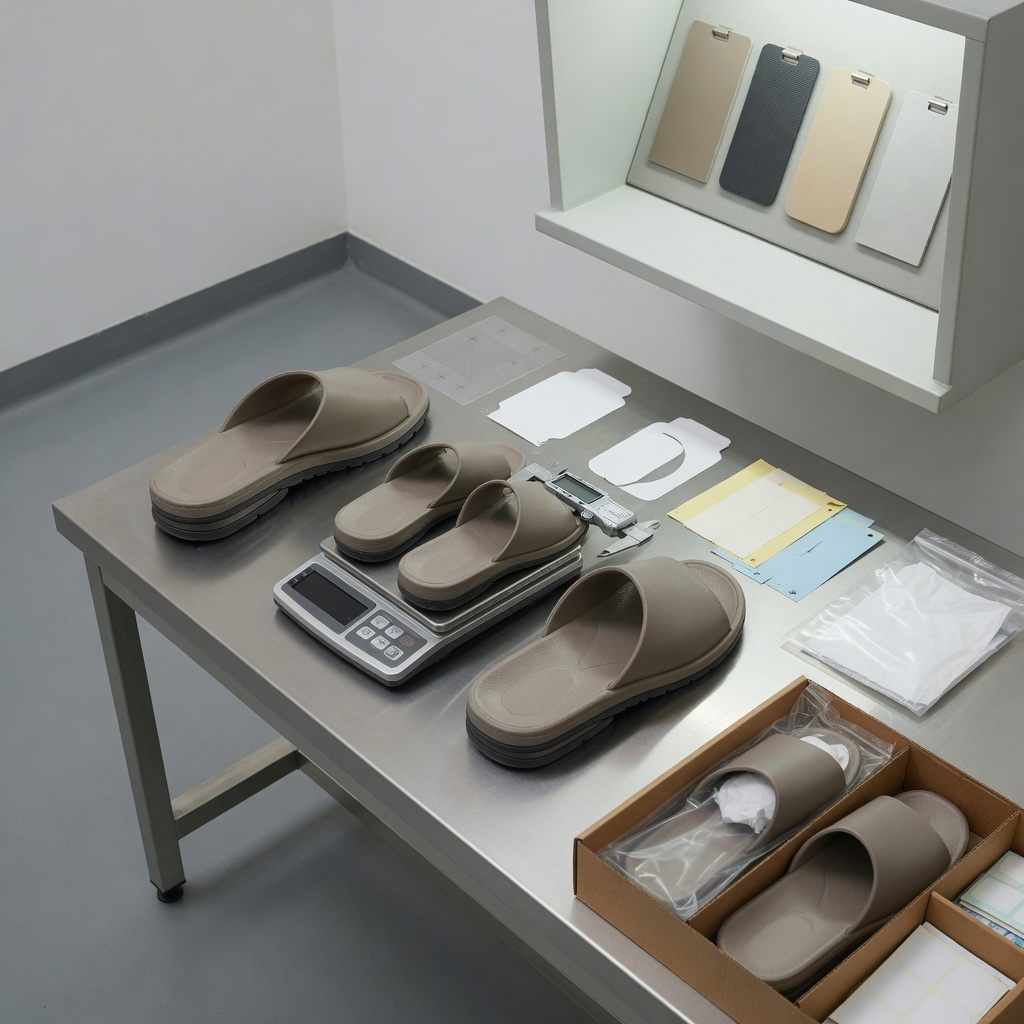
For slipper sourcing sample approval, a United States procurement team needs a controlled record that answers a narrow question: does the identified physical slipper sample match the product, packaging, commercial, and delivery basis proposed for bulk production? Approval should apply only to the listed sample identifier, specification revision, material, colorway, size, decoration, label files, and packaging configuration. Any unsampled variant or disclosed prototype substitution requires its own verification step before release.
The supplied sources support limited parts of this evidence chain. Henghao discusses reviewing color on the actual material while accounting for texture, gloss, lighting, logo process, packaging, and retained references (Henghao color-matching article). Mappershoe identifies size, weight, color, material feel, and packaging as physical-sample checks (Mappershoe wholesale slipper guide). Utop connects an approved sample with specifications, buyer requirements, artwork, packing instructions, and an agreed inspection method (Utop bulk-slipper quality-control guide). These commercial pages do not establish United States legal requirements, universal tolerances, order-specific costs, or delivery commitments.
Use approve for bulk production when the physical sample and controlled records agree, correct and resample when a discrepancy requires a new physical reference, and hold when evidence, quotation alignment, qualified review, or decision authority remains incomplete.
United States slipper sample approval release gate
| Release question | Evidence required in the approval packet | Decision boundary |
|---|---|---|
| Is the sample identifiable? | Sample identifier, submission date, sampled SKU, colorway, size, specification revision, artwork revision, packaging revision, and approval status | Hold if the physical sample cannot be tied to a controlled record |
| Does it represent intended bulk production? | Component descriptions, construction method, finish, outsole profile, decoration process, packaging setup, and a written list of prototype substitutions | Correct and resample when intended bulk material, construction, or presentation differs, unless an approved exception defines later verification |
| Are measurable attributes controlled? | Measurement datum, sample condition, method, tool, unit, target, permitted range, observed result, and disposition | Hold until the buyer defines the method and resolves results outside the approved range |
| Are color and decoration represented physically? | Intended substrate, texture, gloss, viewing setup, color reference, logo process, controlled artwork, dimensions, and placement record | Do not extend final approval from a screen rendering, substitute substrate, or undecorated sample to the finished configuration |
| Are packaging and label files represented? | Fully packed sample, packing sequence, controlled label artwork, placement, attachment method, and buyer applicability signoff | Hold when the physical sample differs from the approved files or applicability review is incomplete |
| Does the quotation match the sample revision? | Itemized product, material, decoration, packaging, tooling, sample, inspection, and logistics charges, with inclusions and exclusions | Request a revised quotation when the approved product or packing basis changes |
| Are landed-cost inputs traceable? | Packing quantity, carton dimensions, gross and net mass, origin information, handoff point, shipping assumption, and buyer-reviewed customs inputs | Do not describe a subtotal as landed cost unless its included and excluded components are recorded |
| Is delivery measured from an observable trigger? | Production start event, payment dependency, material and artwork readiness, packaging readiness, inspection window, handoff milestone, and exclusions | Hold when candidates use different triggers or leave included activities ambiguous |
| Can bulk goods be compared with the approval? | Retained reference, inspection stage, measurement instructions, defect classification, comparison method, and disposition authority | Hold until the bulk-comparison method and decision owner are defined |
Approval scope should be explicit. It should not silently extend to unsampled colors, sizes, materials, molds, decorations, labels, or packaging configurations. When the buyer accepts extrapolation from a sampled variant, the record should identify the affected variants, the attributes being extrapolated, and the production-stage evidence required.
Practical RFQ checklist for slipper sample approval
Attach this checklist to the RFQ and require field-level supplier responses before authorizing sample production. A checked item should point to a quotation field, controlled file, physical sample feature, or named record rather than a general confirmation.
- [ ] State the United States destination, intended use, sales channel, SKU list, colorways, size system, requested order quantity, and variant breakdown.
- [ ] Define the required sample configuration, sampled variants, sample identifier format, correction process, retained-reference responsibility, approval authority, sample charge, and sample delivery basis.
- [ ] List each upper, lining, footbed, outsole, adhesive, coating, decoration, and packaging material, including the policy for proposed substitutes.
- [ ] Provide measurement datums, sample condition, tool, unit, target, permitted range, and reporting method for every controlled dimension or mass check.
- [ ] Attach the physical color reference, intended substrate, controlled artwork, decoration dimensions, orientation, placement datum, and required viewing setup.
- [ ] Attach buyer-reviewed United States label artwork and specify packaging level, position, attachment method, and the party responsible for legal applicability review.
- [ ] Define the retail pack, inner protection, inserts, packing sequence, export-carton configuration, packing quantity, and required carton dimensions and mass data.
- [ ] List each requested report, declaration, test record, or certification document and define the product, material, color, method, date, issuer, and scope that the document must cover.
- [ ] Define the retained-reference process, bulk inspection stage, measurement instructions, visual comparison method, defect classification, and disposition authority.
- [ ] Request an itemized quotation stating currency, quantity basis, included work, exclusions, validity, payment trigger, delivery term, named place, and charges for samples, tooling, decoration, packaging, inspection, and logistics.
- [ ] Request traceable landed-cost inputs, including packing data, origin information, handoff point, shipping assumption, and fields requiring review by the buyer's customs or logistics adviser.
- [ ] Define delivery from observable events and require written disclosure of capacity dependencies, material readiness, artwork readiness, packaging readiness, inspection time, handoff milestone, and exclusions.
- [ ] State which material, construction, color, artwork, label, packaging, price, or schedule changes require disclosure, correction, resampling, requotation, or renewed approval.
Use unresolved checklist items as hold points. Terms such as standard quality, normal tolerance, usual packing, and same as before should be replaced with measurable buyer-defined fields or an exact description of the supplier's offered condition.
RFQ response matrix
| RFQ field | Buyer-controlled input | Supplier evidence needed at approval |
|---|---|---|
| Product and variant scope | United States destination, intended use, sales channel, SKU, colorway, size system, and variants | Accepted scope and written exceptions for unsupported or unsampled variants |
| Sample scope | Required configuration, sampled sizes and colors, correction process, retention responsibility, and approval authority | Sample charge, production trigger, intended materials, ownership terms, and disclosed prototype substitutions |
| Materials and construction | Upper, lining, footbed, outsole, adhesive, coating, decorative material, component stack, joining method, and substitute policy | Offered component descriptions tied to the sample identifier, plus disclosure of deviations from the RFQ |
| Measurements | Named datums, sample posture, conditioning instruction, tool, unit, target, upper and lower limits, and comparison method | Completed measurement record tied to the submitted sample |
| Color and decoration | Physical reference, intended substrate, texture, gloss, viewing setup, controlled artwork, process, dimensions, orientation, and placement datum | Decorated physical sample on the intended material and disclosure of process limitations |
| Packaging | Inner protection, inserts, retail pack, packing sequence, export-carton setup, and material requirements | Fully packed sample, packing specification, carton data, and itemized charge basis |
| United States labels | Buyer-reviewed applicability matrix, controlled artwork, placement, attachment method, and permanence criteria | Physical placement sample and confirmation that bulk production will use the approved files |
| Documents and tests | Reports, declarations, methods, or certification evidence identified as relevant to the actual product and order | Current documents that identify issuer, date, product, material, color, method, result, and covered scope where requested |
| Bulk comparison | Inspection stage, retained reference, measurement method, visual comparison method, defect classification, and disposition authority | Accepted inspection instructions and disclosure of methods the supplier cannot perform |
| Commercial basis | Currency, included work, quote validity, payment trigger, delivery term, named place, and exclusions | Itemized quotation tied to the sample and specification revisions |
| Landed-cost inputs | Packing quantity, carton data, origin information, handoff point, and shipping assumption | Order-specific data for review by the buyer and its qualified customs or logistics adviser |
| Delivery | Start event, dependencies, inspection window, handoff milestone, required evidence, and exclusions | Written schedule that defines the event used to measure each period |
| Change control | Events requiring disclosure, correction, resampling, requotation, or renewed approval | Named contact and written acceptance of the decision process |
Record measurable slipper specifications
The measurement sheet should identify the sample before recording results. Each row should state the attribute, physical datum, sample condition, method, tool, unit, target, permitted range, observed result, document owner, and disposition.
| Attribute | Buyer-defined instruction | Approval control |
|---|---|---|
| Footbed length and width | Define the heel and forward datums, cross-sections, slipper posture, tool, and reporting unit | Do not compare measurements taken from different datums or compression states |
| Outsole thickness | Mark the required heel, forefoot, or other datum and state whether the sample is unloaded | Do not use thickness alone as evidence of comfort, wear life, bonding strength, or slip performance |
| Pair mass | Define the matched sample condition, whether packaging is included, scale resolution, and reporting unit | Do not use mass alone as proof of material identity or durability |
| Logo dimensions and placement | Measure decoration width, height, orientation, and distance from fixed physical edges | Tie the result to the controlled artwork and represented decoration process |
| Packed dimensions and mass | Define the pack state, carton datums, packing quantity, and gross and net mass basis | Replace prototype estimates with final supplier packing data before logistics approval |
Mappershoe supports physical confirmation of size and weight, but the supplied page does not establish universal measurement methods or tolerances. The buyer must set order-specific limits and confirm that the supplier can apply the stated method.
For visual color approval, record the intended material, texture, gloss, background, lighting setup, viewing orientation, logo process, packaging context, and retained reference. If the buyer requires instrument-based comparison, the RFQ should also identify the instrument setup, calculation method, sample locations, and buyer-approved acceptance limit. Henghao supplies context for considering material, surface, lighting, logo process, packaging, and retained references together; it does not establish a universal numerical color threshold.
United States labeling evidence at sample approval
Sample approval should separate legal applicability from physical execution. The buyer's qualified legal, customs, or compliance reviewer determines which content and marking requirements apply to the actual slipper, materials, destination, and sales channel. The buyer then issues controlled artwork and placement instructions. The supplier's role in the approval packet is to reproduce those files and provide a physical sample for verification.
| Responsibility | Required record | Hold condition |
|---|---|---|
| Applicability review | Buyer-controlled matrix identifying required content, approved wording, packaging level, placement, and responsible reviewer | Qualified review is absent or the product scope is unclear |
| Supplier execution | Physical label and packaging sample tied to the controlled artwork revision | Content, placement, attachment method, or packaging level differs from the approved file |
| Buyer verification | Comparison record listing conforming fields, deviations, and disposition | An unresolved deviation remains or the reviewed artwork revision is uncertain |
A supplier template does not establish United States legal applicability. Approval of physical placement also does not independently prove legal compliance. None of the supplied commercial pages is a United States legal authority, so this article does not prescribe statutory wording.
When a relevant test method, standard, declaration, or certification document is requested, the RFQ should name the exact document and required scope. A buyer requirement and a supplier's own practice are distinct from certification. Do not imply that a supplier, material, or slipper is certified without a current document whose issuer, date, validity, product description, material, color, method, result, and scope have been checked.
Landed-cost and delivery checks tied to sample approval
The sample revision establishes the commercial comparison basis. Changes to materials, outsole profile, decoration, labels, packing quantity, or carton arrangement should trigger a supplier statement confirming whether the quotation, logistics inputs, or schedule also changes.
The supplied sources do not provide order-specific prices, freight rates, duty rates, tariff classifications, capacity commitments, or delivery results. Every number below is therefore a buyer-created assumption for the same hypothetical United States slipper RFQ as of January 15, 2025. The values are not supplier data, market benchmarks, recommended limits, or legal classifications. They must be verified against the identified physical sample, the supplier's current specification and quotation, and current customs and logistics inputs before approval.
| Illustrative comparison field | Candidate A assumption | Candidate B assumption | Source, scope, date, and verification requirement |
|---|---|---|---|
| Physically checked sample-pair mass, packaging excluded | 285 grams per matched sample pair | 315 grams per matched sample pair | Buyer-created assumption for this hypothetical United States slipper RFQ as of January 15, 2025; verify on the identified sample with the approved scale method and reconcile with the supplier specification |
| Outsole thickness at the buyer-defined heel datum, sample unloaded | 14 millimeters per checked sample | 17 millimeters per checked sample | Buyer-created assumption for this hypothetical United States slipper RFQ as of January 15, 2025; verify on the identified sample with the approved datum and caliper method |
| Export-carton packing quantity | 20 ordered pairs per export carton | 16 ordered pairs per export carton | Buyer-created assumption for this hypothetical United States slipper RFQ as of January 15, 2025; replace with supplier packing data tied to the approved packaging revision and current quotation |
| Product-charge assumption | US$4.80 per ordered pair | US$5.20 per ordered pair | Buyer-created assumption for this hypothetical United States slipper RFQ as of January 15, 2025; verify in the current itemized supplier quotation for the approved product revision |
| Allocated freight, insurance, brokerage, duty, and destination-delivery assumption | US$1.30 per ordered pair | US$1.05 per ordered pair | Buyer-created assumption for this hypothetical United States slipper RFQ as of January 15, 2025; replace with current origin, route, classification, broker, and logistics inputs |
| Example subtotal for the listed product and logistics components | US$6.10 per ordered pair, calculated from US$4.80 per ordered pair plus US$1.30 per ordered pair | US$6.25 per ordered pair, calculated from US$5.20 per ordered pair plus US$1.05 per ordered pair | Buyer-created example calculation for this hypothetical United States slipper RFQ as of January 15, 2025; verify every included and excluded component in the supplier quote and landed-cost worksheet |
| Production-period assumption from supplier receipt of written approval and agreed payment | 35 calendar days per hypothetical order | 28 calendar days per hypothetical order | Buyer-created assumption for this hypothetical United States slipper RFQ as of January 15, 2025; verify current capacity, start trigger, packaging readiness, inspection time, exclusions, and written supplier commitment |
This comparison is a control example, not a purchasing recommendation. Greater sample mass or outsole thickness does not by itself establish durability, comfort, wear life, bonding strength, or slip performance. A shorter stated production period is comparable only when candidates use the same start event and include the same activities.
For an actual landed-cost review, require an itemized worksheet tied to the approved sample revision, order quantity, packing configuration, origin information, handoff point, shipping assumption, and buyer-reviewed customs inputs. Record inclusions and exclusions before using a per-pair subtotal for supplier comparison.
For delivery review, separate sample correction, written approval, payment, material readiness, artwork readiness, packaging readiness, production, inspection, handoff, transit, and destination delivery. Each period should have observable start and finish events. When a corrected sample changes the product or packing basis, obtain the price and schedule effect before renewed approval.
Remote evidence and retained-reference controls
Photos, recordings, renderings, and live video can screen visible proportions, logo placement, side profile, surface appearance, label position, and packing sequence before a physical sample is released. The evidence record should identify the represented sample and revision.
Remote review remains supplemental when approval requires direct measurement, pair mass, material feel, construction review, or a fully packed reference. Apparent color can be affected by substrate, texture, gloss, logo process, lighting, camera, and display. Henghao supports review on the actual material under a defined viewing setup, while Mappershoe identifies material feel and other physical checks that cannot be resolved from imagery alone.
After approval, buyer and supplier records should connect the retained reference to the same sample identifier, specification revision, measurement sheet, color reference, artwork, label files, packing instructions, quotation basis, and written decision. Utop provides the supplied source context for linking the approved sample with specifications, buyer requirements, artwork, packing instructions, and an agreed inspection method.
Slipper sample approval decision and signoff
Use approve for bulk production only when the physical, documentary, commercial, and delivery records use the same revision and scope. Use correct and resample when the discrepancy requires a replacement physical reference. Use hold when evidence, qualified review, quotation alignment, or approval authority is incomplete.
A release record can use this structure:
> Approved for bulk production: Physical slipper sample [sample identifier], specification [revision], artwork [revision], color reference [reference], label artwork [revision], packaging specification [revision], quotation [revision], and delivery basis [revision], approved on [date]. Approval applies only to [listed SKU, colorway, size, material, decoration, and packaging scope]. No material, construction, color, decoration, label, or packaging substitution is permitted without written disclosure and renewed approval. Bulk goods remain subject to the agreed specification and inspection method.
Before signoff, confirm that the sample identifier matches every controlled file, prototype substitutions have recorded dispositions, measurements use the approved method, the packed sample matches the packing revision, label applicability review is complete, the quotation uses the approved product basis, landed-cost inputs are traceable, delivery triggers are observable, and change-control authority is named.
Sample approval should not be written as a waiver of undisclosed defects or as a replacement for the agreed bulk inspection process. Contract wording should be adapted to the order and reviewed by qualified advisers where appropriate.
Evidence method, source contexts, and limitations
Method: The supplied pages were used only for the sample-control subjects they expressly discuss. Those subjects were mapped to RFQ fields, approval evidence, and release decisions. United States legal review, customs treatment, contract language, landed-cost inputs, order-specific tolerances, and decision authority are presented as buyer-controlled items to verify rather than claims attributed to the supplier sources. The numerical comparison is explicitly hypothetical and was not derived from the cited pages.
| Supplied source context | Used for | Not used to prove |
|---|---|---|
| Henghao color-matching article | Actual material, texture, gloss, lighting, logo process, packaging, color review, and retained-reference context | Universal color limits, legal compliance, certification, supplier performance, price, or delivery results |
| Mappershoe wholesale slipper guide | Physical confirmation of size, weight, color, material feel, and packaging | Universal tolerances, United States labeling rules, performance results, current quotations, or delivery commitments |
| Utop bulk-slipper quality-control guide | Linking an approved sample with specifications, buyer requirements, artwork, packing instructions, and an agreed inspection method | Independent inspection results, certification, statutory requirements, or current supplier QC performance |
| Vincent Xi author profile | Author identity and Editorial Author role | Factory visits, sample testing, client work, certifications, or procurement outcomes |
Limitations and verification: The cited commercial pages are not independent standards, laboratory reports, United States legal authorities, customs rulings, or proof that a supplier, material, or slipper holds a certification. They do not establish universal tolerances, statutory label wording, tariff classification, duty rates, market prices, current production capacity, or delivery performance. The buyer must verify the physical sample, current quotation, material records, applicable labeling obligations, requested documents, customs treatment, packing data, inspection plan, logistics inputs, and delivery assumptions for the specific order.
Author and experience basis: The linked SoleForge profile identifies Vincent Xi as Editorial Author. It does not support a first-hand claim about factory visits, product tests, client engagements, certifications, or procurement outcomes, and no such claim is made here.
Discuss Your Requirements
Review our manufacturing capabilities, then share your specifications for a supplier-fit review.