Sneaker Sourcing Product Development Capability for European Buyers
By Vincent Xi, Editorial Author (Author Profile)
For European sneaker procurement teams evaluating sneaker sourcing product development capability, supplier competence depends on five verifiable deliverables before issuing a purchase order: pattern and stitching fidelity across bounded sample revisions, bill-of-materials (BOM) batch consistency, last and outsole mold engineering in editable 3D formats, distinct development versus bulk minimum order quantities (MOQs), and destination-specific compliance records. European placement cannot be treated as a single regulatory territory: a requirement in an EU member state does not apply uniformly across the EEA or the UK. Therefore, evaluating a footwear supplier requires auditing technical files and physical deliverables rather than relying on general marketing claims.
As documented in a published footwear manufacturer evaluation guide, a professional sneakers manufacturer must be evaluated across three concrete systems: sample development (pattern accuracy, stitching execution, revision turnaround, lead times, and alternative material handling); material sourcing (supplier networks and batch consistency); and tooling development (outsole mold tooling experience and 3D file handling for custom designs) (How to Evaluate a Sneakers Manufacturer Before Placing an Order). Vincent Xi, Editorial Author (profile: https://www.soleforgefootwear.com/authors/vincent-xi/), compiles this briefing strictly from verified production benchmarks; no first-person field testing or proprietary factory operations are claimed.
Product Development Capability in European Sneaker Procurement
In professional sneaker procurement, product development capability refers to a factory's engineering capacity to translate a digital tech pack or reference shoe into a signed prototype and production-ready confirmation sample without undocumented alterations to lasts, upper geometry, or materials. Commercial branding, packaging graphics, and consumer marketing remain secondary to the factory's technical ability to hit mechanical, dimensional, and aesthetic tolerances.
European delivery requires jurisdictional discipline. Placing footwear on the market in an EU member state involves different legal frameworks than doing so in the European Economic Area (EEA) or the United Kingdom (UK). Because the technical sources referenced here do not define specific statutory limits, procurement managers must separate a factory's physical craftsmanship from destination compliance files. Never accept a blanket supplier claim that "European regulations are covered." An RFQ must state the exact destination market—whether an EU member state, an EEA nation, or the UK—and compel the supplier to identify the documentation attached to each confirmation sample.
Published service architectures define the deliverables buyers can enforce. Footwear Solution outlines end-to-end development spanning initial design, prototype construction, last making, mold shop coordination, 3D printing, product engineering, tech pack generation, vendor selection, and commercialization through full-size run samples and tooling (Sourcing & Development). Similarly, The Studio structures custom manufacturing into sequential phases: silhouette and outsole concept workshops, design development for patterns and molds, feasibility quoting to evaluate sourcing pathways and MOQs, and prototype sampling and validation before bulk manufacturing (Custom Sneaker Manufacturing). While these published workflows provide standard milestones, buyers must demand supplier-specific files rather than generic flowcharts.
One published credential requires clear boundaries: Footwear Solution states that it holds over 20 years in the industry. Unit: years of stated operating tenure; scope: marketing statement published on the cited sourcing page, representing that specific service provider rather than a footwear industry average or SoleForge operational metric; as-of context: accessed via cited reference without an independent audit timestamp. Buyers must evaluate the factory's current technical assets rather than relying on self-reported tenure.
Sample Development, Revisions, and Lead Time
Sample development represents the initial measurable hurdle in assessing sneaker sourcing product development capability. The evaluation guide advises buyers to scrutinize pattern accuracy and stitching while setting explicit terms for sample revisions, lead times, and substitute materials. Procurement teams must integrate these points into the RFQ as binding acceptance criteria.
Pattern accuracy requires cut panels to match the approved 2D pattern grade for the designated size, including exact seam allowances, margin skiving, and overlay alignments. Stitching documentation must stipulate stitch type, thread weight, and tension for structural seams at the eyestay, vamp, and heel counter. If the buyer has not established stitch-per-inch (SPI) requirements, require the supplier to propose an SPI tolerance and freeze it on the counter-sample.
Sample revision terms must specify a permitted count, operational boundaries, and a development timeline:
- Example Revision Assumption: Assume a baseline of 3 revision rounds at 12 working days per round, resulting in a 36-working-day development window prior to tooling release. Unit: revision rounds and working days; scope: single sneaker silhouette, upper construction, and sole configuration prior to cutting mold steel; as-of context: hypothetical quotation assumption that must be validated against the supplier's dated quote. Minor pattern adjustments must not be conflated with fundamental sole redesigns, which reset the development clock.
Lead times must be quoted separately across development gates: proto sample, fit/wear sample, and final confirmation sample. If a specified upper textile or synthetic leather is out of stock, require the vendor to submit a physical swatch, composition breakdown, unit price variance, lead-time impact, and any required adjustments to product performance claims before substitution.
Grading precision is essential for European fit profiles:
- Example Confirmation Size Run: Assume an 8-pair confirmation run covering standard European adult sizes from EU 36 through EU 43 (one pair per whole size). Unit: physical pairs and EU whole-size gradations; scope: single style and colorway grading evaluation, excluding half-sizes and UK-specific markings; as-of context: tech pack baseline to be verified against the buyer's distribution target. Because UK sizing differs from continental EU sizing, programs distributing to both the EU and the UK require distinct size marking and fit approvals.
Material Sourcing Consistency and Development Pathways
A common failure in custom sneaker development occurs when initial prototypes utilize premium showroom sample yardage that cannot be replicated in bulk production. The evaluation guide assesses material sourcing through established supplier networks and batch consistency.
Procurement teams must enforce a comprehensive Bill of Materials (BOM) listing every component: upper substrates, lining, structural toe puff, heel counter, eyelets, laces, strobel board, footbed, midsole compound, outsole rubber, and bonding adhesives. Each line must clarify whether the material is buyer-nominated or factory-sourced, along with rules governing mill substitutions. Batch consistency requires documented quality control protocols, defining allowable delta-E color variance and thickness tolerances against the signed reference swatch.
As outlined in The Studio's published process, feasibility quoting evaluates sourcing pathways and MOQs before initiating bulk cutting. This stage enables procurement teams to weigh the financial and logistical trade-offs of nominated mills versus factory-partnered suppliers:
- Nominated Materials: Ensure exact aesthetic and physical alignment but frequently introduce extended lead times and high minimum mill orders exceeding prototype needs.
- Factory-Standard Materials: Deliver shorter lead times and smaller order minimums but carry higher risks of batch-to-batch variation if unmonitored.
A claim of global sourcing capacity does not guarantee repeatability for an individual shoe style. Footwear Solution describes sourcing factories, suppliers, and materials globally across full-size run sampling and tooling. While this indicates a broad service scope, it does not confirm batch stability for a specific sneaker program. Buyers must obtain declared mill identities, raw material lead times, and incoming inspection failure protocols.
Chemical safety declarations must align with the target market. Because European jurisdictions operate under distinct enforcement mechanisms across the EU, EEA, and UK, buyers must mandate that compliance documentation be tied directly to the designated destination country and verified by independent technical counsel.
Tooling, Lasts, Molds, and 3D File Handling
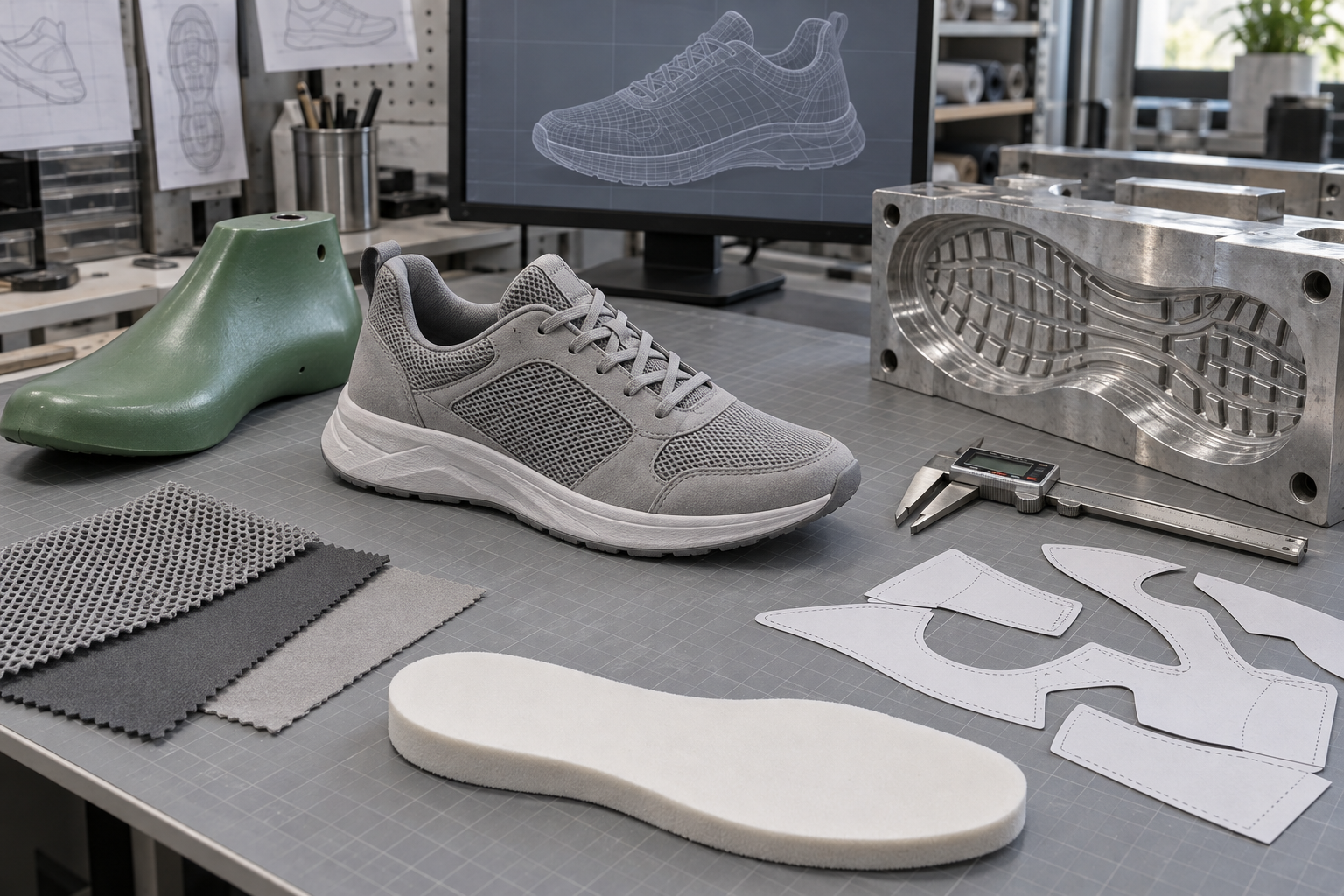
Tooling development capability separates basic assembly shops from advanced footwear manufacturers. The evaluation guide defines tooling capability as outsole mold experience combined with 3D file handling for custom designs. Footwear Solution highlights last making, mold shops, 3D printing, and tooling management, while The Studio identifies mold and pattern development as core engineering gates. These references provide the criteria for auditing tooling infrastructure:
- Last Development: Verify ownership rights, base size specifications, and whether lasts exist as physical turned plastic, digital CAD surfaces, or both.
- Pattern Nests: Require editable CAD pattern files for base sizes and graded nests, compatible with standard footwear software.
- Mold Fabrication: Determine whether outsole tooling is cut in-house or outsourced to a specialty mold shop. Require documented photographic and measurement proof of previously milled tooling with comparable geometry.
- 3D File Integrity: Demand native CAD files alongside neutral exchange formats (such as STEP or IGES) with units explicitly locked in millimetres.
- 3D Prototyping: Treat 3D resin prints strictly as visual or volumetric checks. 3D prints cannot substitute for compression-molded EVA or vulcanized rubber in mechanical wear evaluations.
Tooling schedules must be separated from upper pattern drafting:
- Example Outsole Tooling Timeline: Assume a single-cavity prototype outsole mold requires 25 calendar days for CNC machining after 3D CAD approval, initiated only upon written sign-off of the upper pattern. Unit: calendar days; scope: single-cavity test mold for one sneaker design; as-of context: vendor tooling quotation baseline to verify. Tooling machining should not commence until upper dimensions are frozen, preventing costly scrap steel.
Tooling ownership clauses are critical for European brands that may shift manufacturing between seasons. Contracts must stipulate that all lasts, grading files, and tooling belong exclusively to the buyer upon payment of development invoices, specifying handover procedures and confirming whether subcontractor mold shops are bound by non-disclosure and tooling release terms.
Measurable Trade-offs Before Approval
Procurement decisions involve balancing development speed against technical risk. Selecting compressed prototype turnarounds is advantageous only if comprehensive pattern and material specifications are documented simultaneously. Compressing sample cycles without freezing the BOM increases the likelihood of costly bulk production errors.
| Development Strategy | Operational Advantage | Inherent Risk | Mitigation Requirement |
|---|---|---|---|
| Buyer-Nominated Materials | Preserves exact hand-feel, shade, and technical performance | High mill MOQs and longer lead times | Require feasibility quote comparing mill minimums against bulk pair forecasts |
| Factory-Sourced Materials | Lower MOQs, consolidated shipping, faster sample builds | Batch-to-batch color and tensile drift | Lock incoming inspection tolerances to signed physical swatches |
| In-House Tooling | Direct technical oversight and agile revision turnaround | Factory lock-in and potential capacity bottlenecks | Audit CNC file compatibility and verify tool release clauses |
| Subcontracted Mold Shops | Access to specialized multi-density tooling centers | Slower engineering change orders and IP diffusion | Name or code mold shops in the contract with strict file release terms |
| Consolidated Development | Single-vendor accountability from concept to tooling | High switching costs if commercialization falters | Secure full native pattern and last files at each development milestone |
Buyer Decision Table
Use this decision matrix to evaluate competing sneaker manufacturers during RFQ review. Approval requires dated files, test samples, or contractual commitments rather than verbal assurances.
| Decision Area | RFQ Requirement | Approval Threshold | Rejection Action | Europe Check |
|---|---|---|---|---|
| Sample System | Staged lead times, revision allowances, and pattern verification methods | Counter-sample matching tech pack within approved SPI and seam limits | Suspend sample payment; hold tooling cut | Ensure sample sizing matches target market (EU vs UK standard) |
| Material Control | Line-item BOM differentiating nominated and factory materials | Verified swatches for each line item with defined delta-E tolerances | Reject substitute materials; freeze development | Clarify documentation targets: EU member state, EEA, or UK |
| Material Substitutes | Documented change-order protocol for out-of-stock items | Written delta report showing swatch, cost impact, and technical specs | Treat verbal substitution as unauthorized sample failure | Re-evaluate destination compliance for substituted materials |
| Last & Pattern Assets | Base-size definitions, grade plans, and open CAD file formats | Physical turned last matching editable 3D file in millimetres | Halt pattern grading sign-off | Distinguish continental EU grading scales from UK sizing requirements |
| Outsole Tooling | In-house capability or named subcontractor with fabrication clock | Approved 3D CAD drawing and signed physical upper test fit | Withhold mold deposit | Record manufacturing origin without confusing it with target sales market |
| 3D File Delivery | Native CAD files plus neutral STEP/IGES exchange formats | Buyer engineering team successfully imports and verifies geometries | Development clock stops at vendor expense | Confirm all dimensions and shrinkage allowances are calibrated in millimetres |
| MOQ Structure | Clear separation between prototype costs and production MOQs | Feasibility quote detailing material MOQs vs factory order minimums | Refuse quotes merging sample fees into unconfirmed bulk orders | Differentiate order allocations across EU and UK distribution hubs |
| Confirmation Sample | Complete size run validation against master technical pack | Signed physical sample pair with zero critical construction defects | Deny production authorization | Verify size labeling accurately reflects destination jurisdiction |
| Tool Ownership | Unconditional transfer of last, pattern, and mold IP upon payment | Legally binding tooling release clause and handover schedule | Refuse tooling release; withhold final sample installment | File ownership documentation with the appropriate EU, EEA, or UK legal entity |
| Repeat Production | Master retain sample archiving and incoming lot comparison standard | Sealed reference pair and written batch tolerance agreement | Reject bulk lots deviating from signed reference | Re-verify compliance paperwork if import rules change between seasons |
RFQ Checklist
- Ask the supplier to provide a detailed sample development quotation broken down by prototype stage (proto, fit, wear, and confirmation samples), including pattern cutting verification, stitching specifications, stated lead times, and policies on material alternatives.
- Require the manufacturer to submit a line-by-line bill of materials (BOM) categorizing buyer-nominated versus factory-sourced components, along with specific batch-consistency verification tolerances against the approved swatch.
- Specify destination-market compliance requirements separately for the EU, EEA, and UK, requesting the exact technical documentation and chemical safety declarations the factory will supply for each jurisdiction.
- Require the manufacturer to clarify whether pattern grading, last production, and outsole mold tooling are handled in-house or outsourced, providing written disclosures for all tooling subcontractors.
- Ask the supplier to deliver editable pattern nests and 3D CAD outsole files in neutral standard formats (such as STEP or IGES) with measurements in millimetres, confirming file readability prior to mold cutting.
- Specify a prototype size curve confirmation run (e.g., EU 36 through EU 43), requiring distinct pricing and scheduling that is quoted independently from bulk production MOQs.
- Verify contractual intellectual property terms for proprietary lasts, grading patterns, and molds, detailing tooling release fees and physical file handover requirements upon program completion.
- Compare feasibility quotes across nominated and factory-sourced material pathways to evaluate differences in minimum order quantities, lead-time buffers, and material performance specifications.
- Require the manufacturer to maintain separate schedules for working-day sample revisions and calendar-day tooling fabrication to prevent premature mold release before upper approval.
- Ask the supplier to establish a physical retain sample and a written defect classification guide that will govern incoming acceptance standards for initial bulk delivery.
Source Context, Method, and Limits
Three technical reference frameworks form the factual foundation of this procurement guide. The manufacturer evaluation guide establishes the core evaluation pillars for athletic footwear manufacturing: sample development, material network sourcing, and tooling capabilities including 3D file management and revision control (How to Evaluate a Sneakers Manufacturer Before Placing an Order). Footwear Solution documents end-to-end footwear commercialization, claiming over 20 years in the footwear industry and outlining development workflows that cover last development, mold shops, 3D printing, and full-size run sampling (Footwear Solution). The Studio provides the sequential custom manufacturing framework, detailing concept workshops, pattern and mold engineering, feasibility quotes evaluating sourcing pathways and MOQs, and prototype validation prior to mass manufacturing (The Studio).
Methodology: This analysis synthesizes these documented manufacturing benchmarks into decision trees, comparison tables, and actionable RFQ criteria tailored for European footwear buyers. Planning figures—such as the 3 revision rounds at 12 working days (36 working days total), the 8-pair confirmation run across EU 36–43, and the 25-calendar-day outsole mold machining schedule—represent example calculations designed for quote comparison. They are not measured factory averages, statutory thresholds, or performance guarantees. Footwear Solution's stated 20-year tenure represents a marketing claim from the cited page without independent audit verification.
Limitations and Verification: Procurement teams must directly verify that cited vendor workflows align with current factory contracts; replace all planning assumptions with dated, supplier-specific quotes; confirm CAD file compatibility within their internal technical systems; and consult certified legal counsel to determine current product safety and import documentation requirements for their designated EU, EEA, or UK destination. SoleForge makes no proprietary claims of factory ownership, certifications, or test results on this page. No commercial search engine metrics, keyword difficulty scores, or traffic estimates are expressed or implied.
Discuss Your Requirements
Review our manufacturing capabilities, then share your specifications for a supplier-fit review.