Sneaker Wholesale Supplier Packing Requirements for United Arab Emirates RFQs
By Vincent Xi, Editorial Author
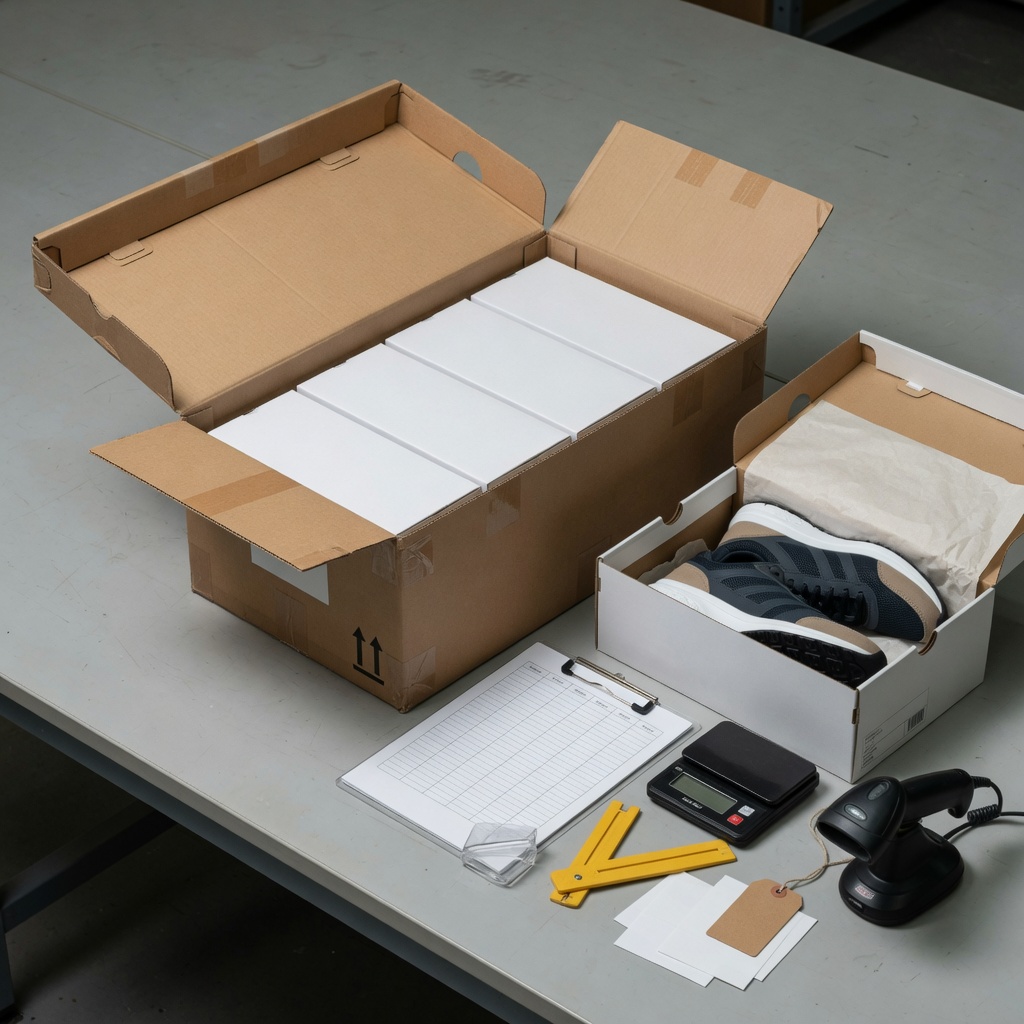
For a United Arab Emirates sneaker wholesale supply RFQ, packaging should be a quoted, measurable specification. Require each supplier to return a completed packing annex covering style, color, size assortment, pairs per carton, inner-box construction, sealed master-carton dimensions and mass, labels, carton marks, and packaging charges. Link every proof and measurement to the same packed-sample identifier. Use the practical RFQ checklist below to record each required response and approval item.
Approve bulk packing only after the physically packed sample, final artwork proofs, measurement record, and draft packing-list entry reconcile. Hold approval when dimensions or mass are estimates, required fields are blank, artwork versions conflict, or a claimed test report does not identify the quoted carton.
The published figures below are commercial comparison benchmarks. They are not United Arab Emirates legal requirements, order acceptance limits, SoleForge specifications, or guaranteed loading results. The supplier quote and measured packed sample remain the order-specific evidence.
Packing Requirements for United Arab Emirates Sneaker RFQs
Send the following matrix with the RFQ. The buyer should complete acceptance criteria and tolerances before suppliers quote so those controls are not chosen after packing starts.
| RFQ control | Supplier must return | Approval evidence | Hold condition |
|---|---|---|---|
| Product and assortment | Buyer and supplier style references, color, size run, ordered pairs by size, assortment per carton, and partial-carton treatment | Packing schedule reconciled with buyer-issued order data | Substitution, incomplete size allocation, or unexplained partial carton |
| Inner sneaker box | Construction, material, packed dimensions in mm, applicable sizes, pair orientation, tissue or inserts, artwork version, setup charge, and unit charge | Measured packed box, open-box image, component list, and final proof | Estimated dimensions, unapproved component, or artwork mismatch |
| Master-carton pack | Pairs per carton, color and size arrangement, orientation, carton construction, supplier board specification, reinforcement, and closure method | Open- and sealed-carton evidence tied to the sample identifier | Count, assortment, or construction differs from the packing schedule |
| Packed dimensions and mass | Sealed outer length, width, and height in mm; net, tare, and gross mass in kg; measurement date; equipment; sample identifier; and included assortment | Dated measurement record for the sealed sample carton | Estimate, ambiguous mass label, missing scope, or result outside the buyer-approved tolerance |
| Labels and barcodes | Required fields, data owner, encoded value source, code type, printed dimensions in mm, placement, artwork version, and replacement process | Final proof and scan record from every required location on the packed sample | Wrong data, unreadable code, incorrect placement, or unapproved artwork |
| Carton marks and documents | Buyer-confirmed fields, placement, print method, carton identifier format, and relationship to the packing list | Applied mark and draft packing-list entry for the same carton identifier | Mark and packing-list mismatch or unconfirmed destination field |
| Commercial terms and changes | Packaging setup and unit charges, packaging minimums, proof timing, production timing, load assumptions, and change-control process | Itemized quote and written acknowledgement of approved specification versions | Bundled charge without scope or an unapproved box, insert, label, carton, or pack-count change |
| United Arab Emirates handoff | Destination fields supplied by the buyer after confirmation from a current authoritative or appointed logistics source | Field-and-placement matrix recording the confirmation source, date, product scope, and shipment scope | Supplier-created local requirement, unconfirmed field, or conflict across the item, box, carton, and documents |
Practical RFQ Checklist for United Arab Emirates Packing Requirements
Attach this checklist to the packing annex. Each checked item should point to a supplier response, proof, measurement record, or buyer approval rather than relying on a verbal confirmation.
- [ ] Identify the buyer-issued style reference, supplier style reference, color, size run, ordered pairs by size, and approved substitution rule.
- [ ] State the pairs per master carton, assortment sequence, pair orientation, and treatment of partial cartons.
- [ ] Describe the inner sneaker box material, construction, applicable sizes, packed dimensions in mm, pair orientation, tissue, inserts, and artwork version.
- [ ] Describe the master-carton construction, supplier board specification, reinforcement, closure method, and relationship to the packed sample.
- [ ] Assign a unique packed-sample identifier and use it on box proofs, carton evidence, measurement records, scan records, and the draft packing-list entry.
- [ ] Record sealed master-carton length, width, and height in mm and net, tare, and gross mass in kg using the actual quoted assortment.
- [ ] Record the measurement date, equipment, operator or responsible party, included components, and buyer-defined tolerance for each packed measurement.
- [ ] List every item, hangtag, shoebox, and carton label field, including the data owner, value source, code type, printed dimensions, placement, and artwork version.
- [ ] Supply scan evidence from every barcode location on the packed sample and define the correction process for an incorrect or unreadable code.
- [ ] Reconcile the carton identifier, carton marks, pair count, size assortment, and mass with the corresponding draft packing-list entry.
- [ ] Itemize packaging setup, proof, tooling, component, and recurring unit charges; state packaging minimums and what each charge includes.
- [ ] State proof timing, packaging production timing, change-control steps, and the commercial effect of changing a box, insert, label, carton, assortment, or pack count.
- [ ] Provide the load calculation using only approved sealed-carton measurements and disclose rounding, partial-carton treatment, and other load assumptions.
- [ ] Add United Arab Emirates destination fields only after the buyer records a current authoritative or appointed logistics source, confirmation date, and applicable product and shipment scope.
- [ ] Mark every unresolved field as an exception; do not treat blanks, estimates, or generic claims such as export quality as approved responses.
- [ ] Issue bulk-packing approval only after the packed sample, final proofs, measurement record, scan evidence, quote, and draft packing-list entry reconcile.
Source-Reported Packing Requirements Benchmarks
Each value below retains the unit and configuration reported by its source. Use these figures to question a quote, not to approve a sneaker packing specification.
| Reported datum and scope | As-of and source context | RFQ decision |
|---|---|---|
6 pairs per finished export master carton and 18-22 kg packed mass for that same finished carton. Scope: the guide's handling-priority configuration. | As-of context: the supplied source is undated; its publication date, measurement date, and underlying order sample are not stated. Source: business-to-business shoe packaging export guide. | Request measured dimensions and mass for the quoted sneaker assortment. Do not transfer the reported result to another size run, box, insert set, or carton construction. |
12 pairs per finished export master carton and below 23 kg packed mass for that same finished carton. Scope: the guide's bulk-lot configuration and manual-handling benchmark. | As-of context: the supplied source is undated; its publication date, measurement date, and underlying order sample are not stated. Source: business-to-business shoe packaging export guide. | Review measured mass, dimensions, carton construction, assortment, and handling method before considering the configuration. The reported mass is not presented here as a legal threshold. |
340-360 mm box length per men's shoe inner box. Scope: the guide's reported typical range for that box type. | As-of context: the supplied source is undated; its publication date, measurement date, and sampled shoe constructions are not stated. Source: business-to-business shoe packaging export guide. | Use the range only as a comparison prompt for an applicable men's sneaker size range. Require actual packed dimensions for every quoted box size. |
2,800-3,200 pairs per nominal 20-foot container. Scope: the guide's reported loading band. | As-of context: the supplied source is undated; its publication date, loading-study date, carton geometry, and order assortment are not stated. Source: business-to-business shoe packaging export guide. | Require a load plan calculated from approved box and sealed-carton measurements. Do not treat the published band as guaranteed capacity. |
The same guide characterizes double-wall corrugated board as standard outer-carton construction and discusses corner reinforcement and complete markings. That is the commercial source's description. It is not a named technical standard, a United Arab Emirates requirement, a SoleForge packing practice, certification evidence, or proof of performance for the quoted carton.
If carton testing is required, the RFQ should identify the agreed test method, sample construction, packed load, conditioning, acceptance criterion, report date, and issuing party. Do not accept a certification or tested-performance claim unless a current document maps to the quoted carton and packing configuration.
Convert Packaging Inputs into RFQ Decisions
Freeze the Inner-Box Scope
The supplied bulk shoe order process says box type, inserts, and labeling should be specified before packing and recommends protective packaging for transit. This supports fixing those inputs before bulk packing. It does not establish an order-specific box material, dimension, construction, or performance result.
The supplier's packed sample should contain the quoted sneaker, tissue, inserts, dividers, labels, and other approved components in their intended positions. Record the box construction, packed dimensions in mm, applicable size range, artwork file and version, proof method, setup charge, and recurring unit charge. A different insert or box requires renewed measurement and approval because it changes the packing configuration.
Measure the Sealed Master Carton
Require the supplier to record sealed outer dimensions in mm and net, tare, and gross mass in kg for the actual packed sample. The record should identify its measurement date, equipment, sneaker style, colors, sizes, assortment, pair count, box version, and carton construction.
Buyer-defined tolerances belong in the packing annex. Terms such as export quality, heavy duty, tested, or compliant are not measurable specifications on their own. If a test result is claimed, verify the method, report date, issuing party, tested construction, packed load, and relationship between the report sample and quoted carton before relying on it.
Reconcile Labels, Marks, and the Packing List
The supplied shoes buying guidelines list logo files, insole print, hangtags, shoeboxes, carton marks, barcodes, and market-compliance needs among inquiry inputs. The page also says packaging labels and carton marks should be reviewed at sample stage and that carton packing, shipping marks, and packing-list details should align before bulk production.
Convert those process points into an order-specific field-and-placement matrix covering:
- Required item, hangtag, shoebox, and carton fields and their placement
- Barcode data owner, encoded value source, code type, printed dimensions, and artwork version
- Carton identifiers used to reconcile physical cartons with the packing list
- Proof approval and scan evidence from the actual packed sample
- Correction and replacement steps for an incorrect or unreadable label
The supplier should complete every field. Mark an inapplicable field as such and obtain buyer approval rather than leaving it blank.
Compare Packaging Cost and Load Assumptions
Use supplier-quoted quantities and packed-sample measurements for each calculation:
cartons required = ordered pairs / approved pairs per carton, with rounding and partial-carton treatment disclosedcarton volume = measured sealed length x measured sealed width x measured sealed height, using consistent unitsplanned shipment volume = measured carton volume x planned carton count, with any partial carton measured separatelypackaging cost per pair = applicable packaging charges / ordered pairs, with setup and proof charges separated from recurring charges
Label each result as a quote calculation and state its assumptions. Do not combine a pair count from one published configuration with dimensions or mass from another. Recalculate when the box, carton, insert, assortment, or approved pack count changes.
The supplied evidence contains no United Arab Emirates freight rate, duty input, tax treatment, insurance charge, port charge, or local delivery charge for the quoted sneaker order. Packaging charges can be compared as RFQ lines, but the cited evidence does not support a landed-cost estimate.
United Arab Emirates Packing Requirements Handoff
The cited buying guideline supports including market-compliance needs in the inquiry and aligning carton packing, shipping marks, and packing-list details before bulk production. It does not identify current United Arab Emirates label fields, customs documents, or other local legal requirements.
A United Arab Emirates buyer should add only fields confirmed through a current authoritative or appointed logistics source. For each field, record the confirmation source, confirmation date, applicable product and shipment scope, required value, and placement. The supplier should then return proofs showing whether the confirmed field appears on the item, hangtag, shoebox, master carton, packing list, or another buyer-designated document.
The supplied sources also provide no United Arab Emirates-specific climate packing specification. They do not support prescribing a particular desiccant, barrier material, ventilation method, climate test, or storage limit for this RFQ. Add a climate control only when the buyer has documented requirements for the actual route, storage plan, sneaker materials, and packing configuration.
Evidence Method and Limitations
Source Contexts
The business-to-business shoe packaging export guide supplies the reported carton pair counts, packed-mass values, men's shoe-box length range, container loading band, double-wall description, reinforcement context, and marking discussion.
The shoes buying guidelines supply inquiry and sample-review context for artwork, hangtags, shoeboxes, carton marks, barcodes, market-compliance inputs, shipping marks, and packing-list alignment.
The bulk shoe order process supplies process context for specifying box type, inserts, and labeling before packing and for using protective transit packaging.
The Vincent Xi author profile supports the visible author identity and Editorial Author role. It is not evidence for factory work, product testing, client outcomes, certification, or packing performance.
Methodology
Source-reported facts are separated from buyer-defined RFQ controls. Numerical claims retain the units and configurations represented in the supplied evidence and are linked directly to their source. Figures from different configurations are not combined into a proposed sneaker packing specification. Quote calculations use order quantities and measured packed-sample data rather than treating published ranges as production measurements.
Limitations and Items to Verify
The supplied sources do not disclose the underlying order samples, sneaker constructions, complete board grades, dimensional tolerances, test methods, or full loading assumptions behind the published ranges. They are not identified in the supplied evidence as current United Arab Emirates government sources and do not establish local labeling, customs, climate, freight, duty, tax, insurance, or delivery requirements.
Before approval, verify the actual inner-box dimensions, sealed-carton dimensions and mass, carton construction, reinforcement, closure, barcode readability, artwork versions, packaging charges, load-plan inputs, and mark-to-packing-list match in the supplier quote and packed sample. No supplier certification, legal compliance, performance outcome, or loading yield is implied without a current applicable document.
Experience note: The Vincent Xi author profile supports Vincent Xi's identity and Editorial Author role only. It does not document first-hand factory visits, product tests, client work, certifications, or order outcomes; none are claimed in this article.
Discuss Your Requirements
Review our manufacturing capabilities, then share your specifications for a supplier-fit review.