Work Boot OEM Product Development Capability for United States Buyers
By Vincent Xi, Editorial Author.
For United States B2B buyers, work boot OEM product development capability should be evaluated through a style-specific development proposal—not an OEM label or a general list of factory services. Ask how the proposed manufacturer will turn the agreed work-use brief, construction, fit, materials, and claim scope into an approved sample and a controlled manufacturing specification.
Keep development approval separate from bulk authorization. The development agreement should define what engineering work the buyer is purchasing; the manufacturing order should identify the approved product, supporting documents, price, acceptance requirements, and delivery commitment.
United States work boot OEM product development capability: approval gates
- Approve development when engineering responsibilities, deliverables, charges, tooling rights, sample requirements, and revision terms are agreed.
- Hold bulk release while fit, materials, construction, dimensions, claim evidence, artwork, or acceptance criteria remain unresolved.
- Authorize manufacturing against the retained approval sample and matching revision-controlled documents, with agreed costs and dated milestones incorporated into the order.
The cited manufacturer pages provide context for these gates. They do not establish SoleForge capability, another supplier's execution, or the conformity of the proposed work boot. The procurement controls below are requirements to negotiate, not reported company practices.
| Source context | Publisher-reported scope | Implication for the proposed work boot |
|---|---|---|
| Rubber-boot development | Trenboot describes development from the design brief through last and outsole selection, paper-pattern engineering, material definition, prototype sampling, production approval, and finished-boot inspection. | Request the proposed manufacturer's construction-specific sequence and deliverables. Do not transfer this rubber-boot description to a leather-welt project without corresponding documentation. |
| OEM and ODM responsibilities | Workway Safety distinguishes OEM execution of customer designs, specifications, and branding from ODM co-development, including product and structural design and sole or mold development support. | Identify what the buyer supplies, what the supplier engineers, and which production-ready files and tools the development fee covers. |
| Engineering and construction services | Southwest Boot lists product development and prototyping, material sourcing and consultation, pattern making and grading, Goodyear welt construction, and quality control. | Request a style-specific scope and sample evidence. A listed service does not establish that the offered style has been developed, tested, or approved. |
Compare OEM build-to-print and ODM co-development quotations by included engineering work, approval responsibilities, and tool rights. Require exclusions and missing development tasks to be quoted separately.
Specify the work boot before sampling
Give each quoting supplier the same work-use brief and construction requirements. Require the quotation to identify the specification revision it covers, with development and tooling charges separated from manufacturing unit prices.
| Development decision | Define in the RFQ | Evidence required for approval |
|---|---|---|
| Work use and claims | Intended application; protective or nonprotective scope; requested performance claims; excluded claims | Approved application brief and a document-based evidence plan for each proposed claim |
| Fit, last, and grading | Buyer-required United States size and width notation; size allocation; fit-review sizes; last identifier; grading responsibility | Fit comments and measurements linked to the sample, size, last, and pattern revision, with written disposition of deviations |
| Construction and materials | Named construction and component specifications for the upper, lining, insole, thread, welt where applicable, outsole, and joining materials | Sample-matching bill of materials, component identifiers, and a written substitution-approval procedure |
| Dimensions and measurement | Units, measurement datums, locations, instruments, conditioning, and permitted variation | Individual results identifying the sample, size, side, measurement location, method, and specification revision—not an unexplained average |
| Patterns, lasts, and molds | Existing versus new tools; engineering responsibility; ownership, reuse, maintenance, access, and transfer rights | Agreed tool and file records, itemized fees, and delivery or access terms |
| Sampling and manufacturing transfer | Pairs per size per round; review authority; revisions; retained-sample custody; inspection and acceptance requirements | Signed sample disposition, revision history, production transfer package, defect definitions, and inspection plan |
Dimensional assumptions for the supplier quotation
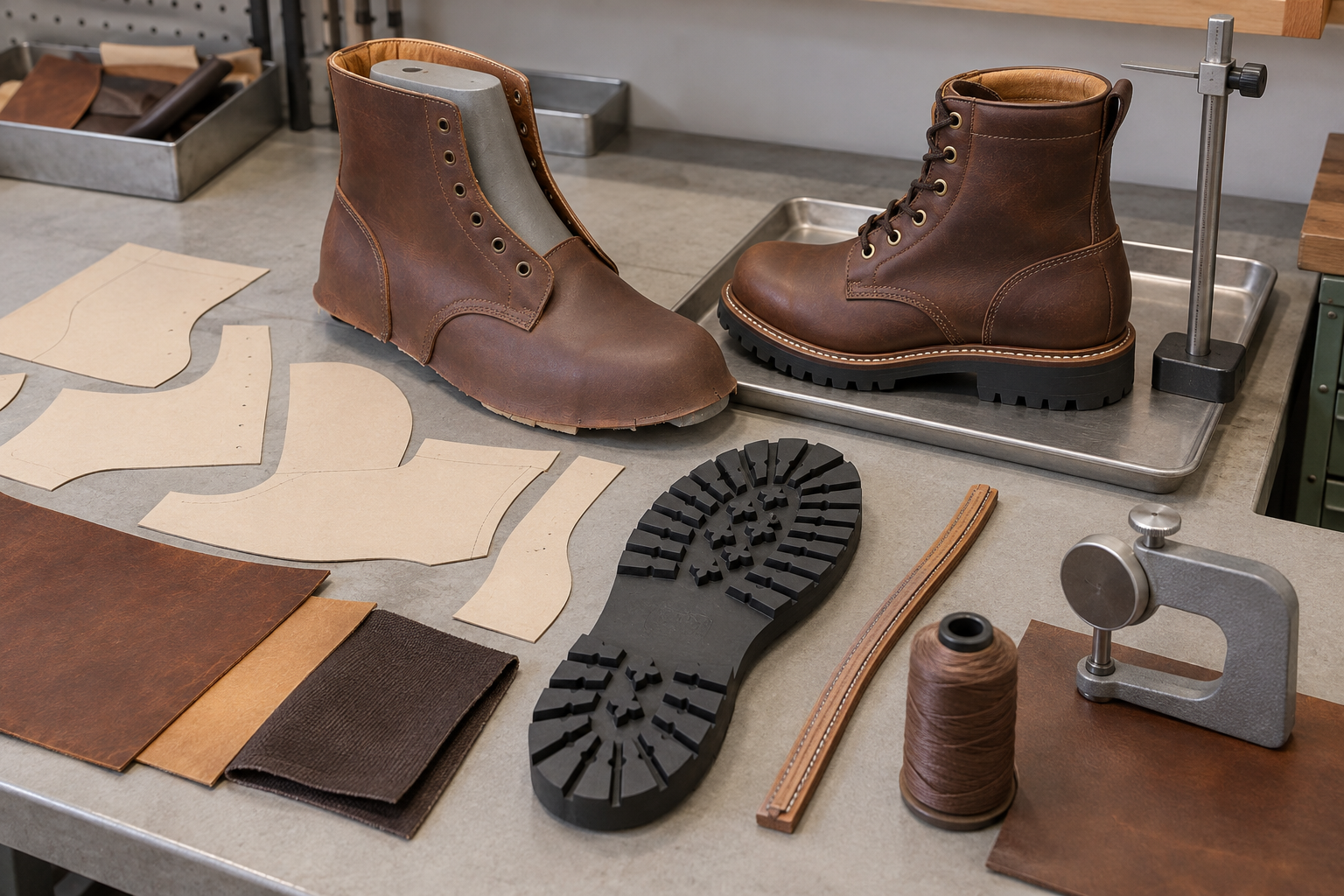
The following values are example assumptions to verify in the supplier quote, not published manufacturer specifications, validated fit requirements, or achieved tolerances. Scope: a proposed brown leather work boot with Goodyear welt construction and a black rubber lug outsole, assessed in a buyer-selected fit-review size.
| Dimension | Example buyer target to verify in the supplier quote | Measurement agreement to request |
|---|---|---|
| Upper leather thickness | 2.0 mm nominal, with allowable variation of ±0.2 mm | Identify the upper components and flat measurement locations; exclude seams and folded layers; agree material conditioning and the thickness-gauge contact setting. |
| Rear upper height | 150 mm nominal, with allowable variation of ±3 mm | Measure vertically from the rear upper-to-welt junction to the collar top with the boot upright; record the selected size and last reference. |
Ask the supplier to confirm whether these targets suit the proposed construction and application. Require alternatives and their effects on fit, materials, tooling, price, and claim evidence to be documented before approval. If Goodyear welt construction is proposed, request its construction specification and sample evidence; Southwest Boot's service listing does not establish another manufacturer's execution.
Keep claims and labeling inside sample approval
If protective performance is requested, require the proposed standard and edition, applicable laboratory report, report date, tested style identifier, materials and construction, tested size coverage, results, and proposed marking. Have a qualified reviewer or laboratory assess whether the evidence covers the offered configuration and how proposed changes affect that coverage. Keep the standard's requirements separate from supplier procedures and buyer-defined acceptance criteria.
Do not present a standard reference or laboratory report as company certification. Require a current document for any certification claim. If protective claims are outside the project scope, record the exclusion and prohibit unsupported protective wording or marks.
Submit proposed country-of-origin marking, size and width identification, style identification, and product and packaging artwork with the approval package. Assign a qualified party to verify applicable United States requirements using the actual manufacturing origin, materials, construction, and import arrangement. Require the review basis and written disposition before printing or bulk release. The cited manufacturing pages are not regulatory sources, and artwork approval is not a substitute for that verification.
Tie development approval to landed cost and delivery
Compare quotations for the same construction, bill of materials, claim scope, size allocation, sampling plan, and tooling arrangement. Require each charge to identify its currency, quantity basis, inclusions, responsible party, quote date, and validity period.
The following figures are example calculations and assumptions to verify in the supplier quote. They are not supplier prices or evidence of production capability.
- Sample-plan example. Scope: the proposed work boot style, using 3 fit-review sizes, 2 sample pairs per size per round, and 2 sampling rounds. Calculation: 3 sizes × 2 pairs per size per round = 6 sample pairs per round; 6 sample pairs per round × 2 rounds = 12 sample pairs. Replace these assumptions with the agreed plan. Do not treat this quantity as evidence of full size-run fit or performance coverage.
- Sample-receiving subtotal example. Scope: those 12 sample pairs sent to a United States review address in 2 shipments, with a shipment for each sampling round. Assume 40 USD per sample pair and 220 USD per courier shipment. Calculation: 12 sample pairs × 40 USD per pair = 480 USD of merchandise; 2 shipments × 220 USD per shipment = 440 USD of courier charges; 480 USD + 440 USD = 920 USD. This partial subtotal excludes development, tooling, insurance, duty, brokerage, taxes, and other charges. Verify shipment grouping and replace every input with quoted or independently verified amounts.
For the approved bulk configuration, request separate lines for development, samples, tooling, merchandise, packaging, freight, insurance, brokerage, applicable duties and taxes, and destination transport or handling. Identify whether each charge applies per pair, shipment, or order, and whether sample or tooling fees are credited later.
Ask the appointed United States customs broker to document classification, valuation, origin-marking review, and applicable import charges using the approved product details and actual manufacturing origin. Do not assign tariff treatment from the phrase work boot alone.
State minimum order quantities by style, color, and size allocation; quantity-based prices; payment milestones; and quote validity. Specify the Incoterms rule, edition, and named place, together with the importer-of-record arrangement and cost responsibilities. Document payment, tooling, acceptance, and remedy terms separately rather than leaving them to a shipping-term label.
Require distinct development-completion, factory-ready, shipment, and United States receiving milestones. Assign dependencies, responsible parties, buyer-review windows, and the contractual delivery date. The change-control procedure should explain how a revised material, pattern, construction, or tool affects approval, cost, and schedule.
Before ordering, agree on inspection location, required records, acceptance window, rejection evidence, and permitted partial shipments. Assign responsibility for rework, replacement, return or corrective freight, and rejected-goods disposition. Unapproved substitutions should not proceed into manufacturing.
Evidence method and limitations
Methodology: This framework separates the attributed manufacturers' descriptions from recommended buyer controls. The sources supply different contexts: rubber-boot development stages, OEM/ODM engineering responsibilities, and development services that include Goodyear welt construction. Their descriptions remain source-specific. Dimensional values are illustrative buyer assumptions; sample totals multiply sizes, pairs, and rounds; the sample-cost subtotal adds merchandise and courier charges. No supplier quotation, measured lead time, or tested performance is inferred.
Author context: Vincent Xi is the Editorial Author. This is a source-based procurement briefing, not a first-hand factory assessment or product-test report.
Limitations and verification: Public service descriptions do not establish the proposed style's tolerances, laboratory coverage, tooling rights, minimum orders, prices, production capacity, or delivery commitments. Request current, dated project evidence and incorporate agreed requirements into the contract. Before award, verify the legal quoting and manufacturing entities, engineering and production locations, subcontracted scope, inspection arrangements, approval authority, and document consistency. Keep unresolved claim evidence, marking questions, and specification deviations on hold rather than treating them as approved assumptions.
RFQ Checklist
- Ask the supplier to identify the legal quoting and manufacturing entities, state whether the project is OEM build-to-print or ODM co-development, and separate buyer-supplied files from supplier engineering deliverables.
- Require the manufacturer to map the quote to construction-specific development, sampling, approval, and inspection stages, identifying deliverables, exclusions, and subcontracted work.
- Specify the intended work use, claim scope, construction, United States size and width notation, size allocation, last and pattern references, component specifications, measurement methods, and acceptance tolerances.
- Ask the supplier to document ownership, reuse, maintenance, access, and transfer rights for patterns, lasts, molds, artwork, and production-ready files, with development and tooling fees listed separately.
- Specify sample pairs per size per round, review and revision responsibilities, shipment grouping, charges, and dated milestones; replace all illustrative dimensions and quantities with agreed requirements.
- Ask the supplier to identify any proposed protective-footwear standard and edition and provide applicable laboratory evidence, or confirm that no protective claim or mark is in scope; require current documentation for certification claims.
- Require the manufacturer to define retained-sample custody, the revision-controlled production transfer package, and the changes that stop manufacturing until written reapproval.
- Specify proposed origin, size and width, product, and packaging artwork for United States review; assign marking-verification responsibility and require documented approval before printing or production release.
- Ask the supplier to quote minimum order quantities by style, color, and size allocation, quantity-based prices, development and tooling charges, currency, payment milestones, validity, and any credits.
- Require a landed-cost responsibility breakdown tied to the approved style, including import and destination charges, the Incoterms rule and edition, named place, United States destination, and importer-of-record arrangement.
- Specify separate development, factory-ready, shipment, and receiving milestones; identify the contractual delivery commitment and agree on inspection, acceptance, partial shipments, remedies, and rejected-goods costs.
- Verify before purchase-order and bulk release that the approved sample record, revision-coded specification, bill of materials, claim evidence, artwork, price, and delivery plan match; define unapproved substitutions as nonconforming.
Discuss Your Requirements
Review our manufacturing capabilities, then share your specifications for a supplier-fit review.