Work Boot OEM Sustainability Sourcing Criteria for United Arab Emirates Buyers
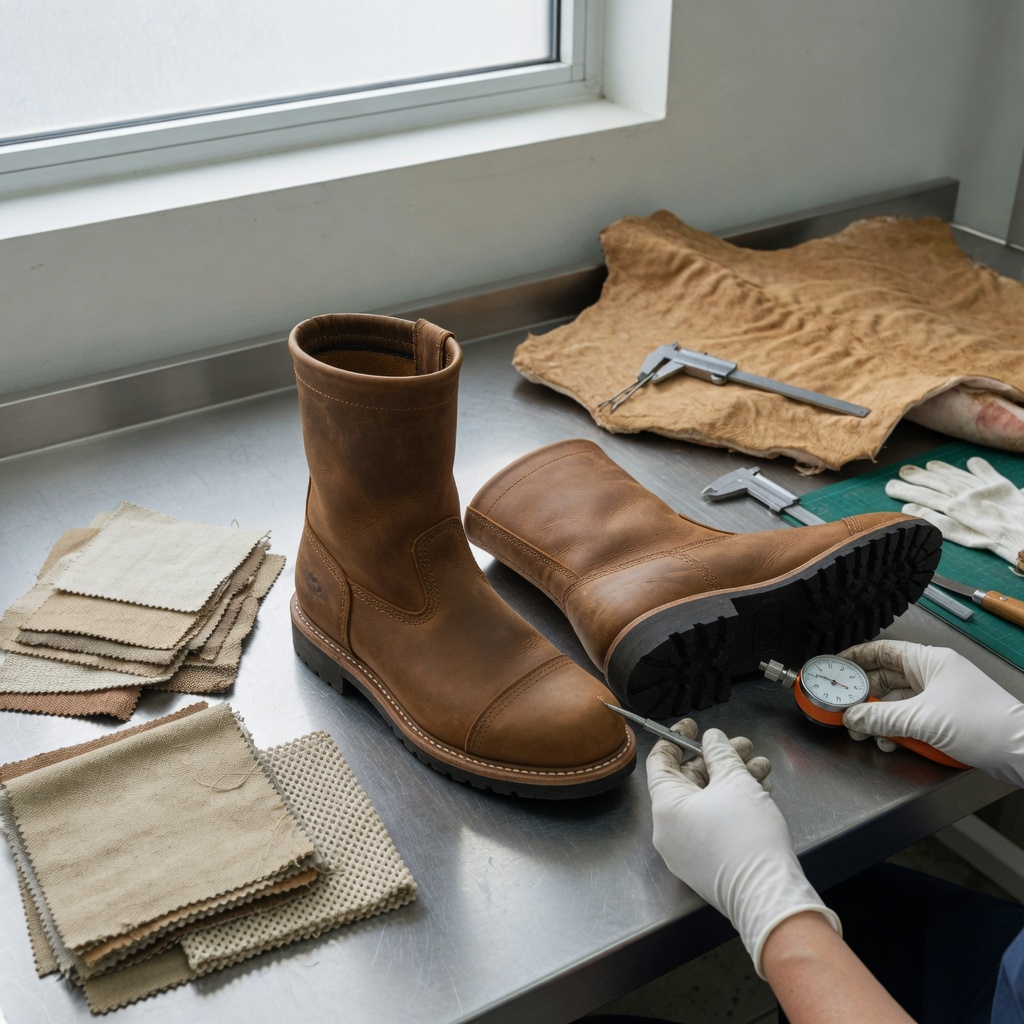
By Vincent Xi, Editorial Author, author profile. This briefing is editorial procurement language for OEM work boot manufacturing. It is not a factory audit, laboratory report, or certification claim for any named mill, tannery, or finished-goods plant, and it does not describe SoleForge production, testing, or certified status.
Decision first. United Arab Emirates buyers specifying OEM work boot manufacturing should freeze sustainability sourcing criteria as contract text before last, tooling, or bulk: named materials, named schemes, named test methods, and named evidence files due with the pre-production sample. Approve a quote only when gold versus silver leather, GRS versus virgin textile components, and site-level social evidence sit as separate lines on the same costing sheet. Brand pages and municipal toolboxes show how other organizations write those clauses. They do not transfer onto the purchase order unless the OEM names the same sites, scopes, lots, and certificate IDs.
A workable pack has four evidence streams:
- Leather: tannery legal name, Leather Working Group (LWG) membership and audit rating, plus a lot-linked declaration that hides are food-sector by-products rather than purpose-raised hide livestock—copying the structure of a published manufacturer leather commitment, not that brand’s numbers.
- Textiles and recycled content: GOTS or GRS claims that match the scheme’s scope for the component that carries the claim, not a whole-boot slogan.
- Finished-boot chemistry and durability: restricted-substance and service-life evidence on the production lot, not only a mill certificate or a prior-season library report.
- Labor: social-compliance evidence mapped to the ILO conventions the buyer writes into the RFQ, a stated living-wage method, and a named third-party program such as EcoVadis, following the template of a public workwear purchasing toolbox.
Reject a sustainability appendix added after tooling; company-wide averages that are not tied to this bill of materials (BOM); a pre-production (PP) sample that cannot point to hide, textile, and outsole lots; and a scheme name with no certificate ID, issue date, scope, and site. Ask the OEM to quantify, on one sheet, any hide-rating floor, verified recycled-content floor, and living-wage documentation line—pair cost, material lead time, MOQ, and approved-vendor list. Ask for paired mass, flex, abrasion, slip, and hydrolysis results whenever a lower-impact substitute is offered. An unpriced “sustainable” option is not a complete pack. Due with the PP sample: leather specification sheet (tannery legal name, LWG membership, audit rating, rating date, percent of upper leather area in this BOM); hide by-product declaration linked to the cutting-ticket lot; GOTS/GRS scope and transaction certificates naming component and lot; lot-level restricted-substance reports for leather, rubber, and foam; paired durability results for any substitute; named cutting, stitching, lasting, and finishing sites with last full social audit date, ILO mapping, living-wage method, and allowed subcontractors; and draft commercial invoice, packing list, certificate of origin, and safety data sheets for adhesives and finishes.
Sustainability sourcing criteria for leather and hide traceability
Leather language should separate three facts buyers often collapse into one logo request: (1) whether the tannery is an LWG member and at what audit rating, (2) whether the hide is a food-chain by-product, and (3) whether the OEM can trace hide lots into the cutting ticket for the buyer’s purchase order. LWG is a tannery environmental audit protocol. A gold-rated tannery does not automatically cover the cemented outsole, metal toe cap, or textile lining.
WorkWear.org’s workwear and sustainability overview is a definitions map for workwear and work footwear. As stated on that page, qualification as sustainable is discussed in terms of raw materials and sources, manufacturing processes, labor practices, and end-of-life disposal, and LWG leather is described in the context of work boot uppers. Use that page as a vocabulary source, not as a certificate for the OEM, and not as proof that any named brand’s supply chain applies to this RFQ. WorkWear.org
Steel Blue’s published leather commitment is a manufacturer practice, not a universal rule, not United Arab Emirates law, and not a SoleForge capability. As stated on that page, the company sources 90 percent of leather for its work boots from LWG member tanneries (unit: percent of that company’s work boot leather; scope: Steel Blue’s stated leather supply, not an industry average and not this RFQ’s BOM; as-of: as published on the cited leather-commitment page), citing one gold-rated Ecco Leather tannery and one silver-rated Tasman Leather tannery, and targeting exclusive gold-rated supply by 2025 (unit: calendar year target; scope: that company’s stated leather-sourcing target; as-of: as published on the cited page—do not treat the target as verified completion). The same page states that all leathers are food-sector by-products rather than from cattle raised for hides, that the firm belongs to Leather Naturally, and that it emphasizes supply-chain transparency to cut carbon footprint. Those tannery names are Steel Blue’s stated sources; they are not an approved-vendor list for a United Arab Emirates OEM program. Steel Blue
Copy the structure of that evidence, not the brand name and not the 90 percent figure. Require the tannery legal name, LWG membership status, and current audit rating (gold, silver, or bronze) on the leather specification sheet; hide origin as a food-sector by-product with a supplier declaration that matches the cutting-ticket lot; and the percentage of LWG-rated leather by area of upper leather in the buyer’s BOM, not a company-wide average from another brand. Distinguish LWG membership, LWG audit rating, and finished-boot claims. Do not accept “LWG boots” as a substitute for a named tannery, rating, rating date, and lot link. Instruct the OEM to show gold-floor versus silver-or-mixed leather as two lines so the United Arab Emirates buying team can approve a rating floor against pair cost and booking window.
Example calculation (assumption to verify in the supplier quote, not a market price and not a SoleForge quote): if upper leather is USD 12.00 per pair (unit: US dollars per pair; scope: upper leather line item only; as-of: example input for the quote workbook) and a gold-rated hide surcharge is 8 percent of that line item (unit: percent of the leather line; scope: example surcharge to price, not a published tannery tariff), the leather line item rises by USD 0.96 per pair. Confirm currency, Incoterm, and whether any surcharge is on hide only or on the full upper assembly.
Textile, recycled-content, and chemical criteria for work boot components
Uppers, linings, laces, stitch thread, foams, and packaged spare laces are where GOTS and GRS claims actually attach. The RFQ fails when it asks for “a GOTS boot.” GOTS is a textile scheme. A GOTS-certified lace or lining does not make the leather upper or rubber outsole GOTS.
WorkWear.org states that GOTS-certified organic textiles appear in work boot laces and uppers, and that GRS covers recycled content of at least 50 percent in boots (unit: percent recycled content; scope: the recycled-content threshold as described on that page for GRS coverage in boots, not a SoleForge specification and not automatically the current GRS standard text; as-of: as stated on the cited WorkWear.org page). Treat that 50 percent figure as a page-level description to verify against the current GRS standard text and the supplier’s transaction certificate, including mill-level versus product-level scope and whether the percentage is by mass of the named component. WorkWear.org
Specify components, not slogans. Name GOTS (or another scheme the buyer selects) only for laces, collar textile, or other in-scope fiber, with scope certificate and transaction certificate IDs matching the PO lot. For mesh lining or recycled polyester collar, set GRS recycled content at least 50 percent by mass of that component as the default floor transcribed from the WorkWear.org GRS note, unless the OEM quotes a higher buyer-set floor (for example 70 percent by mass of that component—example buyer floor to price, not a GRS rule) as a priced option. Use a buyer-owned RSL that names each substance, test method, and detection limit. If the RSL includes chromium VI in leather, azo dyes, PAHs in rubber, or phthalates in foams, require lot-level reports against those named lines. Do not treat this briefing as an RSL, and do not accept a facility sustainability policy PDF in place of a transaction certificate that matches the production lot.
GRS linings and recycled polyester collars can change moisture transport, abrasion, and colorfastness as well as virgin polymer mass. Require paired test reports: the recycled option and the virgin control, same last and same lining pattern, so the buying team can accept or reject the substitution on measured results rather than on a recycled-content percentage alone.
Example calculation (assumption to verify in the supplier quote): if a standard lining is USD 1.80 per pair and a GRS lining (recycled content at least 50 percent of that component) is USD 2.15 per pair on a 5,000-pair first buy (units: US dollars per pair and pairs per lot; scope: lining line item on the first buy only; as-of: example inputs for the quote workbook), the lining delta is USD 0.35 × 5,000 = USD 1,750 for that lot. Ask the OEM to show whether scheme fees are amortized in that delta or billed separately.
Labor, ILO conventions, living wages, and factory audit evidence
Material certificates do not prove labor conditions at the cut-stitch-last plant. The City of Ghent toolbox for socially responsible workwear is a public-purchaser framework, not a private United Arab Emirates contract and not a factory certificate, but it is a concrete template for what “socially responsible” can mean in a bid. That document describes a framework agreement covering workwear, linen, and work shoes produced in a socially responsible manner with third-party verified audits such as EcoVadis, full supply-chain transparency, ILO convention compliance, living wages, and preference for organic fair-trade cotton plus recycled polyester focused on the production phase. City of Ghent toolbox PDF
Translate that template into OEM work boot manufacturing language. Name the production sites (cutting, stitching, lasting, finishing) that will run the buyer’s PO; a headquarters EcoVadis score that excludes the lasting line is not site evidence. Map the ILO conventions the buyer includes in the RFQ to the audit protocol and the date of the last full audit. Require the living-wage method (benchmark name, year, and region of the plant), not a statement that wages meet local law. Require a chain-of-custody list for subcontracted stitching or outsole molding and treat undisclosed subcontracting as a default rejection. Keep social evidence on the same critical-path calendar as material certificates: a late audit is a late PP sample.
If the OEM says EcoVadis-style scorecards, living-wage calculations, and full-site access change overhead or MOQ, those deltas must appear as separate lines. Price a two-plant option only when both plants can run the same last, same safety components, and same material pack. Split production without split traceability defeats the pack.
Durability, restricted substances, and end-of-life without substituting logos for lot evidence
Criteria that ignore durability push cost into replacement pairs and waste. WorkWear.org includes manufacturing processes and end-of-life disposal in its sustainability definition for workwear and work footwear. Use end-of-life as a specified outcome (repairable construction, spare-part list, take-back only if the OEM actually operates one), not as a recycling logo on a cemented boot that cannot be disassembled. WorkWear.org
Put durability and chemistry controls next to environmental claims: safety and service tests that match the buyer’s hazard list (impact, compression, slip, puncture, electrical where specified)—environmental claims do not replace those tests, and this briefing does not assign a safety standard number; flexing, sole adhesion, and hydrolysis ageing on the outsole/midsole system at the same sample size for the standard and lower-impact BOM; restricted-substance results on production-lot leather and rubber against the buyer’s RSL, not on a library swatch from a previous season; and repair rules for replaceable laces, a defined resoling method if offered, and spare-part lead time in the same Incoterm as the boot. If the OEM proposes recycled rubber or bio-attributed polymer in the outsole, require a mass-balance or physical-content statement and the test delta versus the incumbent outsole. A percentage of recycled content with no slip or abrasion numbers is incomplete.
Example calculation (assumption to verify in the supplier quote, not a warranty and not field data): if a standard pair is specified for 12 months of rotational wear and a lighter recycled-foam footbed is quoted with a 9-month expected replacement interval (units: months of stated wear interval; scope: example footbed substitution on one wearer roster; as-of: example inputs pending OEM test data), replacement frequency rises from 1.00 to 1.33 pairs per wearer-year. On an 800-wearer United Arab Emirates site roster (unit: wearers; scope: example roster size to price, not a published headcount) that is 800 × 0.33 = 264 extra pairs per year before any durability test has confirmed the 9-month figure. Use the OEM’s actual warranty and test data, not this example, to approve the foam.
United Arab Emirates manufacturing RFQ checks that stay on the product
Keep the product and the RFQ primary: the task is to approve an OEM work boot manufacturing specification for United Arab Emirates buyers, not to publish a country guide. Name operating conditions only as buyer-owned test inputs the OEM must design against, and name import files only as documents the buyer will verify with its broker. The three source pages used for this briefing do not set United Arab Emirates technical regulations, so this section does not invent labeling statutes, duty rates, or ESMA numbers.
Ask the OEM to quote against the buyer’s stated service conditions and document pack:
- Climate inputs the buyer supplies: storage and job-site temperature range, humidity, UV exposure, and chemical splash list. Request heat-ageing and hydrolysis data for the outsole and adhesive system against those inputs. Do not treat a stock “hot-climate” story as evidence.
- Landed-cost sheet in the quote currency, with material sustainability uplifts shown as separate lines (LWG leather, GRS lining, audit surcharge) so the United Arab Emirates buying team can accept or reject each uplift. This briefing does not assign a duty, freight, or clearance figure.
- Shipment documents the buyer’s broker will check: commercial invoice, packing list, certificate of origin, material certificates, safety data sheets for adhesives and finishes, and any restricted-substance declarations. Do not treat a sustainability one-pager as a substitute for those files.
- Arabic/English marking only as the buyer specifies in the artwork kit. This article does not assert a statutory mark-up list.
If a factory offers a “UAE climate boot” as a stock story, still require the same lot-level certificates and tests as any other OEM run. Geography is not evidence.
Buyer decision table: specify, compare, verify, approve
Use this table in the RFQ. Each row is a decision the United Arab Emirates buying team can sign.
| Criterion | What to specify in the OEM pack | Evidence to request | Compare / trade-off | Approve or reject rule |
|---|---|---|---|---|
| Upper leather rating | LWG member tannery; rating floor (e.g. silver or gold); % of upper leather area in this BOM | Current LWG audit summary, tannery legal name, rating date | Gold vs silver vs mixed; hide line and booking lead time as quoted | Reject if rating is company-wide and not tied to this hide lot |
| Hide origin | Food-sector by-product declaration; country of slaughter/tannery | Supplier declaration + lot link to cutting ticket | By-product hide vs unspecified hide | Reject purpose-raised-hide language or missing lot link |
| Recycled textile / polymer | GRS (or equal) on named component; recycled content at least 50% of that component unless a higher floor is priced | Scope certificate, transaction certificate, mass % worksheet | 50% vs higher % vs virgin control on abrasion/colorfastness | Reject product-level claim with only a facility certificate |
| Organic textile parts | GOTS on laces, collar, or lining only where the fiber is in scope | GOTS scope + TC IDs matching the PO | Organic lace cost vs conventional lace; no “GOTS boot” claim | Reject whole-boot GOTS claims for leather/rubber product |
| Chemical / RSL | Named buyer RSL; substances, test methods, and limits the buyer lists | Lot-level lab reports on leather, rubber, foam | Extra lab cost vs library reports from a prior season | Reject library reports older than the buyer’s stated validity window |
| Durability vs lower-impact BOM | Paired tests: incumbent vs proposed recycled/bio option | Flex, adhesion, slip, hydrolysis, wear-interval estimate | Pair cost vs replacement frequency | Reject environmental option that fails the buyer’s safety tests |
| Social compliance | Named sites; ILO mapping as written in the RFQ; living-wage method and year; audit program (e.g. EcoVadis-style third-party verification as in the cited public workwear toolbox) | Site audit, CAPA log, subcontract list | MOQ and overhead vs dual-plant quotes | Reject HQ-only scores and undisclosed subcontracting |
| Traceability | Hide, textile, and outsole lot IDs on the PP sample and bulk | Chain-of-custody file with the PP sample | Admin time vs recall speed | Reject PP sample that cannot point to lots |
| End-of-life / repair | Spare laces, defined resoling if offered, parts lead time | Parts price list and construction method | Repairable welt vs sealed cement | Reject take-back claims with no operator or logistics |
| UAE document pack | Landed-cost lines; SDS; origin; certificates the buyer’s broker will file | Draft document set with the PI | Incomplete docs vs delayed clearance | Do not approve bulk until the draft pack is complete |
RFQ checklist for OEM work boot manufacturing
Every item below is a specify, compare, verify, approve, or order action.
- Specify last, safety components, and dual-column BOM (incumbent vs sustainability option), same pair count.
- Specify LWG tannery, rating floor, rating date, BOM-area percentage, and lot-linked food-sector hide declaration.
- Specify GRS only on named components at at least 50 percent by mass as described on WorkWear.org, with priced higher floors; GOTS only on in-scope textiles.
- Specify buyer RSL, lot-level reports due with the PP sample, and paired flex, adhesion, slip, and hydrolysis tests for substitutes.
- Specify sites, subcontractors, ILO mapping, living-wage method (name, year, region), and last full-audit date.
- Compare FOB/CIF, lead time, MOQ, and separate LWG, GRS, and audit lines; compare replacement intervals from OEM tests.
- Verify scheme IDs (LWG, GRS, GOTS, EcoVadis or equal), PP lot IDs, and the draft broker pack before approval.
- Approve artwork and Arabic/English marking after evidence is complete; order bulk with change control and spare laces on the same PO.
Evidence, method, and what to verify before you place the PO
Source contexts. This briefing uses three public sources: WorkWear.org’s definitions-and-certifications page for workwear and work footwear (GOTS in laces/uppers, GRS recycled-content coverage of at least 50 percent in boots as that page states it, LWG leather described in work boot uppers); Steel Blue’s leather-commitment page (90 percent of that company’s work boot leather from LWG member tanneries, one gold-rated Ecco Leather source and one silver-rated Tasman Leather source, exclusive gold-rated target by 2025, food-sector by-product hides, Leather Naturally membership as stated there); and the City of Ghent toolbox PDF for socially responsible workwear, linen, and work shoes (EcoVadis-type third-party audits, supply-chain transparency, ILO compliance, living wages, preference for organic fair-trade cotton and recycled polyester in the production phase).
How the data were derived. Numbers, scheme names, and purchasing-template language were transcribed from those pages as editorial inputs for RFQ language. No laboratory testing, factory visit, certificate authentication, or first-hand production review was performed for this article. Brand practices (Steel Blue) and public-purchaser tools (Ghent) are cited as examples of how others write criteria, not as SoleForge capabilities, not as approved mills for this BOM, and not as United Arab Emirates law. Example pair-cost and replacement-interval figures are labeled assumptions to verify in the supplier quote.
Limitations / what to verify. Scheme rules change; confirm current LWG rating protocols, GRS recycled-content and labeling rules, GOTS fiber scope, and EcoVadis coverage with the issuing organizations and with certificates that name the actual sites on the purchase order. The 90 percent leather figure is Steel Blue’s stated share for its work boots, not an industry average and not a SoleForge metric. The 50 percent GRS figure is the recycled-content threshold as stated on WorkWear.org and must be checked against the current GRS standard and the mill transaction certificate. The Ghent toolbox is a municipal purchasing aid (document filename dated 1406) for workwear, linen, and work shoes; it is not a United Arab Emirates regulation and not a private OEM contract. This article does not assign ESMA, customs, or duty values. United Arab Emirates buyers should verify import files with their broker and should run climate and chemical-exposure tests against their own job-site list. Do not treat LWG, GOTS, GRS, Leather Naturally, or EcoVadis names in this briefing as proof that any factory is currently certified.
This specification pack covers work boot OEM sustainability sourcing criteria for manufacturing programs sold to United Arab Emirates buyers. Adjacent topics (consumer retail ratings, unrelated product families, or other country guides) are out of scope.
Discuss Your Requirements
Review our manufacturing capabilities, then share your specifications for a supplier-fit review.