Work Boot Sourcing Product Development Capability for Canadian Procurement
Byline: Vincent Xi, Editorial Author, https://www.soleforgefootwear.com/authors/vincent-xi/
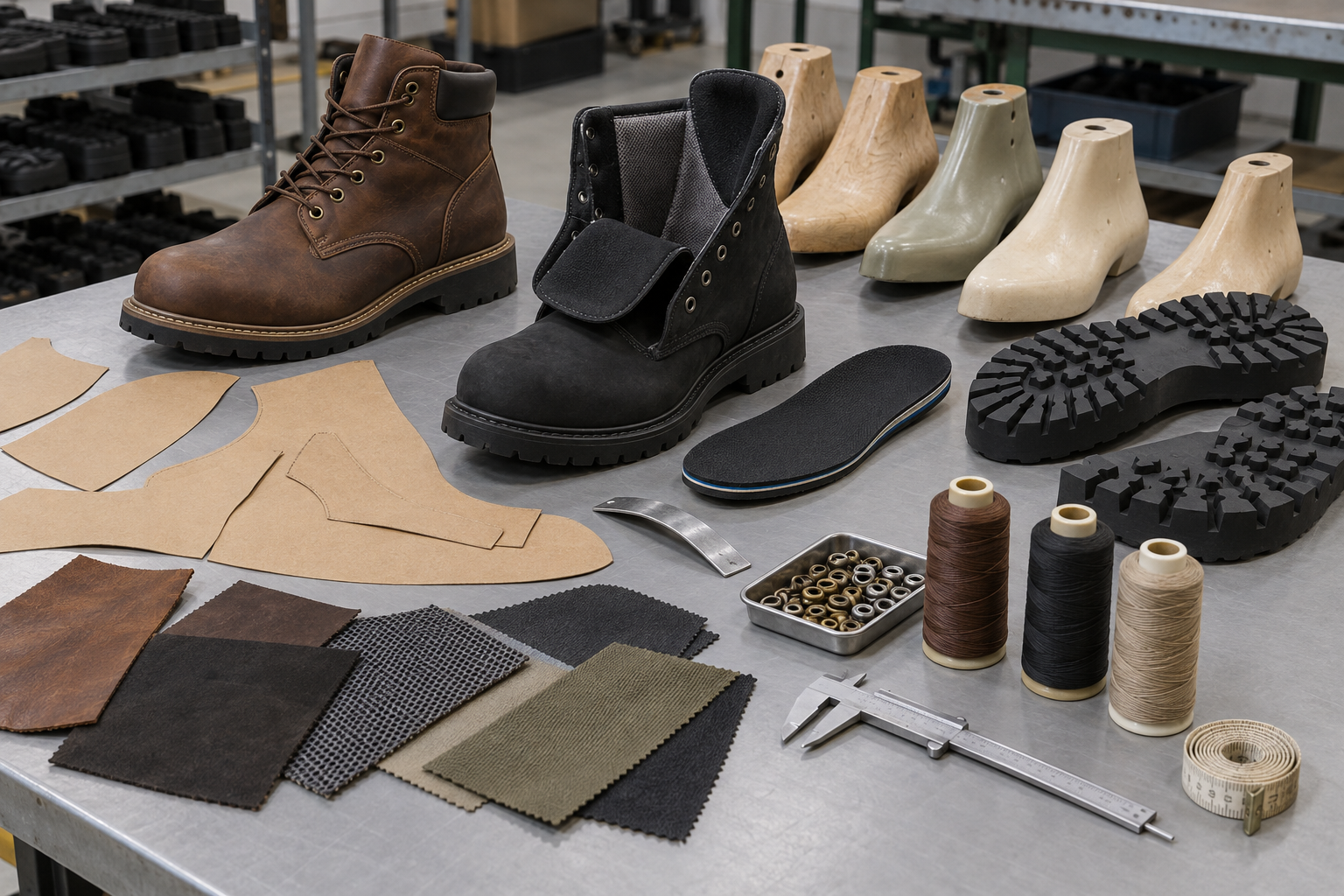
Canadian buyers running work boot sourcing should evaluate product development capability before comparing unit prices. For industrial procurement teams in Canada, the critical question is whether a footwear manufacturer can transform a concept sketch, reference boot, or preliminary specification into an engineered production package. That requires building and controlling the last, grading patterns across target sizes, selecting uppers and outsoles, and running disciplined sample rounds that freeze the technical package before purchase orders are signed. Industry sourcing guidance highlights pattern making, last development, material and outsole consultation, and iterative sample revisions as the foundational tests of an OEM boot manufacturer, alongside quality control, minimum order quantity (MOQ) flexibility, and export capability (How to Choose the Right Boots Manufacturer). Meanwhile, published OEM process documentation outlines a 90-day sketch-to-shelf custom boot workflow using digital design and rapid prototyping, with material and tooling sourcing running concurrently from day 15 (From Sketch to Shelf in 90 Days). Similarly, specialized bootmakers list product development, prototyping, material consultation, pattern making, and grading as core manufacturing capabilities across small-batch and full-scale runs (Manufacturing - Southwest Boot Company). These published benchmarks provide criteria to audit in supplier bids, but they must be calibrated against Canadian delivery, testing, and sign-off requirements.
This editorial review relies exclusively on publicly documented manufacturer capabilities and explicit buyer-side calculations. It includes no search-traffic metrics or commercial performance estimates, and claims no direct wear-testing or on-site factory audits.
What product development capability means for work boot procurement
In work boot procurement, product development capability represents the engineering bridge between an initial buyer brief and a locked, repeatable manufacturing bill of materials. A pre-existing stock catalog or a broad claim of custom flexibility does not satisfy this requirement. Development controls ensure that fit, protective geometry, and material specifications remain identical across repeat reorders.
Herrains advises sourcing teams to assess whether a prospective boot manufacturer can translate rough design concepts into production-ready specifications, draft master patterns, develop physical lasts, advise on leather and outsole selection, and execute disciplined sample revisions (How to Choose the Right Boots Manufacturer). While the same analysis notes the importance of material supply chains, export logistics, and flexible batch volumes, commercial flexibility cannot compensate for missing pattern files or untracked last modifications.
Southwest Boot Company structures its manufacturing scope around dedicated product development and prototyping, raw material sourcing, pattern grading, bench construction, and integrated quality control across both small-batch and high-volume work boot programs (Manufacturing - Southwest Boot Company). While representative of technical bootmaking, stated factory workflows must be verified during commercial negotiations rather than assumed to apply across every prospective vendor.
Canadian procurement teams should partition every development tender into explicit technical stages:
- Design translation: Defining who translates the 2D sketch or reference footwear into graded technical drawings and cross-sectional construction files.
- Last development: Determining who designs, tests, and owns the foot lasts, and documenting approval gates for instep, toe-box clearance, and heel cup volume.
- Pattern drafting and grading: Identifying who cuts original master patterns and oversees dimensional grading across the complete Canadian size run.
- Material consultation: Evaluating recommendations for full-grain uppers, abrasion-resistant linings, puncture-resistant midsoles, shanks, and slip-rated outsoles.
- Sample iteration cycles: Capping the number of physical sample iterations included in development fees and defining what milestone each round locks.
- Production technical package: Archiving the finalized bill of materials, stitch density guidelines, lasting tolerances, and assembly notes for production runs.
While logistical terms and low batch minimums facilitate market entry, descriptive claims of small-batch agility or international export experience do not specify freight transit times to Canadian receiving hubs (How to Choose the Right Boots Manufacturer; Manufacturing - Southwest Boot Company). All volumetric thresholds and shipment timelines must be defined numerically in the quotation.
How Canadian buyers should test a stated development calendar
The single structured timeline documented in the reviewed literature is Jinhua Shoes' OEM boot calendar: custom technical boots delivered from sketch to shelf in 90 days via digital modeling, 3D prototyping, and parallel sourcing of materials and outsole molds starting on day 15 (From Sketch to Shelf in 90 Days). The scope applies to technical OEM boot development, measured in sequential days as stated in source materials reviewed without an explicit original publication date. While this offers a baseline for compressed development, Canadian buyers must treat these intervals as supplier targets that require verification against their own testing gates.
Two concrete operational data points emerge from that published model:
- 90 days: The total stated duration from initial concept sketch to completed stock for custom technical boots.
- Day 15: The designated development stage where raw material acquisition and mold tooling are launched concurrently with pattern adjustments.
A third critical metric is an example calculation that procurement teams should incorporate into their vendor bids rather than accepting vendor claims at face value. Assuming a standard protocol of 3 sample rounds, with each physical iteration quoted at 14 calendar days for fabrication and fit evaluation, sampling alone requires 3 x 14 = 42 calendar days prior to final purchase order authorization and international shipping to Canada. If a supplier's quote limits development to a single prototype round inside an advertised 90-day schedule, the buyer is acquiring a compressed schedule by sacrificing iterative fit validation.
Concurrency introduces definite financial risk. Launching leather tanning and outsole tooling on day 15 compresses critical paths (From Sketch to Shelf in 90 Days), but initiating physical mold cutting before fit trials finish risks costly tooling scrap. If fit checks reveal inadequate toe clearance or poor heel lock, modifying finished steel dies or re-ordering leather creates substantial delays. Canadian buyers must require vendors to establish written approval gates that freeze upper geometries before tooling deposits are released.
Canadian master schedules must also account for sample transit into Canada, internal technical review, workplace wear evaluations, and third-party laboratory verification. Because manufacturing methods vary significantly between cemented, Goodyear-welted, and direct-injection safety boots, quotes should explicitly detail how construction choices affect the prototype calendar.
Decision table: compare product development capability before you shortlist
Score competing vendors using concrete technical evidence rather than promotional claims:
| Development Control | Buyer Specification | Supplier Quote Evaluation | Required Evidence | Release Gate |
|---|---|---|---|---|
| Design Translation | Concept sketches, physical reference boot, or detailed tech pack | In-house CAD drafting team versus outsourced design brokers | Detailed technical drawings and resolution log for design queries | Do not release last production until upper geometry is approved |
| Last Engineering | Standard width, high-instep, or safety-toe last parameters | Proprietary owned lasts, licensed forms, or buyer-funded tooling | Unique last identification codes and recorded dimensional specs | Lock last identification code directly on approved sample |
| Pattern & Grading | Base sample size (e.g., Men's 9) and full Canadian grading range | Documented pattern making and CAD grading protocols | Pattern component index and proportional grading rules | Restrict grading changes once fit approval is documented |
| Material Selection | Full-grain leather, moisture-wicking lining, puncture board, outsole spec | Tailored material consultation versus static catalog defaults | Detailed bill of materials listing certified vendor choices | Lock raw material suppliers before cutting bulk materials |
| Tooling Concurrency | Outsole mold requirements, steel shank dies, toe-cap tooling | Tooling investment timeline versus sample acceptance milestones | Written sign-off criteria before cutting production dies | Authorize mold investment only after prototype fit sign-off |
| Sample Revision Cycles | Number of prototyping rounds covered under development fees | Permissible structural revisions per prototyping stage | Sample serial numbers, tracking logs, and formal revision notes | Issue production PO solely against signed sample serial number |
| Pre-Production QC | Critical tolerances for lasting, welt stitching, and bond strength | In-line construction checks versus post-assembly visual audits | Quality control inspection checklist aligned with build method | Block production runs if sample build diverges from quotes |
| MOQ & Batch Scaling | Trial batch size versus planned initial commercial volume | Explicit numeric order minimums across style, color, and size | Written volume commitments and tiered pricing tables | Require identical construction standards for trial batches |
| Delivery to Canada | Specified Incoterms (e.g., DDP, DAP, FOB) to Canadian facility | Freight booking ownership and export documentation management | Segregated line items for product, molds, samples, and shipping | Execute purchase orders only with clear delivery and acceptance terms |
These criteria synthesize capability categories established by Herrains (development, material sourcing, QC, MOQ flexibility, export processes) and Southwest Boot Company (prototyping, pattern design, material consulting, construction, quality management) (How to Choose the Right Boots Manufacturer; Manufacturing - Southwest Boot Company).
Trade-offs that change cost, fit, and the production file
Custom lasts versus speed to market. Developing a proprietary last provides tailored fit and toe-box volume, but requires extended pattern tuning. Selecting an off-the-shelf factory last shortens lead times, yet limits upper styling and ergonomic adjustments. While industry sources detail last development and pattern grading capabilities, they do not publish fixed schedules for last fabrication (How to Choose the Right Boots Manufacturer; Manufacturing - Southwest Boot Company). Buyers should demand separate quote items for last carving and pattern grading rather than accepting an unitemized turnaround estimate.
Parallel tooling versus risk of mold modifications. Initiating mold fabrication on day 15 of a 90-day OEM schedule accelerates manufacturing lead times (From Sketch to Shelf in 90 Days). However, ordering custom rubber outsoles or safety-toe tooling before completing dynamic wear trials can result in scrapped molds if pattern lines shift. A sequential model—authorizing tooling investments only after final sample fit approval—extends project timelines but protects capital. Procurement proposals must specify which workflow governs the quoted timeline.
Included prototyping rounds versus billable change orders. Iterative sample adjustments are central to proving engineering capability (How to Choose the Right Boots Manufacturer). While extra revisions refine boot comfort, each stage adds manufacturing and courier days. The benchmark calculation of 42 calendar days (3 cycles at 14 calendar days each) illustrates the scheduling impact of thorough sampling. If an initial quotation includes only 1 or 2 iterations and bills subsequent revisions as change orders, overall program costs escalate rapidly. Vendor quotes must clearly identify the count of included sample rounds, turnaround times per round, and excess revision fees.
Component consultation versus an auditable production file. Material consultation must translate into an unchangeable specification file (How to Choose the Right Boots Manufacturer; Manufacturing - Southwest Boot Company). Relying on generic factory materials accelerates development but risks unvetted performance in cold, damp Canadian operating conditions. Quality management systems cited in OEM literature describe internal factory disciplines rather than formal certification (From Sketch to Shelf in 90 Days; Manufacturing - Southwest Boot Company). Similarly, broad claims of small-batch support or flexible minimums do not guarantee specific pair quantities. A development project is successful only when the buyer retains a transferable production package: unique last identifiers, graded patterns, detailed bills of materials, assembly tolerances, and signed reference samples. Supplier manufacturing origin must be recorded as an operational parameter that does not dictate landed shipping terms into Canada.
What to verify on the technical package before a Canadian release
A work boot style should be cleared for bulk production only when the technical file is complete enough for an independent factory to manufacture without technical ambiguity. Require documented deliverables across all core engineering stages:
- Final production CAD files and master drawings that resolve all prototype queries.
- Unique last serial numbers, noting whether forms are proprietary, shared, or adapted.
- Complete graded pattern files covering the contracted Canadian size range.
- An itemized bill of materials naming leathers, lining weights, eyelets, safety components, and outsoles.
- Prototyping history logs detailing modifications, rejections, and the signed sample serial number.
- In-process quality control protocols that match the contracted manufacturing method.
- A staged timeline spanning initial drafting, last approval, sampling, tooling authorization, bulk assembly, and Canadian shipping. If a supplier promises a 90-day delivery cycle, map quoted milestones against that target.
A fourth concrete data point to model during procurement planning is an example logistics calculation. If air courier transit between the overseas sample facility and a Canadian review office requires 5 calendar days in each direction, each sample iteration incurs 10 calendar days of transit. Across 3 sampling iterations requiring 14 days of fabrication each, courier transit adds 3 x 10 = 30 calendar days. Total sampling time reaches 42 + 30 = 72 calendar days before final production sign-off. This logistical reality must be factored into commercial delivery commitments.
Specific standards for Canadian occupational footwear safety ratings and bilingual packaging/labeling regulations are not defined in the reviewed manufacturer sources. Buyers must not assume compliance based on generic OEM capability descriptions. Procurement teams must demand valid, third-party laboratory test reports that identify active standards, test methods, revision years, and required French/English labeling layouts before authorizing bulk manufacturing. Strong product development capability executes these requirements, but does not replace formal compliance documentation.
How this brief was derived, and what it cannot decide
Method. Factual findings in this analysis are synthesized from three publicly accessible manufacturer resources: Herrains' guide to choosing a boots manufacturer, Jinhua Shoes' OEM custom boot process documentation, and Southwest Boot Company's manufacturing scope page. Exact quantitative markers are derived from these sources or explicitly presented as buyer-side sample calculations. Sourced operational numbers include the 90-day sketch-to-shelf duration and the day-15 concurrent sourcing milestone from Jinhua Shoes, verified during editorial source review without a published original document date. The 42-calendar-day sampling figure and 72-calendar-day total evaluation timeline are operational modeling examples based on 3 sample iterations, a 14-day build cycle, and 5-day international shipping legs. This brief excludes search-volume estimates and web traffic metrics. The author byline is Vincent Xi, Editorial Author (profile: https://www.soleforgefootwear.com/authors/vincent-xi/). The author's role is editorial synthesis of published supplier capabilities; no direct on-site factory audits, third-party lab accreditations, or field trials are claimed.
Limitations. Published supplier descriptions may not reflect current factory capacity or proprietary commercial terms. Procurement professionals should review source links directly to confirm active terms and capabilities. The 90-day timeframe and day-15 concurrency target describe a specific OEM supplier's technical boot workflow rather than an industry standard. Southwest Boot Company's documentation outlines domestic U.S. manufacturing practices and broad batch terminology without publishing minimum pair counts. Herrains provides selection criteria rather than binding contract terms. None of the cited pages provides landed Canadian freight tariffs, bilingual packaging rules, or accredited Canadian safety certificates. Where source literature is silent, buyers must obtain direct contractual confirmations.
RFQ Checklist
- Ask the supplier to list who performs last development, pattern making, grading, material and outsole recommendation, sample revisions, and the production technical package for this work boot style.
- Require the manufacturer to state how many sample rounds the development price includes, what each round may change, the quoted days per round, and the fee for an added round.
- Specify the design input you will send, the master size, the size run, and the fit points that must close before the last is frozen.
- Ask the supplier to name the approval gate that must pass before materials and tooling are sourced concurrently, and to price tooling on its own line item.
- Require the manufacturer to attach a bill of materials and construction notes that match the sample submitted for approval, with sample QC notes for that construction.
- Specify the delivery term to price for your Canadian receiving site, and require separate amounts for goods, samples, tooling, and freight.
- Require the manufacturer to provide current documentation for any standard, test report, or Canadian label requirement, including standard edition and date, before signing off on the technical file.
- Specify that production purchase orders will be released only against an approved sample ID and a frozen last ID after matching quoted timelines to Canadian review milestones.
- Ask the supplier to state the numeric minimum order quantity, the unit (pairs per style, color, or size), and whether trial batches use the identical pattern and construction as bulk production.
Discuss Your Requirements
Review our manufacturing capabilities, then share your specifications for a supplier-fit review.