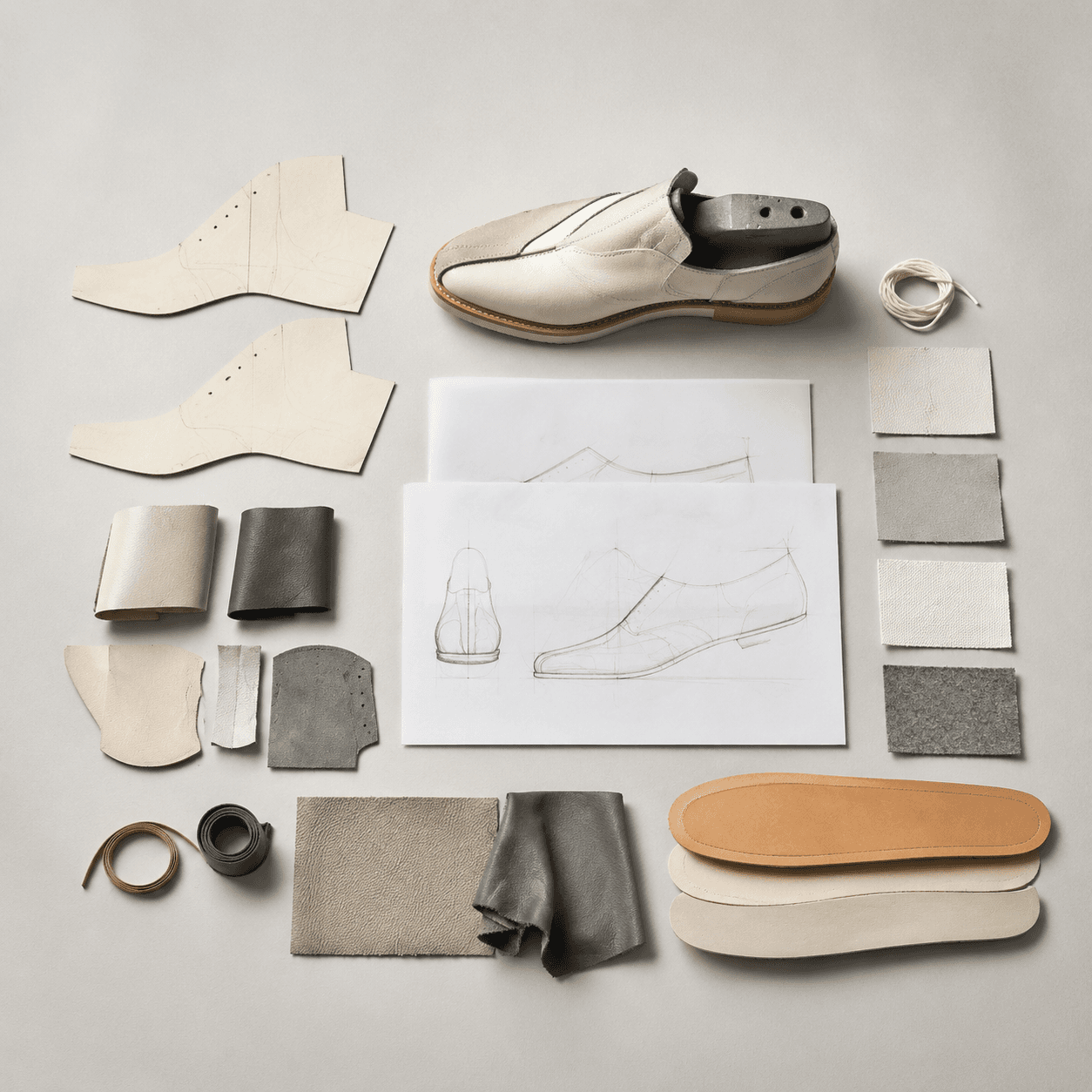
Custom basketball shoes require tighter engineering control than most casual or running-inspired programs because court use puts more stress on lateral support, outsole bonding, and fit consistency. For sourcing managers buying from China, the main risk is not artwork approval. It is whether the factory has locked the last, support package, foam density, rubber hardness, and test standard before sample confirmation.
A reliable basketball shoe manufacturer will normally qualify the project in the first discussion with six points: target FOB, order quantity by color, intended level of play, size range, outsole ownership, and target ship window. Those inputs determine whether the project should stay on an existing bottom unit or move to new tooling. They also decide if the requested specification is commercially realistic at the stated volume.
For importers planning team basketball shoes bulk orders, the most expensive mistakes are usually hidden inside the shoe: underspecified heel counters, weak shanks, low-density collar foam, or soft outsole compounds chosen to save cost. The article below treats custom basketball shoes as an OEM specification and cost-control exercise, with concrete guidance on materials, pricing, lead time, and factory quality control.
In custom basketball shoes, the hidden support package usually determines claim rate more than the logo, print, or box design.
How Chinese factories usually scope custom basketball shoes
Most factories quote custom basketball shoes under three development routes. The first is logo and color customization on an existing platform. In that model, the outsole mold, last, strobel shape, and much of the bottom construction stay unchanged, while the buyer customizes upper panel layout, branding, color blocking, sockliner print, and packaging. The second route is a semi-custom build using a stock outsole and last with a new upper pattern, revised eyestay, and changed support parts. The third is full OEM with a dedicated outsole mold, unique sidewall geometry, proprietary tread, and multiple rounds of wear-test revision.
From a supplier-side view, the first technical question is not colorway. It is whether the project needs exclusive tooling. For distributors, school contracts, and repeat team basketball shoes bulk business, existing molds usually make better commercial sense because they remove a 3,000 to 8,000 dollar outsole mold charge and cut roughly 20 to 40 days from development. For a retail brand building a long-term line, exclusive tooling may be justified because mold ownership affects design control, margin protection, and reorder leverage.
Target FOB must match the requested play level. A low-top training or school model at FOB 15.00 to 19.50 dollars per pair usually uses 250 to 320 GSM sandwich mesh, 1.2 to 1.4 mm microfiber, single-density phylon, and solid rubber in the mid-60 Shore A range. A stronger club or retail model at FOB 22.00 to 34.00 dollars per pair can support 320 to 420 GSM mesh, larger TPU quarter pieces, better collar foam recovery, strobel inserts, and stricter bond and abrasion targets. If the BOM and FOB are misaligned at quotation stage, the factory will usually remove cost from hidden components unless the purchase specification prevents it.
- 01Define the end use first: school issue, training, club competition, or retail performance. This sets the support package and test threshold.
- 02Fix the commercial frame early: target FOB, order quantity by color, size range, and whether tooling must be exclusive.
- 03Choose the development route: existing bottom, semi-custom upper on stock tooling, or fully new outsole and support mold.
- 04Approve the BOM, test methods, and material tolerances before size-set. That is the point where later claim risk is controlled.
Construction choices that drive performance, claim rate, and FOB
Upper construction is visible to the buyer, but internal support parts decide whether the shoe survives court use. A standard basketball upper may combine sandwich mesh or engineered textile with microfiber, PU film, hot-melt overlays, eyelet webbing, and quarter support reinforcements. Cost-down pressure usually removes material from the lateral forefoot, eyestay, or heel quarter first. Those changes can save a few tenths of a dollar per pair, but they increase the risk of lace-row distortion, upper collapse, and rollover complaints.
Midsole specification should be written in measurable values, not descriptive language such as soft, responsive, or premium. For team-level custom basketball shoes, standard EVA or phylon density often sits around 0.18 to 0.25 g/cm3, commonly with hardness around C45 to C60 Asker depending on sidewall stability and underfoot feel. If the density drops too low, the midsole may feel plush in sample review but lose shape quickly in wear. Higher-tier projects may add eTPU, TPEE-based supercritical foam, or a strobel cushion insert, but every added layer increases molding tolerance demands, bonding risk, and cost.
Outsole engineering has direct impact on wear claims. Indoor-focused compounds typically run softer, around 55 to 60 Shore A, for better tack on cleaner courts. Mixed-use or outdoor-oriented programs often move toward 62 to 68 Shore A to improve DIN abrasion performance and reduce edge wear. Tread depth usually falls between 3.0 and 5.5 mm, and the rubber gauge at high-wear zones should be checked separately because a visually deep pattern can still wear fast if crown thickness is too thin.
The most commonly downgraded components in a commercial quote are the ones the buyer cannot see after assembly: lasting board, shank, heel counter, toe puff, and foam package. In basketball shoes, a short or low-rigidity shank can create unstable torsion even when the outsole looks substantial. A heel counter with insufficient gauge can cause heel slip and quarter deformation after only a short period of use. Buyers that want predictable output should request either a cut-open confirmation sample or a component board signed against the approved BOM before production starts.
Upper materials
Commercial upper specifications often include 250 to 420 GSM sandwich mesh, 1.2 to 1.6 mm microfiber, 0.8 to 1.2 mm synthetic film, and lining in the 120 to 220 GSM range. Tongue and collar foam are commonly 8 to 15 mm thick, but thickness alone is not enough. Density and rebound matter because low-density foam packs down quickly and reduces lockdown after repeated wear.
Midsole and cushioning
For most opening-price custom basketball shoes, single-density phylon remains the safest industrial choice because molding consistency, dimensional stability, and bond reliability are easier to maintain across production. Dual-density sidewalls, drop-in insoles, supercritical inserts, and embedded cushioning units can improve ride and rebound, but each added process step increases scrap risk and sample iteration time.
Outsole and support package
A strong basketball shoe manufacturer should specify rubber hardness, DIN abrasion target, shank material, heel counter standard, lasting board type, and flex expectation in the tech pack. If the quotation only describes color and branding, the supplier is quoting appearance rather than performance.
Typical OEM cost drivers for custom basketball shoes
| Component / Cost Driver | Typical Range | Notes |
|---|---|---|
| MOQ | 600-1,200 pairs/color on existing tooling; 1,500-3,000+ pairs/color on new tooling | MOQ rises when outsole, shank, stabilizer, or support parts are exclusive |
| FOB price per pair | $15.00-$22.00 team/basic model; $23.00-$38.00 retail/performance model | Typical China OEM FOB before freight, duty, and retailer compliance cost |
| Outsole mold fee | $3,000-$8,000 standard; $8,000-$12,000+ complex | Adult size range only in many cases; translucent or multi-part molds cost more |
| Prototype lead time | 10-18 days | Assumes stock bottom unit and locally available upper materials |
| Second sample revision | 7-14 days | For fit correction, support adjustment, and color updates |
| New tooling development | 18-35 days | From CAD approval to first mold trial sample |
| Bulk production lead time | 45-75 days typical; 75-90 days peak season | After sample approval, deposit, and material booking |
| Upper material spec | 250-420 GSM mesh; 1.2-1.6 mm microfiber; 120-220 GSM lining | Higher GSM and thickness improve support but raise cost and weight |
| Midsole foam | EVA/phylon density 0.18-0.25 g/cm3; C45-C60 Asker hardness | Lower density feels softer but can reduce stability and durability |
| Rubber outsole hardness | 55-68 Shore A | Softer for indoor grip, harder for outdoor wear resistance |
| Collar/tongue foam | 8-15 mm typical | Density and rebound matter more than thickness alone |
| Testing budget | $500-$2,500+ per style | Depends on EN ISO, ASTM, SATRA scope and third-party lab requirements |
| Packaging | $0.60-$2.20 per pair | Standard box versus printed retail box, extra lace set, labels, and inserts |
MOQ, tooling, sample cycles, and practical lead times
MOQ in custom basketball shoes is mainly determined by how many unique components the buyer wants. If the project uses an existing outsole and standard last, MOQ commonly starts at 600 to 1,200 pairs per colorway, and some factories allow 1,200 to 1,800 pairs total split across two or three colors when upper materials are shared. If the buyer requests a dedicated outsole, new injected stabilizer, custom shank, or exclusive bottom geometry, MOQ usually rises to 1,500 to 3,000 pairs per colorway, sometimes higher for a first run.
Tooling charges vary with size range and mold complexity. A standard rubber outsole mold for one adult size range often costs 3,000 to 8,000 dollars. If the design includes translucent windows, sculpted sidewall logos, multi-part cavities, or separate injected TPU pieces, the tooling package can move above 10,000 dollars. Buyers should confirm whether the quoted fee includes wear-test revisions, cavity correction, and confirmation samples, because some factories quote the first mold cut only and add charges after testing comments.
Sampling should be planned as an engineering process, not as a marketing deadline. A first prototype on an existing bottom can be ready in 10 to 18 days if the upper materials are locally available. A second-round revision for fit, collar shape, eyestay tension, or outsole color usually needs another 7 to 14 days. New outsole development adds about 18 to 35 days from CAD approval to first mold trial. After final sample approval and deposit, bulk production usually requires 45 to 75 days, with 75 to 90 days more realistic in peak season or before Chinese New Year.
For team basketball shoes bulk orders tied to tournaments, distributor launches, or school calendars, the delay point is often not sewing capacity. It is outsole color matching, lab approval, fit correction, shank revision, or late carton approval. A buyer that works backward only from ex-factory date usually underestimates the time needed for footwear-specific confirmation steps.
- 01First prototype on existing tooling: 10 to 18 days if standard materials are in stock or available locally.
- 02Second sample after fit or support revision: 7 to 14 days, longer if last adjustment is required.
- 03New outsole or support tooling: add 18 to 35 days after CAD sign-off and tooling deposit.
- 04Bulk production after confirmation: normally 45 to 75 days, or up to 90 days in peak periods.
Testing standards, compliance, and inline quality control
Basketball footwear needs a stricter control plan than low-impact casual product because the shoe is exposed to hard stops, side cuts, and repeated torsion. At minimum, buyers should define upper tear strength, seam strength, outsole abrasion, adhesive bond, flex resistance, color fastness, and dimensional tolerance by size. If the goods enter the EU, substance control under REACH and correct footwear labeling should be managed before shipment. If the customer requires third-party testing, the test matrix should be frozen before materials are booked, otherwise the factory may need to substitute already-approved components late in the cycle.
There is no single universal basketball standard that replaces a detailed footwear specification, so most factories work against agreed EN ISO, ISO, ASTM, or SATRA methods. Buyers commonly reference EN ISO 17708 for upper tear strength, EN ISO 20871 for outsole or unit sole bond, ISO 17707 or SATRA flex methods for repeated flexing, and ASTM or SATRA abrasion and slip protocols depending on market and customer channel. The crucial point is not just the test method. It is the written pass criterion. If the PO does not state minimum bond force, flex cycles, abrasion limit, or color fastness grade, the supplier can default to a lower internal standard.
On the production line, the main basketball defects are often hidden until wear. Typical failure points include upper overlay bubbling after heat, inconsistent primer application on outsole bonding surfaces, heel lasting asymmetry, collar height mismatch, left-right weight deviation, and webbing anchor pull-out below target load. AQL alone is not enough. Good factories also run inline controls such as rubber hardness checks by lot, foam density checks against approved standards, bond cure timing control, and fit comparison against the sealed sample for each production size.
- Approve upper thickness, foam density, collar rebound, rubber hardness, and heel counter firmness against physical standards, not visual comments only.
- For translucent or white outsoles, add yellowing observation, glue-line cleanliness, and bloom control as separate inspection points.
- For size extensions such as EU46-EU48 or mixed youth and men's runs, confirm shank length and flex point placement because simple pattern scaling is not enough.
- Freeze logo placement tolerance, pair weight tolerance by size, and carton drop standard at the pre-production meeting.
Cost breakdown for custom basketball shoes
FOB on custom basketball shoes is driven by the upper material package, bottom unit complexity, labor minutes, tooling amortization, testing scope, and packaging level. For a school, team, or opening-price club model using an existing outsole, a practical FOB range is about 15.00 to 22.00 dollars per pair at 1,200 to 3,000 pairs per style. For a better-specified retail model with stronger support parts, denser foam, larger TPU pieces, and a more engineered upper, FOB commonly lands around 23.00 to 38.00 dollars per pair. Below that range, the supplier usually removes material weight, support components, or quality controls unless the project volume is very large.
Upper materials are often the single largest visible cost block, but labor and bottom construction are close behind. A basketball upper with many stitched overlays, folded edges, molded badges, printed films, and webbing loops can add 10 to 18 labor minutes per pair compared with a simpler school model. Outsoles with translucent rubber, multi-color foxing details, or complex sidewall geometry also raise scrap rate and production control cost. Those factors explain why a shoe that looks only slightly more technical can quote 3.00 to 6.00 dollars higher per pair.
Tooling should be amortized across expected repeat volume, not judged only against the first PO. A 6,000 dollar outsole mold spread over a 1,500-pair launch adds 4.00 dollars per pair if treated as one order only, but only 1.00 dollar per pair across 6,000 pairs over repeat production. By contrast, premium gift-box packaging on a one-time team basketball shoes bulk order often adds cost without helping sell-through or performance. For institutional or distributor channels, a 350 to 450 GSM standard shoe box with practical labeling is usually enough.
- Existing bottom-unit programs reduce launch cost, shorten lead time, and lower MOQ.
- Exclusive outsole programs improve control and brand differentiation but increase sample cycles and financial exposure.
- Hidden support components should be protected in writing before negotiating FOB downward.
- Packaging upgrades should follow channel needs, not factory presentation habits.
How to brief a basketball shoe manufacturer so the quote is usable
Factories quote more accurately when the brief is measurable and footwear-specific. Instead of asking for a premium lightweight model, specify whether the shoe is low-top or mid-top, target sample weight in US9, expected use frequency, target FOB, preferred upper materials, outsole hardness direction, and whether the priority is indoor grip, outdoor durability, or balanced all-court use. If you also provide annual repeat potential, the supplier can decide whether to absorb some development cost or require stricter tooling recovery.
The strongest OEM briefs also define which items cannot change after confirmation. In basketball footwear, that usually means last, shank structure, heel counter standard, outsole compound, and visible branding locations. Colors and trims can stay flexible for longer, but internal support parts should be frozen before size-set. Otherwise, when raw material prices move or the buyer continues pushing cost down, the factory may quietly downgrade the hidden package and still deliver a visually acceptable pair.
When screening a basketball shoe manufacturer, ask for recent court-shoe production examples with comparable construction, not just general sports footwear references. A running shoe or casual sneaker factory is not automatically qualified for basketball. The pressure points are different: lateral containment, bond strength under torsion, collar hold, and midfoot rigidity. A supplier that cannot discuss those items in technical values usually does not have the right production background for performance-oriented custom basketball shoes.
- Send target FOB, quantity by color, target ship date, and size range in the first RFQ.
- State early if you need GS sizes, women's grading, or EU47-EU48 because the support package may need adjustment.
- Clarify whether the project uses existing tooling or requires outsole exclusivity and mold ownership.
- Request written confirmation on sample charges, tooling fees, substitution rules, lab testing, and claim handling before development starts.
SoleForge manufactures athletic & running shoes under OEM and ODM for brands and importers worldwide. Request a quote with your tech pack or reference pair and we'll reply within one business day.