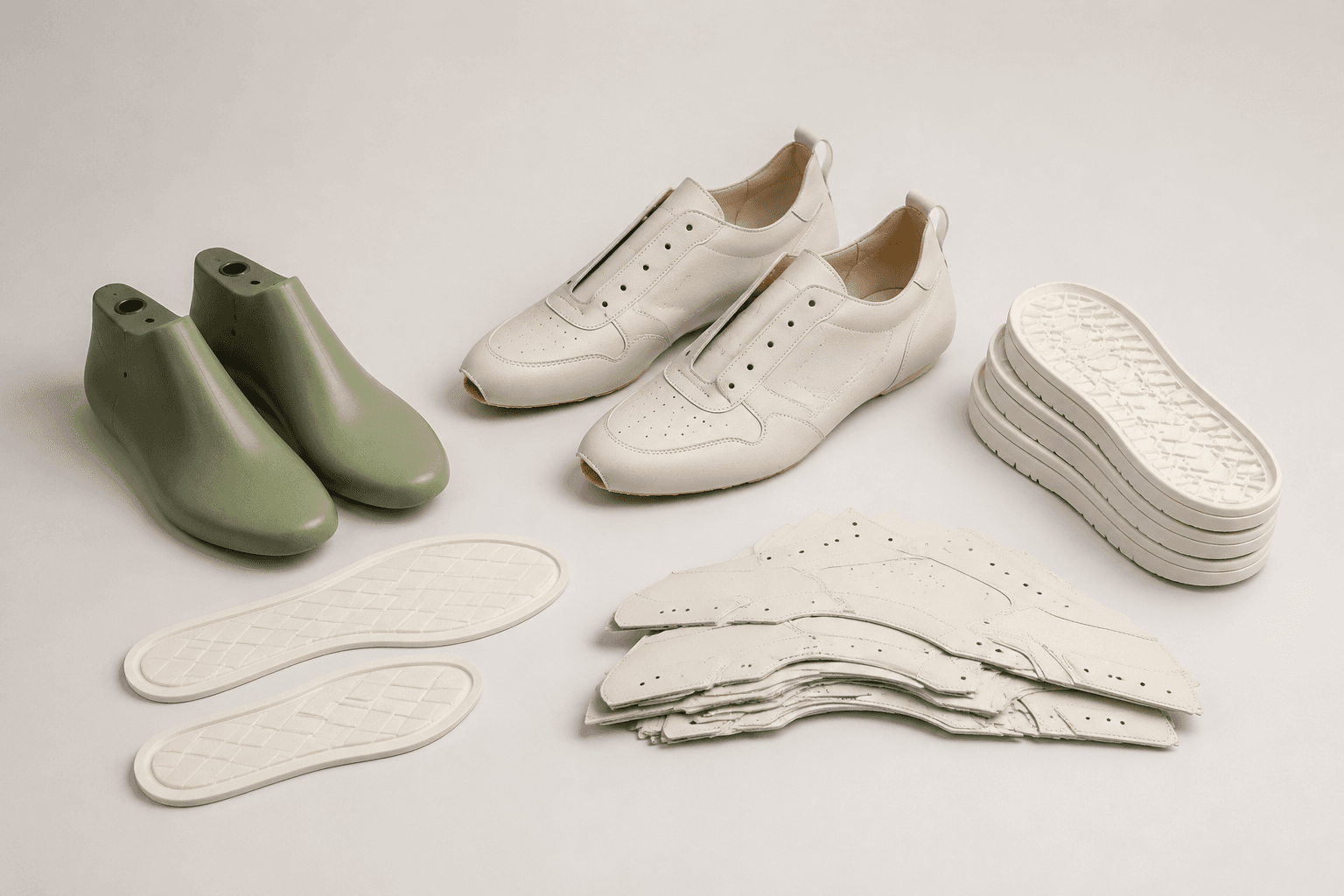
Custom running shoes are usually bought for one of two reasons: you already have a product spec and need a factory to execute it, or you need a supplier to develop a sellable running shoe from a brief. In footwear sourcing, that difference determines the right manufacturing route, the development cost, and how much control you keep over materials, fit, and margin.
For buyers working with a running shoe manufacturer in China, OEM and ODM are not interchangeable labels. OEM is specification-led manufacturing: you provide the design, BOM, construction details, and test targets. ODM is catalog-led development: the factory offers an existing platform that can be customized in upper pattern, outsole color, logo, foam package, and packaging. Both can work for custom running shoes, but each carries different MOQ, tooling, lead-time days, and compliance requirements.
If you are sourcing for a brand, importer, or private label program, the key is to compare each offer on the same commercial basis: sample timeline, bulk price per pair, carton pack, lab testing, material conversion, and repeatability. A proper athletic footwear oem discussion should start with technical feasibility, not with a low headline price.
The cheapest running shoe is often the one that fails fit, abrasion, or repeat-order consistency.
OEM or ODM: choose the manufacturing route first
The first decision is whether you need OEM or ODM. In OEM, the factory builds to your tech pack and keeps the product aligned to your brand requirements. In ODM, the factory starts from an existing last, midsole, outsole, and upper template, then adapts details for your market. For custom running shoes, OEM is better when fit, performance, or brand differentiation matters. ODM is better when speed to market and lower development cost matter.
A running shoe manufacturer will often present both options in one conversation, but the commercial implications are different. OEM usually has higher sampling effort, possible mold or tooling charges, and tighter approval control. ODM usually reduces development time because the platform already exists, but it limits how far you can change the midsole geometry, outsole lug pattern, or upper structure without moving back into OEM territory.
- Ask whether the proposed shoe is a true OEM build or an ODM base with customization.
- Confirm whether tooling is new or existing: last, outsole mold, midsole mold, logo plate, or print plate.
- Request a written list of what can change without extra mold cost.
- Check whether the factory can support your size run and width grading.
- Confirm if the same platform has been exported to your target market and tested for repeat orders.
Minimum order quantity and why it changes by construction
MOQ is not a single number in footwear. It changes with construction complexity, outsole tooling, color count, and material availability. For custom running shoes, an ODM program may start around 300-500 pairs per colorway if the base platform is in stock. A true OEM build commonly starts at 800-1,500 pairs per style, and more if you require a new outsole mold or a custom foam specification.
Buyers should separate MOQ by development stage and by bulk order. Sample MOQ may be 1-3 pairs per size set. Production MOQ should be confirmed per color and per size breakdown, because a factory may quote 1,000 pairs total but expect at least 300 pairs per color. If you plan multiple widths, multiple logos, or special packaging, the effective MOQ rises quickly.
- Ask for MOQ by style, by color, and by size ratio.
- Confirm whether MOQ includes mixed sizes or requires one full run per size curve.
- Check if the factory can combine colors on the same outsole and midsole tooling.
- Ask whether a new custom mold changes MOQ or just tooling cost.
- Request a clear policy for repeat orders and re-order minimums.
OEM vs ODM for custom running shoes
| Item | OEM | ODM |
|---|---|---|
| Development basis | Your tech pack and spec | Factory platform with customization |
| Typical MOQ | 800-1,500+ pairs/style | 300-500+ pairs/color if base exists |
| Sample lead time | 15-30 days first sample | 7-15 days |
| Bulk lead time | 45-75 days | 35-55 days |
| Tooling need | Often new molds/lasts | Usually lower or existing tooling |
| Price range | Higher, but more differentiated | Lower, faster launch |
| Best for | Brand-specific performance and fit | Private label and fast market entry |
Development time, sample lead time, and bulk lead-time days
Development speed is usually where ODM wins. If the platform already exists, initial samples can be ready in 7-15 days after artwork and color confirmation. OEM development is slower because the factory may need to source new foam, produce prototype tooling, adjust pattern pieces, and revise fit after trial wear. A realistic OEM sample cycle is 15-30 days for first sample, then 7-14 days for each revision.
Bulk lead-time days depend on material availability and production load. For a standard custom running shoes order, plan 35-55 days after pre-production approval if materials are in-house. If there is a new outsole mold, specialized knit, imported TPU, or custom box printing, the lead time can extend to 60-75 days. For seasonal launches, always ask the factory to separate sample days, lab test days, material booking days, and mass production days.
- Ask for a timeline with dates for sample, fit approval, lab testing, and bulk start.
- Confirm whether lead time starts from deposit, tech pack approval, or sample sign-off.
- Request a contingency schedule for mold changes or failed test results.
- Check if the factory can reserve line capacity for your ship date.
- Verify whether packing and carton labeling are included in the stated bulk lead time.
Material selection: upper, midsole, outsole, and consumables
A supplier-side review of custom running shoes must start with materials, because most complaints come from foam feel, upper durability, and outsole wear. For uppers, common options include engineered mesh, sandwich mesh, knit, monomesh, and TPU overlays. For midsoles, EVA, CMEVA, super critical foam, or blended compounds affect rebound, weight, compression set, and cost. Outsoles may use rubber, blown rubber, or a rubber-foam combination depending on traction and abrasion targets.
You should ask for the actual material specification, not just generic names. For example, mesh GSM matters because it affects breathability, hand feel, and structure retention. Foam density matters because it changes ride and cost. If the factory cannot give density in kg/m³ or a comparable technical value, you are not buying a controlled running product. The same applies to insole thickness, strobel board spec, heel counter stiffness, and thread construction.
- Ask for upper fabric GSM, coating weight, and abrasion performance.
- Request midsole density, rebound %, and compression set data.
- Confirm outsole rubber hardness and abrasion standard used by the lab.
- Check whether the insole uses EVA, PU, or molded foam and its thickness.
- Ask for colorfastness, hydrolysis, and delamination test results for key components.
Performance and testing standards you should require
Testing is where many importers lose money after shipment. For custom running shoes, the factory should align to EN ISO or ASTM methods that match your market and product claims. If you sell in Europe, confirm chemical compliance and relevant safety expectations. If you sell in the US, make sure the factory can support ASTM-related material and performance checks where applicable. At minimum, you need documentation for physical durability, adhesion, color transfer, and material safety.
Do not accept a verbal promise that the shoe is 'tested.' Ask for the test report name, standard number, result, and sample date. Common points include outsole abrasion, upper flex, sole bond strength, pull-off strength, seam slippage, and color migration. For running shoes, foam compression set and outsole wear are especially important, because the product must survive repeated impact without collapsing early in the lifecycle.
- Request recent third-party reports, not only factory in-house sheets.
- Ask which lab was used and whether it is accepted by your market.
- Confirm adhesion, abrasion, flex, and colorfastness results by style code.
- Check restricted substances compliance for adhesives, inks, and foams.
- Ask how failed results are corrected before bulk approval.
Cost structure: what a realistic $/pair quote should include
A useful price discussion starts with the full landed factory offer, not a single ex-factory number. For bulk custom running shoes, an ODM private-label shoe may fall in the roughly $8-$16/pair range depending on materials, outsole type, and packaging. A more technical OEM running shoe with custom tooling, higher-grade foam, and upgraded upper materials can move into the $14-$28/pair range or higher. These are broad sourcing ranges, not promises, and they change with order volume and fabric market pricing.
When comparing quotes, ask what is included: upper, midsole, outsole, laces, insole, sockliner print, hangtag, polybag, carton, and master carton packing. Some factories quote low on the shoe body and recover margin in packaging, testing, or logo application. Others exclude mold amortization, color matching, and size labeling changes. If you want an honest comparison, ask each supplier to quote the same BOM and the same size ratio.
- Ask for a line-by-line quotation by component and process.
- Confirm whether tooling, plates, or molds are amortized into price or listed separately.
- Check if the price includes carton, tissue, silica gel, and barcode labels.
- Ask for a volume price ladder at 1,000 / 3,000 / 5,000 pairs.
- Request a revised quote when material substitutions are made.
Fit, sizing, and last control
For a running shoe, fit is not cosmetic. A poor last creates returns, complaints, and poor sell-through. You should ask whether the factory has an existing men’s and women’s running last or whether a new last must be created from your target fit. If you are selling into multiple regions, confirm size grading by market, because US, EU, UK, and Asian grading do not always translate cleanly.
The fit review should include toe spring, heel grip, forefoot width, instep volume, and arch support position. For custom running shoes, a sample that looks correct can still fail in wear if the last is too narrow or if the vamp structure collapses after flexing. Ask for a fit confirmation process with wear trial notes, not just visual approval.
- Ask whether the last is performance running or casual sport derived.
- Request sample fit on all target sizes, not only one midpoint size.
- Confirm grading rules by market and gender line.
- Check if width options are available or only one width run.
- Ask for wear-test feedback before final bulk approval.
Packaging, labeling, and importer requirements
Packaging often decides whether the shipment passes receiving without exceptions. A running shoe manufacturer should confirm carton size, pair packing, polybag compliance, barcode format, and country-of-origin marking. If you sell through retail or e-commerce, check whether the factory can apply size stickers, QR labels, care labels, and retail hangtags consistently on every pair.
For importers, carton configuration affects freight cost and warehouse handling. Ask for net/gross weight, carton dimensions, pairs per carton, and whether the packing method protects the upper shape. If your shoes use soft knit uppers or high-volume foam, poor packing can deform the product before it reaches the customer.
- Confirm pair packing, carton packing, and master carton data before production.
- Ask for label artwork approval and barcode verification.
- Check whether retail-ready packing is included or charged separately.
- Request carton drop test or packing integrity confirmation if shipping long distance.
- Verify compliance with your market’s labeling and fiber disclosure rules where relevant.
How to evaluate a running shoe manufacturer before placing the PO
A good athletic footwear oem partner should be evaluated on process discipline, not only on price. Ask who owns pattern making, who approves fit, who checks incoming materials, and who signs off bulk production. If the answers are vague, the risk is high. You want a factory that can explain its sample room, quality checkpoints, and whether it uses inline inspection at upper stitching, lasting, and bottoming.
Also ask what happens when materials are delayed or a test fails. A serious supplier will show you alternate sourcing options, timing impact, and what gets frozen before bulk. If the factory cannot control change management, your custom running shoes program will drift in color, fit, or finish across repeat orders.
- Ask for the full development flow from brief to shipment.
- Confirm QC checkpoints for upper, lasting, cementing, and final inspection.
- Request examples of previous running programs in your target price band.
- Check whether the factory supports repeat orders with archived materials and patterns.
- Ask who is responsible for defect analysis and corrective action.
Key takeaways
- Decide OEM or ODM before price negotiation.
- Get MOQ, lead time, and tooling terms in writing.
- Require actual material specs: GSM, density, hardness, and test data.
- Do not approve bulk without fit, lab, and packing confirmation.
- Compare quotes on the same BOM, carton, and size run.
- Choose a running shoe manufacturer that can explain corrections, not just quotations.
SoleForge manufactures athletic & running shoes under OEM and ODM for brands and importers worldwide. Request a quote with your tech pack or reference pair and we'll reply within one business day.