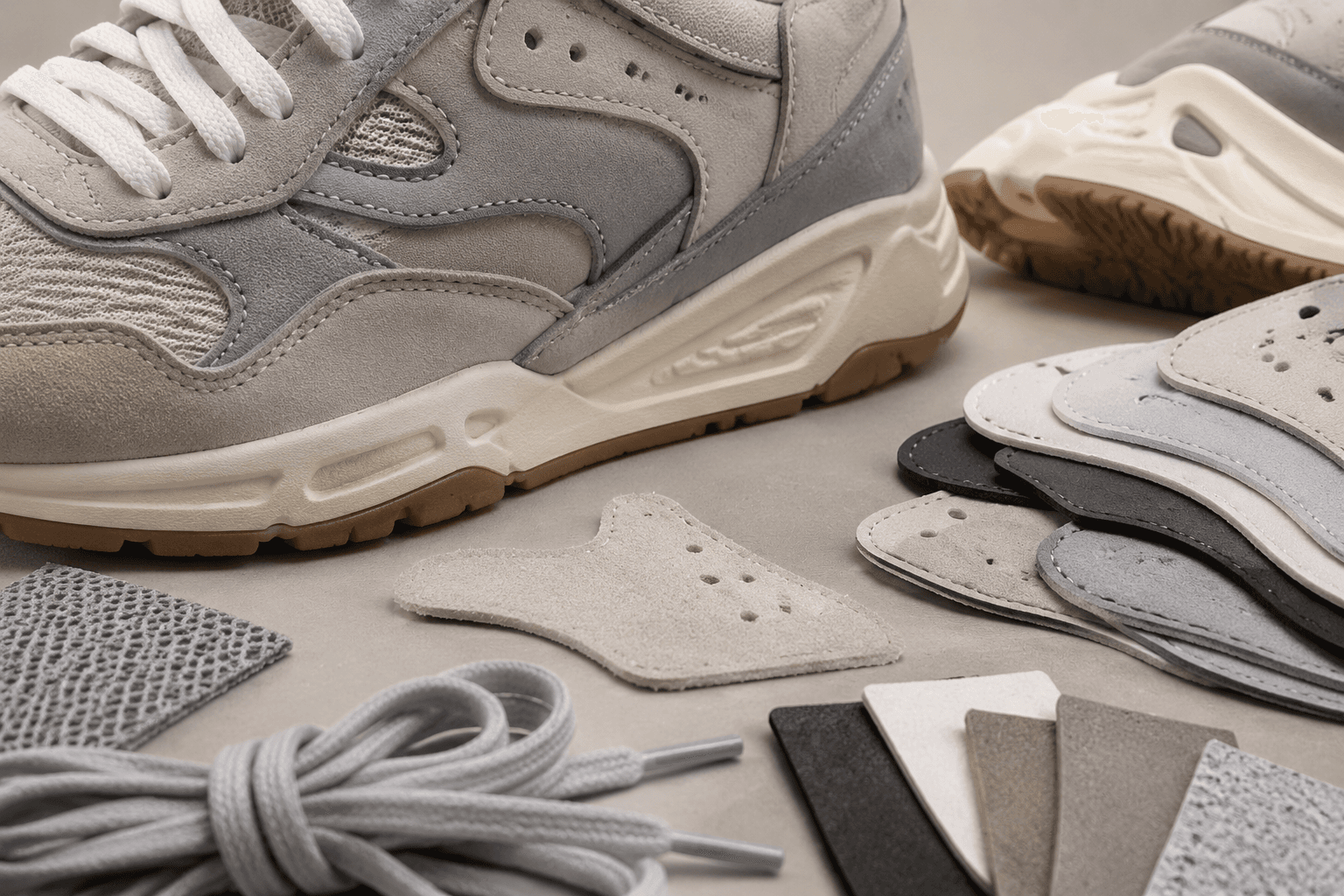
Buying custom sneakers in bulk is not only a design exercise. It is a sequence of sourcing decisions that affect fit approval, mold cost, compliance risk, ex-factory price, and on-time shipment. For sourcing managers, brand owners, and importers, the main question is not whether a factory can make a sample. It is whether a custom sneaker manufacturer can repeat that sample at scale with stable quality, controlled material lots, and realistic lead times.
In China, the difference between a smooth program and an expensive one usually comes down to a few technical points decided early: whether you use an existing outsole mold or open a new one, which upper construction suits the target FOB, what foam density is required for comfort retention, and what test standard the market demands. Private label sneakers with simple logo changes can move quickly. Fully customized styles with new tooling, special compounds, and retail packaging need more development rounds and tighter pre-production controls.
This guide is structured as a buyer decision framework. Each section focuses on one factor you should confirm before placing deposits or approving production. The aim is practical evaluation: MOQ, lead-time days, $/pair, test methods, material specifications, and the exact questions to ask before you commit.
In bulk footwear, the cheapest sample is often the most expensive production order if the BOM, fit, and test standards were never locked.
Define the product brief before you ask for a price
A factory can only quote accurately when the brief is technically complete. For custom sneakers, the minimum commercial brief should include target category, gender, size range, construction, target market, price objective, and expected annual volume. If one of these is missing, the quote will usually be padded or revised later.
At concept stage, separate what is visually important from what is structurally required. A cupsole low-top in synthetic leather, mesh, and TPR outsole is a different cost and lead-time profile from a running-inspired style with phylon midsole, rubber patches, strobel construction, and molded TPU parts. The first may fit into a 30-45 day bulk window after confirmation. The second may require 60-90 days depending on tooling and material sourcing.
For buyer-side control, specify target ex-factory or FOB range in USD/pair. For example, many entry-level private label cupsole sneakers land in a broad ex-factory range of $8.50-$14.00/pair at standard MOQs, while more technical multi-material sneakers may run $14.00-$24.00/pair or higher depending on outsole, branded components, and packaging.
- Confirm target market: EU, US, UK, Middle East, or mixed distribution
- State size range and fit base: men's 39-45, women's 36-41, kids, or extended sizes
- Define construction: cemented, cupsole, strobel, vulcanized-look, board-lasted
- Give target price in $/pair and expected order quantity per style/color
- Clarify whether the project is private label, semi-custom, or full custom tooling
Choose the right development route: private label, modified existing sole, or new tooling
The fastest route for many importers is private label sneakers built on an existing last and outsole. This avoids mold amortization, shortens sampling, and lowers MOQ. It is suitable when the brand value sits in color, upper material, logo application, and packaging rather than proprietary tooling.
A middle route is to use an existing outsole mold but build a new upper pattern. This gives more design separation without the full cost of opening sole tooling. It often works well for fashion sneaker programs where visual identity matters but unit economics remain tight.
Full custom tooling is justified when sole identity is part of the brand language or when performance requirements demand a specific geometry or compound. Outsole molds commonly require 25-35 days to cut, trial, and correct. Depending on complexity and size run, mold investment can range from roughly $2,000 to $8,000 for outsole tooling alone, with additional cost for phylon, EVA, or injection components.
- Ask if the quote is based on an existing outsole mold or new tooling
- Request mold ownership terms and whether future transfer is allowed
- Confirm if tooling cost is refundable against volume and under what threshold
- Check whether grading is already available for your full size range
- 01Use stock outsole + stock last when speed and MOQ matter most
- 02Use stock outsole + custom upper when brand differentiation is needed within budget
- 03Open new outsole mold when long-term volume can absorb tooling and test iterations
Indicative sourcing benchmarks for custom sneaker programs
| Program type | Typical MOQ | Development lead time | Bulk lead time | Indicative ex-factory $/pair | Notes |
|---|---|---|---|---|---|
| Private label cupsole sneaker | 600-1,200 pairs/style | 10-20 days | 30-45 days | $8.50-$14.00 | Best for stock sole and existing last |
| Custom upper on existing outsole | 800-1,500 pairs/style | 15-30 days | 35-50 days | $10.50-$18.00 | Balanced route for branding and speed |
| Full custom outsole tooling | 1,200-3,000 pairs/style | 30-50 days | 45-70 days | $14.00-$24.00+ | Tooling cost and more approval gates required |
| Knit or technical multi-material sneaker | 1,000-2,000 pairs/style | 20-40 days | 45-60 days | $13.00-$22.00 | Higher risk on yarn and color matching |
Evaluate the upper and bottom construction against target cost and performance
Material selection changes both appearance and failure risk. PU microfiber, action leather, split leather, knitted polyester, sandwich mesh, suede, and TPU film each behave differently in lasting, bonding, abrasion, and color migration. A buyer should not approve materials only from a swatch book. The same black microfiber can vary in thickness, backing strength, and hand feel across suppliers.
Construction matters just as much. A classic cupsole with stitched foxing line may still be cemented internally. A running-inspired sneaker may use strobel stitching for flexibility, then attach to a phylon midsole with rubber patches. If you push a fashion style into athletic wear conditions without adjusting the construction, returns will follow.
For insocks and midsoles, ask for actual density and hardness rather than generic terms like soft or premium. Memory foam insocks may be 0.18-0.22 g/cm3 for low-cost builds, while better rebound PU or open-cell foams may be specified for improved compression recovery. For EVA or phylon midsoles, density often sits around 0.18-0.25 g/cm3 depending on cushioning target and weight objective.
- Request upper material thickness in mm and backing type
- Confirm foam density for collar, tongue, insock, and midsole
- Ask for outsole compound: TPR, rubber, RB, EVA, phylon, TPU, or blended
- Check lining GSM, breathability, and colorfastness performance
- Verify counter and toe puff specification for shape retention
Common material specifications worth locking early
Upper mesh is often quoted by GSM and yarn composition. Lining should be defined by material, colorfastness expectation, and anti-friction requirement. Foxing, eyestay reinforcements, counters, and toe puffs should be specified by thickness and stiffness because these influence shape retention after bulk packing and shipment.
Assess MOQ by component, not only by finished pair count
Many buyers ask only for style MOQ, but the true constraint often comes from raw materials. A factory may accept 600 pairs per color on paper, yet the reflective webbing supplier needs 2,000 meters, the custom jacquard label mill needs 5,000 pieces, and the outsole color compound requires a minimum mixing lot. If these component MOQs are ignored, the final unit price will rise or substitutions will appear during sample revision.
For standard custom sneakers using stock outsole molds and market-available materials, workable MOQs often start around 600-1,200 pairs per style, split across 1-3 colors. For fully customized projects, especially with special outsole colors, logo molds, custom knits, or molded ornaments, practical MOQs more often sit at 1,200-3,000 pairs per style.
The buyer should also ask how sizes are packed into the MOQ. If the size scale is uneven, excess stock in slow sizes can erase any savings from a lower unit quote.
- Ask for style MOQ, color MOQ, and size-run rules separately
- Request a list of material MOQs for all custom trims and fabrics
- Check surcharge thresholds for orders below standard outsole color lots
- Confirm whether the MOQ is per shipment or cumulative over repeat POs
Map the sample and approval timeline realistically
Bulk dates are missed most often because the development calendar is underestimated. A realistic timeline for private label or light-custom projects may include 5-7 days for material confirmation, 7-14 days for first samples, 5-7 days for comments, and 7-12 days for revised samples. Fully customized projects with new sole tooling can extend initial development to 30-50 days before wear-test pairs are ready.
Insist on approval gates. In footwear, design approval, fitting approval, material approval, color approval, wear-test approval, and pre-production sample approval are not interchangeable. When these are compressed into a single sample stage, factories compensate with assumptions. Assumptions become claims later.
A disciplined custom sneaker manufacturer will issue a BOM, color card, outsole swatch, and measurement sheet before PP approval. These documents are not bureaucracy. They are how the line knows what to make when the merchandiser is no longer on the floor.
- Request a development calendar in days from tech pack to PP approval
- Confirm how many sample rounds are included in the quoted development fee
- Ask whether size-set samples are required before bulk cutting
- Approve color, logo placement, measurements, and packaging separately
Verify fit, grading, and wear testing before commercial approval
A sneaker can look correct and still fail commercially if fit is off by half a size or heel slip appears after break-in. For bulk buyers, fit should be reviewed on the target last with the intended sockliner and collar foam, not on a showroom sample built with substitute components. Collar thickness, topline shape, and toe spring all change wearing perception.
Ask for internal length by size, ball girth, heel width, and last reference. For brands selling into multiple markets, decide whether fit should follow EU standard comfort or a narrower fashion profile. Do not assume factory grading matches your historical sell-through data.
Wear testing should include at least short-term flex, upper crease behavior, heel lock, and bond stability after repeated walking. If the style uses light-colored linings or suede overlays, also inspect crocking and edge staining under realistic use.
- Request measurement sheet by size and grading increments
- Check fit on the final sockliner, not a substitute insole
- Run wearer trials on at least 2-3 foot types if volume justifies it
- Confirm corrective actions after fit comments and who updates the last
Set compliance and lab testing standards by destination market
Footwear testing should be specified at PO stage, not after production. The relevant standard depends on your market and claim set. For general physical performance, buyers commonly reference internal methods aligned with EN ISO or ASTM expectations for adhesion, abrasion, flexing, colorfastness, and slip resistance where applicable. The exact method should match the product type and market requirement.
For example, outsole abrasion and upper flexing requirements differ between casual cupsole sneakers and performance-inspired sneakers. If the shoe contains components subject to restricted substance control, include your RSL and test plan in the contract. This is especially important for printed insocks, synthetic uppers, glues, pigments, foams, and metallic trims.
A practical sourcing model is to split testing into in-line material checks, pre-final production checks, and final third-party verification on sealed samples. This reduces the chance of discovering a bonding or chemical issue after goods are already packed.
- State destination standards and your required test methods before sampling
- Provide RSL requirements for upper, lining, insole, outsole, inks, and adhesives
- Ask whether the factory has in-house adhesion, flex, and abrasion testing
- Confirm who pays for failed retests caused by material substitution
Control costing with a clear cost-driver breakdown
The price of custom sneakers is usually driven by six items: outsole and midsole construction, upper material package, labor content, branded trims, packaging, and order quantity. Without a breakdown, it is difficult to know where savings are real and where the factory is removing value silently.
Ask the supplier to identify major cost drivers. A one-piece TPR outsole may cost less than a phylon midsole plus rubber patch combination, but the wear and weight profile will differ. A knitted upper may save on overlay count, yet special yarns and machine programming can offset the gain at low volume. Small logo moldings, custom eyelets, and special tissue paper are rarely expensive individually, but together they can add $0.50-$1.50 per pair.
Negotiation should focus on specification choices, not only on margin pressure. If you need to reduce $1.00/pair, consider standardizing lace tip finish, moving from custom carton print to sticker labeling, simplifying outsole color split, or using an existing footbed mold.
- Request ex-factory and FOB quotes separately if freight handling is involved
- Ask for surcharge items: tooling, sample fee, test fee, packaging upgrade, tariff coding support
- Check whether prices are based on current raw material validity period
- Confirm if repeat orders on the same BOM receive improved pricing
Review production planning, QC checkpoints, and defect tolerance
A good sample room does not guarantee a good production line. For bulk footwear, line planning matters because glue open time, upper pre-heating, sole priming, and cooling all affect bond quality and shape consistency. Ask whether your style runs on a dedicated line window or is inserted between multiple constructions requiring frequent machine resets.
Quality control should include incoming material inspection, cutting checks, stitching patrol, lasting checks, bonding checks, and final random inspection. For casual sneakers, common risk points are toe shape mismatch left-right, foxing line inconsistency, cement overflow, collar asymmetry, logo placement drift, and dirty glue edge on light-color midsoles.
Define defect tolerance before production. If you rely only on final AQL language without footwear-specific defect criteria, disputes will be harder to resolve. The inspection manual should classify what is critical, major, and minor for appearance, measurement, function, and carton packing.
- Ask for the QC flow from raw material arrival to final packed carton
- Confirm line capacity per day for your construction type
- Request defect photos from prior similar projects, not only ideal samples
- Define AQL and footwear-specific defect standards in writing
Confirm packaging, carton specs, and shipping readiness
Packaging affects both cost and damage rate. Sneaker importers often focus on the shoe while overlooking box compression strength, silica gel policy, barcode placement, carton dimensions, and palletization rules. These details matter for e-commerce and wholesale programs differently.
If the product ships in branded shoe boxes, specify board grade, print finish, drop test expectation, and barcode format. For sea freight, carton bursting strength and master carton stacking tolerance should be checked against loading plan. Light-color midsoles and suede uppers may also require extra tissue, shoe trees, or dust protection to reduce transit marks.
Before shipment, ask for carton pack ratio, net and gross weight, CBM, and loading quantity by 20GP and 40HQ. Small changes in box size can materially change freight cost per pair.
- Confirm individual box dimensions and master carton count
- Check box board thickness, GSM, and compression requirement
- Ask for CBM per pair and container loading estimate
- Verify barcode, size sticker, and carton mark placement before printing
Key takeaways
- Confirm whether your custom sneakers use stock tooling or require new molds, and get ownership terms in writing.
- Approve BOM, material thickness, foam density, color standards, and fit measurements before PP sample sign-off.
- Check MOQ at component level, especially for custom labels, outsole colors, knits, and packaging.
- Set compliance, RSL, and physical test requirements at PO stage, not after production starts.
- Ask for a realistic calendar in days covering samples, revisions, PP approval, production, and final inspection.
- Negotiate cost through specification choices and packaging simplification, not by forcing an unclear price cut.
SoleForge manufactures casual sneakers and athletic & running shoes under OEM and ODM for brands and importers worldwide. Request a quote with your tech pack or reference pair and we'll reply within one business day.