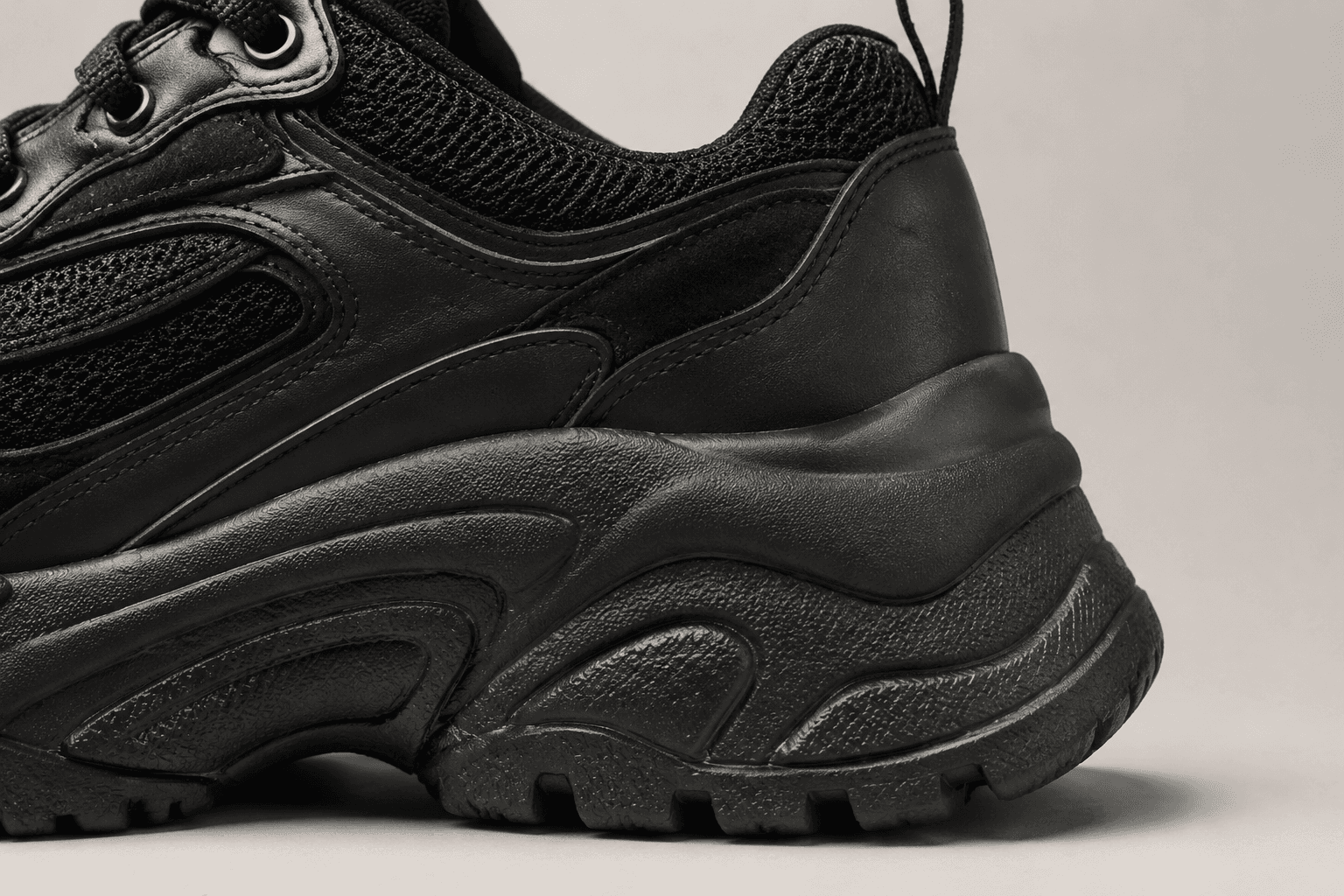
For sourcing managers and importers, composite toe safety shoes should be purchased as a tested construction, not as a toe cap option added to a catalog shoe. The final compliance depends on the toe cap, outsole compound, puncture insert, shank, upper, lining, insock and even metal trim. One material change can affect ASTM or EN ISO claims.
China factories often quote the same style name with very different builds. A low-cut warehouse shoe may use fiberglass toe, textile puncture insert, direct-injection PU outsole and ASTM F2413 EH/PR marking. A construction boot may use composite toe, steel plate, 2.0 mm leather, rubber outsole and EN ISO 20345 S3 or S7 marking. Both can be valid, but they serve different buyers, price points and certification files.
This protective footwear guide follows the order a buyer should use before placing bulk orders: define the destination standard, select the composite toe package, specify electrical hazard shoes correctly, choose puncture resistant footwear, lock the material bill, control sampling and testing, then inspect production before shipment.
In safety footwear sourcing, the approved sample only protects the buyer when the certified components behind it are locked, traceable and checked during production.
1. Define the Standard, Marking and Sales Market First
Start the RFQ with the market standard. For the United States, the common reference is ASTM F2413. Impact and compression are the base requirements, with additional markings such as EH for electrical hazard and PR for puncture resistance. For Europe and many adjacent markets, EN ISO 20345 is the usual reference, with classifications such as SB, S1, S1P, S3, S7 and additional markings for penetration resistance, water resistance, slip resistance and heat contact.
Do not ask for “CE and ASTM” as a general phrase. ASTM and EN ISO use different test methods, marking logic and documentation. A shoe that passes ASTM I/C is not automatically an EN ISO 20345 product. A textile anti-perforation insert tested for one system should not be treated as approved for another system without confirmation from the lab or certification body.
Ask whether the supplier has a valid report on the exact construction. Exact means the same outsole mold and compound, same toe cap supplier, same puncture insert, same upper material group and same construction method. If the report belongs to a similar style, use it only as a reference for feasibility and cost. For regulated channels, the certificate must match the SKU you sell.
Testing affects the calendar. If the existing certificate covers the final product, development can move quickly. If a new official test is required, allow 15 to 30 days after test samples are ready. Add 10 to 20 days for development samples and 30 to 55 days for bulk production after deposit and pre-production sample approval. New outsole tooling, waterproof membranes and Chinese New Year planning can add another 20 to 45 days.
- State the destination market: US, EU, UK, Canada, Middle East, Australia or mixed distribution.
- Specify the required marking: ASTM F2413 I/C EH PR, EN ISO 20345 S1P/S3/S7, or the local equivalent.
- Check certificate holder, model code, test date, component description and construction method.
- Confirm whether cartons, tongue labels and hangtags must show legal safety markings or batch codes.
- Reject certificate claims based only on a visually similar factory stock model.
2. Select the Composite Toe Around Last, Weight and Cost
Composite toe safety shoes normally use fiberglass, carbon fiber blend, plastic composite or hybrid non-metallic caps. The main supplier-side reasons to choose composite are lower weight, better thermal comfort and metal-free positioning. Composite caps are common in logistics, light manufacturing, warehousing, airport service, electrical maintenance and distribution centers where users walk long shifts.
The cap must match the last and outsole cavity. Composite toe caps are usually thicker than steel caps. If a factory replaces steel with composite without changing vamp height, toe allowance or toe spring, the shoe may pass impact testing but feel tight across the forefoot. For bulk buying, this becomes a return problem, not a lab problem. Ask for fitting samples in the main selling size, typically US 9 or EU 42, and check toe room with the actual sockliner installed.
Cost should be itemized. Compared with a basic steel toe, a certified composite cap usually adds about US$0.40 to US$1.20 per pair. Carbon blend caps may add US$1.00 to US$2.50 per pair depending on origin and volume. Existing certified cap shapes are the practical choice for most importers. A custom toe cap shape can require 10,000 to 30,000 pairs per size range or a separate mold charge, so it only fits long-running programs.
Check finished shoe weight, not only toe cap weight. A composite cap may save 40 to 80 grams per shoe versus steel, but that saving can disappear if the design uses a rubber outsole, heavy leather, thick waterproof bootie or steel puncture plate. Set a control weight in one size, such as EU 42, with a bulk tolerance of plus or minus 3% to 5%.
Composite Toe RFQ Details
A complete RFQ should identify toe cap material, impact and compression standard, size range, toe shape and whether the cap is certified for the final construction. If the product will be sold as metal-free, confirm the puncture insert, shank, eyelets, hooks, zipper pull, logo plate and decorative trims. A composite cap alone does not make the full shoe non-metallic.
For orders above 3,000 pairs, require toe cap batch traceability. The factory should record supplier name, cap size range, incoming inspection result and batch number. Keep one signed approval pair at the factory and one in your office. If the toe shape changes during production, stop and compare against the approved pair before packing.
3. Specify Electrical Hazard Protection Without Overclaiming
Electrical hazard shoes need precise claim language. Under ASTM usage, EH footwear provides a secondary source of protection against accidental contact with live electrical circuits under dry conditions. It is not primary electrical insulation equipment. Avoid packaging phrases such as “shockproof,” “electrician proof” or “100% insulated.” These claims create liability and may not match the test scope.
EH performance depends on the tested finished shoe. The outsole and heel are critical, but conductive paths also matter. Steel puncture plates, metal shanks, metal eyelets, wet linings, contamination and outsole compound changes can affect risk. A shoe can include some metal parts and still be tested as EH, but the claim must match the exact tested bill of materials.
Specify outsole data, not only “PU” or “rubber.” For dual-density PU, a common comfort midsole density is 0.35 to 0.45 g/cm3, with outsole density around 0.80 to 1.05 g/cm3. For rubber, request Shore A hardness, oil resistance, abrasion target and heat contact requirement if needed. TPU can give a clean finish and abrasion resistance, but it must be checked for slip, flex and electrical performance. Ask whether recycled material, conductive additives or high carbon black loading are used.
If the supplier already has an EH-tested construction, sampling can often be completed in 10 to 20 days. Bulk production commonly runs 35 to 55 days after deposit and PP sample approval. If you change outsole color, outsole compound, insole board, puncture insert or construction method, ask whether the previous EH report still applies. For distributor or government tenders, assume a new test may be required unless the lab confirms otherwise.
- Use exact wording: ASTM F2413 EH, electrical hazard, or the approved local marking.
- Confirm whether the shoe is fully non-metallic or only composite toe.
- Request outsole material, density, hardness, oil resistance, slip rating and flex requirement.
- Check that the EH report covers the same outsole, same upper construction and same hidden components.
- Align carton labels, hangtags, product pages and sales sheets with the tested claim.
4. Choose Puncture Resistance by Workplace and Flex Requirement
Puncture resistant footwear usually uses a steel plate or a non-metallic textile insert made from aramid, high-tenacity polyester or layered woven material. Steel plates are cost-effective and common for construction, waste handling, foundry support and basic heavy industry. Textile inserts are lighter and more flexible, and they are the normal choice for metal-free composite toe safety shoes.
Coverage matters as much as material. A low-cost insert can fail commercially if it is too short near the toe, too narrow at the waist or poorly graded across sizes. During sample review, ask for a bottom-view photo of the insole board and insert before lasting. For wide size ranges, confirm size-specific grading instead of one small insert used across many sizes.
A steel plate usually adds US$0.25 to US$0.60 per pair. A certified textile anti-perforation insert often adds US$0.80 to US$1.80 per pair depending on material, layer count, thickness and GSM. Typical textile inserts are around 1.2 to 2.0 mm thick and 900 to 1,500 GSM, but the numbers are only supporting data. The insert must pass the relevant nail and force test for the destination standard.
For EN ISO 20345 programs, penetration resistance marking has become more specific, including differences between metallic and non-metallic inserts and test nail diameter. For ASTM programs, confirm PR marking on the report. If the end user works around pallet nails, scrap metal, demolition debris, broken glass or recycling lines, PR should be a core safety shoe feature, not an add-on after the outsole is selected.
Steel Plate or Textile Insert
Use steel plate when the target FOB price is tight, the market accepts metal components and stiffness is not a major complaint. Use textile insert when the shoe must be lightweight, airport-friendly, flexible or fully non-metallic. Textile is better for workers who kneel, climb ladders or walk long warehouse shifts.
For cemented shoes, check that the insert stays flat during lasting and does not wrinkle under the sockliner. For direct-injection PU footwear, confirm the insert can tolerate injection conditions and does not shift before PU is injected. For orders above 5,000 pairs with a PR claim, include destructive inspection across several sizes.
5. Lock the Upper, Lining, Insock and Outsole Bill of Materials
After toe, EH and puncture requirements are fixed, build the rest of the shoe around the claim and price target. Uppers for industrial safety shoes commonly use full-grain leather, corrected-grain leather, split suede, microfiber, textile mesh or woven textile with TPU or leather reinforcement. Each choice affects water resistance, breathability, abrasion, cutting loss, MOQ and shade control.
Leather should be specified by type and thickness. Many safety shoes use 1.6 to 2.0 mm leather. Heavy-duty boots may use 2.0 to 2.2 mm leather. Split suede can reduce cost but needs clear abrasion and colorfastness targets. Textile uppers should state construction and GSM: 280 to 380 GSM mesh may suit light-duty warehouse footwear, while outdoor or construction styles may need heavier woven textile, TPU film, rubber toe bumper or leather overlays.
Lining and insock details drive comfort returns. Basic sandwich mesh lining may be 180 to 250 GSM. More durable abrasion lining can be 280 to 350 GSM, especially in the heel. Removable insocks should specify EVA, PU or open-cell foam, with thickness and density. A common comfort range is 0.12 to 0.25 g/cm3, but very soft foam can collapse after a few weeks of shift use. Ask for compression set data if the insole is a selling point.
Outsole choice should follow the workplace. Dual-density PU is common for comfort, lighter weight and competitive pricing. Rubber is heavier but can improve heat contact, abrasion and certain oil resistance. EVA/rubber can work for lightweight styles, but stability and puncture insert integration must be checked. Slip resistance should be tested on the exact outsole pattern and compound, not a similar mold.
FOB pricing depends on construction. A low-cut textile composite toe safety shoe with textile PR insert and dual-density PU outsole may quote around US$13 to US$22 per pair at normal wholesale volume. A leather composite toe boot with waterproof membrane, textile PR insert and rubber outsole may quote around US$24 to US$45 per pair. Custom outsole molds, private compound colors, small size runs and new certification add cost.
- Upper: specify leather thickness in mm or textile GSM, plus abrasion and colorfastness targets.
- Lining: define mesh GSM, heel abrasion requirement and waterproof membrane type if used.
- Insock: state EVA, PU or open-cell foam, density range, thickness and top cloth.
- Outsole: define PU, rubber, TPU or EVA/rubber, plus hardness, density, slip and oil resistance.
- Construction: confirm cemented, direct-injection PU, vulcanized or welted because tooling and lead time differ.
6. Convert the Specification Into a Factory RFQ and Sample Plan
A strong RFQ lets the supplier quote the real product, not a visual approximation. Include target standard, hazard markings, FOB price range, annual forecast, first order quantity, size run, packaging, labeling, test responsibility and inspection method. For China suppliers, incomplete RFQs produce low quotes that later rise when compliance details appear.
MOQ depends on tooling and materials. With existing outsole molds and standard materials, many safety shoe factories accept 800 to 1,200 pairs per color, often with a total style order of 1,500 to 2,000 pairs. With new outsole molds, custom bottom logos, special leather colors or exclusive mesh, expect 3,000 to 5,000 pairs per style/color. A new last or exclusive composite toe package may require larger commitments or a tooling agreement.
Sampling should be staged. First approve a development sample for appearance, construction and basic fit. Then approve a fitting sample in the main sales size, such as EU 42 or US 9. Finally approve a pre-production sample made with bulk materials, final labels, final packaging and correct safety markings. Do not send temporary materials for official tests if the bulk shoe will use different components.
Write lead time by phase. Typical timing is 10 to 20 days for development samples, 15 to 30 days for official lab testing if required, 20 to 35 days for material preparation and 30 to 55 days for bulk production after deposit and PP sample approval. Waterproof booties, imported toe caps, custom cartons and late artwork can delay production even when the factory has open capacity.
- 01Send a tech pack with standard, hazard markings, last or fit reference, size range, forecast and target FOB price.
- 02Request a component sheet listing toe cap, PR insert, shank, upper, lining, insock, outsole, adhesive and packaging.
- 03Approve development and fitting samples before paying for official tests or outsole tooling.
- 04Use a PP sample made from bulk materials as the shipment approval reference.
- 05Set AQL, carton drop test, label checks, destructive pair cutting and metal detection requirements before production starts.
7. Control Bulk Production With Traceability and Destructive Checks
The largest production risk is substitution after sample approval. A factory may change lining GSM, use lower-density insole foam, switch toe cap supplier, reduce anti-perforation insert coverage or adjust outsole compound to recover margin or solve a delivery issue. The finished shoe may look the same, but the safety claim may no longer match the approved file.
Write incoming material control into the purchase order. The factory should record toe cap batch, puncture insert batch, leather or textile roll number, outsole compound batch and packaging version. For orders above 5,000 pairs, buyer inspection should compare these records with the approved bill of materials. If the supplier cannot trace critical components, the product file is weak.
In-line inspection should focus on toe cap placement, lasting quality, stitch density, eyelet setting, outsole bonding, size marking and packing accuracy. For cemented shoes, request peel strength checks from the factory lab if available. For direct-injection PU, check injection completeness, density consistency, outsole flash trimming and contamination at the sole edge.
Final inspection should include weight checks, size measurements, fitting review, carton marks, label accuracy and destructive checks. Cutting one left and one right shoe from random cartons is reasonable for EH/PR/composite toe programs, and more pairs may be needed for large orders or mixed size runs. Cutting confirms toe cap position, puncture insert coverage, shank material, lining layers and outsole construction before shipment.
Do not release balance payment only on carton count. Keep the invoice, packing list, test reports, declarations, material list, approved sample photos, inspection report, production date codes and component batch records. This file protects the importer if a distributor, customs authority or end customer questions the safety shoe features.
- Compare bulk components against the approved bill of materials, not only the approved appearance sample.
- Cut random pairs when PR insert, composite toe placement or metal-free construction is part of the sales claim.
- Verify carton labels, tongue labels and hangtags against ASTM or EN ISO wording before shipment.
- Hold payment release until inspection findings, certificates and packing documents are consistent.
Key takeaways
- Define ASTM, EN ISO or local standard requirements before selecting toe cap, puncture insert or outsole materials.
- Composite toe safety shoes can reduce weight and support metal-free positioning, but fit, last shape and finished shoe weight must be verified.
- Electrical hazard shoes need exact tested claims; avoid overstated shock-protection language on packaging and product pages.
- Puncture resistant footwear should specify steel or textile insert type, coverage, thickness or GSM and the required ASTM or EN ISO marking.
- Typical China MOQs range from 800 to 1,200 pairs per color for existing constructions and 3,000 to 5,000 pairs or more for custom materials or molds.
- Bulk control should include component traceability, in-line checks, final inspection and destructive pair cutting for hidden safety components.
SoleForge manufactures safety & work shoes under OEM and ODM for brands and importers worldwide. Request a quote with your tech pack or reference pair and we'll reply within one business day.