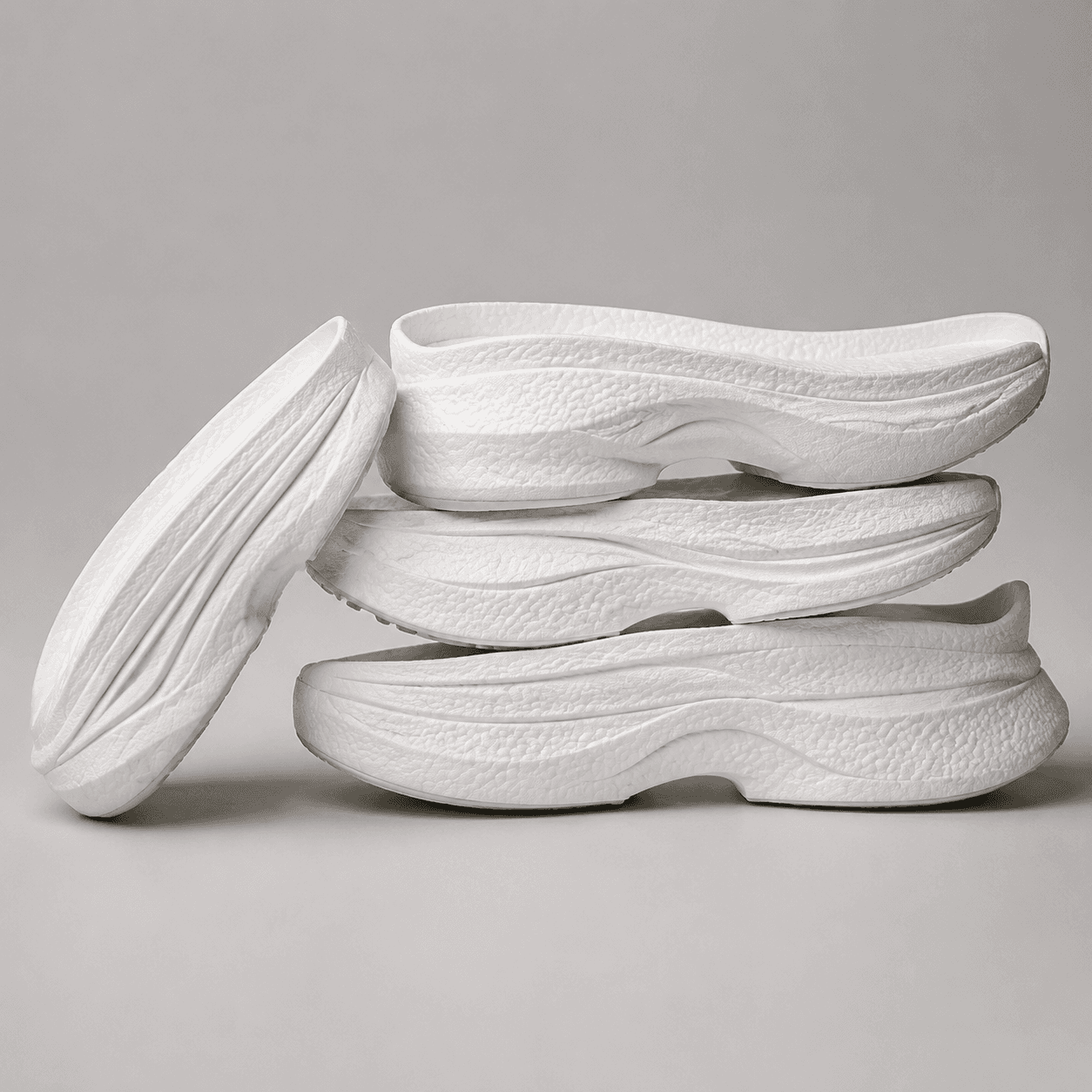
For a professional buyer, EVA slides vs rubber slippers is a product-engineering decision before it is a styling decision. The right choice affects FOB, CBM, mold cost, claim rate, and reorder stability. A pair that looks competitive on a sample board can still fail commercially if it shrinks after molding, wears out on rough concrete, smells in a hot container, or slips on wet ceramic tile.
On the factory side, EVA and rubber programs run on different controls. EVA is highly sensitive to foam density, expansion ratio, cooling time, and post-mold shrinkage. Rubber and rubber-like compounds are more sensitive to specific gravity, filler ratio, cure stability, strap construction, and abrasion performance. Buyers who compare only unit price usually miss the variables that later create debit notes: Shore hardness drift, pair-weight reduction, DIN abrasion failure, unstable color matching, and weak strap pull.
This guide is built as a practical buying sequence for sourcing managers, brand owners, and importers buying footwear in volume from China. It covers how to define the target market, compare materials using measurable data, choose the correct manufacturing route, calculate real landed cost, lock testing and QC standards, and select a supplier that can repeat the approved sample in bulk.
The better material is not the one with the lowest FOB; it is the one that reaches your retail target, survives the actual wear environment, and can be repeated in bulk without hidden claim cost.
Define the end-use, retail band, and failure risk before requesting any quote
A useful slipper material comparison starts with use conditions, not with a reference photo. When a buyer sends only an image, most factories quote the closest mold and lowest workable compound. That creates false comparisons. A 120 g one-piece EVA slide for hotel or shower use is not directly comparable to a 230-280 g rubber slipper intended for street wear in tropical wholesale channels.
Specify the channel first. Pool, spa, bathroom, and beach programs usually prioritize low water absorption, quick drying, low weight, and low mold complexity. Supermarket and discount chains prioritize FOB control, broad size breaks, and low return rates for flattening, odor, and color variation. Open-market and outdoor casual channels often accept higher pair weight if abrasion resistance and outsole grip are stronger. This is where rubber slippers still have an advantage in many markets.
Price architecture should be fixed before sample development. If your target FOB is below US$1.40 per pair, the factory will likely work with lower density EVA, fewer finishing steps, simpler packaging, and open molds only. At US$2.20-3.50, you can usually specify higher material stability, cleaner trimming, more accurate deboss logo, tighter hardness tolerance, and retail-ready packing. Above that level, dual-density EVA, custom footbed geometry, or upgraded rubber compounds become commercially realistic.
The destination market also changes the technical requirement. A bathroom slide for the EU may need closer attention to slip performance and chemical compliance than a promotional domestic order. A mass-merchant program in North America may focus heavily on carton labeling, barcode accuracy, and ASTM-aligned internal test protocols. These details must be written into the RFQ so the supplier prices the real requirement instead of a visual approximation.
- Define use case: shower, poolside, beach, indoor, rough outdoor, or supermarket basics
- Set target FOB, target landed cost, target retail, and acceptable claim rate before RFQ
- List top three likely failures in your channel: slip, odor, outsole wear, heat deformation, shrinkage, strap tear-out
- Confirm destination compliance scope: restricted substances, country-of-origin marking, carton labels, barcode format
Compare EVA and rubber by density, hardness, wear life, and heat stability
EVA is used mainly because it is light, soft, and efficient for one-piece molding. In commercial China production, one-piece EVA slides commonly run at about 0.18-0.30 g/cm3 density, with Shore C hardness often around 45-60. At the lower end of that density range, the pair becomes very price competitive and freight efficient, but the risk of compression set, heel collapse, and heat deformation increases. For supermarket basics, many buyers try to hold density near the middle of the range so the pair still feels soft without collapsing too quickly in wear.
Rubber slippers are less standardized than buyers assume. In actual quotations, "rubber" may mean NR/SBR blends, TPR, or PVC-based compounds with a rubber hand feel. That is why material description must be exact. Ask the supplier for compound family, specific gravity, Shore A hardness, regrind ratio, and whether the strap and sole come from the same or separate compounds. Typical rubber or TPR slipper soles often run at Shore A 55-70 with much higher specific gravity than EVA, so they feel heavier and usually resist abrasion better on rough surfaces.
For wear performance, focus on six measurable points: density or specific gravity, hardness, DIN abrasion, slip resistance, compression set, and heat aging. EVA usually wins on grams per pair and on freight cost per thousand pairs. Rubber-type compounds usually win on edge toughness, outsole wear on concrete, and resistance to deformation under load. However, badly controlled rubber can smell stronger, bloom on dark colors, or become brittle around strap plug areas. Cheap EVA can warp in cartons or flatten under the heel after short wear. Neither material is automatically better; execution decides the result.
Never approve by hand feel alone. A soft sample can still fail after warehouse heat or repeated wear. Ask for actual data on density, hardness, and pair weight for every revised sample. If the supplier cannot provide those basics, the program is being managed by appearance only, which is where most quality disputes begin.
Typical EVA slide failure points on the factory floor
The usual EVA problems are post-mold shrinkage, left-right size mismatch, foam skin pinholes, color drift between cavities, excessive odor from low-grade recycled content, and footbed collapse after wear. On rushed lines, poor cooling discipline causes warping in the carton, especially for dark colors shipped in hot seasons. A common commercial mistake is reducing pair weight after sample approval by lowering density or shaving outsole thickness where the buyer will not immediately see it.
Typical rubber slipper failure points on the factory floor
The common rubber slipper problems are unstable hardness by batch, flash around the perimeter, visible trimming marks, blooming on black or navy compounds, stronger raw-material odor, and strap tear-out at the plug or welded joint. When the quote depends on high filler loading or aggressive regrind use, the sole may pass visual inspection but wear out quickly on abrasive ground.
Choose the manufacturing route that matches your volume and reorder plan
For slide sandals manufacturing, the process route determines labor content, MOQ, mold investment, and lead time. EVA slides are usually injection molded or compression molded as a one-piece construction. That eliminates stitching, cementing, lasting, and most assembly labor. As a result, EVA is often the most efficient route for replenishment, supermarket, hotel, and promo programs where speed and low conversion cost matter.
Open-mold EVA is normally the best first order for an importer testing a new market. In many Wenzhou and Fujian factories, MOQ starts at about 1,200-3,000 pairs per colorway using standard size ratios, stock outsole geometry, and simple deboss or print logo. If you require a custom outsole profile, custom footbed angle, dual-color mold, or oversized logo texture, MOQ usually moves to 3,000-6,000 pairs per style, sometimes higher if size tooling is split by gender or region.
For lead time, open-mold EVA is the shortest route. Color swatch confirmation usually takes 3-7 days. Wear-test sample or salesman sample often needs 7-12 days. Pre-production sample from booked bulk material generally needs 10-15 days. Mass production is commonly 25-35 days after deposit, artwork confirmation, and final size breakdown. During peak summer capacity, add 7-10 days if the factory is heavily loaded on injection machines.
Rubber slippers are often made by compression molding or by molding sole and strap parts separately and then assembling them. A simple plug-strap slipper remains common in wholesale because it allows color changes without full mold redevelopment. Typical MOQ is around 2,000-5,000 pairs per style and color, depending on whether the sole mold is open, whether the strap is stock, and how many size cavities are available. Bulk production often takes 35-50 days because cure, trimming, assembly, and finishing are less streamlined than one-piece EVA.
- 01Use open molds for market validation unless annual volume clearly exceeds the level needed to amortize tooling
- 02Approve a full graded size set, not one showroom sample, before any custom mold is frozen
- 03For plug-strap constructions, confirm plug diameter, hole tolerance, and pull strength before bulk material booking
- 04Lock pack ratio, nesting direction, and carton dimensions early because poor nesting can erase an FOB advantage
Calculate true landed cost from pair weight, CBM, and mold amortization
The cleanest way to compare offers is by actual pair weight in a defined size. For a basic one-piece EVA slide, commercial FOB in China is often around US$1.10-2.80 per pair depending on size range, density, mold status, color count, logo process, and packing. Better-finished retail programs with cleaner molding skin, stricter color matching, and upgraded packing can move into US$2.80-4.20. If a quote is much lower than the market, check first whether the actual pair weight is below the approved sample or whether the supplier has substituted a lower-density formula.
Rubber slippers generally consume more material by weight. Entry wholesale styles may start around US$1.40-3.20 FOB, while heavier compounds, deeper anti-slip tread, larger size runs, and separate assembled straps can move the price higher. Compare by size and grams, not by category label. A size 41 EVA slide at 140 g is solving a different problem than a size 41 rubber slipper at 260 g. One is a freight-efficient comfort item; the other is usually a heavier-wearing outdoor basic.
Freight is where many buyers misread margin. EVA is lighter, but some bulky one-piece slides do not nest efficiently. A well-designed sidewall and strap opening can improve loading quantity by 10-20% in a 40HQ compared with a bulkier shape. Ask for master carton dimensions, pairs per carton, gross weight, net weight, and estimated 40HQ loading quantity before final sample approval. In practice, this data often matters more to landed cost than a US$0.05 FOB difference.
Tooling should be amortized honestly. A custom EVA mold can be justified when annual volume is above roughly 20,000-30,000 pairs and the footbed profile or sidewall shape is part of the brand signature. For smaller programs, open molds usually protect cash flow better. Many new brands spend on custom tooling too early, then lose the benefit because reorder volume does not come through.
Secondary materials should also be specified. If the style includes textile straps, padded linings, or binding, define the fabric GSM and foam thickness. Entry strap textiles may run around 180-220 GSM, while more stable laminated uppers can be 230-300 GSM. Without GSM control, the hidden components are the first place a factory may downgrade when trying to hold a low target price.
- Request quotation by pair weight, size, density range, and pack method, not by image only
- Separate FOB, mold fee, sample fee, test fee, carton upcharge, and logo charge in the offer
- Ask for estimated 40HQ loading quantity and nesting method before PO confirmation
- Confirm whether the cost assumes virgin material, approved regrind ratio, or mixed formula
Set a usable quality standard with test methods before bulk release
Most post-shipment disputes happen because sample approval was visual but production was not technically locked. Terms such as "soft," "good grip," or "premium quality" have no value on a factory floor. For EVA, specify density range in g/cm3, Shore C hardness tolerance, target pair weight by size, outsole thickness at forepart and heel, and heat-aging expectation. For rubber slippers, specify compound family, specific gravity, Shore A hardness, DIN abrasion level, odor standard, and strap pull requirement if applicable.
For performance testing, use recognized methods and align them with your customer protocol. Abrasion is commonly checked by DIN abrasion testing. Slip resistance may be reviewed under EN ISO footwear test structures or ASTM-based internal retailer methods depending on destination and customer requirement. Flexing, tear strength, bond strength, and tensile behavior should also follow the appropriate recognized methods for the material family. If the goods are destined for the EU or major chain retail, chemical testing should at minimum consider phthalates, PAHs, lead, cadmium, and any restricted azo-related substances in the customer RSL.
In-line process control matters more than one final inspection day. EVA density can drift when the foaming ratio changes or when resin lots differ. Rubber hardness can drift when filler loading, cure time, or temperature control is unstable. A well-managed line checks first-article, mid-line, and final data for weight, hardness, dimensions, and color against the sealed standard. If the supplier only offers a final AQL report without in-line control records, the quality system is incomplete.
For shower, bathroom, and poolside products, anti-slip should never be approved from tread appearance alone. Wet-surface behavior depends on compound, texture, contact area, and drainage pattern. A shallow glossy tread may look clean in a sample room but perform poorly on wet ceramic tile. Require a realistic wet-surface trial using the actual bulk compound, not a development compound from an earlier sample.
Minimum specification points to write into the tech pack and PO
A workable slipper specification sheet should list material composition, density or specific gravity, Shore hardness tolerance, pair weight target by size, outsole thickness, approved color standard, logo method, odor acceptance level, packaging method, barcode placement, and carton specification. If there is any textile or padded upper part, list fabric GSM, foam thickness, and lamination structure. These hidden items are common downgrade points if they are not written clearly.
Select the right China supplier and run the order as a repeatability project
In EVA slipper sourcing, factory fit matters more than trading-office polish. A plant strong in one-piece EVA injection may not control rubber compounding well, and a rubber factory may not deliver the clean skin finish, cavity-to-cavity consistency, or low-shrink discipline needed for fashion EVA slides. Ask what percentage of their output is EVA slides versus rubber slippers, how many molding machines they operate, what tonnage range they run, and whether compounding is in-house or outsourced.
Repeatability is the best supplier screen. Compare first sample, revised sample, and pre-production sample for weight, hardness, color, and outline stability. If the factory cannot reproduce the same size within tolerance three times, the bulk will not be stable. Also review a full size run. Some suppliers grade outsole length correctly but fail to adjust strap opening, instep height, or footbed width, which creates fit complaints although sole length looks acceptable on paper.
For rubber slippers wholesale orders, ask directly about regrind ratio, filler ratio, odor control, and batch traceability. For EVA, ask about density control by lot, cooling time after molding, and aging time before packing. Require a sealed pre-production sample from actual bulk material and actual final packaging before mass output starts. This catches late substitutions in compound, weight, color, or carton specification.
Commercial control should follow the technical risk. For repeat open-mold EVA, standard terms with 25-35 day production are usually workable. For custom molds or multi-component rubber constructions, use stage-gate control: development sample approval, mold trial approval, pre-production approval, in-line check, and final inspection. If shipment timing is tight, confirm cavity count, daily output per machine, and backup capacity in case of mold repair. A good sample is not enough if the supplier has only one mold set and no schedule buffer.
- Audit process capability: EVA molding, rubber compounding, assembly, finishing, and packaging
- Confirm machine count, mold cavity count, and daily output plan for your specific style
- Review defect photos, internal CAP records, and previous corrective actions on slipper orders
- Seal a bulk-material pre-production sample before authorizing full production
Key takeaways
- In EVA slides vs rubber slippers, the correct choice depends on use case, retail band, and expected failure risk, not on material name alone.
- EVA usually offers lower weight, faster one-piece production, and better freight efficiency; rubber-type slippers usually offer higher abrasion resistance and a heavier, more durable hand feel.
- Buy from measurable specs: density, Shore hardness, pair weight, DIN abrasion, slip performance, heat stability, and strap strength.
- Match MOQ and lead time to the process: open-mold EVA can start lower and move faster, while custom rubber programs usually need more tooling and assembly time.
- Use landed-cost analysis, not FOB alone. CBM, nesting efficiency, tooling amortization, and packaging can change margin more than a small unit-price difference.
SoleForge manufactures sandals & slippers under OEM and ODM for brands and importers worldwide. Request a quote with your tech pack or reference pair and we'll reply within one business day.