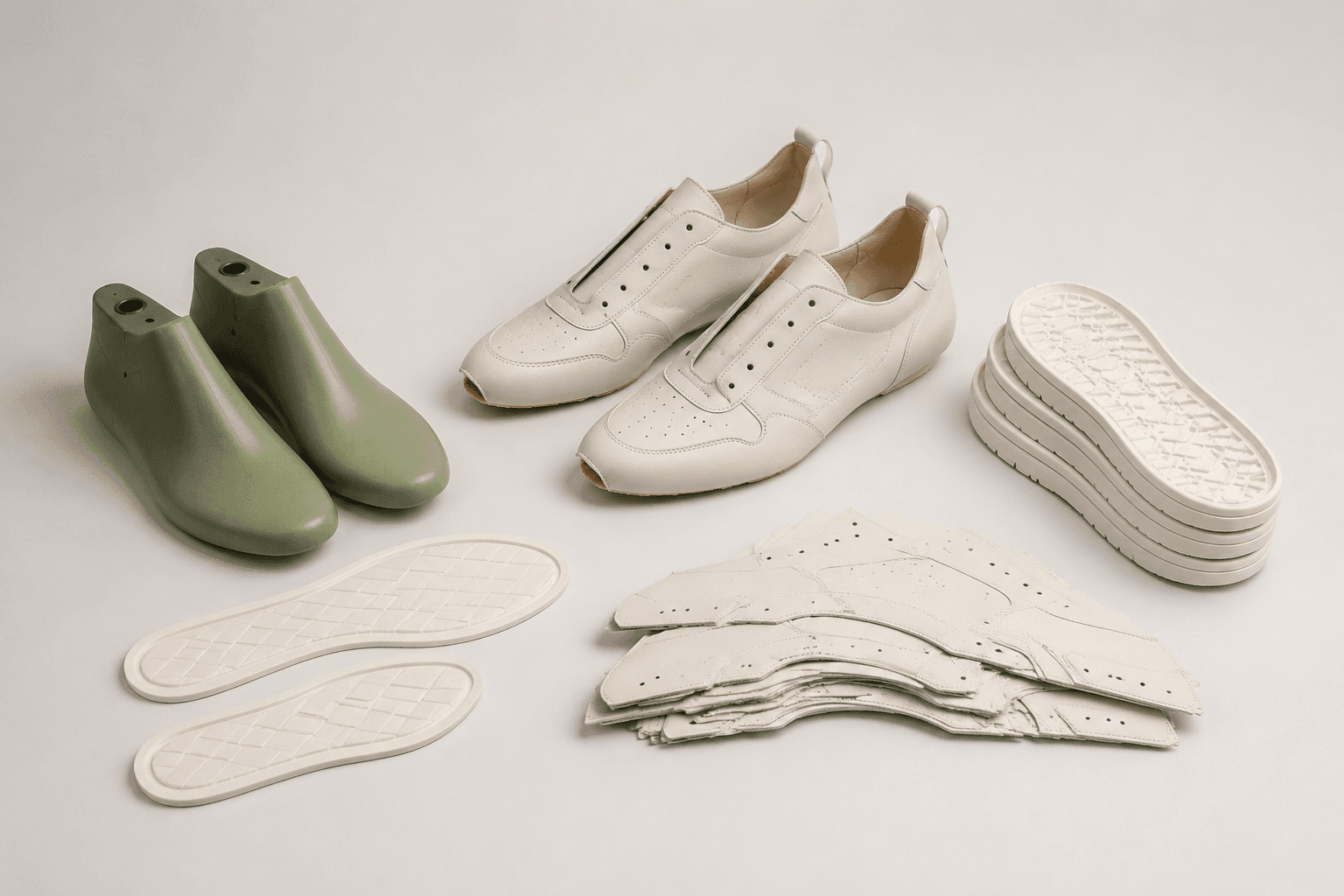
A footwear tech pack is a control document, not a design mood board. The trade-off is straightforward: a lighter pack is faster to draft and cheaper at the concept stage, but a factory will fill the gaps with its own assumptions on outsole hardness, upper stitch construction, insole thickness, carton packout, and fit. A heavier pack takes longer to prepare, yet it cuts sampling rounds, claim risk, and production drift.
For bulk footwear buying from China, the question is not whether you need a tech pack. The real comparison is how complete it needs to be for the shoe category, target price, and factory capability. A canvas vulcanized style at 1,200 pairs can survive with fewer controls than a cemented runner with molded strobel board, injected TPU counter, and EN ISO slip testing. The more components and performance claims you add, the more detailed your shoe spec sheet must become.
Below is a practical comparison of the main ways buyers document footwear, from a simple reference pack to a factory-ready package. The goal is to write a footwear tech pack the supplier can quote, sample, test, and scale without guessing.
A footwear factory does not build from intent; it builds from definitions, tolerances, and exceptions.
The first comparison: design reference pack versus build-ready footwear tech pack
Many buyers send a few sketches, outsole photos, and material notes and call it a tech pack. In practice, that is a design reference pack. It may be enough to start a conversation, but it is not enough to lock cost or quality. A factory can interpret the same upper paneling, foxing height, or collar foam requirement in three different ways, each with a different labor minute value and material yield.
A build-ready footwear tech pack tells the factory exactly what to make and what can vary. It includes upper material callouts by panel, lining construction, reinforcement placement, last reference, size grading logic, outsole dimensions, logo application method, packaging, test requirements, and acceptable tolerances. This is what lets a merchandiser issue an accurate FOB quote instead of a broad estimate that changes after the first sample.
The cost difference between weak and strong documentation shows up quickly. A missing outsole Shore A target can trigger a second tooling correction. An undefined insole board can change flex and fit. No stitch-per-inch target can make visible top-line sewing look inconsistent across pairs. One extra sampling round often adds 7-14 days and can cost more than the time required to build a proper pack.
- Reference pack: faster to prepare, higher interpretation risk, wider quote variance
- Build-ready pack: slower upfront, lower risk, tighter costing and fewer sample revisions
- Best choice depends on complexity, MOQ, target FOB, and compliance level
What a factory needs to quote accurately
Quoting starts from component consumption and labor content. If your shoe tech pack template does not identify all major components, the factory will price using assumptions. Those assumptions usually favor speed, not your intended construction. For example, generic wording like 'premium mesh upper' does not tell the factory whether the vamp mesh is 220 GSM sandwich mesh, 1.4 mm spacer mesh, or 320 GSM mono mesh with hot-melt support overlays.
A workable quote pack should identify at minimum the upper material map, lining material, sockliner build, lasting method, outsole compound type, logo application, size range, and packaging. On athletic and outdoor shoes, it should also identify the midsole process, footbed density, heel counter and toe puff requirements, and whether there are bonded films, no-sew cages, welded eyelets, or molded parts. On sandals, strap construction, webbing width, buckle specification, and outsole abrasion target matter more.
If cost is a priority, ask the factory to quote at two or three construction levels from the same design intent. For example, PU open-cell sockliner at 0.18-0.22 USD per pair versus molded Ortholite-type footbed at 0.55-1.10 USD per pair; conventional screen print logo versus molded rubber badge; standard carton with 5-ply corrugation versus export carton with higher burst strength. The shoe spec sheet should make these options visible instead of hidden.
Minimum quoting fields
For each material and component, list name, composition, thickness or weight, color standard, supplier source if nominated, and test requirement if applicable. For each process, specify whether it is cemented, cupsole, vulcanized, strobel, sidewall stitched, direct-injected, or California construction. For packaging, include box dimensions, tissue, silica gel, barcode labels, and carton pair count.
Typical quote variance when details are missing
In casual and sport categories, incomplete packs often create FOB variance of 0.50-2.00 USD per pair once real materials are confirmed. On low-ticket slippers that may be acceptable. On leather casuals or technical runners at 5,000-10,000 pairs, that gap is enough to break target margin or force a late redesign.
Comparison of footwear documentation levels
| Dimension | Simple reference pack | Standard pack | Factory-ready footwear tech pack |
|---|---|---|---|
| Best use case | Repeat styles, low complexity, existing mold and last | Line extensions, moderate changes, known construction | New styles, custom molds, compliance-heavy or performance programs |
| Quote accuracy | Low to medium; FOB can shift 0.50-2.00 USD/pair after material confirmation | Medium to high; most major components defined | High; BOM, construction, packaging, and testing all priced with fewer assumptions |
| Sample rounds to approval | Often 2-4 rounds | Often 2-3 rounds | Often 1-2 rounds if factory capability is matched |
| Technical content | Sketches, photos, rough material notes, basic size range | Colorways, BOM, key measurements, logo and packaging notes | Full BOM, graded specs, tolerances, diagrams, tests, labeling, QC criteria |
| Risk in production | High risk of interpretation drift on fit, materials, and finish | Moderate risk; some hidden assumptions remain | Lowest risk; deviations easier to identify before bulk |
Comparing three documentation levels on technical control
Not every style needs the same pack depth. The right comparison is between simple, standard, and factory-ready documentation. A simple pack works for proven repeats where the outsole mold, last, and materials are already approved. A standard pack works for line extensions with moderate changes. A factory-ready pack is the safer option for new constructions, private molds, or compliance-heavy programs.
The deeper the pack, the easier it is to control measurable items that factories otherwise normalize differently. These include heel height, forepart thickness, outsole width, collar opening, tongue length, lace length, webbing pull strength, stitch density, seam allowance, foam density, and bonding temperature windows.
- 01Simple pack: sketches, reference photos, rough material notes, basic size range
- 02Standard pack: colorway pages, BOM, key measurements, logo placements, packaging notes
- 03Factory-ready pack: full BOM, graded measurements, tolerances, construction details, tests, labeling, AQL and packout
Measurements and tolerances: where most shoe spec sheets fail
Footwear is not apparel. A chest width tolerance or body length tolerance mindset does not transfer well. A good shoe spec sheet controls fit, bottom dimensions, and assembly relationships. Factories need both inside-fit intent and outside-size intent. If you only give outsole dimensions without a last reference or internal length target, the factory can hit the bottom size and still miss the fit.
For each sample size and graded size, specify the measurement point, tool, and tolerance. Examples: outsole length in mm measured heel breast to toe tip; ball girth on last in mm; top-line opening circumference in mm; heel height in mm measured center back; forepart outsole thickness in mm; sockliner thickness under heel and forepart; lace length in cm; foxing height on vulcanized shoes in mm. Give realistic tolerances, not zero-defect fantasy numbers.
Common working tolerances on bulk footwear depend on category and process. Outsole dimensions may hold to plus or minus 1.0-1.5 mm after mold stabilization. Foam thickness may vary by plus or minus 0.5 mm. Upper panel cutting tolerance may be around plus or minus 1.0 mm before lasting effects. Color matching may target 4-5 grade under D65, with clear rules for suede, mesh, and natural rubber where shift is normal. If your footwear tech pack omits tolerances, quality control teams will argue after production instead of before it.
- Specify measurement points on diagrams, not only in text
- Separate fit-critical dimensions from cosmetic dimensions
- Align tolerances with process capability and material behavior
- State sample size and grading increments clearly
Materials and component detail: generic names are not enough
In Chinese factories, the same material family can cover a wide spread in price and performance. 'PU upper' can mean dry PU microfiber, wet PU synthetic, transfer-coated base cloth, or split leather with PU film. 'Rubber outsole' can mean natural rubber blend, TPR, or a compound with very different abrasion and slip results. Your shoe tech pack template should force material specificity.
For uppers, define composition, backing, thickness, finish, color reference, and critical tests. For linings, define whether they need anti-abrasion, colorfastness, or moisture management. For foams, state density and compression set expectations where relevant. EVA midsole hardness should be listed in Shore C or Asker C if that is the factory norm, along with target weight and color. Rubber outsole should identify hardness, specific gravity if critical to weight, and abrasion or slip requirement if the style claims performance.
This level of detail matters because substitutions happen at scale. A factory under target FOB may move from 45-50 kg per cubic meter collar foam to a lighter foam, or from 600D heel webbing to a lower denier tape, unless the pack fixes it. A full BOM also supports failure analysis. If bond failure occurs, you can trace whether the issue came from upper coating, primer, adhesive type, or curing conditions.
Examples of useful material callouts
Mesh vamp: polyester sandwich mesh, 240 plus or minus 15 GSM, black, 4-5 colorfastness to rubbing dry, minimum tear strength as agreed. Quarter overlay: 1.2-1.4 mm microfiber, matte, hot-cut capable. Collar foam: PU foam 45-50 kg per cubic meter. Sockliner top cloth: polyester mesh 130-160 GSM with anti-slip print if required. Outsole: rubber compound Shore A 60-65, DIN abrasion target based on category.
Construction notes versus exploded diagrams
Some buyers rely on text notes only. Others invest in sectional drawings and exploded views. Text is faster, but diagrams remove interpretation at the line and pattern room level. If the style has hidden stitch-and-turn seams, folded edge binding, strobel attachment, toe spring requirements, or molded heel clip integration, diagrams pay back immediately.
A supplier-side rule is simple: the more layers, lamination steps, or hidden components a shoe has, the more visual construction guidance you need. A vulcanized plimsoll can be built from fewer pages because the process is standardized. A trail runner with welded eyestay cage, injected heel stabilizer, gusseted tongue, and rock plate should not rely on text notes alone.
For China production, clear diagrams also reduce communication loss between sales, merchandising, pattern engineering, and the workshop. The English name in your pack may not match the term used on the line. A labeled diagram avoids that problem.
Testing, compliance, and labeling: compare optional control with mandatory control
This is where many importers under-specify. If the footwear is fashion-only with no performance claims and is sold into low-risk channels, you may handle testing as a separate quality protocol. But if the shoe is sold into workwear, school, outdoor, kids, or retailer programs with compliance gates, the footwear tech pack must carry test and labeling instructions from the start.
Testing should connect directly to materials and construction. For safety footwear, reference the relevant EN ISO or ASTM standard and list the required components such as toe cap, penetration-resistant midplate, slip class, antistatic behavior, or energy absorption. For lifestyle or athletic footwear, list the practical tests that affect claims or returns: upper-lining abrasion, flexing, sole bond, color migration, slip, hydrolysis risk for PU systems, and carton drop performance. If retailer manual requirements exist, include them in the pack or append them.
Labeling is also part of buildability. State size format by market, country of origin marking, material content language where required, warning labels, carton markings, and barcode format. If the factory does not know whether you need US, EU, and UK size conversion on the woven label, it will either omit one or print the wrong sequence, and that causes repack cost and shipping delay.
- State applicable standard by market and product type
- Match test methods to actual claim and construction
- Add labeling artwork, placement, and language requirements
- Include carton and inner box marking rules
Lead time, MOQ, and cost impact of a stronger pack
A frequent objection is that detailed documentation slows development. In reality, it shifts time forward. A strong pack may add 2-5 working days at the buyer side, but it can remove 1-2 sample rounds and prevent tooling correction cycles. In footwear sourcing, that usually means a net gain.
Typical China timelines vary by category. A first sample from a simple reference pack may come in 10-15 days, but approval often takes 2-4 rounds. A first sample from a factory-ready pack may still take 10-18 days, yet approval often lands in 1-2 rounds if the factory capability matches the product. Mold development, if needed, still drives the calendar, but the pack helps you freeze dimensions before steel cut.
MOQ and cost also benefit from clarity. When a factory understands exactly which components are common across colorways and which are unique, it can optimize purchasing and suggest MOQ-efficient changes. For example, standardizing lace tip finish, eyelet color, or footbed base across three colorways can reduce dead stock and help meet 1,200-1,500 pair MOQs per style. On the opposite side, unclear packs tend to create last-minute material changes that push the factory to surcharge or increase MOQ.
How to structure a shoe tech pack template your team can reuse
The best shoe tech pack template is not the prettiest one. It is the one your developers, merchandisers, QC team, and factory all read the same way. Reusable structure matters more than graphic polish. Use fixed sections so no one forgets hidden items such as strobel stitching color, top-line foam spec, or polybag suffocation warning.
A practical template starts with style identity and commercial targets, then moves into visual pages, BOM, measurements, construction notes, labeling, packaging, and testing. Keep one version-controlled master file and issue revision numbers. Every page should carry style code, revision date, and sample stage. When factories quote or sample, require them to mark any deviations line by line.
If you source several categories, use a core template plus category modules. Sandals need strap pull and hardware details. Vulcanized shoes need foxing and sulfurization controls. Safety footwear needs standard references and certification mapping. Running shoes need more bottom and cushioning detail. The template should adapt by category, but the document logic should stay stable.
- 01Cover page: style code, season, target FOB, MOQ, target ex-factory weight, intended market
- 02Visual pages: lateral, medial, top, bottom, back, outsole artwork, logo placements, colorways
- 03BOM: every component with spec, thickness, density, supplier, color, finish, test requirement
- 04Measurement pages: sample size, grading, measurement points, tolerances, fit notes
- 05Construction pages: seam types, stitch count, reinforcement, lasting method, adhesives, assembly notes
- 06Packaging and labeling: unit box, carton, tags, barcode, shipping marks
- 07Testing and QC: standards, test list, inspection criteria, AQL or retailer protocol
Verdict: choose the pack depth by risk, not by habit
If you are repeating an approved style with the same last, outsole mold, and proven materials, a standard pack may be enough. If you are changing only color and minor branding details, do not overengineer the document. But for any new outsole, new fit block, new upper construction, new compliance requirement, or target order with low margin for error, use a factory-ready footwear tech pack.
The best comparison is not simple versus detailed in abstract terms. It is cheap upfront versus cheap in total landed execution. In bulk sourcing from China, the factory can only build consistently from what you define consistently. A real shoe spec sheet reduces quote drift, sample loops, test failures, and claim exposure. That is why the correct verdict for most private-label and branded programs is clear: build a reusable, measurement-led, material-specific pack and make it the only source of truth.
SoleForge manufactures casual sneakers and athletic & running shoes under OEM and ODM for brands and importers worldwide. Request a quote with your tech pack or reference pair and we'll reply within one business day.