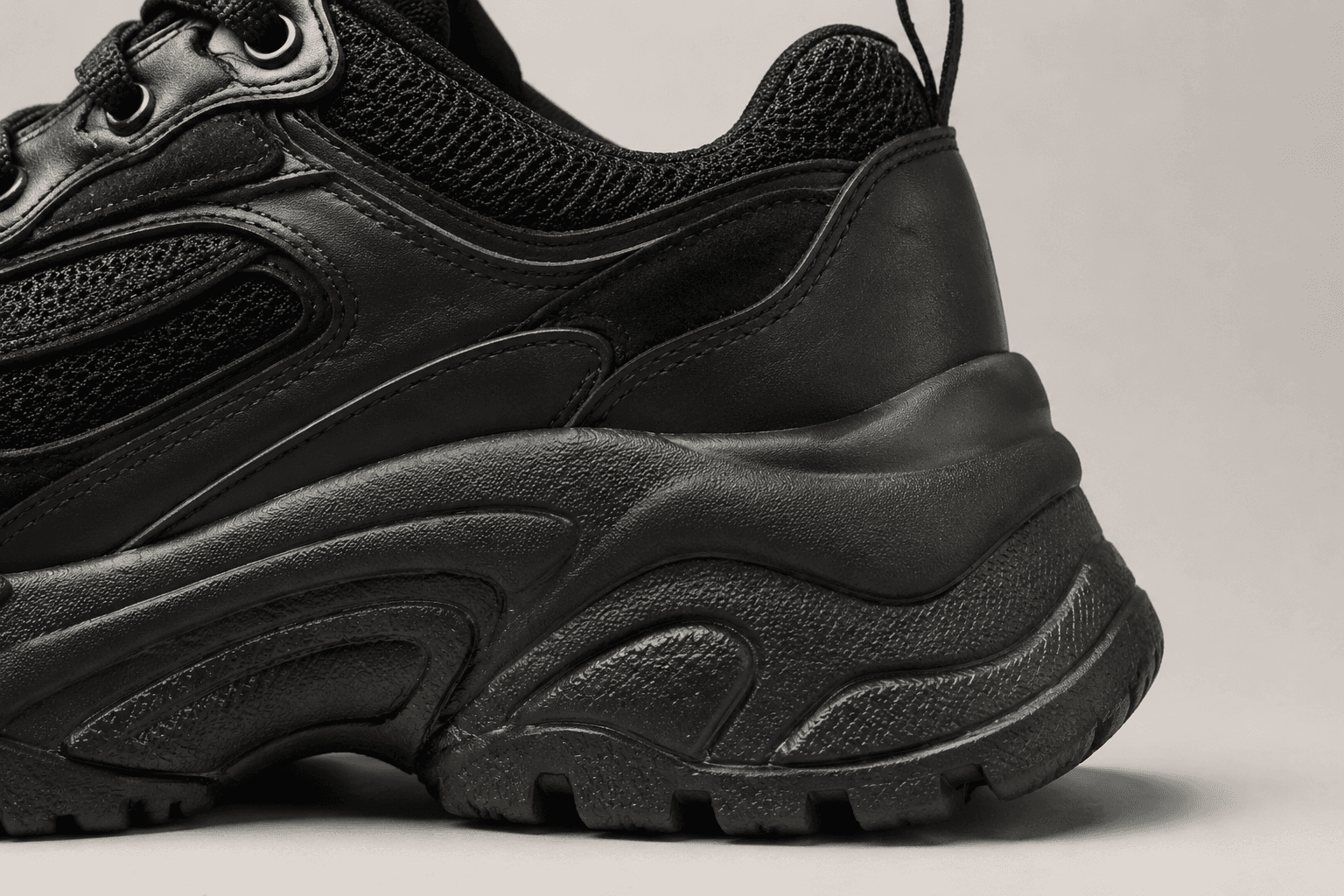
A factory FOB price for footwear is not a guess. It is built from the footwear BOM cost, standard labor minutes, packaging, expected waste, compliance cost, overhead and margin, then adjusted for MOQ, size run, construction and tooling status. When buyers ask why one supplier is $0.90 higher than another, the answer is usually in these assumptions, not in a single material line.
For sourcing managers buying from China, the real problem is rarely getting a quote. The problem is getting a quote on the same basis. One factory may price FOB Xiamen at 2,400 pairs per color with a stock cupsole, 250 lb test export carton and no third-party testing. Another may price EXW Quanzhou at 1,200 pairs per color, include a custom outsole mold recovery and assume EN ISO or ASTM lab work. On paper, both are 'quoted.' In practice, they are different offers.
This article explains how a proper footwear pricing breakdown is built from materials, labor and tooling, how those numbers move during development, why they matter for bulk buying, and when a buyer should request a line-by-line cost review instead of accepting a single FOB number.
The cheapest shoe factory quotation is usually the one that leaves the most assumptions unstated.
What a footwear pricing breakdown actually includes
A usable footwear pricing breakdown separates recurring cost per pair from one-time cost. Recurring cost means the dollars that repeat on every pair in bulk production: upper, lining, foam, reinforcement, insole board, sockliner, outsole or sole unit, trims, packing, direct labor, factory overhead, expected defect allowance and export handling. One-time cost means pattern engineering, grading, cutting dies, logo molds, outsole molds, midsole molds, trial runs and some test setup charges.
In China footwear sourcing, many factories first issue a short quotation such as '$11.60/pair FOB Xiamen, MOQ 1,200 pairs/color, lead time 45 days.' That is acceptable as a budget number, but not enough for approval. A buyer still needs to know whether the outsole is stock or custom, whether the quoted upper mesh is 180 GSM or 240 GSM, whether the sockliner is flat EVA or molded PU, whether carton dimensions are fixed, and whether the quote includes mold recovery, testing and extra-large size surcharges.
A supplier-side costing sheet usually starts with the BOM, then adds consumption loss, process labor, overhead, finance cost and a factory margin. The costing logic differs by category. A cemented running shoe factory, a vulcanized canvas factory, a direct-injection sandal factory and an EN ISO 20345 safety shoe factory do not carry the same machine cost, mold base, reject rate or production speed. That is why buyers should compare quotations by construction and specification, not only by target price.
- Upper package: mesh, knit, PU, microfiber, split suede, TPU film, no-sew, collar foam, tongue foam, heel counter and toe puff
- Bottom package: EVA, phylon, rubber, TPR, PU, TPU shank, strobel board, insole board and sockliner
- Direct process cost: cutting, skiving, stitching, lasting, roughing, priming, cementing, pressing, finishing and packing
- Losses: cutting waste, color shading, outsole molding loss, glue marks, pairing defects and rework
- Packing and compliance: shoe box, tissue, stuffing, barcode label, carton, silica gel, hangtag and lab testing
- Tooling and development: outsole mold, footbed mold, logo insert, cutting die, print screen, graded pattern and confirmation samples
How trade term and port basis change the same price
A shoe factory quotation is incomplete without the trade term. EXW excludes inland trucking, port handling and export customs. FOB usually includes standard factory-side export cost to the named port such as Xiamen, Fuzhou or Shanghai. CIF adds freight and insurance but still excludes duty, destination charges and last-mile warehousing.
In footwear, freight basis matters because carton cube matters. A vulcanized high-top in a rigid retail box may ship at 0.010-0.013 CBM per pair, while a lightweight knit runner in a compact box may be 0.006-0.008 CBM per pair. A factory that saves $0.12 on FOB but uses larger cartons can still be more expensive on landed cost. The quote should state pairs per carton, carton size, GW and NW.
Why MOQ, size curve and lead time must be stated up front
MOQ changes the cost base. A custom casual sneaker at 3,000 pairs per color can usually buy upper materials and outsole color batches at normal supplier MOQ. The same style at 600 pairs per color may trigger surcharges on mesh dyeing, webbing, lace tips, custom box print and outsole color because sub-suppliers are forced to run short lots. In many Fujian factories, practical MOQ is 1,200-1,500 pairs per color for simple custom styles and 2,000-3,000 pairs per color for technical uppers or special bottom colors.
Lead time belongs in the quotation, not only in email notes. A repeat order with approved materials may run 30-40 days after deposit and final confirmation. A new custom style with fresh upper materials and stock bottom often needs 45-60 days. A new outsole mold usually adds 20-35 days for mold opening and first trial, then 7-10 more days if cavity correction or size grading adjustment is required.
How material cost is built from the footwear BOM cost
Material is usually the largest part of shoe manufacturing cost. In common bulk programs from China, materials account for roughly 50-68% of FOB on casual and athletic footwear. For simple injected slippers it can be lower. For trail, work or safety styles with heavy rubber coverage, molded components and stricter testing, it can be higher.
The footwear BOM cost is a consumption calculation, not a shopping list. The pattern room calculates each panel area by size. The costing team then checks material width, nesting efficiency and expected waste. For a simple microfiber upper, cutting loss may be 8-10%. For hairy suede, reflective material or directional knit, loss can move to 12-18% because nap direction, roll defects and color matching reduce usable yield.
A small specification change can move cost more than buyers expect. A single-layer mesh at 160-180 GSM is not the same cost as a sandwich mesh at 220-260 GSM with 3 mm foam backing. A flat 4 mm EVA sockliner at 35-40 kg/m3 density may cost a fraction of a molded PU footbed at 45-55 kg/m3 with jersey lamination and screen print. A rubber outsole with standard wear performance is different from a high-abrasion compound specified for heel strike or oil-resistant work environments.
- 01Lock each component by material code, color, thickness, GSM, density, hardness and finish before final quote approval.
- 02Calculate consumption by size run, usually from the middle size, then apply grading and the order curve.
- 03Add cutting, laminating or molding loss based on real factory historical yield, not ideal CAD yield alone.
- 04Apply supplier prices at the actual MOQ bracket for each material, especially for dyed mesh, knit yarn and custom rubber color.
- 05Add trims, labels, carton, box inserts and any compliance-related material to complete the footwear BOM cost.
Upper cost drivers that buyers often miss
The upper is where design complexity quietly inflates cost. Each overlay adds material, die-cutting, positioning, stitching or heat-bonding time, plus more risk of misalignment. Reflective films, welded no-sew pieces, molded heel clips, stitched web loops and perforated decorative panels may each add only a few cents alone, but together they can increase FOB by $0.40-$1.20 per pair depending on volume.
Foam specs are often too vague in tech packs. 'Soft collar' is not a usable costing standard. A collar foam at 8 kg/m3 behaves differently from 12 kg/m3 or 15 kg/m3. Tongue foam at 4 mm versus 8 mm changes hand feel, compression set and cost. If the factory priced 4 mm low-density foam and the approved wear-test sample uses 8 mm higher-density foam, the quotation should change.
Color count also drives material price. A 2,400-pair order in one color buys more efficiently than 2,400 pairs split over four colors of 600 pairs each. Factories may accept the split, but then charge on the basis of low-yield material buying, extra roll-end waste and more frequent cutting changeovers.
Bottom cost in EVA, phylon, rubber, TPR and PU
Bottom cost depends on both material and process. A stock cupsole may only add the sole unit price because the mold already exists and shrinkage behavior is known. A custom phylon midsole with rubber outsole pods requires separate compounding, molding, trimming, bonding and inventory control, so the price structure is higher even before mold charges are added.
Density and hardness must be stated. A phylon midsole at 0.23-0.25 g/cm3 and 45-50 Asker C is not the same as a softer, lighter 0.18-0.20 g/cm3 version. Rubber at 58-62 Shore A for general casual wear is not the same as a high-wear carbon rubber or oil-resistant nitrile blend used on work shoes. Heavy bottoms can also distort pair cost because buyers sometimes compare only raw compound price per kilogram instead of grams consumed per pair.
For work, occupational or safety footwear, bottom decisions may be tied to EN ISO 20345, EN ISO 20347 or ASTM F2413 performance at the shoe level. Slip resistance, fuel oil resistance, heat contact, puncture protection, antistatic behavior and toe cap integration all affect compound choice, insert count and test budget.
Typical cost buckets in a China shoe factory quotation
| Cost bucket | What is included | Common pricing unit | Buyer checkpoints |
|---|---|---|---|
| Upper materials | Mesh, PU, suede, lining, foam, webbing, labels, eyelets, counters and toe puffs | $/pair from BOM consumption | GSM, thickness, foam density, color MOQ, cutting loss |
| Bottom materials | EVA, phylon, rubber, TPR, PU, TPU shank, footbed and insole board | $/pair or internal kg-based cost | Density, Shore hardness, abrasion target, stock or custom mold |
| Direct labor | Cutting, stitching, lasting, cementing, finishing and packing | $/pair from standard minutes | Construction type, line efficiency, rework risk, order volume |
| Packaging | Shoe box, tissue, stuffing, polybag, barcode, master carton and tape | $/pair | Pairs/carton, carton size, print level, CBM per pair |
| Testing and compliance | Physical tests, chemical checks, slip, flex, abrasion and safety tests | Per report or allocated $/pair | EN ISO, ASTM, market claim, third-party lab scope |
| Tooling and development | Outsole molds, cutting dies, logo molds, patterns, grading and trials | One-time charge or amortized $/pair | Ownership, lead time, recovery volume, correction terms |
How shoe labor cost is calculated inside the factory
Shoe labor cost is built from standard minutes, line efficiency and process difficulty. The factory estimates labor time for cutting, preparation, stitching, lasting, sole attaching, finishing and packing, then converts those minutes into $/pair based on wage level, line output and expected efficiency. The same-looking style can cost very differently if one uses stable synthetic leather and stock sole matching while the other uses stretchy knit, a sharp toe shape and high glue-cleaning requirements.
In most China footwear factories, direct labor on a basic casual sneaker may land around $1.20-$2.20 per pair, while a more technical runner, boot or safety style can be $2.50-$4.50 or more depending on construction, operator skill and output. These are not universal benchmarks, but they are realistic sourcing ranges. When a quotation is far below this range, buyers should check whether key processes have been omitted or under-assumed.
Labor should not be viewed separately from overhead. The stitching line, QC staff, warehouse issue team, mechanics, compressors, roughing dust collection, mold maintenance and planning office all support each pair produced. A disciplined factory may quote $0.25-$0.60 more than a weak factory because it carries better process control, but that extra cost often buys lower defect rates and fewer shipment delays.
- Cutting minutes rise with panel quantity, directional materials, laminated materials and manual defect sorting.
- Stitching minutes rise with seam length, folded edges, decorative topstitching, bartacks, piping and reinforcement patches.
- Lasting minutes rise with stiff uppers, narrow toe shapes, heavy counters, large size ranges and difficult toe spring.
- Bottom assembly minutes rise with roughing area, primer type, cement system, heat activation and pressing requirement.
- Finishing and packing minutes rise with glue-cleaning standard, lace threading, paper stuffing, hanger insertion and retail labeling.
Why construction method changes labor by dollars, not cents
Construction controls process count. A cemented sneaker requires upper closing, lasting, roughing, primer, cementing, heat activation, attaching, pressing and curing. Strobel construction adds the strobel seam before lasting. Vulcanized footwear needs foxing placement, sidewall treatment and oven handling. Direct injection can reduce bonding operations, but only in factories with the right mold capacity and disciplined cycle control.
The labor effect is material in the quote. Moving from a simple cemented stock-sole casual to a strobel runner with molded heel support and rubber pods can add $0.50-$1.20 per pair in labor alone. If the buyer wants stronger bond performance for hot and humid markets, the factory may also extend curing time or use a more demanding cement system, which affects both labor and overhead.
How defects convert into hidden labor cost
Rework is one of the most underestimated supplier-side costs. A style running at 78% line efficiency can fall to 62-65% if materials fray, toe lasting is unstable, outsole matching is poor or light upper colors show glue marks. Then the factory handles the same pair twice: once in normal production and again in repair or cleaning.
Buyers looking for cost reduction should ask where time is lost. A realistic cost-down may come from deleting one welded overlay, widening seam allowance by 1.5 mm, switching a fragile heat-transfer logo to a molded patch, or using a stock eyelet and stock lace tip. These changes can remove labor and reject cost without weakening the shoe.
How tooling cost shoes is quoted and recovered
Tooling cost shoes is not one number. It may include outsole molds, phylon midsole molds, rubber outsole molds, footbed molds, logo inserts, cutting dies, embossing plates, tongue label molds and grading support. Buyers should ask for a tooling list, not just a total amount.
For an upper developed on an existing stock sole, tooling may be limited to paper pattern engineering, cutting dies and small branding hardware, often from a few hundred dollars up to around $1,500 depending on size range and logo complexity. A new rubber outsole mold set can easily be several thousand dollars. A custom phylon midsole plus rubber outsole package across EU 36-46 can be materially higher because multiple cavity sets, inserts and test shots are involved.
Tooling also moves delivery. Cutting dies usually take 5-10 days after pattern approval. Small logo molds may take 7-12 days. New outsole molds commonly require 20-35 days before the first sole trial. If fitting or wear test shows instability, toe spring error, arch mismatch or excessive sole shrinkage, correction may add another 7-14 days before commercialization.
Separate tooling charge versus amortized tooling in the pair price
A separate tooling charge gives cleaner pricing. The buyer pays, for example, $4,800 for outsole molds and $650 for cutting dies, while the FOB remains a true recurring pair cost. This makes reorders easier to verify because tooling is not hidden inside the unit price.
Amortized tooling spreads recovery into the FOB, such as $0.35 per pair over the first 12,000 pairs. This can help launch cash flow, but the quotation must state the recovery logic clearly: recovery amount, target volume, expiry point and post-recovery FOB. Otherwise a buyer may still be paying mold recovery after the tooling has already been covered.
Ownership, maintenance and modification rules
Tool ownership should be written before PO placement. The buyer should know whether the mold is exclusive, where it is stored, whether another customer can use a similar tread base, who pays maintenance and whether the tool can be transferred if business moves.
Buyers should also assume that not all tooling changes are free. If the outsole sidewall logo moves, the tread depth changes, the size range expands from EU 40-45 to EU 36-46, or a steel shank is added later, the first tooling charge may no longer cover the revised tool set.
Why the shoe factory quotation often changes after development
The first quotation is usually based on provisional assumptions. After the confirmation sample, upper materials, foam spec, bottom hardness, carton size, lab test scope and actual line process become clearer, so the factory may re-quote. That is normal if the assumptions have changed. It is poor practice only when the original assumptions were hidden or incomplete.
Typical cost movements are concrete. Changing from a 180 GSM mesh to a 240 GSM sandwich mesh may add $0.12-$0.28 per pair. Moving from a flat EVA sockliner to molded PU can add $0.25-$0.60. Adding rubber coverage to the forepart may add $0.15-$0.40. Upgrading from a plain brown box to full-color retail packaging with barcode stickers and internal paper wrap may add $0.20-$0.55, depending on quantity and print format.
Testing is another common gap. A quote may exclude third-party lab fees until the target market is confirmed. For fashion casual shoes, the buyer may only need routine physical and chemical checks. For work or safety categories claiming EN ISO 20345, EN ISO 20347 or ASTM F2413-related performance, the test package is broader and the sample cycle is longer. That affects both cost and approval timing.
When to use a line-by-line cost review and when not to
A line-by-line cost review is most useful when the buyer is developing a new outsole, missing target FOB by more than 5-8%, comparing suppliers with a price gap above roughly $0.70-$1.00 per pair, reducing MOQ, or commercializing a style with multiple unknowns. In these situations, a single total price hides the real decision points.
A detailed review is less valuable on a stable repeat order where materials, molds, packaging and destination standard have not changed. On repeats, the buyer should instead verify whether raw material prices, wage levels, exchange movement or carton specs have changed enough to justify any new quotation.
The goal of review is not to argue over every eyelet and label. It is to identify the 3-5 lines driving the quotation. In footwear, those are usually the bottom package, upper consumption, labor minutes, packaging cube and tooling recovery. Once those are clear, the buyer can make technical decisions instead of pushing for an unsupported discount.
- 01Normalize trade term, named port, MOQ, size range, carton spec and lead time before comparing quotes.
- 02Separate recurring $/pair from one-time tooling, sample and development charges.
- 03Ask the factory for the top five cost drivers and their estimated $/pair impact.
- 04Lock material specs: GSM, thickness, foam density, hardness, supplier source and approved color standard.
- 05Confirm EN ISO, ASTM or customer protocol testing before finalizing the commercial price.
- 06Requote after confirmation sample and again before PO release if any spec changed.
SoleForge manufactures athletic & running shoes and safety & work shoes under OEM and ODM for brands and importers worldwide. Request a quote with your tech pack or reference pair and we'll reply within one business day.