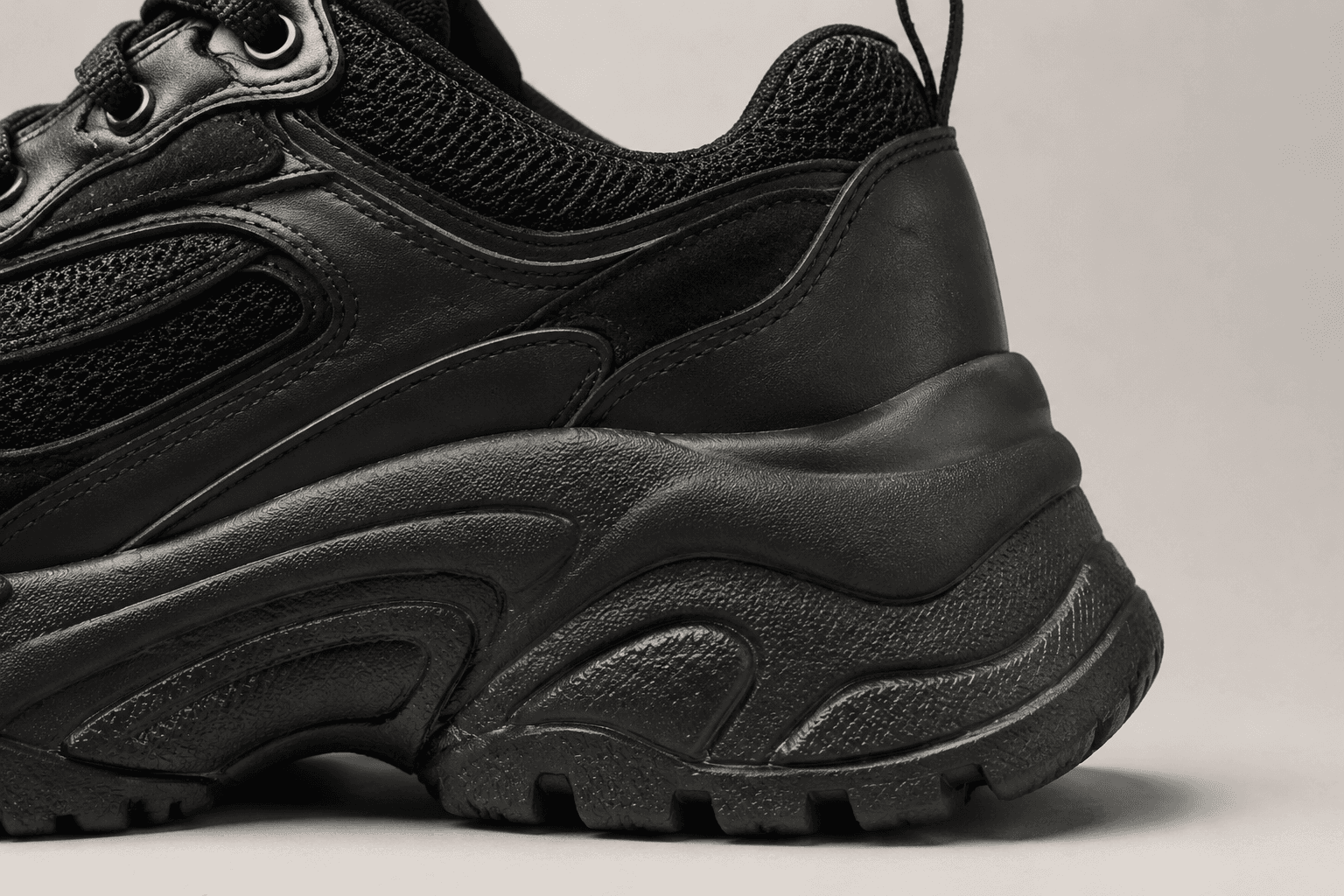
To reduce defects in footwear orders, buyers need to control the manufacturing points where defects are created, not rely on final inspection to catch them. In footwear, claims usually start upstream: a bulk upper approved from a hand swatch instead of the actual lot, a size set signed off only in size 37 or 42, a cemented outsole launched without confirming roughing depth or activation temperature, or a target FOB that leaves no room for stable materials. A 1.5 mm vamp pattern drift, a foam density drop from 0.22 to 0.18 g/cm3, or a mesh substitution from 220 GSM to 180 GSM is enough to turn a good prototype into an unstable bulk order.
For sourcing managers, brand owners, and importers buying footwear from China, the practical target is not zero defects. In real production, that is not a commercial standard. The target is to keep the shipment within an agreed tolerance while protecting fit consistency, wear performance, labeling accuracy, and retail presentation. That requires a footwear QA process built around spec control, bulk material approval, pilot verification, in-line factory defect prevention, bulk footwear inspection, and disciplined pre-shipment shoe checks against the same standard used for sample sign-off.
From the factory side, the most reliable way to reduce defects in footwear orders is to set release gates. First define acceptance in measurable terms. Then lock materials and components. Then verify first output under normal line speed. Then audit the high-risk operations where defects repeat fastest. Finally, inspect packed goods by size run, lot, and carton assortment. Buyers who manage those gates usually see fewer claims, less sorting cost, and fewer delays caused by late rework before vessel cutoff.
In footwear, final inspection does not create quality; it only shows whether materials, process control, and packed-goods checks were managed early enough.
Define the acceptance standard before the PO is released
The first buyer decision is whether the factory and the buyer are working to the same measurable standard. In footwear, many disputes begin because the approval sample was accepted visually, but never translated into tolerances, defect categories, packaging rules, and shipment criteria. If you want to reduce defects in footwear orders, the PO pack should state upper and lining construction, color standard, size tolerance, logo position tolerance, outsole hardness range where relevant, carton method, and exact ship-release rules.
A usable standard should separate critical, major, and minor defects with footwear-specific examples. Wrong size marking, exposed sharp metal, sole separation, severe left-right mismatch, strong contamination, and missing mandatory compliance labeling should not sit in the same category as a slight glue shadow inside the topline or a brushing-direction variation on nubuck. For EU and US shipments, reference the applicable EN ISO or ASTM method where needed, but do not assume a lab pass removes commercial risk. Many returns come from fit, appearance, or pair-matching issues that are not captured by chemistry or durability reports alone.
MOQ influences defect risk more than many buyers plan for. A basic cemented casual style may run at 600 to 1,200 pairs per colorway, while cupsole, vulcanized, injected, or molded programs often start from 1,200 to 3,000 pairs. At low MOQ, factories are more likely to combine material lots, reduce cutting buffer, or compress line setup time. That can still be managed, but only if the acceptance standard is tighter and the approval file is complete before production starts.
- Ask for a written defect classification sheet tied to the approved sample
- Confirm measurement tolerances by point: insole length, outsole length, topline height, heel height, tongue height, logo position
- State compliance scope at PO stage: REACH-related restrictions, EN ISO, ASTM, CPSIA where applicable
- Freeze packing method: stuffing, tissue, silica gel, box label, carton marks, and carton drop expectation
- Define acceptable shade band across pairs, sizes, and cartons under the agreed light source
Choose the factory by construction capability, not FOB price alone
The second buyer decision is whether the supplier is actually built for your construction and material mix. A factory that runs vulcanized canvas well may still struggle with knit uppers, molded EVA footbeds, cupsole pressing, light-color suede, or water-based adhesive systems. To reduce defects in footwear orders, evaluate the line by construction experience, operator stability, incoming material discipline, and defect history before comparing only FOB price.
Price pressure and lead-time pressure usually return later as quality cost. A cemented sneaker quoted at FOB $7.80 can be riskier than one at $11.80 if the lower-priced supplier is using unstable stock fitting, lower-grade backing, inconsistent adhesive handling, or weaker finishing control. The same applies to time. For a new outsole mold, 35 days ex-factory is aggressive if the order still needs mold trial, size-set review, bulk material arrival, and pilot confirmation. A more realistic first order is often 45 to 60 days, while repeat orders with frozen materials may ship in 30 to 40 days depending on volume and line loading.
Capability also means knowing what is controlled in-house. If printing, embroidery, insocks, sockliners, eyelets, or cartons are outsourced, the buyer should ask how incoming QC, lot traceability, and shade matching are handled. A large share of defects found during pre-shipment shoe checks come from outsourced components that never followed the same control standard as the upper and outsole.
- Ask which processes are in-house and which are subcontracted
- Check style experience by construction: cemented, strobel, cupsole, vulcanized, injection
- Confirm daily line capacity for your style, not only total factory capacity
- Review actual defect history by type: bonding, stitching, fit, odor, color migration, packaging
- Compare total landed quality cost, not only FOB $/pair
Minimum capability questions for a new supplier
Ask how many pairs per day the assigned line can produce for your specific style, what normal internal rework rate is accepted, and whether upper, lining, outsole, footbed, and carton components are controlled by lot number. A capable factory should answer with real operating data, not sales-level estimates.
Also confirm whether the factory can run internal checks for peel strength, flexing, colorfastness, Shore A hardness, and foam density. External labs are still needed for formal reports, but production should not stop because the supplier cannot quickly confirm whether an EVA footbed is 0.20 or 0.23 g/cm3, or whether a rubber outsole batch shifted from Shore A 58 to 65.
Control points that most directly reduce defects in footwear orders
| Stage | Main risk | What buyer should confirm | Typical control metric |
|---|---|---|---|
| PO and sample approval | Unclear quality standard | Approved spec sheet, defect classification, packaging standard, compliance scope | Tolerance in mm, defect class, market compliance list |
| Material booking | Lot variation or substitution | Bulk material card, supplier identity, substitution approval rule | Thickness, GSM, density g/cm3, Shore A, color standard |
| Pilot run | Sample-to-bulk mismatch | Trial output review before full launch | 30-100 pairs per colorway checked |
| In-line sewing and lasting | Repeat workmanship and shape defects | Operation-level QC records, size-set control, rework segregation | Checks every 30 minutes or by output quantity |
| Sole attaching | Bonding failure | Adhesive system, activation setting, press standard, lot traceability | Peel result, process temperature, dwell time |
| Pre-shipment | Packed-goods defects and labeling errors | AQL inspection on packed goods, assortment, carton condition | AQL 2.5/4.0 typical, 0 critical |
Lock bulk materials and components before cutting starts
Material instability is one of the most common root causes behind failed bulk footwear inspection. Pair-to-pair variation in upper thickness, backing stiffness, outsole hardness, insole board flex, toe puff behavior, and footbed lamination often looks like operator error when it is really an incoming-material problem. The earlier the buyer locks the material specification, the stronger the factory defect prevention result.
Footwear materials should be approved by measurable values, not color swatch alone. Typical controls include microfiber thickness in mm, mesh GSM, EVA or PU density in g/cm3, rubber hardness in Shore A, strobel cloth weight, counter stiffness, foxing thickness, and lace tensile performance. If a supplier changes a 1.4 mm microfiber to 1.2 mm, swaps a 220 GSM sandwich mesh for 180 GSM, or replaces a 55 Shore A outsole with 62 Shore A compound, the shoe may still look acceptable on the table but lose sewing stability, shape retention, comfort feel, or carton recovery during transit.
Foam parts need tighter control than many buyers give them. A footbed at 0.18 g/cm3 compresses and recovers differently from one at 0.22 g/cm3. That changes fit volume, step-in feel, and how the shoe presents after 30 to 45 days in a closed box. For open-cell or multilayer foam sockliners, compression set, rebound, and lamination strength should also be checked, especially in athleisure, recovery, and kids' footwear where comfort claims are sensitive.
- Request a bulk material card listing thickness, GSM, density, hardness, color standard, and supplier name
- Approve cutting swatches from actual production lots, not only lab dips or showroom hangers
- Check shade matching under agreed light source, especially for split leather, suede, nubuck, and white mesh
- Confirm adhesive, primer, and treatment system for each upper-outsole combination
- Require written approval before any material, foam, sockliner, or outsole compound substitution
Run a pilot before full production, especially on new styles
A disciplined footwear QA process includes pilot verification before the line runs at full output. This is where the factory proves that the approved sample can be repeated with bulk materials, real operators, standard machine settings, and normal workshop conditions. Buyers who skip this step to save two days often lose one to two weeks later in sorting, rework, or replacement production.
For orders above roughly 3,000 pairs, a pilot of 30 to 100 pairs per colorway usually exposes the main risks. The purpose is not only to inspect the finished pair. The buyer or QC team should also review cut panels, sewing balance, lasting shape, size grading, sidewall alignment, heel-seat wrapping, glue-line control, and packing recovery after 24 hours. A shoe that passes in a sample room can still fail when the line moves from 120 pairs to 1,000 pairs per day under production pressure.
This stage is also the correct point to confirm the full size run. Many bulk claims start because only the salesman sample size was reviewed carefully. For women's dress-casual and children's footwear, where fit tolerance is tighter, buyers should check internal length, ball-area fit, vamp depth, topline pressure, heel grip, and sockliner seating across the size set before all bulk cutting is released.
- 01Review first-cut panels for grain direction, nap consistency, print placement, and cutting cleanliness
- 02Check sewing SPI, seam allowance, tongue centering, backstay symmetry, and label attachment position
- 03Inspect lasted shoes for toe spring, medial-lateral balance, sidewall alignment, heel-seat wrap, and counter shape
- 04Test pilot pairs for bond strength, flex response, shape recovery, and visible deformation after 24 hours rest
Control the highest-risk operations in-line, not at the end
If the first serious quality review happens at final inspection, the factory is already late. The most effective shoe quality control sits in-line at the operations where defects are created: cutting, skiving, sewing, lasting, roughing, cementing, sole attaching, finishing, and packing. This is where defects are cheapest to stop and most expensive to repeat.
For uppers, in-line control should focus on panel direction, seam puckering, skipped stitches, needle damage, ink transfer, material contamination, and left-right pattern symmetry. At lasting, watch toe shape, heel-seat position, topline balance, sidewall centering, and quarter tension because shape drift increases when output speed rises. In cemented footwear, monitor roughing depth, primer coverage, adhesive open time, activation temperature, pressing pressure, and dwell time. In cupsole or vulcanized construction, watch outsole seating, wall contact, sulfur contamination where relevant, and sidewall cleanliness. A bonding defect found during pre-shipment shoe checks usually means the process was already unstable two or three days earlier.
A factory should not depend on one roaming inspector checking random pairs casually. Strong control uses three layers: operator self-check, line QC check, and QA audit by time interval or output quantity. For example, lasting may be verified every 30 minutes, finishing every 100 pairs, and peel samples every shift or lot change. These are ordinary controls on a stable line, but they are the difference between five defective pairs and five hundred.
- Ask how in-line defects and rework are recorded by operation and by lot
- Check whether adhesive room temperature and humidity are monitored and logged
- Confirm broken-needle control and fragment accountability procedure
- Review roughing standard, activation setting, and press parameters by outsole material
- Require segregation and quarantine for nonconforming pairs instead of mixed rework flow
Common defects that should be stopped in-line
The most frequent avoidable footwear defects include uneven stitching, dirty uppers, weak bonding at flex points, collapsed counters, twisted tongues, outsole mismatch, sidewall gaps, sockliner bubbling, incorrect logo orientation, and pair shade variation. None of these should first appear when 80 percent of the goods are already packed.
Light-color programs need stricter finishing discipline. White PU, white mesh, and pastel suede pick up contamination quickly from glue, carbon dust, transfer ink, carton abrasion, or dirty gloves. On nubuck and suede, brushing direction and pressure also need control because inconsistent finishing can make one material lot appear like two different shades in the same carton.
Set a realistic AQL and a footwear-specific pre-shipment method
Bulk footwear inspection should confirm shipment readiness, but it should not act as the only quality gate. Buyers still need an agreed AQL because it creates a practical ship-or-hold standard. For many commercial footwear orders, AQL 2.5 for major defects and 4.0 for minor defects is common, with zero tolerance for critical defects. Premium leather lines, children's programs, and safety-related constructions may need tighter thresholds.
The inspection method should match the way footwear fails in real shipments. Pre-shipment shoe checks should be done when at least 80 percent of goods are packed and 100 percent are produced. Inspectors should open cartons across size runs, color lots, and production dates, then check workmanship, pair matching, measurements, labeling, accessories, barcode accuracy, carton assortment, and packaging completeness. In footwear, packed-goods inspection matters because toe collapse, counter crushing, pair rubbing, and transfer staining often appear only after the goods are boxed and master-cartoned.
Buyers should also define what happens when one repeated defect is found in a concentrated lot. A random sample can still pass AQL while hiding a problem in one colorway, one size range, or one production day. In those cases, the correct action is not to rely on the pass result alone. The correct action is to expand inspection on the affected segment, hold the lot, and decide whether sorting, rework, or partial remake is the cleaner commercial option.
- Confirm AQL levels by critical, major, and minor defect before bulk production starts
- Inspect packed goods, not only loose finished pairs on the shelf
- Check size run, carton assortment, inner box labels, and outer carton marks together
- Open mixed cartons from different production dates or line lots where possible
- Define what triggers expanded inspection, lot hold, or shipment block
Use testing where it changes shipment risk and claim exposure
Testing should be practical and tied to the failure modes that create returns, claims, or compliance exposure. Buyers do not need a large report stack on every repeat order, but they do need the right tests on the right constructions. To reduce defects in footwear orders, test what is most likely to fail in wear, transit, or market surveillance.
For cemented sports-casual shoes, the most useful controls often include bond strength, flex resistance, colorfastness to rubbing, outsole abrasion where relevant, odor review, and dimensional stability after conditioning. For sandals, buckle pull, rivet retention, and strap attachment strength may matter more. For children's footwear, small-parts security, chemical compliance, and lining colorfastness carry higher risk. For EVA and PU parts, density, hardness, rebound, and compression set often provide better production control than visual approval alone.
Timing matters as much as test selection. New materials, new outsole compounds, and new adhesive systems should be checked before full bulk commitment. If the first formal failure arrives after production is complete, the buyer is left with only expensive choices: rework, downgrade, remake, or delayed shipment. Testing is valuable only when there is still time to change the process.
- Select tests by failure mode: bonding, flexing, colorfastness, abrasion, hardness, compression set
- Use EN ISO or ASTM methods that match the footwear category and market requirement
- Test new upper materials, foam parts, and outsole compounds before full launch
- Keep retained reference samples from tested lots for future claim comparison
- Match all test reports to actual production lot numbers and component suppliers
Agree rework limits and shipment release rules before vessel cutoff
The final buyer decision is commercial discipline. Even strong factories can produce isolated defects in bulk, but the buyer and supplier should agree in advance what can be reworked, what must be replaced, and what blocks shipment. Without those rules, quality decisions become rushed negotiations when ETD is close and container booking pressure is high.
In footwear, acceptable rework may include removing light surface dirt, replacing laces, correcting tissue or stuffing, relabeling boxes where traceability is maintained, or repacking cartons. High-risk rework includes recoloring visible uppers, repeated reheating of bonded areas, aggressive solvent cleaning on PU or suede, trimming that changes pattern symmetry, or any size remarking. These actions often solve one visual problem while creating a second defect in wear, appearance, or claim liability.
Shipment release should therefore consider defect type, concentration, rework method, and remaining lead time. If tolerance is exceeded, the supplier should propose a clear corrective action by quantity: sort-and-repair, selective remake, replacement on next order, or negotiated discount by affected pairs. What matters is whether the fix is controlled and repeatable. A rushed repair on 8,000 pairs in 48 hours often introduces more inconsistency than the original issue.
- Define which defects are reworkable, replaceable, or automatic shipment blockers
- Require re-inspection after any large-scale rework on affected lots
- Check ETD impact before approving repair that affects wear performance or appearance
- Retain sealed shipment samples from the released lot for future claim review
- Document root cause and corrective action before the next repeat PO
Key takeaways
- Do not release the PO until the approved sample has been converted into measurable tolerances, defect classes, packaging rules, and compliance requirements.
- Choose suppliers by construction capability, line control, and realistic lead time; the lowest FOB $/pair often creates the highest quality cost later.
- Lock bulk materials by measurable values such as thickness, GSM, Shore A hardness, and foam density to prevent hidden pair-to-pair variation.
- Use a pilot run and operation-level controls to stop stitching, shape, contamination, and bonding defects before they repeat across the order.
- Treat bulk footwear inspection and pre-shipment shoe checks as release gates inside a wider footwear QA process, not as the only quality tool.
- Agree rework limits, replacement rules, and shipment blockers before ETD so the final decision remains technical and commercially clean.
SoleForge manufactures athletic & running shoes and kids' footwear under OEM and ODM for brands and importers worldwide. Request a quote with your tech pack or reference pair and we'll reply within one business day.