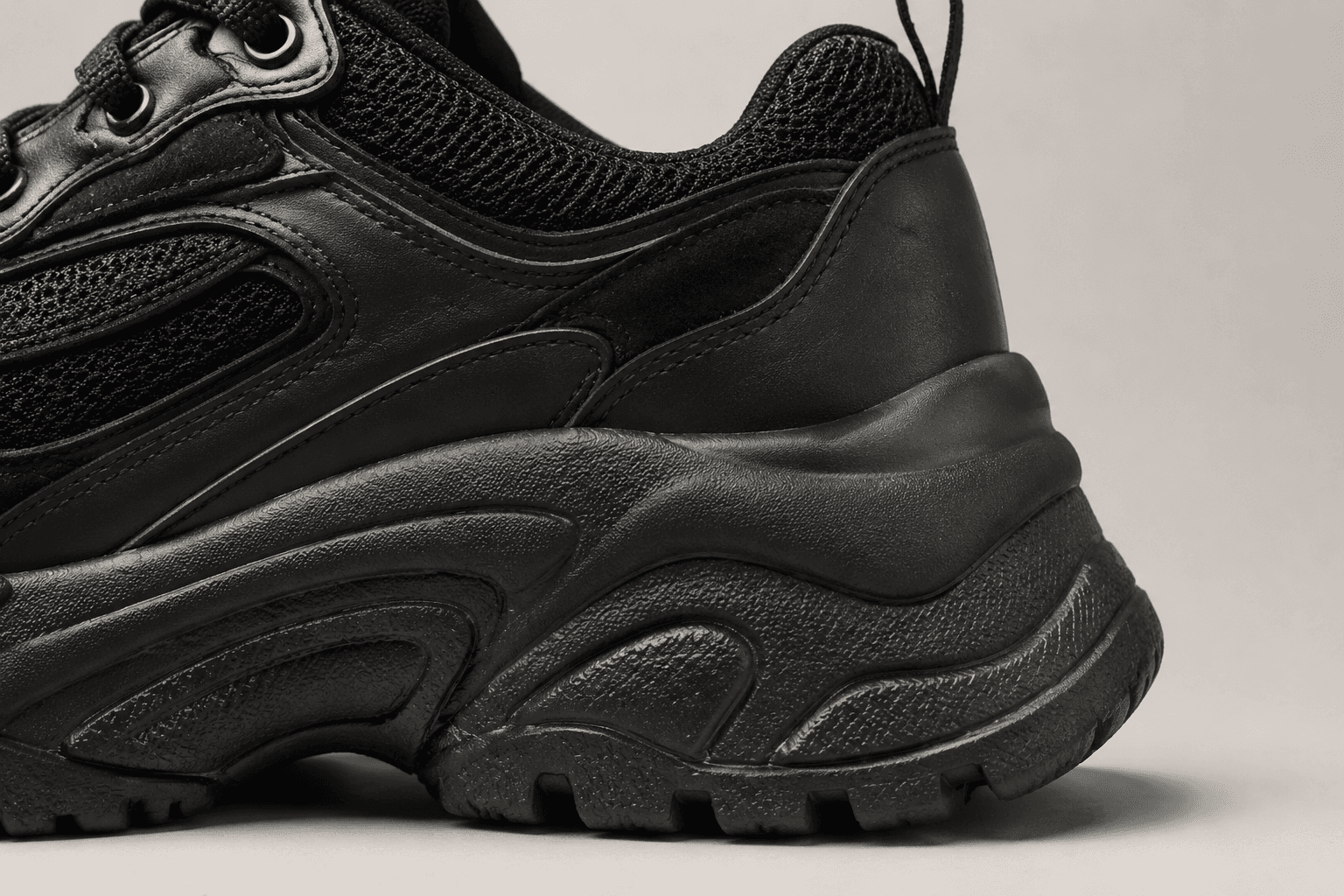
Sourcing private label leather dress shoes is usually harder than sourcing sneakers or basic casuals. The styling is restrained, so buyers and end customers judge details more aggressively: last shape, throat balance, toe spring, edge ink, welt line cleanliness, sock comfort, outsole slip, and whether the factory can repeat color, burnish depth, and pair symmetry across bulk production. For importers buying from China, the main risk is not finding a supplier. It is selecting a dress shoe manufacturer that can translate one approved sample into 500, 2,000, or 8,000 pairs without drift in fit or finish.
In men’s leather shoes wholesale, problems usually start in the technical package, not at shipment. A polished salesman sample may hide thin upper stock, weak counters, low-density insole foam, unstable shanks, or leather lots that shift shade by half a tone. In formal shoe sourcing, a $24/pair oxford and a $39/pair oxford can both fail if the supplier cannot control lasting, upper clicking, outsole bonding, and final cleaning standards.
This article is structured as a buyer decision guide. Each section is a decision factor for OEM dress shoes and private label formal footwear, with specific checks, numbers, and questions to use when screening factories in China.
In dress shoes, the difference between an acceptable sample and a repeatable production program is usually hidden inside the construction, last control, and finishing process.
1. Define the exact shoe category before requesting quotations
The first decision is the product itself. Oxford, derby, loafer, monk strap, Chelsea, and cap-toe business styles use different patterns, different lasting tension, and different upper reinforcement. A factory that produces bulky uniform derbies may not be the right source for a narrow-waist oxford with a closed lacing throat and clean beveled waist. If you request quotations without fixing the category, you will get prices built on different assumptions and the comparison will be meaningless.
For private label leather dress shoes, define channel and wear profile early. Corporate uniform shoes, entry-price department store shoes, and premium specialty-retail shoes should not be built the same way. A uniform program may accept cemented construction with a rubber or TPR outsole at $20-$28 FOB. A better specialty program may need Blake stitch, leather lining, finer upper selection, and a cleaner silhouette at $34-$55 FOB. If the target is premium, Goodyear welt or hand-finished Blake Rapid can move FOB to $60-$120+ depending on leather and finishing.
- Specify style family: oxford, derby, loafer, monk, Chelsea, wholecut, wingtip, apron toe.
- State target channel: uniform, office, department store, e-commerce, specialty retail.
- Confirm target FOB range and construction expectation before sampling.
- Ask whether the factory's main output is formal footwear or casual shoes with occasional dress styles.
2. Freeze upper leather and lining specifications before cost negotiation
Leather is where many quotations are distorted. Suppliers may quote against corrected grain while the buyer assumes full grain, or they may show a premium sample then substitute a lower-grade cut in bulk. For private label leather dress shoes, upper leather should be specified by type, thickness, finish, and grade tolerance. A practical range for dress shoe uppers is 1.1-1.3 mm for standard business styles, 1.3-1.5 mm for heavier derbies or boots, and 0.8-1.0 mm only where the pattern and reinforcement support it.
State the finish clearly. Corrected grain and embossed crust can work in entry programs. Semi-aniline and full grain perform better for mid to upper tiers, especially in black, dark brown, and burnished tan where surface depth matters. For lining, pigskin or sheep lining is common in mid-level dress shoes; full cow leather lining is stronger but heavier and more expensive. If cost needs to be controlled, use leather at the vamp and quarter lining with textile at the topline only if the wear profile allows it. Do not accept 'genuine leather' as a usable technical description.
- Upper leather: request type, tannage, thickness in mm, finish, and defect allowance.
- Common upper range: 1.1-1.3 mm for oxfords and derbies; 1.3-1.5 mm for heavier formal boots.
- Lining: specify pigskin, sheep, cow, or synthetic, including thickness and colorfastness expectation.
- Ask for color approval under controlled light and bulk shade banding by lot.
- Confirm whether the tannery can provide chromium VI and restricted substance compliance.
Typical commercial ranges for private label leather dress shoes from China
| Program level | Indicative MOQ | Lead time days | Indicative FOB $/pair | Common build |
|---|---|---|---|---|
| Entry private label | 300-500 pairs/style | 35-50 | $20-$30 | Cemented, corrected grain or mixed leather, rubber/TPR outsole, partial or synthetic lining |
| Mid-market formal | 500-1,000 pairs/style | 45-60 | $30-$55 | Better full-grain or semi-aniline leather, full leather sock/lining mix, improved last and finishing |
| Premium OEM dress shoes | 800-1,500 pairs/style | 60-90 | $55-$120+ | Blake, Blake Rapid, or welted construction, cleaner clicking, leather outsole or premium rubber, stricter hand finishing |
3. Match construction method to price point and failure risk
Construction determines both commercial positioning and complaint rate. Cemented construction is the most common in China for volume business shoes because it is efficient and commercially flexible. A basic cemented leather dress shoe with rubber outsole, leather sock, and standard branded box may start around 300-500 pairs per style with 35-50 days production after approval. Blake stitch usually requires more experienced operators and a cleaner internal build; MOQ is often 500-800 pairs with 45-60 days lead time. Goodyear welt or Blake Rapid is slower, needs more skilled assembly and more components, and commonly starts at 800-1,500 pairs per style with 60-90 days production.
Do not stop at the words 'cemented' or 'stitched'. Ask what is inside the shoe. For OEM dress shoes, the insole board should be identified, the shank should be specified, toe puff and counter material should be named, and outsole bonding method should be documented. Many bulk failures in formal shoe sourcing come from heel-seat instability, soft counters, poor toe shape retention, or outsole separation at the feather edge rather than from obvious upper defects.
- Ask whether quoted construction is cemented, Blake, Blake Rapid, or Goodyear welt.
- Request toe puff and counter material: thermoplastic, non-woven stiffener, leatherboard, or molded reinforcement.
- Specify shank: steel, fiber, or nylon; ask thickness and placement standard.
- Confirm insole board material and thickness, typically 1.8-2.5 mm depending on build.
- Ask what construction upgrade changes FOB by how much per pair.
4. Check the comfort package, not just the visible materials
Comfort complaints in dress shoes are often traced to low-cost internal materials. A shoe can have acceptable leather and still feel hard or unstable if the footbed package is weak. Ask what sits above the insole board: latex, PU foam, memory foam, EVA, or a combination. For standard business shoes, sock foam density around 0.16-0.22 g/cm3 and thickness 2-4 mm is common. Premium comfort builds may use molded PU footbeds or latex plus PORON-type inserts, which can add $0.80-$2.50 per pair depending on the program.
Collar and topline foam also matter, especially in loafers and derbies where heel slip complaints are common. Ask for foam density and thickness instead of accepting general terms like 'soft padded'. In a factory quote, 35-45 kg/m3 collar foam behaves differently from 20-25 kg/m3 low-density foam, especially after hot container storage. If the shoe includes a removable insole, specify covering material, bonding method, and compression set expectation.
- Ask for sockliner foam type, thickness, and density; typical range 2-4 mm, 0.16-0.22 g/cm3.
- Confirm collar/topline foam density; 35-45 kg/m3 is more stable than soft low-density foam.
- Request heel grip material or anti-slip topline construction if loafers are included.
- Check whether the factory uses full cement lamination or spot bonding in the comfort package.
5. Control the last, fit, and grading before you approve samples
Formal shoes have low tolerance for fit errors. A 2 mm change in toe spring or instep height is visible and wearable. The factory should provide last measurements in millimeters, not only EU or US size names. At minimum, ask for internal length, ball girth, waist girth, instep circumference, heel height, and toe spring on the sample size and one graded-up size. If the supplier cannot provide this, they are not controlling fit in a disciplined way.
For private label formal footwear, confirm whether the sample last is the same as the planned production last. Some factories sample on one last and switch to a similar one later to save tooling time. That is a known cause of repeat-order fit drift. If your market has high return sensitivity, fit-test at least two rounds: one in sample size and one in a midpoint production size such as EU 42 or US 9, depending on your range.
- Ask for last measurement sheet in mm, not only nominal size conversion.
- Confirm grading increment for length, girth, toe spring, vamp height, and heel seat.
- Check whether half sizes and width options are available or simulated through sock changes only.
- Require confirmation that production last code matches approved sample last code.
6. Request a usable cost breakdown, not a headline FOB number
A serious supplier should be able to explain the FOB build. In men’s leather shoes wholesale, pair cost moves quickly when you change upper grade, lining, outsole, construction, hardware, or packaging. For example, switching from a molded TPR outsole to a stitched leather-look rubber outsole can add $1.20-$3.50 per pair. Upgrading from partial synthetic lining to full pigskin lining can add $1.00-$2.20. Moving from corrected grain to a cleaner full-grain article can add $2.50-$6.00 or more depending on tannery and color.
Ask the factory to quote across realistic breakpoints such as sample quantity, 500 pairs, 1,000 pairs, and 3,000 pairs. Also ask how color splits affect price. A supplier quoting $27 FOB at 1,000 pairs may move to $31 if the order becomes three colors in small runs because clicking yield, shade control, and line changes become less efficient. For private label programs, also check charges for logo molds, outsole molds, last tooling, and packaging setup.
- Request line-item pricing for upper, lining, outsole, footbed, packaging, labor, and testing.
- Ask for prices at 500, 1,000, and 3,000 pairs per style.
- Confirm separate charges for tooling, outsole molds, logo plates, and sample development.
- Check cost impact of full leather lining, leather outsole, premium box, and dust bag.
H3: Typical commercial ranges for sourcing from China
The numbers below are not universal, but they are workable screening ranges for China when the supplier is an actual formal shoe factory rather than a trader. Prices move with leather article, outsole, and construction, but ranges help buyers eliminate unrealistic quotes early.
7. Use MOQ and capacity to judge whether the supplier is operationally suitable
MOQ tells you how the factory consumes leather, outsoles, and line time. For a standard cemented business shoe with stock outsole and no custom last, 300-500 pairs per style is normal. For custom outsole color, special burnish, or leather outsole with stitched channel effect, MOQ may move to 500-800 pairs. For premium stitched constructions, 800-1,500 pairs is more realistic. A supplier offering 100 pairs on everything may be a trading company, a workshop, or a factory planning to outsource key steps.
Capacity should also be segmented by product type. A factory claiming 20,000 pairs per month may only produce 2,000-4,000 pairs of true formal footwear, with the balance in sneakers or casuals. Ask how many lines are dedicated to dress shoes, how many skilled closers and lasters they keep, and whether clicking, stitching, lasting, and finishing are done in-house. Outsourced clicking or finishing increases color and symmetry variation risk.
- Typical MOQ: 300-500 pairs for basic cemented styles; 500-800 for upgraded outsole or leather mix; 800-1,500 for stitched premium shoes.
- Ask monthly capacity for dress shoes only, not total factory output.
- Confirm whether clicking, closing, lasting, outsole attaching, and finishing are in-house.
- Ask current utilization rate; above 85-90% usually means slower sample and bulk response.
8. Verify compliance and testing with footwear-specific standards
Compliance needs to be connected to the product, not handled as a generic paperwork step. In dress shoes, important tests include outsole adhesion, heel attachment strength, flex resistance, upper finish rubbing, colorfastness of lining, and slip performance where claims or destination market requirements apply. Request recent reports and confirm whether they refer to the same material family being quoted, not an unrelated shoe from another season.
Depending on the market, you may request test methods aligned with EN ISO or ASTM references. Slip may be checked under EN ISO 13287 or ASTM F2913. Leather physical tests and labeling support should align with the applicable material standards and legal claims in the destination market. Restricted substances should cover chromium VI in leather, azo dyes where relevant, phthalates in synthetic components, and other substances restricted by your market. If the supplier cannot explain which materials are tested and how often, the compliance process is too weak.
- Ask for finished shoe and material test reports from the last 12 months.
- Confirm slip-resistance method if required: EN ISO 13287 or ASTM F2913.
- Request chromium VI, colorfastness, flex, and adhesion results for relevant materials.
- Set cosmetic and functional inspection criteria before bulk starts, not after goods are packed.
9. Inspect finishing quality with formal-shoe criteria
A dress shoe is sold by visual precision. Inspection must cover more than carton count and labeling. Review left-right vamp balance, facings, topline height, toe puff definition, quarter overlap, heel seat alignment, outsole centering, welt or sole edge consistency, edge ink coverage, burnish depth, and polish uniformity. On black shoes, look for streaking and over-buffing. On brown and tan shoes, compare left-right shade and hand-finish transition under white light.
Inside the shoe, check sock placement, glue squeeze-out, loose stitching ends, exposed staples or nails, folded lining edges, and rough seam allowances at the toe. These are common complaint triggers in private label leather dress shoes because customers wear them with thinner dress socks and notice internal roughness quickly. A good supplier should inspect after upper closing, after lasting, after sole attaching, after final polishing, and again before packing.
- 01Check pair symmetry at toe, throat, topline, heel seat, and sole edge.
- 02Flex the forepart 10-15 times and inspect for finish cracking, glue whitening, or sole lift.
- 03Press the counter and collar to verify stiffness recovery and foam stability.
- 04Inspect lining seam smoothness and sock edge bonding inside both shoes.
- 05Review random cartons for polish transfer, tissue marks, and shape retention after packing.
10. Treat packaging as part of the product specification
Packaging changes landed complaint rates more than many buyers expect. Dress shoes scuff easily in transit, especially polished black and burnished tan finishes. If the factory uses thin tissue or low-rigidity cartons, the shoe may arrive saleable in only part of the shipment. For standard export, ask for pair-level wrapping, internal toe support if required, and a master carton suitable for the route and stacking pattern.
If dust bags are included, specify fabric and weight rather than allowing a generic substitution. Non-woven dust bags around 70-100 GSM are common in mid-range programs; better bags may run 100-120 GSM. Shoe box board weight and carton strength should also be specified where branding matters. A premium-looking box with weak board often collapses under stacking and creates return issues in retail distribution.
- Specify tissue, polybag policy, toe support, and whether each shoe is individually wrapped.
- Confirm dust bag material and GSM if included; 70-120 GSM is a common working range.
- Ask for shoe box board grade and export master carton construction.
- Check whether polished uppers need protective film or extra tissue at vamp and toe.
11. Build the timeline around sample rounds, material booking, and inspections
Lead time should be broken into stages. First prototype on an existing last may take 10-15 days. A second prototype with pattern correction is often another 7-12 days. New last development can add 12-20 days. Once materials are approved, bulk production for cemented styles is commonly 35-50 days; Blake styles 45-60 days; welted programs 60-90 days. These are factory-side working ranges, not guarantees, and they assume timely buyer approvals.
For formal shoe sourcing, leave time for lab tests, pre-production sample sign-off, inline inspection if used, and final random inspection. If special leather must be ordered from a nominated tannery, add booking time before line launch. A realistic calendar reduces pressure on finishing, and rushed finishing is where many dress shoe defects appear: uneven polishing, excess edge ink, glue cleanup damage, or poor pair matching.
- Separate timeline into prototype, revision sample, size set, material booking, bulk production, and inspection.
- Ask which materials are stock and which are made-to-order.
- Require a production calendar with milestone dates and approval cutoffs.
- Plan buffer days for rework, replacement packing, and booking changes near peak season.
Key takeaways
- Define the exact style, construction, and target channel before comparing any supplier quote.
- Freeze leather, lining, outsole, and comfort-package specifications in writing, including thickness, density, and finish.
- Treat last measurements and grading as a core approval point; do not approve on appearance alone.
- Use realistic benchmarks: MOQ 300-500 pairs for basic cemented styles, 45-60 days for many mid-level programs, and higher for stitched premium builds.
- Request footwear-specific compliance and test evidence, including relevant EN ISO or ASTM methods where required.
- Before committing, confirm in-house capacity, cost breakdown, inspection criteria, and packaging spec down to foam density and dust-bag GSM.
SoleForge manufactures leather & dress shoes under OEM and ODM for brands and importers worldwide. Request a quote with your tech pack or reference pair and we'll reply within one business day.