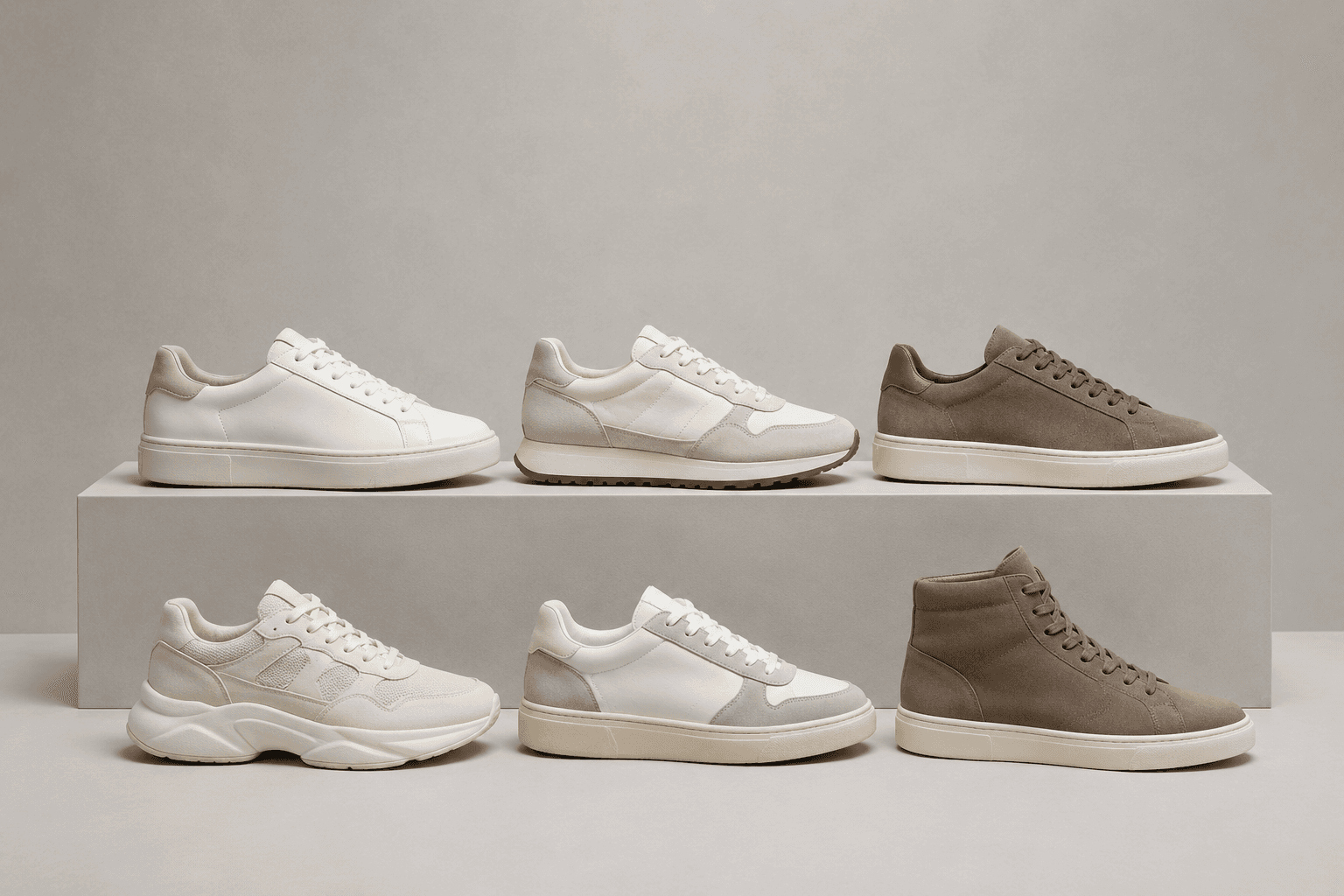
Sourcing men's casual shoes wholesale is a specification job before it is a price job. A sample can look acceptable on the table and still fail after shipment because the upper cracks before 40,000 flexes, the cupsole abrades too quickly, the heel counter collapses, or the bond fails after 60-70°C container heat exposure. Importers protect margin by controlling materials, construction, testing, and approvals in advance.
For China-made men's casuals, the commercial range is broad: cemented court shoes, cupsole sneakers, knit casuals, vulcanized canvas, slip-ons, and smart-casual hybrids with EVA or rubber bottoms. Each uses different molds, adhesives, labor minutes, and QC points. A capable men's casual shoe manufacturer should speak in measurable terms: upper thickness, lining GSM, sockliner foam density, Shore A hardness, adhesive system, and realistic lead-time days.
This guide explains what the category covers, how bulk casual shoes sourcing works, why factory capability matters, and when private label men's footwear is the better route. The focus is practical and supplier-side: MOQ, ex-factory and FOB US$/pair, sample timelines, EN ISO or ASTM-style test planning, and the details that reduce claims on repeat orders.
The right factory for men's casual shoes wholesale is the one that can repeat the same fit, finish, and performance across multiple POs, not simply the one with the lowest opening price.
What men's casual shoes wholesale includes
In export footwear, men's casual shoes wholesale usually means bulk orders built on existing lasts and outsole tooling, or semi-custom/private label programs developed from a factory base pattern. Commercial MOQ is normally 600-1,200 pairs per style on stock tooling. If a buyer requests a new outsole mold, special foxing, or major upper redevelopment, MOQ usually rises to 1,200-3,000 pairs per style because mold amortization, size grading, and material booking all increase.
The category is wider than many buyers expect. It includes low-cut court sneakers, skate-influenced cupsoles, business-casual lace-ups with sneaker bottoms, slip-ons, knit uppers with phylon bottoms, and canvas vulcanized product. These shoes are sold under one retail label, but they are not sourced the same way. They use different lines, bottom suppliers, adhesives, and test standards.
This is why supplier matching matters early. A factory strong in vulcanized canvas may not be reliable on knit upper shape retention or phylon bonding. A supplier focused on wholesale men's sneakers may not control cleaner topline folding, edge paint consistency, and dress-casual last shape needed for a smarter men's program.
- MOQ with existing outsole and last: 600-1,200 pairs per style, often 2 colors x 300 pairs or 3 colors x 200-400 pairs
- MOQ with new outsole mold: usually 1,200-3,000 pairs per style depending on mold complexity and size run
- Development sample lead time: 7-12 days for color/material change on existing pattern; 21-30 days for new upper pattern
- Bulk lead time after confirmation sample and deposit: 30-45 days for standard materials; 45-60 days for custom components
- Indicative FOB China range: US$8.50-11.50 basic canvas or entry PU casuals; US$12.00-18.00 better microfiber or cupsole styles; US$18.00-26.00 premium leather or complex private label builds
Construction types and how they affect sourcing
Cemented construction is the most common base for private label men's footwear. It supports the widest material mix, manageable MOQ, and moderate tooling cost. It works well for PU, microfiber, split suede, full-grain leather, mesh, and mixed uppers. The key risk is bond stability. On EVA, phylon, and painted TPU parts, surface treatment, primer choice, adhesive open time, and heat activation have to be controlled tightly or sole separation claims appear after wear.
Cupsole construction suits court and skate-inspired product. It gives stable silhouette, good sidewall branding space, and strong sell-through in core men's sizes EU 40-45. The trade-off is weight, packing efficiency, and freight cost. In EU 42, a basic cemented knit casual can weigh 650-780 g/pair, while a heavier cupsole sneaker can easily run 900-1,100 g/pair. That difference affects courier replenishment and carton loading density.
Vulcanized construction remains useful for low-to-mid price canvas product. It can be cost-efficient, but consistency depends on foxing alignment, sulfur cure control, toe cap positioning, sidewall cleanliness, and anti-yellowing storage. It is not the best route when the target market expects low weight, rebound cushioning, or a cleaner premium upper finish.
Material choices importers should lock early
For uppers, the common choices are PU, microfiber, split suede, full-grain leather, canvas, knit, and mixed textile combinations. Entry PU may help hit an FOB target, but hydrolysis resistance should be checked if the goods may sit in humid warehouse conditions. Microfiber usually gives better abrasion resistance, cleaner folding, and more stable upper appearance. Full-grain leather supports a higher FOB and stronger wear result, but buyers must accept hide grading variation in cost and appearance.
For lining and comfort materials, details matter. Standard mesh lining usually runs about 180-250 GSM. Padded sandwich mesh can run 250-320 GSM and gives better heel comfort but higher cost. For sockliners, open-cell PU foam around 0.16-0.22 g/cm3 is common in better casuals because it keeps rebound longer. Entry-level shoes often use 6-8 mm EVA foam, which can save US$0.20-0.40 per pair but normally compresses faster under daily wear.
For outsoles, rubber gives better abrasion performance, TPR is economical and flexible, EVA or phylon reduces weight, and TPU is often added for heel support or branding detail. Buyers should define target hardness. For casual rubber, Shore A 55-70 is a common commercial range depending on tread and market. If the bottom is too soft, wear claims rise. If too hard, comfort and cold-weather flex can become issues.
How bulk casual shoes sourcing works from tech pack to shipment
A controlled bulk casual shoes sourcing process begins with a complete product brief. A supplier needs target FOB, annual volume, size range, target market, upper material direction, bottom type, branding method, packaging standard, labeling language, and required test protocol. If the buyer sends only trend photos, the factory can offer a rough range, but not a reliable cost or delivery commitment.
The sample stage is where many sourcing mistakes begin. Development samples should confirm pattern feasibility, last shape, material substitution, outsole matching, and risk points such as topline collapse, tongue drift, stitch exposure, and glue cleanliness. A serious factory will revise quotation after confirming actual upper thickness, outsole source, logo process, and packaging. If FOB is fixed before the confirmation sample, the cost base is often inaccurate.
After confirmation sample approval, production starts with material booking, outsole planning, and line reservation. Stock materials can move quickly. Custom dyed mesh, molded logos, own-brand lace tips, branded insocks, or custom boxes add days before cutting can start. In practical terms, 30-40 days is realistic for clean repeat constructions. For custom private label builds with more approvals, 45-60 days is safer. If a new outsole mold is involved, add mold development and wear-test time.
- 01Define the product by target retail level, FOB ceiling, annual volume, and sales channel.
- 02Submit a full tech pack or a physical sample with branding notes and packaging expectations.
- 03Request material swatches, outsole options, pair-weight estimate, and ex-factory packing data before sample approval.
- 04Approve development sample, then confirmation sample in actual materials and branding.
- 05Approve size set or at least key sizes such as EU 41, 43, and 45 on the final last.
- 06Approve all packaging artwork: box, tissue, barcode, hangtag, carton mark, and country-of-origin labeling.
- 07Issue PO and deposit so the factory can reserve capacity and book materials.
- 08Control pre-production sample, inline inspection, final inspection, and shipment release against retained sample.
What a complete tech pack should contain
A useful tech pack for a casual footwear factory should specify upper panel material code, finished thickness, backing, color reference, stitch construction, SPI or stitch density, eyestay reinforcement, lace material and diameter, tongue foam, collar foam, toe puff grade, heel counter stiffness, strobel board, sockliner build, outsole material, hardness range, logo placement, packaging details, and target pair weight. Without this, the factory will use house standard, which may be lower or simply different from the buyer's expectation.
The wording must be measurable. If a brief says 'padded tongue', one factory may use 4 mm foam and another 8 mm. If the target handfeel needs 6-8 mm tongue foam and 8-10 mm collar foam, write it. If shape retention matters on a court shoe, specify toe puff and counter grade rather than asking for a 'firm toe'. If odor sensitivity is a concern, ask for low-VOC adhesive process and check aged samples after 24-48 hours in closed-box condition.
Approvals that should happen before cutting
Do not stop at one confirmation sample. Before cutting starts, approve outsole color, foxing color if relevant, sockliner print, logo scale, lace tip finish, barcode location, carton size, pair stuffing method, silica gel quantity where needed, and carton drop expectation. These details affect appearance, packing speed, moisture control, and transit performance.
Size grading must be reviewed carefully in men's footwear because proportion problems become obvious in EU 44-46. Vamp depth, eyestay spacing, throat opening, and toe spring often need adjustment beyond digital scaling. A reliable supplier of wholesale men's sneakers should be able to show fit history by last family or provide size-set samples for approval.
Typical specification checkpoints for men's casual footwear
| Component | Commercial Range | What to Verify | Common Risk |
|---|---|---|---|
| Upper PU/microfiber | 1.2-1.8 mm finished thickness | Surface consistency, flex-crack performance, color match | Cracking, shade variation, delamination |
| Mesh lining | 180-250 GSM standard; 250-320 GSM padded | Abrasion resistance, moisture handling, colorfastness | Pilling, crocking, heel wear-through |
| Sockliner foam | Open-cell PU 0.16-0.22 g/cm3 or EVA 6-10 mm | Compression set, rebound, odor | Flattening, low comfort retention |
| Rubber outsole | Approx. Shore A 55-70 depending on design | Abrasion, flex, slip profile | Fast wear, stiffness, high weight |
| Phylon/EVA midsole | Density per target weight and cushioning | Compression, color consistency, bonding | Shrinkage, denting, bond failure |
| Bonding strength | Per buyer test protocol after conditioning | Upper-to-sole adhesion consistency | Sole separation after wear or heat exposure |
Why factory capability matters more than the cheapest FOB
A difference of US$0.60-1.20 per pair usually reflects a real construction difference, not just supplier margin. One factory may be using thicker microfiber, more stable outsole source, better heat-activated bonding, cleaner lasting, tighter pair matching, and stronger export cartons. Another may quote low by downgrading upper thickness, using low-density sockliner foam, reducing stitching operations, outsourcing key processes, or simplifying packaging. The product can look similar at random inspection and still perform differently in the market.
A dependable men's casual shoe manufacturer should clearly explain which steps are in-house, which are outsourced, what AQL level is followed, how repeat color is controlled, how outsole molds are maintained, and how pairing and size-mix are prevented. If the supplier cannot give direct answers on these points, the low FOB is not the real commercial picture.
This matters because claims are expensive. A 4% failure rate on a 6,000-pair order means 240 pairs at risk. Add chargebacks, reverse logistics, replacement freight, and lost replenishment, and the cheapest initial quote can become the most expensive order in the season.
- Verify whether cutting, stitching, lasting, bottom assembly, and packing are in-house or approved subcontract only
- Ask actual monthly capacity by product type, for example 80,000 pairs/month cupsole versus 120,000 pairs/month cemented light casuals
- Confirm tooling ownership: factory-owned, outsole supplier-owned, or buyer-owned
- Request recent physical test records for adhesion, flexing, abrasion, and colorfastness to rubbing
- Check export carton standard: 5-ply may be enough for light knit shoes, but heavy cupsole programs often require stronger carton quality
How to evaluate quality in men's casual shoes
Quality review in casual footwear should cover four points: appearance, fit, wear performance, and compliance. A clean-looking pair can still fail if the upper cracks after flexing, the strobel seam opens, the outsole wears too fast, or the bond weakens after heat aging. Buyers should define measurable checkpoints before bulk starts, not after complaints are received.
At development stage, ask the factory to declare upper thickness, lining GSM, foam density, outsole hardness, insole composition, shank use if any, and pair weight by sample size. On men's casuals, pair weight in EU 42 can range from about 650 g to more than 1,100 g depending on construction. For e-commerce channels, this matters for freight and returns. For brick-and-mortar channels, it matters for wear comfort and customer perception.
Physical testing should reflect the market. Importers commonly request upper flexing, upper-to-sole adhesion, outsole abrasion, colorfastness to rubbing, and odor evaluation. Depending on the buyer, protocols may reference EN ISO methods for EU business or ASTM-oriented methods and retailer protocols for US programs. The standard name is less important than whether the chosen materials can pass consistently in production, not only on one salesman sample.
- Set appearance tolerance for glue marks, stitch deviation, panel alignment, and logo position before production
- Review fitting on final last in key sizes, not sample size only
- Record pair weight, shoe box weight, and carton gross weight to avoid logistics surprises
- Keep sealed retention samples for every PO and compare all repeat orders against them
Specification checkpoints that reduce claims
For uppers, commercial ranges such as 1.2-1.8 mm finished thickness for PU or microfiber are common depending on target segment. For mesh lining, 180-250 GSM is usual on standard casual sneakers, with higher GSM at the heel where abrasion risk is highest. Open-cell PU sockliner foam at 0.16-0.22 g/cm3 generally gives better comfort retention than low-grade EVA. Outsole hardness must match intended wear. A soft bottom may feel good at first try-on but can wear too quickly on rough urban surfaces.
If the product uses white sidewalls, white foxing, or natural-color midsoles, inspect glue cleanliness under both daylight and cool white factory light. If the upper uses dark suede or heavily dyed textile lining, ask for dry and wet rubbing checks before bulk. If the design includes TPU clips, welded films, or decorative rubber patches, check color migration and edge lifting after heat exposure.
Compliance and test planning by market
For EU business, many buyers use EN ISO-based physical methods through nominated labs and their own restricted-substance lists. For US business, importers and retailers often use in-house protocols with ASTM-related references where relevant. The factory should know in advance whether testing will be done on confirmation samples, incoming materials, or finished goods, because this changes lead-time planning.
Men's casual footwear still needs preventive chemical control even when the product is not children's footwear. The common risk points are coated synthetics, inks, adhesives, PVC details, foam components, and some textile finishes. A mature casual footwear factory will pre-screen high-risk materials instead of waiting for a finished-goods failure.
When to choose private label men's footwear
Private label men's footwear is the better route when the buyer wants product continuity, exclusive branding, controlled fit, and less direct price comparison. If the same open-line style is sold to multiple importers, the market quickly moves to price-only comparison. Private label allows the buyer to control visible details, comfort level, packaging, and repeat-order discipline.
Open-line sourcing is better when speed matters more than exclusivity. A factory with established lasts and outsoles can often adjust a stock upper, swap materials, add a tongue label, and revise color in 2-3 weeks of sampling. This is practical for testing a new channel, filling a seasonal gap, or launching with limited development budget.
A common sourcing path is to start with semi-custom product on stock tooling, then move into exclusive upper pattern, custom insock print, own box, and finally a dedicated outsole once annual volume is proven. This limits tooling cost while still building a proprietary product line.
Private label cost structure and tooling reality
Private label cost is not only the FOB pair price. Buyers should budget for development sample charges, logo mold or screen charges, custom box setup, and sometimes outsole mold cost. A new rubber or cupsole outsole mold can range roughly from US$1,500 to US$6,000 depending on complexity, size run, and insert details. A simple modified upper on stock tooling may require only sample fees and artwork charges.
From the factory side, the most efficient private label route is often to keep the last and outsole standard while differentiating the upper pattern, tongue label, heel branding, sockliner print, lace tip detail, and packaging. This gives the buyer brand identity without forcing an unnecessarily high MOQ in the first season.
MOQ planning for collection launch
For a new men's program, 800-1,200 pairs per style is often the safest starting level if materials are shared across colors. A practical split is 300 pairs black, 300 pairs white, and 400 pairs in a seasonal color, assuming one base upper and one outsole. Going below this usually raises FOB because material loss, setup time, and logo efficiency worsen.
For distributors, broad size depth is usually more important than too many colors. For online-first brands, stronger color differentiation may matter more, but low-volume fashion colors should still be balanced against fabric and lining minimums. Too many small color buys create leftover components and difficult reorder shade matching.
How to cost men's casual shoes wholesale accurately
Accurate costing starts with one rule: compare like with like. A factory quoting 1.4 mm microfiber upper, 250 GSM mesh lining, open-cell PU sockliner, branded box, and rubber cupsole is not quoting the same product as a factory using 1.1 mm PU, standard lining, EVA sockliner, plain box, and TPR bottom. Importers should align bill of materials, test requirement, packaging, MOQ, and payment term before comparing FOB.
As a practical guide, basic canvas or low-complexity PU lace-ups can start around US$8.50-11.50 FOB. Better-value court or cupsole styles in microfiber or split suede usually run US$12.00-18.00 FOB. Premium leather casuals, mixed-material builds, or higher-detail private label programs often land in the US$18.00-26.00 FOB range, especially when MOQ is lower and packaging is branded.
Ask the supplier to separate cost by upper, outsole, footbed, packaging, and logo application where possible. This makes value engineering useful. For example, changing from open-cell PU sockliner to cheap EVA may save US$0.25-0.40 per pair but weaken comfort and returns performance. Removing a decorative molded badge or changing to standard lace tips may save a similar amount with less impact on wear.
When to place orders and how to manage lead-time risk
Lead-time risk in footwear usually starts before the stitching line. Delays often come from custom-dyed upper materials, outsole mold queue, logo component booking, lab scheduling, and late packaging approval. Buyers sometimes count only factory assembly days and miss the pre-production calendar that actually controls shipment timing.
For standard wholesale men's sneakers with common materials, a practical timing model is 2-4 weeks for development and approvals, then 30-45 days for bulk production. For custom-tooling private label product, 60-90 days from final approval to ex-factory is safer, especially when wear testing, package approval, and lab testing are included in the gate. If shipping around Chinese peak export periods, extra buffer is sensible.
Forward planning reduces risk. Buyers with stable annual volume should reserve outsole capacity, pre-approve common materials, and standardize black, white, navy, and gum color references across seasons. This is especially effective for evergreen men's casual programs where repeat business depends on consistent fit and color, not on fashion novelty.
- Start new development 4-6 months before in-store date if custom branding or new tooling is required
- Lock packaging artwork before cutting starts; late barcode or box changes can hold finished goods
- Use shared materials across multiple SKUs to reduce MOQ pressure and speed replenishment
- Approve color under agreed lighting such as D65 to reduce shade disputes
- If repeat potential is high, discuss raw material reservation before the first shipment leaves
SoleForge manufactures casual sneakers and leather & dress shoes under OEM and ODM for brands and importers worldwide. Request a quote with your tech pack or reference pair and we'll reply within one business day.