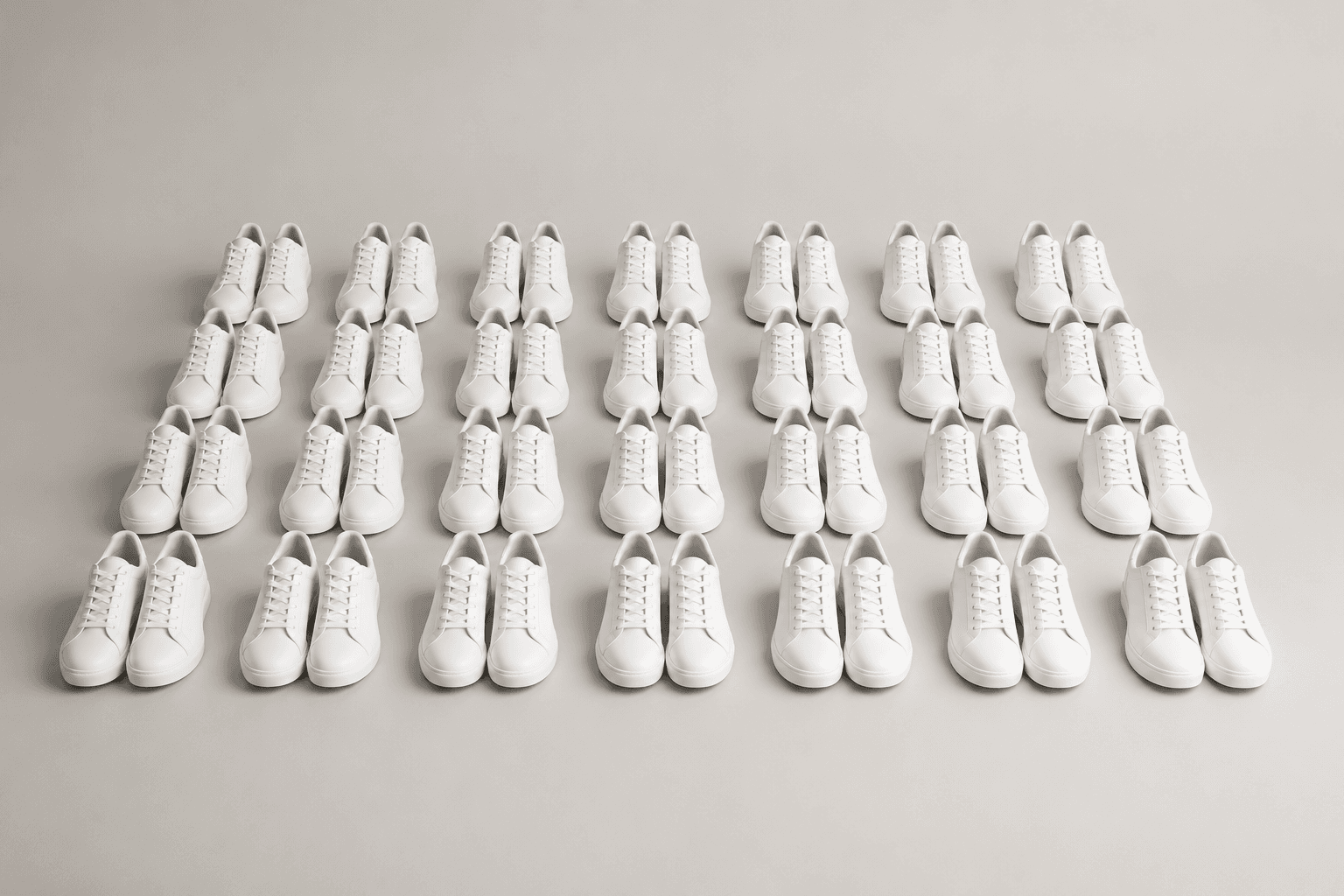
Selecting a metal free safety shoes manufacturer is less about catalog breadth and more about build control. For industrial distributors buying from China, the risk is not finding a supplier that can make one acceptable sample. The risk is approving a shoe that passes a lab test once, then changes in bulk through different toe caps, lighter mesh, softer PU, or substitute footbeds. In safety footwear, small component changes create large field problems.
Metal-free programs now cover more than basic warehouse shoes. Buyers are sourcing composite toe safety shoes for logistics, assembly, maintenance, facility management, and detector-sensitive environments. That means the factory must balance compliance, weight, comfort, and repeatability inside a defined FOB target. Typical decisions come down to PU/PU versus EVA/rubber, fiberglass cap versus polymer cap, mesh versus microfiber, and whether the complete shoe must exclude metal trims or only the protective package.
This guide lays out the sourcing sequence in the order a distributor should run it: define the use case, lock the protection package, qualify the factory, control sampling and certification, compare cost on a true like-for-like basis, and secure bulk quality controls. The numbers below are grounded in current China export practice: MOQ by construction, lead times in days, common FOB ranges in $/pair, lining GSM, foam density, and the specific compliance points an industrial footwear supplier should be able to explain without guessing.
The best metal-free supplier is not the cheapest sample maker; it is the factory that can repeat the tested build at scale without silent substitutions.
1. Define the end use, the compliance route, and what “metal-free” means in your program
Start with the job environment, not the styling reference. A low-cut safety trainer for e-commerce picking, an ESD style for electronics assembly, and a waterproof mid-cut for maintenance crews can all be sold as metal-free, but they require different soles, uppers, and internal packages. If you send only photos and a target price, most factories will quote the lightest build that looks right in a sample room, not the build that survives 8-10 hours of wear across a full shift.
The first filter is the legal market. For Europe, most bulk programs are built to EN ISO 20345, commonly S1PS for indoor dry use, S3S for water-resistant uppers with penetration resistance, or S7 where full waterproof performance is required. For the US, ASTM F2413 is the base route, generally with I/C protection and optional PR, EH, SD, or CD claims depending on the tender. If you plan to sell one style in both regions, decide early whether one construction will be submitted under both systems or whether you will split the SKU by market. That decision affects sample timing, labels, carton markings, and test cost.
Next, write down the exact meaning of metal-free. Some buyers only require a non-metal toe cap and a non-metal puncture plate. Others need the entire shoe to clear detector gates, which means no metal eyelets, speed hooks, washers, lace tips, rivets, shanks, or decorative logos. Factories will not assume the strict version unless you specify it. If detector compliance matters, state it in the tech pack and confirm it at inline inspection.
Then define the wear target using measurable values. Give acceptable weight per shoe in the reference size, expected outsole life, and whether the climate is hot, humid, cold, or wet. As a practical benchmark, a low-cut metal-free warehouse shoe in EU 42 often targets 540-620 g per shoe. A sportier knit style with EVA/rubber may reduce that to 500-580 g. A waterproof mid-cut with a stronger quarter package can run 720-880 g. These numbers shape the upper GSM, footbed density, outsole choice, and ultimately the FOB.
- State the sales market and standard first: EN ISO 20345, ASTM F2413, or both
- Specify protection claims in full: I/C, PR, EH, SD, CD, FO, HRO, WR, ESD, slip category
- Define metal-free clearly: toe cap only, toe + plate, or complete shoe with non-metal trims
- Set target weight, wear environment, and target FOB before requesting development samples
2. Build the shoe from the safety package outward, not from the upper pattern inward
Once the use case is fixed, develop the internal package first. In most metal-free constructions, the core bill of materials is fiberglass or composite toe cap, textile anti-penetration insert, lightweight upper shell, PU or EVA-based comfort package, and either PU/PU or EVA/rubber outsole. If any one of these parts is chosen purely to hit a price, the shoe may still pass a single lab submission and then fail in fit, flex, hydrolysis, or wear consistency.
For toe protection, factories in China typically source either fiberglass caps or molded composite polymer caps. Fiberglass caps are common in distributor programs because they are stable in impact testing, relatively light, and easy to grade across commercial sizes. Compared with steel, the cost increase is often about $0.35-$0.80 per pair at volume. Ask for the cap model code, wall thickness range, internal clearance after lasting, and whether the same cap has existing EN ISO or ASTM history on a similar last. A passed cap alone is not enough. If the toe spring and toe puff geometry are wrong, wearers will still report pressure or shallow fit.
For penetration resistance, textile inserts are standard in metal-free product. These are often aramid-based or multilayer non-metal boards. They reduce weight compared with steel and support detector-sensitive applications, but they can create stiffness in the forepart if the strobel and outsole flex line are not engineered together. Require the supplier to confirm whether the insert is full-board, strobel-mounted, or integrated with the insole board. Also ask for flex test history and actual thickness. An overbuilt textile plate may pass puncture with margin but create a harsh flex point in daily wear.
Upper choice should match abrasion level and climate. For lightweight safety shoe sourcing, knitted polyester and engineered mesh are common in the 280-420 GSM range, often backed with hot-melt film or TPU reinforcement around the eyestay and quarter. For more abrasive environments, microfiber at roughly 1.6-2.0 mm equivalent thickness is usually safer commercially than open knit. Where distributors need a leather-look product without the weight and shade variability of split leather, microfiber remains the most predictable option for bulk consistency.
The lining package also needs numbers. Standard sandwich mesh may run 250-320 GSM for breathable low-cuts. Denser air mesh around 320-380 GSM is often used at the collar and heel for better abrasion resistance and shape retention. If the shoe targets warmer markets, avoid lining substitutions during production. A small drop in GSM is enough to increase heel wear and return rates.
Translate comfort claims into density, thickness, and hardness
Do not approve wording such as “soft insole” or “cushioned sole” without specifications. For distributor-grade product, a PU footbed density around 0.16-0.22 g/cm3, heel thickness 8-12 mm, and forepart thickness 4-6 mm is a workable baseline. If the shoe uses memory foam layers, ask for total thickness and rebound behavior; low-cost memory foams can collapse quickly in hot warehouses. Collar foam typically performs better around 45-60 kg/m3 than in lower ranges where compression set becomes visible after limited wear.
For the bottom unit, direct-injected PU/PU remains the most commercially stable choice for bulk industrial programs because it reduces bonding risk and keeps cost under control. In lighter-duty styles, PU midsole density usually sits around 0.45-0.60 g/cm3, with outsole hardness around 55-65 Shore A. EVA/rubber can lower weight but demands tighter process control on bonding and heat aging. Rubber coverage improves abrasion and can support HRO constructions, but it usually adds about $1.20-$2.50 per pair and 80-180 g per shoe depending on coverage and lug depth.
3. Qualify the factory on process ownership, test discipline, and realistic MOQ
A convincing salesman sample does not prove a factory can run compliant bulk. Qualification should focus on process control. Ask which operations are in-house: upper cutting, stitching, lasting, direct injection, cementing, finishing, packing, and final inspection. If outsole production is outsourced, if the lasting line changes by season, or if the toe cap vendor is switched on price, the risk of mismatch between approved sample and shipped bulk rises immediately.
A serious safety factory should provide current social or quality audit documents, a list of export markets, and a basic in-house test capability sheet. Useful internal controls include flexing checks, upper-to-sole bond checks, pair weight control, slip pre-checks, outsole hardness checks, PU hydrolysis monitoring, lining abrasion review, and toe cap positioning gauges. Third-party certification remains necessary, but a supplier that waits for the external lab to identify obvious problems is not controlling the product at factory level.
MOQ needs to be checked by construction, not just by style count. For direct-injected PU safety shoes, MOQ is often 800-1,200 pairs per colorway when the outsole mold already exists. For cemented knit or mesh styles with an existing sole, MOQ may start around 600-1,000 pairs per color. For waterproof mids or larger size spreads such as EU 36-48, factories may ask for 1,200-1,500 pairs per color because the size run complicates cutting yield and toe cap inventory. If you need US 13-14 or EU 47-48 regularly, confirm whether these sizes require separate outsole cavities or a price surcharge of $0.20-$0.60 per pair.
For private label safety footwear, packaging and trim customization should also be qualified up front. Branded footbeds, woven tongues, printed boxes, barcode labels, and multilingual leaflets are not always included in opening FOBs. Many factories add $0.15-$0.40 per pair for custom packaging at lower volumes, or keep the FOB unchanged only when the total order reaches 2,000-3,000 pairs across colors.
- Request the full process map: cutting, stitching, lasting, injection or cementing, finishing, packing
- Verify approved vendors for toe caps, textile plates, outsole chemicals, microfiber, mesh, and footbeds
- Check MOQ by color, size range, and outsole construction, not only total order quantity
- Confirm actual export experience in EN ISO 20345 and ASTM F2413 programs, not just casual work shoes
4. Run sampling, fit approval, and certification in the right order
Delays in safety footwear usually come from submitting the wrong sample to the lab. The design sample may use substitute mesh, a different footbed, a lighter outsole insert, or even a different puncture-resistant board because the factory wants to move faster. Once the tested sample and the production BOM diverge, the certificate becomes commercially weak and rework can add 30-45 days to the schedule.
Treat design approval and technical approval as separate gates. The first sample should be approved only for visual direction: silhouette, panel layout, outsole appearance, and branding placement. The second sample must be a confirmation build using intended production materials, identified by component code. The BOM should state upper specification, upper GSM or microfiber thickness, lining GSM, toe cap model, anti-penetration insert code, footbed density, strobel material, collar foam density, outsole compound, lace construction, and all non-metal trims. If the style is marketed as detector-safe, all trims should be listed explicitly.
Fit needs to be reviewed in more than one size. Composite and fiberglass cap constructions can feel shallower than steel if the internal geometry is not managed correctly. Approve a fit set at least in one small, one core, and one large commercial size. Check toe clearance, vamp pressure, instep fit, heel lock, tongue migration, and flex point after walking. For low-cuts, monitor heel slip after 20-30 minutes of wear. For mids, check ankle bite and collar stiffness.
Only after the confirmation sample is frozen should the shoe be submitted for EN ISO 20345 or ASTM F2413 testing. State the exact category and optional claims to be marked on the shoe and carton. If ESD is required in a fully metal-free construction, ask how the electrical path is achieved and controlled in bulk, especially if the footbed or strobel may be changed by season. If waterproof performance is required, confirm whether the claim depends on upper treatment alone or on a membrane or full bootie construction, as this changes both test route and lead time.
- 01Approve the first sample for appearance only
- 02Approve a confirmation sample built with the intended production BOM
- 03Review fit across key sizes, not only one salesman size
- 04Submit the production-equivalent build for EN ISO or ASTM testing
- 05Run a 7-14 day wearer trial before releasing the bulk PO
Use a short wear test to catch failures a lab will not show
A 10-20 person wearer trial over one to two weeks is one of the lowest-cost controls in the whole project. It can reveal lace bite, collar rubbing, heel slip, forefoot stiffness from the textile plate, squeaking at the sole interface, heat buildup over the toe cap, or early footbed collapse. These issues drive first-order returns and poor reorders even when the shoe is technically compliant. For a work shoe distributor guide, this is the point where product acceptance becomes market viability.
5. Compare FOB the right way: by component, tooling, and lead-time exposure
Price comparisons only matter when the builds are aligned. A factory can appear $1.00 lower on FOB simply by using a lighter footbed, thinner lining, lower-density PU, less rubber coverage, or a less proven puncture-resistant insert. Ask for enough cost structure to identify where money sits: outsole, safety package, upper shell, lining, footbed, packaging, and labeling. You do not need the supplier’s margin, but you do need clarity on what quality level the quote assumes.
As a practical range from China, entry-level metal-free safety shoes with microfiber or action leather-look uppers, fiberglass or composite toe, textile plate, and PU/PU outsoles commonly quote around FOB $11.50-$13.80 per pair at 3,000+ pairs total. Sportier low-cuts with knit uppers, stronger TPU film support, branded footbeds, and upgraded outsole tooling often sit around FOB $14.50-$19.00. Mid-cuts with waterproof membranes, heavier quarter support, or rubber outsole packages often move into the FOB $18.50-$24.00 range. If the quote is well below these ranges, ask where the reduction comes from before approving development.
Tooling cost should be separated from pair FOB. A new outsole mold commonly costs about $2,500-$6,500 depending on size range, cavity count, and whether the project uses a one-piece direct-injected bottom or multi-part cemented tooling. Logo patch molds, puller molds, custom eyelet details, and carton artwork are smaller costs but still need ownership terms in writing. If exclusivity matters, confirm whether the last and outsole mold can be used for other customers after a period of inactivity.
Lead time should be split into development, testing, and production. A repeat-upper sample on an existing outsole often takes 7-12 days. New outsole tooling usually adds 25-40 days before first trial. Confirmation sample revisions often take another 7-12 days. Third-party lab scheduling can add 7-20 days depending on season and test queue. Bulk production after deposit and approval is commonly 35-60 days for repeatable direct-injected constructions and 45-75 days for new programs with testing, custom packaging, or peak-season capacity constraints.
Quote review checklist
A serious quote should allow your sourcing, technical, and quality teams to read the same product definition and reach the same conclusion on risk.
6. Lock production controls before shipment and review first-market performance fast
Certification is only one checkpoint. Bulk quality depends on incoming material approval, process discipline, and lot traceability. The most important control points in metal-free safety shoes are toe cap placement, anti-penetration insert positioning, outsole compound consistency, footbed density, and bond performance where the style is cemented. If the factory cannot link the shipped lot back to component batches, it will be difficult to isolate the root cause of a claim.
Before cutting starts, hold a pre-production meeting around a sealed golden sample and signed BOM. Review stitching tolerances, upper reinforcement locations, lasting allowance, roughing and priming standards for cemented styles, mold temperature and shot parameters for direct-injected PU, and the complete non-metal trim list. If the order must pass detector checks, build simple handheld detector checks into inline control so that hidden metal washers or incorrect lace tips are caught before packing.
Inline inspection should include more than cosmetics. Open sample pairs from each lot to verify the correct puncture-resistant insert and footbed build. Check pair weight against tolerance, for example within plus or minus 3 percent of the approved sample in the same size. Confirm outsole hardness, flex line position, logo placement, color consistency, and inner labeling. At final random inspection, review carton assortment, barcode accuracy, legal marking, and user leaflet language for the target market.
Once the first order ships, collect claim data within the first 60-90 days. Classify failures by mode: sole separation, upper tearing at flex point, collar wear-through, toe discomfort, lace breakage, footbed collapse, water ingress, or slip complaint. Feed these findings directly into the second PO. The strongest distributor-factory relationships in safety footwear are built this way: not on broad promises, but on measured corrections between order one and order two.
- Retain a sealed golden sample with signed BOM before production starts
- Check incoming lots for toe caps, textile plates, upper shade, lining GSM, outsole compound, and footbeds
- Use inline controls for weight, bond, flex, trim conformity, and detector compliance where required
- Review first-order claims within 90 days and convert them into revised specs for the next PO
Key takeaways
- Define the use case, legal market, and exact metal-free scope before requesting quotes.
- Engineer the shoe around the safety package: toe cap, textile plate, upper GSM, lining GSM, footbed density, and outsole compound.
- Choose a factory with in-house process control, real EN ISO or ASTM experience, and transparent MOQ by construction.
- Freeze the BOM before lab submission and run a short wearer trial to catch fit, flex, and comfort issues early.
- Compare FOB on a like-for-like basis including tooling, packaging, testing, and size-range surcharges.
- Bulk success depends on traceable component control, inline verification, and disciplined review of first-shipment claims.
SoleForge manufactures safety & work shoes under OEM and ODM for brands and importers worldwide. Request a quote with your tech pack or reference pair and we'll reply within one business day.