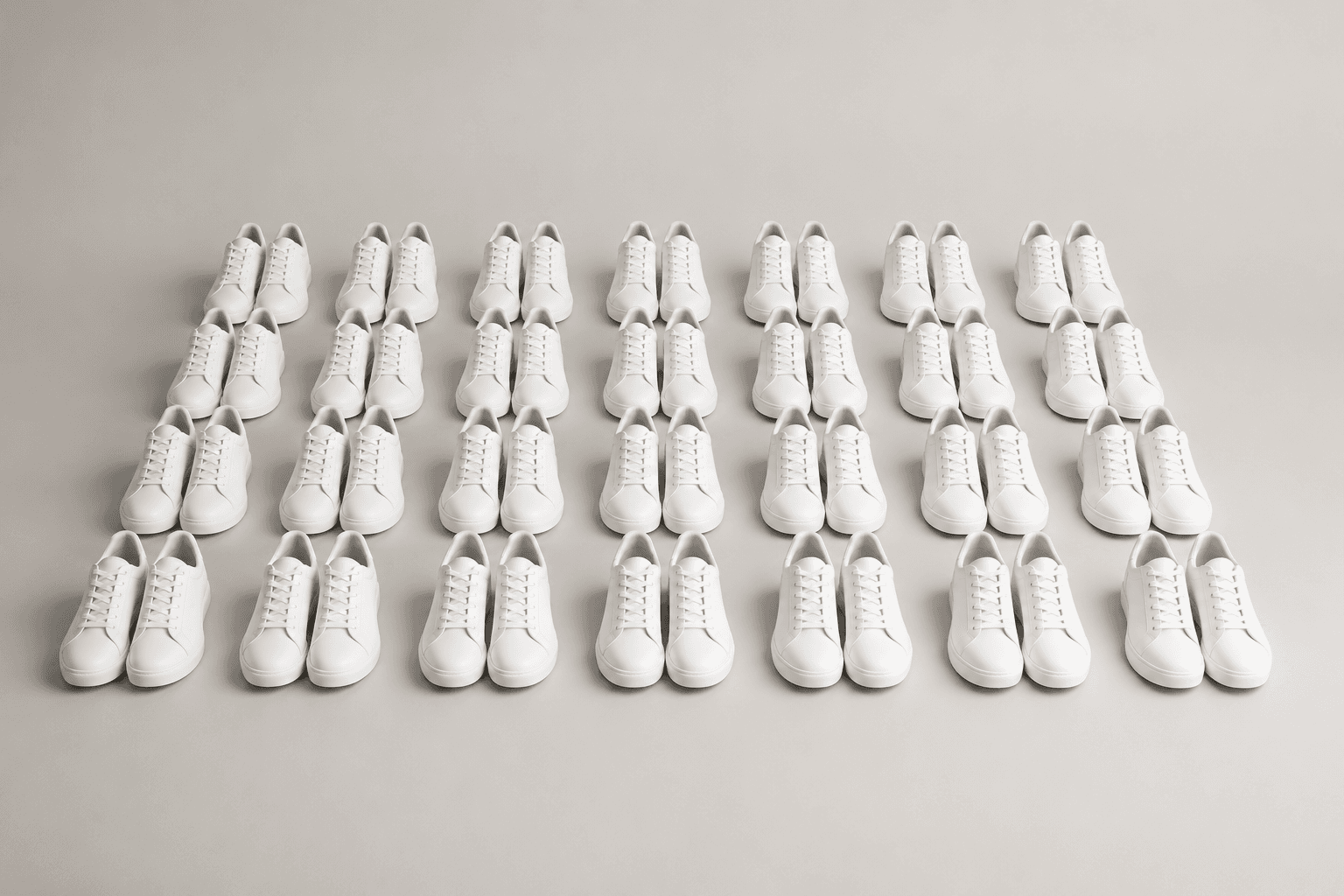
Trend-right sneakers usually fail in development for practical reasons, not creative reasons. The reference photo is clear, but the last is not fixed. The outsole looks right, but the mold MOQ is too high. The mesh shade is approved, but nobody checked tear strength or color migration. By the time the buyer asks for six colorways, the base shoe is still not stable.
For sneaker sourcing for brands, the job is to turn a market trend into a production-ready shoe with controlled cost, lead time, testing, and repeatability. Private label sneakers, trend sneakers wholesale programs, ODM sneaker factory projects, and full custom sneaker development all need different levels of control. Treating them the same is where calendars slip and FOB prices move.
This guide is written from the supplier side for sourcing managers, brand owners, and importers buying bulk footwear from China. It follows the order we use on a factory floor: define the brief, choose the sourcing route, lock the base fit, specify materials, manage samples, cost the shoe, then verify testing and shipment quality.
The easiest sneaker to source is not the cheapest sample; it is the style where last, outsole, material, MOQ, test plan, FOB, and delivery date are aligned before production starts.
1. Turn the Trend Into a Production Brief
A trend board is useful for direction, but a sample room needs a production brief. Before asking for prices, define the sales channel, gender, size range, target retail, target FOB, order volume, delivery month, and compliance standard. A court sneaker for a discount chain at FOB $8.80 cannot be built like a leather lifestyle sneaker at FOB $24.00. If the supplier does not know the price level, the first sample will be a guess.
Name the construction early. A rubber cupsole low top, vulcanized canvas shoe, EVA retro runner, chunky fashion sneaker, knit sock sneaker, skate shoe, and cemented leather court sneaker use different lasts, mold sets, compounds, upper processes, labor minutes, and test risks. A simple cupsole sneaker may use an existing TPR or rubber bottom. A retro runner may need phylon EVA, rubber outsole pods, TPU stabilizer, back counter, multiple overlays, and more stitching. That can add $3.00-$8.00 per pair before packaging.
Separate fixed requirements from flexible ones. If the toe shape, outsole height, logo size, lace width, or heel tab must match the brand line, say it in the brief. If the factory can use a stock outsole, stock lining, stock lace, standard shoebox, or existing rubber color, say that too. Good fashion sneaker sourcing is not asking for every possible option. It is narrowing the options enough for the factory to quote, sample, and reserve capacity accurately.
- State target FOB per pair, such as $9.50, $13.80, or $22.00. A factory cannot engineer correctly against the phrase "best price".
- Give expected order volume by style and color. Common MOQ is 600-1,200 pairs per color with existing tooling, and 2,400-5,000 pairs when outsole color, special mesh, or custom lace is required.
- Confirm size range at the start: EU 36-41 women, EU 40-46 men, US women 5-11, US men 7-13, or kids sizing. Extended sizes may need extra outsole molds.
- List standards before quotation: REACH, CPSIA, California Prop 65, EN ISO flex and bonding methods, ASTM F2913 slip resistance, or a retailer RSL.
- Specify packaging early: shoebox board weight, tissue, polybag, hangtag, barcode label, silica gel, master carton ply, carton drop test, and carton gross weight limit.
2. Choose the Right Sourcing Route Before Sampling
Not every trend sneaker needs custom development. The correct route depends on delivery date, exclusivity, MOQ, and budget. When the selling window is close, trend sneakers wholesale may be the practical answer. The buyer selects an existing style, adjusts color, adds tongue label or sockliner print, and ships from ready or near-ready production. This route can work in 30-45 days, but the product will not be exclusive.
Private label sneakers are the normal middle route for importers. The factory uses an existing last and outsole, then changes upper panels, material combinations, logo treatment, lining, sockliner, lace, trim, and packaging. This gives enough brand identity for most retail programs while avoiding new mold cost. First sample lead time is often 10-20 days if materials are available.
An ODM sneaker factory should do more than copy a reference. A useful ODM supplier brings last options, outsole molds, material boards, sample technicians, previous fit comments, and production records. The factory can tell you which outsole has passed flex, which mesh supplier can deliver in 20 days, which PU has peeling risk, and which silhouette already has grading across the full size run.
Full custom sneaker development is justified when the last, outsole, or technical feature is part of the product value. It is also the slowest path. A simple rubber cupsole mold set may cost $2,500-$6,000 depending on size range and cavity count. A multi-part EVA/rubber/TPU runner bottom can cost $6,000-$15,000 or more. First mold trial usually needs 30-45 days after 2D and 3D confirmation, and each correction round can add 10-20 days.
- 01Use trend sneakers wholesale for 30-45 day delivery when speed matters more than exclusivity.
- 02Use private label sneakers for 45-75 day programs with brand details, controlled FOB, and low tooling risk.
- 03Use ODM development when you need supplier-led outsole, last, material, and construction options.
- 04Use full custom sneaker development when the outsole, fit, or construction must be proprietary and the calendar allows 90-150 days.
3. Lock Last, Outsole, Fit, and Foam First
The last and outsole decide the sneaker before color does. If toe spring is wrong, heel seat is loose, ball width is tight, or the outsole looks too heavy under the upper, material changes will not fix the shoe. On a working development calendar, approve the last, outsole, pattern balance, flex point, and fit before opening many colors.
Trend-right shape is specific. A court sneaker needs a clean vamp, correct foxing height, and a toe box that is not too bulbous. A retro runner needs the right wedge angle, eyestay curve, heel counter volume, and tongue height. A chunky sneaker can look strong in photos but fail if pair weight is too high. For women’s lifestyle sneakers, 650-800 g per pair is often easier to wear than 900 g plus, depending on size and outsole material.
Fit should be checked on actual size samples, not only one salesman size. For EU 37 women and EU 42 men, check heel grip, instep pressure, toe allowance, ball width, collar bite, tongue slip, and flex point. If the outsole flex groove sits too far forward, the shoe feels stiff. If the heel counter is weak, the upper collapses after try-on. These are cheap to correct before color samples and expensive after sales samples are shown.
Foam is a sourcing decision, not a comfort slogan. EVA midsoles for lightweight fashion runners often sit around 0.18-0.25 g/cm3 density. If density is pushed too low, the shoe feels soft in hand but loses shape after compression. PU sockliners for private label sneakers commonly use 4-6 mm thickness at about 0.12-0.18 g/cm3. Higher-rebound foam or Ortholite-type insoles can add $0.40-$1.20 per pair, but they improve recovery and moisture handling.
- Confirm outsole weight and pair weight before bulk. Heavy bottoms increase freight cost and reduce wear comfort.
- Check flex point on size-set samples, especially if the same style covers small women’s and large men’s sizes.
- Approve collar foam, tongue foam, heel counter stiffness, sockliner thickness, arch shape, and insole board material in writing.
- Keep one signed reference sample at the factory and one with the buyer, marked with style code, size, color, date, and version.
- Avoid last changes after sales samples unless the fit issue is serious; last changes affect pattern, grading, outsole match, and packing.
4. Specify Materials by Performance, Not Just Look
Materials create the trend look, but they also create many claims. PU can peel. Mesh can tear. Metallic film can crack at flex. Suede can bleed onto lining or laces. Recycled polyester can vary by lot. A supplier-side material review checks appearance, yield, cutting waste, bonding behavior, chemical compliance, and supplier lead time.
Use measurable specifications. PU synthetic leather may be 1.2-1.4 mm. Microfiber may be 1.4-1.6 mm. Polyester mesh for lifestyle runners often runs 220-320 GSM. Ripstop can be 180-240 GSM. Canvas for vulcanized sneakers may be 10-14 oz. Cow suede for better-grade casual sneakers is often 1.4-1.6 mm. These numbers help the factory quote the shoe you expect, not a weaker substitute with the same color.
Color approval must be handled by material type. Pantone on PU, mesh, rubber, EVA, lace, webbing, and printed TPU will not look identical because each substrate reflects color differently. For off-white, beige, grey, sage, pale pink, and other low-saturation trend colors, check swatches under D65 light and warm indoor light. Many shade disputes come from approving a lab dip under one light source only.
Outsole material must match the test plan. Rubber gives better abrasion and grip but adds weight and cost. TPR is common for lower-cost fashion sneakers, but abrasion and cold flex can be weaker. EVA is light, but hardness, shrinkage, and compression set must be controlled. TPU inserts give structure and shine, but bonding to EVA or rubber requires the correct primer and drying time. If ASTM F2913 slip resistance or a retailer wet/dry slip test is required, test the compound before bulk outsole production.
- Ask for material data sheets showing thickness, GSM, composition, backing, colorfastness, flex resistance, and supplier lead time.
- Request lab dips or strike-offs before a full sample when color is a main selling point.
- Confirm REACH, CPSIA, California Prop 65, phthalate, lead, azo dye, DMFa, formaldehyde, and brand RSL requirements before material purchase.
- Avoid metallic PU, mirror film, glitter, flocking, and transfer film on high-flex areas unless the brand accepts higher failure risk.
- Approve backup materials for core colors if delivery is tight or the first material supplier has unstable shade control.
5. Manage Sampling With Version Control
Sampling slows down when every round changes direction. A normal private label sneaker should need two or three rounds if the brief is complete. The first round checks silhouette, pattern, outsole match, fit, flex, and construction. The second round checks revised materials, color, logo, lace, lining, sockliner, and comfort. The pre-production sample confirms actual bulk materials, labels, outsole compound, carton marks, and workmanship before mass cutting.
Typical first sample lead time is 7-15 days when the factory uses an existing last, existing outsole, and available materials. If new upper materials, custom sole color, embossing plate, embroidery tape, woven label, special lace, or injected logo must be sourced, allow 15-25 days. Salesman samples in 4-8 colors can take another 15-30 days after base approval. New outsole tooling adds 30-45 days before normal sampling continues.
Sample cost is not the main cost; lost calendar is. Many factories charge $80-$200 per pair for development samples, sometimes refundable against a bulk order. A custom mold, embossing plate, screen print frame, sublimation strike-off, or special woven upper trial is separate. Paying for serious development is normal, but the comments must be measurable.
Use numbered comments with photos and measurements. Do not write only "make it more premium" or "toe shape not good". Mark the vamp curve, collar height, foxing line, logo size, stitch density, lace color, tongue thickness, heel tab length, or eyelet position. If the collar feels hard, specify whether to change foam from 3 mm to 5 mm, reduce lining tension, or soften the counter. A factory can correct a measured problem faster than a subjective one.
- 01Approve outsole, last, target FOB, and test plan before the first complete sample.
- 02Review first sample for shape, fit, pattern balance, flex, outsole match, and major construction issues.
- 03Review second sample for material, color, branding, comfort, and packaging direction.
- 04Approve PP sample only after bulk materials, labels, outsole compound, logo method, and carton marks are confirmed.
- 05Seal and sign the approved sample with version number so QC has one fixed production standard.
6. Cost the Shoe Around Components and MOQ Reality
Accurate sneaker costing is built from components. The main cost drivers are outsole compound and weight, upper material yield, cutting waste, stitching minutes, lasting difficulty, foam package, lining, branding method, packaging, reject allowance, and order quantity. A molded TPU logo, metal eyelets, double lace, padded tongue, or extra overlay can look small but add labor and cents that matter at 20,000 pairs.
As working FOB ranges from China, a simple canvas vulcanized sneaker may sit around $6.50-$10.50. A PU court sneaker often runs $9.00-$15.00. A leather court sneaker may sit around $16.00-$28.00 depending on leather grade and lining. A multi-material EVA/rubber runner with overlays and padded collar often runs $13.00-$24.00. These are working ranges, not fixed quotes. Exchange rate, material market, compliance testing, packaging, and order quantity all move the final price.
MOQ must be read through the whole supply chain. A shoe factory may accept 600 pairs per color, but the mesh mill may require 500-1,000 yards, the outsole supplier may require 1,200 pairs per color, and a custom lace supplier may require 3,000-5,000 pairs equivalent. Small color runs become expensive because the factory either carries leftover material risk or builds that waste into FOB.
After PP approval and deposit, bulk production for normal private label sneakers is usually 35-60 days. Material booking may take 10-25 days. Outsole production may take 15-30 days depending on compound, color, and mold capacity. Cutting, stitching, lasting, cleaning, inspection, and packing may need 15-25 days after materials arrive. Peak season before back-to-school and holiday shipments can stretch every supplier in the chain.
Use Cost-Down Without Creating Claims
If the target FOB is too high, ask for controlled cost-down choices. Use an existing outsole mold, reduce rubber coverage, change leather to microfiber, simplify panel overlays, use stock lining, reduce custom hardware, or switch from molded logo to heat transfer. Do not save money by weakening adhesive, skipping primer, reducing foam density too far, or using an untested upper film. Those savings often return as delamination, collapse, odor, or retailer rejection.
7. Verify Testing, Production Control, and Shipment QC
A trend-right sneaker still has to pass wear and retailer checks. Common tests include sole bonding, flex resistance, outsole abrasion, colorfastness, color migration, upper tear strength, lace strength, eyelet pull, size measurement, chemical compliance, and carton drop. If the buyer has a retailer manual, send it before quotation because test level can change material choice and FOB.
For EU and UK programs, buyers often reference EN ISO methods for flexing, abrasion, tear, colorfastness, and bonding, depending on product type and retailer protocol. For US programs, ASTM methods may apply, especially ASTM F2913 for slip resistance when required. Children’s sneakers need stricter control for CPSIA, lead, phthalates, small parts, sharp points, and labeling. Kids’ footwear cannot be sourced as only a smaller adult shoe.
Production risk is concentrated in a few stations: incoming material inspection, cutting, stitching, lasting, cementing, pressing, chilling, finishing, and packing. Bonding failures usually come from poor roughing, wrong primer, short drying time, contaminated outsole surface, weak adhesive mix, or insufficient pressure. For rubber bottoms, buffing and primer control are critical. For EVA, surface treatment and adhesive selection must match the compound.
Final inspection should follow the purchase order and retailer requirement. Many importers use AQL 2.5 for major defects and 4.0 for minor defects, while some retailers require tighter limits. Inspect pair matching, size assortment, shade, glue marks, loose threads, outsole alignment, logo position, sockliner fit, barcode scan, carton marks, and gross weight. A pre-shipment inspection cannot repair bad production, but it can stop a bad shipment from leaving China.
- Confirm the test plan before bulk: bonding, flexing, abrasion, colorfastness, chemical compliance, and slip resistance if required.
- Approve a first-off production shoe from the line before full output continues.
- Set written defect limits for glue stains, outsole gaps, stitch skips, shade variation, logo placement, and size tolerance.
- Check carton dimensions and gross weight early because bulky sneaker boxes can increase freight cost.
- Keep shipment samples from bulk production for claim review and repeat-order comparison.
Key takeaways
- Start sneaker sourcing for brands with target FOB, volume, size range, delivery date, packaging, and test requirements, not only reference photos.
- Use trend sneakers wholesale for speed, private label sneakers for controlled brand differentiation, ODM for supplier-led development, and full custom only when tooling is justified.
- Lock last, outsole, fit, flex point, and foam package before opening multiple colors or expensive material trials.
- Specify materials by thickness, GSM, density, backing, composition, color standard, compliance requirement, and supplier lead time.
- Plan MOQ around the whole supply chain, including mesh mills, outsole suppliers, lace suppliers, logo vendors, and carton factories.
- Confirm EN ISO/ASTM or retailer testing before quotation so the factory can choose suitable materials and bonding processes.
SoleForge manufactures athletic & running shoes and casual sneakers under OEM and ODM for brands and importers worldwide. Request a quote with your tech pack or reference pair and we'll reply within one business day.