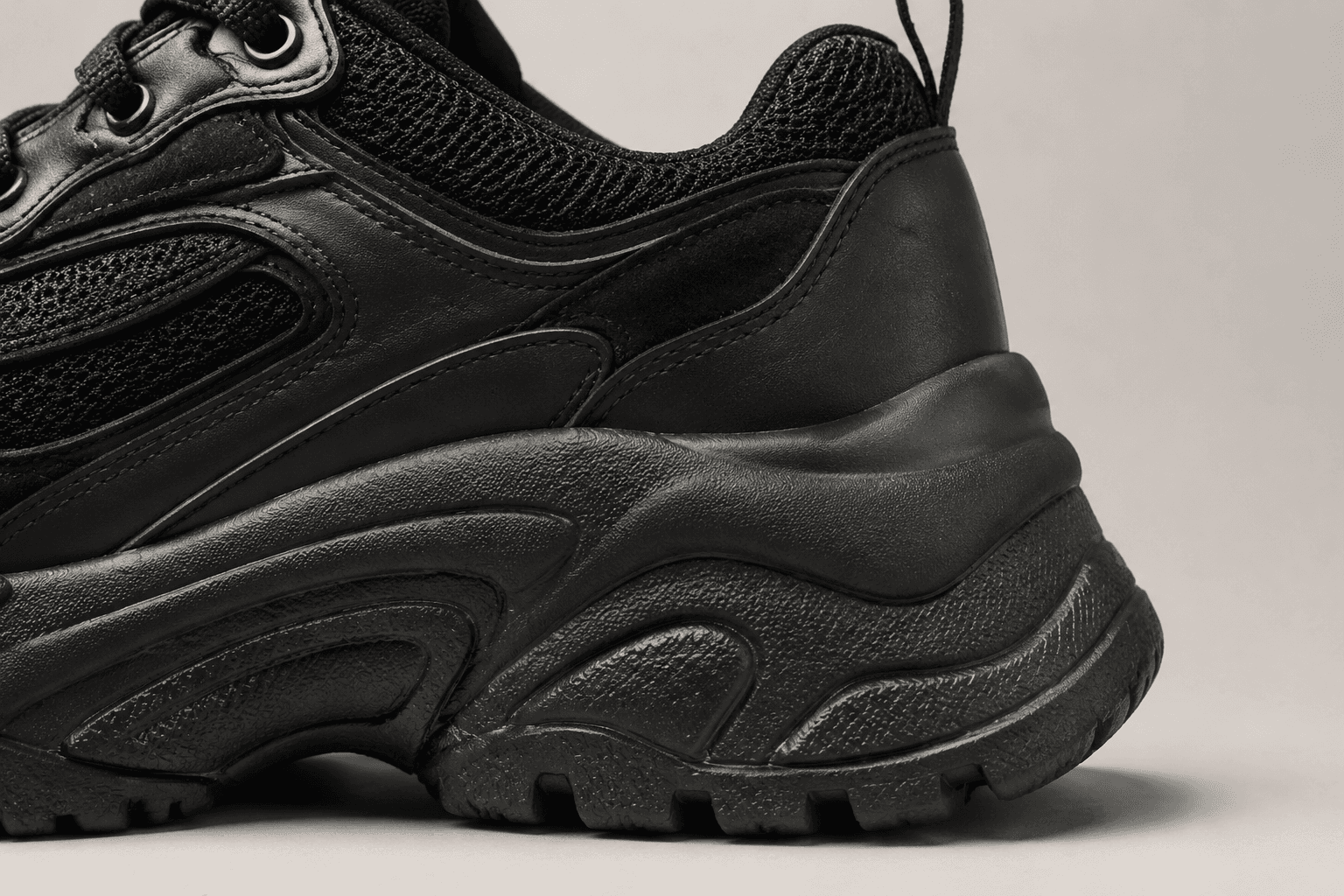
Uniform footwear sourcing is the bulk purchase of work shoes built for a defined shift pattern, floor condition and dress code. For hotels, clinics, hospitals, restaurants and service contractors, the shoe is not a generic black basic. It is an occupational product that must hold slip performance, fit consistency, cleanability and acceptable wear life at a controlled FOB price.
For importers buying from China, the bigger risk is usually not first-sample development. It is repeat-order drift. A first order may use a 0.22 g/cm3 PU footbed, 220 GSM lining and rubber-rich outsole, then the reorder arrives with 0.16 g/cm3 EVA, 170 GSM lining and a harder compound that behaves differently on wet tile. If the specification is not locked at component level, the program becomes unstable even when carton appearance and unit price still match the PO.
This guide explains what uniform footwear sourcing is, how it works from brief to shipment, why technical control matters, and when to choose stock platforms versus full custom development. The focus is supplier-side and measurable: MOQ by construction, lead time in days, target FOB ranges, EN ISO and ASTM references, foam density, lining GSM, outsole hardness and the documents that should be fixed before bulk production starts.
In uniform footwear, the real quality test is whether the fourth repeat order performs like the first.
What uniform footwear sourcing is
At factory level, uniform footwear sourcing is the controlled purchase of job-specific shoes for staff who stand or walk 8-12 hours per shift in kitchens, lobbies, wards, clinics, retail floors, airports and cleaning routes. The sourcing brief starts with working conditions, not styling. Floor contamination, cleaning chemicals, temperature, required silhouette and replacement cycle all affect upper choice, outsole compound, footbed density and construction method.
The buying logic differs from fashion wholesale because the success metric is field performance over time. A uniform program works when pairs fit consistently across the size run, maintain traction through the expected wear period, and can be reordered without drift in upper shade, foam feel, outsole hardness or carton standard. That requires a more technical sourcing file than a visual tech pack.
- Typical MOQ for stock occupational styles: 300-600 pairs/style with mixed sizes
- Typical MOQ for private label with custom upper, logo and printed box: 800-1,500 pairs/style/color
- MOQ for new outsole mold programs: commonly 1,200-3,000 pairs/style after tooling sign-off
- Repeat-order lead time on approved materials: 25-35 days
- Lead time for new upper on existing outsole: 35-50 days
- Lead time for full custom outsole + upper: 50-75 days
- Common FOB range from China for non-safety uniform shoes: US$8.50-18.50/pair; formal security or premium leather work shoes often run US$19.00-24.00/pair
How these categories differ by job function
Hospitality shoes wholesale usually divides into front-of-house and back-of-house. Front desk, concierge and restaurant service staff need a cleaner silhouette, secure heel seat, controlled flex point and quiet outsole contact on polished tile or sealed stone. Kitchen and stewarding teams need deeper tread channels, better detergent-film traction, fewer exposed stitch lines and uppers that tolerate repeated wiping without finish cracking.
Healthcare work shoes supplier programs prioritize long-shift cushioning, easy cleaning, forefoot flex, stable heel hold and tolerance to disinfectant wiping. A nurse in a 12-hour shift may walk 12,000-18,000 steps. That makes compression set, sockliner recovery and outsole abrasion more important than they are in light retail use. Weight targets matter, but ultra-light builds should not sacrifice rearfoot stability.
Service footwear manufacturer programs vary the most. Housekeeping teams need lightweight, flexible shoes with good heel retention. Security teams often require a more formal toe shape, firmer counters and stronger upper support. Retail chains focus on appearance consistency and replenishment speed, but still need verified slip performance because polished floors and cleaning residue create the same risk profile seen in hospitality.
What counts as a uniform shoe program
A uniform shoe program is not a one-off PO for a black work shoe. It is an approved package of last, pattern, upper material, lining GSM, toe puff and counter specification, footbed density, outsole compound, color standard, carton ratio and test benchmark. It should also define what can be substituted and who must approve a change.
For importers managing chain accounts, uniform shoe programs reduce claim risk and speed up replenishment. Instead of rebuilding every order, the buyer freezes measurable points: microfiber thickness 1.4-1.8 mm, lining 180-260 GSM, PU footbed density 0.18-0.25 g/cm3, outsole hardness 55-68 Shore A, glue system, lace spec, barcode format and AQL level. That is the control level needed in bulk occupational footwear.
How uniform footwear sourcing works from brief to shipment
The sourcing sequence should start with wear conditions, not sketches. Ask what floor surfaces are common, whether water, oil, soap or sanitizer residue is present, how the shoe is cleaned, whether metal-free or ESD performance is required, whether staff change shoes on site, and whether the role is mostly standing, walking, pushing carts or lifting. Those answers determine whether the correct build is a cemented dress-work shoe, a soft strobel nurse shoe, an injected occupational style or a molded clog.
After the end use is clear, the supplier should push the buyer toward proven outsole and last options first. In most programs, speed, MOQ and repeat consistency improve when the buyer uses an existing outsole mold and modifies the upper, sockliner print, logo and packaging. Full custom should be reserved for annual volume high enough to support tooling and repeat material reservation.
- 01Define end use by department: front desk, server, chef, nurse, cleaner, retail, security or facilities.
- 02Set non-negotiable performance points: slip resistance, upper cleanability, weight target, toe shape, closure type, anti-static or ESD need, and expected wear life in months.
- 03Choose construction: cemented, strobel + cement, direct injection, molded EVA or other proven occupational build.
- 04Freeze the bill of materials: upper thickness, lining GSM, heel patch, toe puff, counter, footbed density, midsole foam, outsole compound and hardness.
- 05Approve a wear-test sample plus a size set in core sizes.
- 06Run lab tests or verified factory testing against the agreed claim set.
- 07Issue the PO with packaging, carton ratio, AQL, ex-factory date and approved substitution limits.
- 08Approve the pre-production sample, inspect inline at 20-30% output, then run final inspection before shipment.
Material and component specifications to lock early
For uppers, microfiber is often the safest material for hospitality and healthcare because shade is more consistent than low-grade leather and wipe-down performance is usually better. A practical supplier spec is 1.4-1.8 mm microfiber with hydrolysis-resistant backing and available abrasion data. If full-grain or corrected-grain leather is used for premium programs, request actual thickness tolerance, finish type, color fastness and flexing data. Split leather may save US$0.50-1.20/pair, but it is more likely to crack at vamp flex points or show grain variation between lots.
For lining, 'mesh' is not a usable specification. Ask for composition and weight. A workable range for breathable work-shoe lining is 180-260 GSM. Heel areas should use either a higher-abrasion sandwich mesh or a microfiber patch, especially where staff remove shoes quickly between shifts. For footbeds, PU foam or open-cell polyurethane at 0.18-0.25 g/cm3 and 4-8 mm thickness usually outperforms low-density EVA in rebound and long-shift recovery. A cheap EVA sockliner may feel soft in sample review and collapse within 4-8 weeks of heavy use.
For outsole units, rubber gives the strongest slip and heat performance but adds cost and weight. TPR and phylon-rubber combinations are common in hospitality and general service. In nurse clogs and some clinic shoes, EVA can work if tread geometry and surface contact are engineered for smooth floors, but pure EVA wears quickly on abrasive service routes. Always ask for compound hardness, usually 55-68 Shore A, and whether outsole color and hardness are controlled by the same material supplier on repeat runs.
Testing, compliance and documentation
Uniform footwear is not always sold as certified safety footwear, but any occupational claim still needs evidence. If a style carries protective features, relevant EN ISO or ASTM references may apply depending on market and claim. In Europe, buyers commonly review EN ISO 20347 for occupational footwear and EN ISO 20345 where protective requirements apply. In the US, ASTM F2413 becomes relevant if toe protection, puncture resistance or electrical hazard claims are made. A factory should identify the actual standard and test method used, not say only 'meets work shoe standard.'
For non-protective uniform shoes, the minimum request should still include slip test results on relevant surfaces, upper-outsole bond strength, outsole abrasion, flexing, color fastness for dark linings and internal wear-test notes. For hospital or food-service programs, ask for wipe testing on the actual upper finish using common disinfectant or detergent exposure. If anti-static or ESD is required, treat it as a finished-shoe claim with test records on the completed pair, not only on raw outsole compound.
Typical sourcing choices by segment
| Segment | Recommended construction | Typical MOQ | Lead time | Indicative FOB |
|---|---|---|---|---|
| Front-of-house hospitality | Cemented upper + rubber/TPR outsole | 600-1,200 pairs/style | 35-50 days | US$11.00-18.00 |
| Kitchen and food service | Cemented or injected with high-slip outsole | 800-1,500 pairs/style | 40-60 days | US$12.50-19.50 |
| Healthcare nurse shoe | Strobel + cement or molded clog | 500-1,200 pairs/style | 30-50 days | US$8.50-16.00 |
| Cleaning and facility teams | Lightweight cemented or molded easy-clean style | 500-1,000 pairs/style | 30-45 days | US$8.00-13.50 |
| Security and formal service | Structured dress-work cemented construction | 800-1,500 pairs/style | 45-60 days | US$13.00-22.00 |
Why technical control matters in hospitality, healthcare and service footwear
Most field failures in uniform footwear come from one component that was never frozen properly. Heel lining wears through in 30-60 days because GSM was cut. Footbeds flatten because density dropped from 0.22 g/cm3 to 0.16 g/cm3. The outsole slips on detergent film because the tread profile was taken from a casual sneaker, not an occupational pattern. The upper cracks across the vamp because the finish looked good in the salesman sample but could not survive repeated flexing and cleaning.
For importers, these are not minor factory issues. They directly affect replacement cost, customer credits and account retention. A quote that is US$0.70-1.20/pair cheaper can become more expensive if the claim rate rises from 1.5% to 5% or if end users start rejecting staff issue after the second replenishment. In uniform footwear sourcing, technical stability over three or four repeat orders matters more than first-sample appearance.
- Slip-related claims are among the highest-cost failures in occupational footwear programs.
- Low-density footbeds and low-GSM heel lining create complaints faster than visible upper defects.
- Upper cleanability directly affects replacement cycle in healthcare and food service.
- Size grading inconsistency causes immediate staff issue problems in chain rollouts.
- Black shade drift in uppers or outsoles is common when raw material sources change without written approval.
Hospitality-specific risk points
In hospitality shoes wholesale, buyers often over-specify upper appearance and under-specify outsole function. A slim black derby may work for front desk staff with a low-profile rubber outsole, but banquet setup crews and food runners need more torsional support and a tread pattern that still grips when the floor has detergent residue. Kitchen teams need compound performance against oil, soap and water, not simply a sole pattern that looks aggressive in photos.
Noise is another supplier-side detail that should be discussed early. Harder compounds can create an audible strike on marble or polished hotel flooring. A quieter outsole can be achieved with contact patch changes or dual-compound design, but that must be balanced against wear resistance and cost. If the buyer wants low noise, strong durability and low FOB at the same time, the factory should show the trade-off in measurable terms.
Healthcare-specific risk points
When working with a healthcare work shoes supplier, comfort language should be translated into measurable specifications. Ask for sample weight by size, footbed density, thickness, rebound or compression set data if available, and flex behavior at the forefoot. For many non-safety nurse styles, buyers target below 320 g per shoe in women's EU 38 and below 420 g in men's EU 42, but reducing weight too aggressively often weakens heel support and outsole wear life.
Upper selection must also match cleaning reality. Open knit uppers may feel softer, but they are often unsuitable for clinics or eldercare settings that require rapid wipe-down cleaning or better splash resistance. Smooth microfiber, coated textile and enclosed molded constructions are usually more practical. On dark linings, ask for crocking and color-transfer checks because white or light socks are common in medical settings.
When to use different constructions and sourcing models
The correct construction depends on environment, expected wear period, target FOB and reorder pattern. Cemented construction remains the most common for hospitality and service because it supports formal uppers and a wide range of outsole units at manageable cost. Strobel + cement works well for lighter healthcare and housekeeping shoes where forefoot flexibility and lower weight are priorities. Direct injection can improve bond consistency and water resistance but usually requires more tooling commitment and stricter process control.
From a sourcing view, most buyers should first review stock outsole platforms from a Chinese service footwear manufacturer. Reusing a proven outsole mold and last reduces development time, lowers MOQ and improves repeatability. Full custom outsole development only makes commercial sense when annual volume can amortize tooling and support repeated runs on the same component supply base.
Typical construction choice by segment
Front-of-house hospitality normally performs best with a cemented upper and rubber or TPR outsole, especially when the look must stay close to a formal shoe. Kitchen and food-service teams often justify a heavier-duty cemented construction with a higher-grip rubber-rich outsole, or direct injection where bond integrity and wipe-down resistance are priorities. Nurse shoes usually suit strobel + cement or molded clog construction depending on dress code and cleaning practice.
Cleaning crews and facilities teams usually benefit from lighter cemented or molded options with easy-clean uppers and secure heel fit. Security teams often need a structured dress-work shoe with stronger counter support, firmer toe shape retention and more stable shank support than a standard service slip-on.
Stock platform versus full custom
Use a stock or lightly modified platform when speed, lower MOQ and proven wear performance matter most. This is common for importers testing a new account, regional distributors with mixed size runs or replenishment programs that need 30-40 day delivery. In those cases, changing upper panels, branding, sockliner print and packaging usually gives enough differentiation without raising production risk.
Use full custom when the buyer requires a proprietary silhouette, dedicated fit profile, special outsole geometry or a multi-year chain account where tooling amortization is realistic. At many factories, full custom becomes commercially efficient only when annual demand is strong enough to support repeated runs and raw material reservation from the same vendors.
How to build a repeatable uniform shoe program with Chinese factories
Repeatability depends on documents and process discipline. Many buyers approve the salesman sample, negotiate price and leave too much open during production. The factory then substitutes a lower-GSM lining, changes outsole source or softens the internal quality target to protect FOB. The shipment may pass a visual final inspection and still perform differently in the field. Every approved style should therefore have a signed material card and a production spec sheet tied to a sealed sample.
Fit control is equally important. Staff-issued shoes generate immediate complaints when internal length, forefoot girth or heel shape changes between runs. Ask for a full size set, internal measurement chart and sample weight by core sizes. For chain programs with quarterly replenishment, discuss whether the factory can hold outsole units, upper color stock or printed packaging against a forecast to reduce shade variation and shorten lead time.
- 01Seal a master sample against a full bill of materials and internal measurement chart.
- 02Record upper thickness, lining GSM, footbed density, outsole hardness, color code and component supplier.
- 03Define approved glue system, stitch density, lace spec, eyelet finish and branding placement.
- 04Set AQL and classify critical defects for bonding, pairing, contamination, wrong labeling and severe shade variation.
- 05Require pre-production confirmation after raw materials arrive, especially for dark upper shades and custom outsole colors.
- 06Run inline inspection at 20-30% completion to catch lasting shape, stitch quality and bonding problems early.
- 07Run final inspection with carton drop test, size-ratio verification, barcode check and random wear-pair review.
MOQ and replenishment strategy
MOQ should be checked by component, not only by finished pair count. A factory may accept 600 pairs on paper, but the custom outsole color may require a 1,200-pair batch, or the box supplier may impose a 1,000-box minimum. In uniform programs, these hidden MOQs often create the real constraint on short replenishment orders.
If annual volume is stable, ask the supplier for two quotations: initial MOQ and repeat-order MOQ using stocked molds and pre-approved materials. Some factories can support 300-500 pair repeat orders after first production if the buyer accepts standard carton dimensions, pre-selected upper colors and limited branding changes. That structure works well for phased rollout by property, region or hospital group.
Cost drivers buyers often miss
The main technical cost drivers are better outsole compound, stronger heel lining, PU footbeds instead of cheap EVA, custom last work, anti-static or ESD validation and external compliance testing. These usually add only US$0.30-1.80/pair and are often justified because they reduce claims and replacement requests.
The least useful cost additions are often decorative. Extra stitch lines, metal logo pieces, complex lace tags and oversized packaging rarely improve field performance. Also check carton efficiency. Lightweight healthcare and service shoes can become freight-inefficient if the box is oversized. Ask the factory for master carton dimensions, pairs per carton and volumetric impact before approving packaging.
SoleForge manufactures safety & work shoes and casual sneakers under OEM and ODM for brands and importers worldwide. Request a quote with your tech pack or reference pair and we'll reply within one business day.