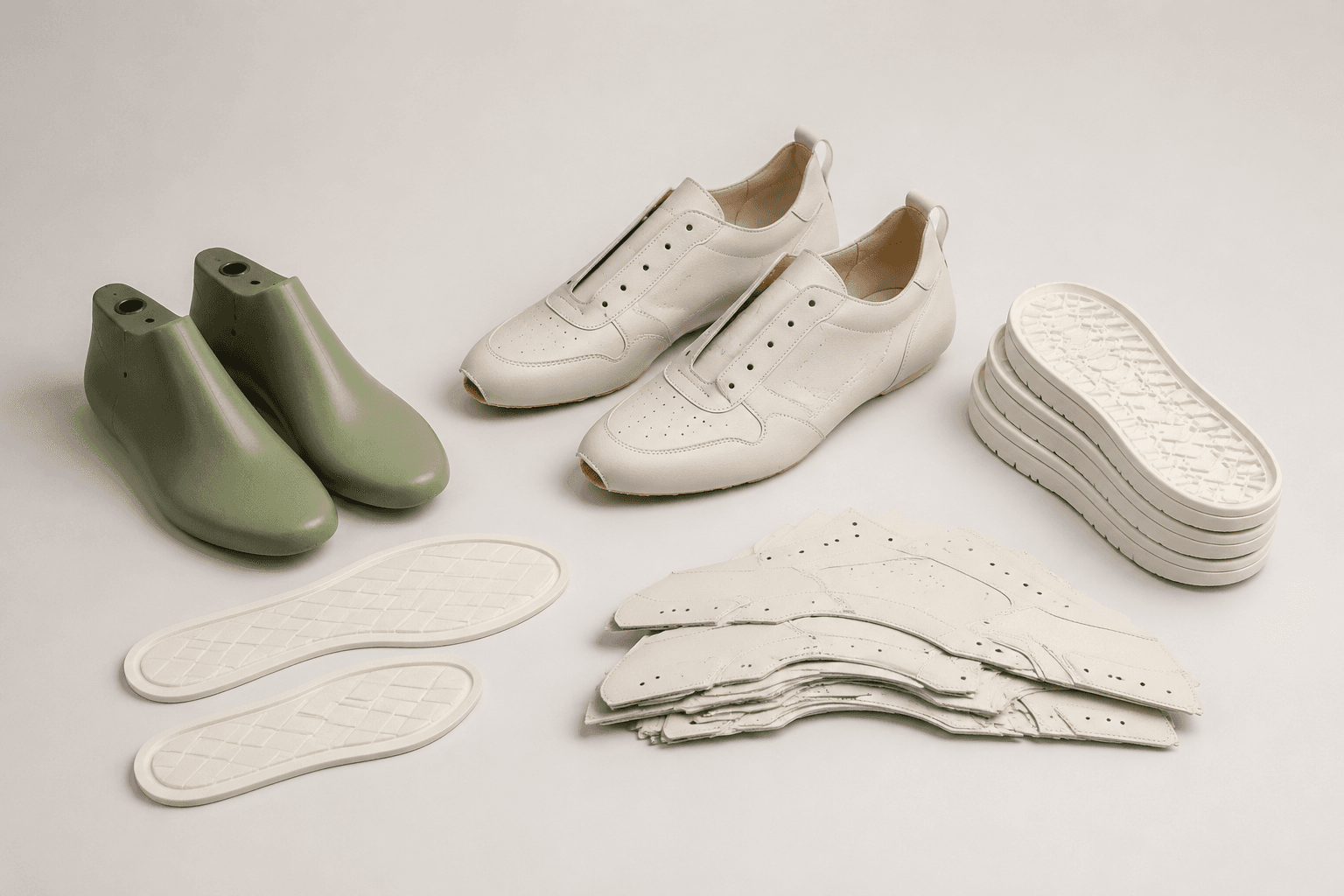
To start a shoe brand, most founders focus first on logo, website, and sales channels. On the factory side, the order is different. Product category, target FOB price, materials, sizing, compliance, packaging, and MOQ determine whether your concept can actually be made at a workable margin. In footwear, small specification errors create expensive problems because outsole molds, upper patterns, fit grading, and wear testing all interact.
For sourcing managers, brand owners, and importers buying from China, the real question is not only how to launch a footwear brand, but how to launch one that can repeat orders without constant quality drift. A good startup sourcing plan converts design intent into a factory-ready package: last shape, upper construction, outsole compound, insole spec, carton standard, labeling, test protocol, and delivery calendar.
This playbook explains what it takes to start a shoe brand from a supplier-side perspective: what the process is, how it works in production, why each step matters to margin and quality, and when to use different sourcing approaches. The goal is practical decision-making, not theory.
The best first footwear program is the one that can pass testing, fit consistently, and reorder at margin.
What it means to start a shoe brand from a sourcing perspective
A founder may define a shoe brand by design identity and consumer positioning. A factory defines it by technical package quality and order discipline. If you want to start a shoe brand successfully, you need both. In manufacturing terms, a brand is a repeatable product program with stable specifications, approved materials, predictable reorder logic, and a realistic MOQ mix by season.
Footwear is not one product family. A vulcanized canvas sneaker, a cemented running shoe, a strobel-knit trainer, a cupsole court style, an injected EVA slide, and a Goodyear-welt boot all require different machinery, components, labor skill, testing standards, and costing structures. A startup that treats all shoes as equivalent usually receives inconsistent quotations or development delays because the wrong factory type is being approached.
The first sourcing task is category narrowing. One strong SKU family with controlled variations usually outperforms a scattered first collection. For a startup, color extensions and upper material swaps are lower risk than changing outsole tooling across multiple constructions.
- Define the first category: sneaker, sandal, slide, casual, boot, safety, kids, or performance
- Set your target price architecture: ex-factory, FOB, landed, wholesale, retail
- Choose construction early: cemented, vulcanized, strobel, injection, cupsole, welted
- Fix your compliance scope: REACH, CPSIA, Proposition 65, EN ISO, ASTM, customer-specific RSL
- Decide the launch width: 1 outsole mold platform with 2-4 upper options is usually more efficient than 6 unrelated styles
What founders often underestimate
The biggest underestimation is tooling commitment. New outsole molds in China commonly range from about $2,500 to $8,000 per mold set for standard rubber or phylon/rubber constructions, and more for complex multi-part tooling. If your first season carries three unique bottoms, tooling can consume the same budget that should have gone to wear testing and material upgrades.
The second issue is fit. In footwear, poor fit destroys reorder potential faster than small cosmetic defects. Last selection, toe spring, heel pitch, forefoot girth, and sockliner thickness all affect fit. A startup without a fit standard should decide whether to fit on EU 37 and EU 42, or US women's 7 and men's 9, then lock grading rules before confirmation samples.
When a private label base is the better start
If speed and cash preservation matter more than full originality, a ready outsole and pre-engineered upper base can be the best route. For many founders, using an existing cupsole or EVA slide platform reduces tooling risk, lowers development time by 20-40 days, and allows MOQs from roughly 300-600 pairs per style depending on materials and color count.
This approach is especially useful when testing a market, opening first wholesale accounts, or validating size curves. It is less suitable when your brand promise depends on proprietary cushioning geometry, technical performance claims, or a distinctive bottom profile.
How product development works with a shoe manufacturer for startups
A shoe manufacturer for startups will usually divide development into four stages: brief review, sample development, confirmation, and bulk pre-production. Each stage has cost and timing implications. A founder who sends only reference images will receive broad estimates, not actionable production commitments.
A workable development brief should include target category, retail positioning, reference styles, upper materials, lining, outsole concept, colorways, branding placements, size range, target FOB, packaging needs, and compliance requirements. The more technical your brief, the more accurate the first quotation will be.
Typical sample lead times in China are 7-14 days for simple stock-bottom modifications, 14-21 days for fresh upper developments on existing outsoles, and 25-40 days when new molds or complex material sourcing are involved. These are normal windows, not delays.
- 01Tech pack or concept brief submission
- 02Factory feasibility review and target costing
- 03Material swatch confirmation and component booking
- 04First prototype or counter sample
- 05Fit sample and wear comments
- 06Salesman sample or photo sample
- 07Pre-production sample before bulk
- 08Bulk material cut, stitching, lasting, assembly, packing
What belongs in a startup footwear tech pack
A footwear tech pack should show lateral, medial, top, bottom, and back views; logo dimensions; stitch count expectations; upper pattern break lines; eyelet count; lace length; outsole hardness target; footbed density; material callouts; barcode location; carton marks; and approved tolerance logic. For apparel, some details can be interpreted. For footwear, interpretation creates avoidable variation.
On materials, specify measurable items where possible. Examples include PU synthetic at 1.2-1.4 mm, mesh at 220-280 GSM, memory foam sockliner at 6 mm with 0.16-0.22 g/cm3 density, EVA midsole at 0.20-0.28 g/cm3 depending on compression target, and rubber outsole hardness around Shore A 55-70 based on category. Performance claims should match test plans.
How sample rounds affect speed and cost
Every sample round resets part of the calendar. A change from suede to microfiber may be minor. A change from stitched cupsole to foxing vulcanized is a category shift. Founders should classify comments into cosmetic, fit, structural, and compliance-related issues. Structural changes are expensive because patterns, boards, counters, and outsole interface may all need revision.
A practical target is two to three rounds before pre-production sample approval. More than that usually means the concept was not frozen early enough, or the target FOB and design ambition are mismatched.
Indicative startup footwear sourcing ranges from China
| Shoe type | Typical MOQ | Sample lead time | Bulk lead time | Indicative FOB/pair | Typical tooling |
|---|---|---|---|---|---|
| EVA slide/slipper | 300-500 pairs/color | 7-12 days | 30-40 days | $2.80-$5.50 | Low if existing mold; new mold extra |
| Canvas or vulcanized sneaker | 600-1200 pairs/style | 14-21 days | 45-60 days | $6.50-$12.00 | Foxing and outsole tooling if custom |
| Cemented casual sneaker | 500-800 pairs/style | 14-21 days | 45-60 days | $8.50-$16.00 | Low on stock outsole, medium on custom bottom |
| Running-inspired knit trainer | 800-1500 pairs/style | 21-35 days | 55-75 days | $11.00-$22.00 | Higher due to molds and performance components |
| Leather boot | 500-1000 pairs/style | 21-30 days | 50-70 days | $18.00-$38.00 | Moderate to high depending on outsole and hardware |
| Safety shoe | 1000-1500 pairs/style | 25-40 days | 60-90 days | $16.00-$32.00 | Higher due to certified components and testing |
Why MOQ, pricing, and tooling determine whether you can launch a footwear brand profitably
To launch a footwear brand, commercial structure matters as much as design. Many first-time buyers ask only for the lowest FOB. That is incomplete. You need to know MOQ by style, MOQ by color, tooling amortization, carton efficiency, payment terms, and defect allowance assumptions. A style that looks cheap on paper can become expensive if it forces low carton utilization, high mold cost, or excessive color-separated components.
Startup MOQs vary by construction and factory setup. For EVA injected slippers and slides, some factories can start at 300-500 pairs per color. For standard cemented sneakers with existing outsoles, 500-800 pairs per style split across two colors is common. For fully custom performance footwear with new molds and many special materials, practical minimums often begin at 1,000-1,500 pairs per style.
Pricing must be built backward from the consumer target. If your planned retail is $89 and your wholesale target is a keystone model, your landed cost may need to stay near $18-22 depending on freight, duty, packaging, and channel margin. That can imply an FOB target around $11-15. If your design uses premium suede, molded TPU parts, and branded outsole tooling, that target may be unrealistic.
- Existing outsole platform: lower tooling, faster launch, lower risk
- New outsole mold: stronger differentiation, higher upfront cash requirement
- Simple color palette: easier matching, lower material MOQ pressure
- Heavy upper paneling and many overlays: higher labor minutes per pair
- Special packaging: strong brand effect, but often adds $0.40-$1.50 per pair
Typical startup cost drivers by shoe type
The table below shows broad sourcing-side ranges for startup footwear programs from China. Actual FOB depends on volume, material grade, season, testing scope, and target market. These are planning ranges, not firm offers.
How compliance and testing work in footwear production
Compliance is not a final paperwork task. It should begin during material nomination. If you are buying for the EU, UK, or US, your chemical and physical test expectations must be clear before lab dips and material bookings. Otherwise, the factory may quote one material level and later discover your market requires a more expensive alternative.
For lifestyle footwear, the most common startup oversight is failing to align claim language with test evidence. If you call a shoe slip-resistant, waterproof, anti-static, or work-rated, the burden changes. In many cases you move from general consumer footwear expectations into specific EN ISO or ASTM test frameworks.
Basic physical tests can include upper-to-sole adhesion, flexing resistance, color fastness, abrasion, sole hardness, hydrolysis review for PU components, and carton drop performance. Safety or occupational footwear may additionally require toe cap impact/compression, puncture resistance, electrical properties, slip testing, and marking conformity under EN ISO 20345 or ASTM F2413 depending on market.
Why material booking before test alignment is risky
If your microfiber, adhesive system, ink, or foam compound is booked before restricted substance and physical performance standards are confirmed, failed tests create either shipment delay or rework cost. Small brands feel this sharply because one failed test can affect the entire season's cash flow.
Ask suppliers to confirm whether nominated materials have existing pass history for the intended market. Pass history is not a substitute for your own testing, but it reduces avoidable experimentation.
When to use third-party pre-shipment inspection
For startup orders, third-party inspection is useful when production is placed with a new factory, when packaging has retailer-specific requirements, or when your internal team cannot visit during packing. Use it at least for first bulk orders and whenever a new outsole mold or major material switch is involved.
AQL planning should fit the risk level. Many buyers use AQL 2.5 for major defects and 4.0 for minor defects on consumer footwear, but internal standards may be tighter for premium channels.
When to choose private label, hybrid customization, or full custom development
There is no universal best model. The right path depends on order size, speed target, differentiation need, and how much cash you can lock into tooling and inventory. Founders often over-customize too early. That slows launch and increases unsold stock risk.
"The best first collection is usually the one you can reorder cleanly, not the one with the most design features."
- 01Use private label when speed, low MOQ, and market testing are the priority.
- 02Use hybrid customization when you want a branded identity on proven outsole platforms.
- 03Use full custom development when your sales forecast can absorb molds, longer lead times, and stricter forecasting.
Private label: what it is and when it works
Private label in footwear means selecting existing factory constructions, outsoles, or patterns and customizing logo, color, materials, insock print, box, and sometimes upper detailing. This works well for slides, sandals, basic sneakers, and casual shoes where commercial timing matters more than patented performance features.
It matters because it reduces development uncertainty. For a new brand, proving demand with a stable base can be more valuable than owning every technical element from day one.
Hybrid customization: the practical middle ground
Hybrid development typically keeps a factory's existing outsole and sometimes last, while building a custom upper, branded footbed, special strobel board, upgraded foam package, or distinct trim set. This allows stronger differentiation without the full burden of outsole tooling.
For many brands, this is the most efficient way to launch a footwear brand in the first two seasons because it balances MOQ, speed, and product identity.
How to control lead time, quality, and repeatability after launch
Once you start a shoe brand, the next challenge is repeatability. Most sourcing failures happen not in first sample review, but in reorders when assumptions are no longer written down. A confirmed sample alone is not enough. You need a signed specification standard that production, QC, and merchandising all reference.
Normal bulk lead times from sample approval and deposit can range from 30-45 days for simple injected products, 45-60 days for standard casual and sneaker programs, and 60-90 days for mold-heavy or material-complex orders. Peak season, holiday shutdowns, and outsole line loading can extend this. Strong founders build calendars with buffer, not optimism.
Quality control should include incoming material check, inline stitching and lasting inspection, outsole bonding check, final appearance inspection, and carton verification. For repeat orders, lock critical items: last code, outsole cavity, color standard, glue line tolerance, net weight range, and packaging configuration.
- Freeze approved color standard with physical swatches, not photos only
- Keep one golden sample and one production-sealed sample per style
- Record fit comments by size and width, not just by style name
- Track defect trends by process: cutting, stitching, lasting, assembly, packing
- Review reorder material availability 60-90 days before repeat PO
SoleForge manufactures casual sneakers and athletic & running shoes under OEM and ODM for brands and importers worldwide. Request a quote with your tech pack or reference pair and we'll reply within one business day.