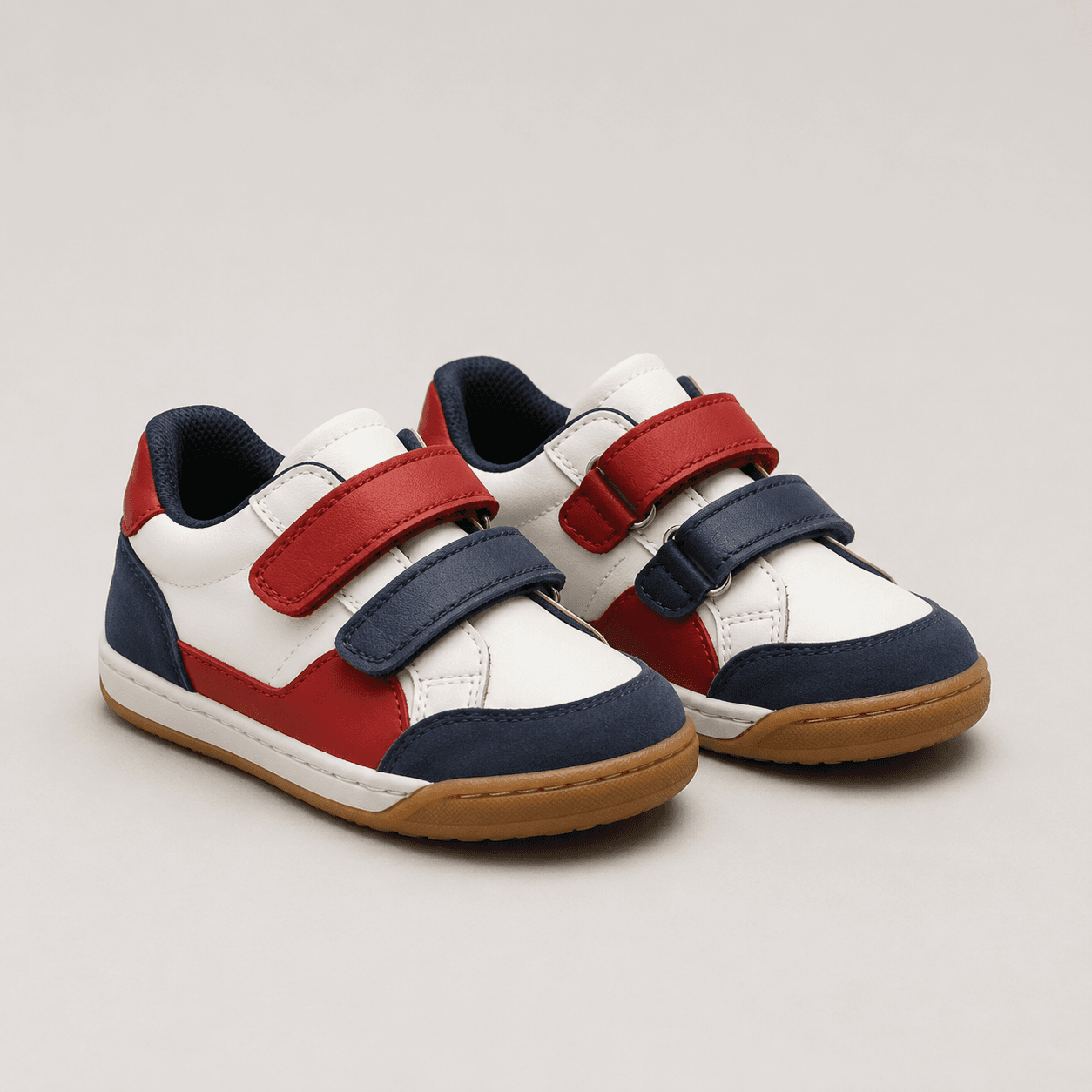
Sourcing children’s footwear from China is a control job before it is a price job. A capable kids shoes manufacturer has to manage low-weight constructions, accurate fit grading, secure closures, chemical compliance, and repeatable bonding quality across thousands of pairs. A good-looking sample is not enough. Bulk problems usually come from material substitution, weak size grading, or a test plan that does not match the real bill of materials.
For sourcing managers, brand owners, and importers, the commercial risk is specific. A 2 mm loss in internal length, a softer heel counter board, a 30-40 GSM drop in lining weight, or a lower-density insock foam can turn an approved sample into a return problem. In children’s footwear, parents notice fit inconsistency quickly, retailers escalate safety claims faster, and compliance failures are less forgivable than in many adult categories.
This guide is structured as a buyer decision framework. Each section covers one purchase decision, explains what strong suppliers do differently, and ends with practical checks to use during factory screening, sample approval, and pre-production booking. The focus stays on supplier-side facts: MOQ, lead-time days, FOB $/pair ranges, test method logic, material specs, and the process controls that matter most in kids shoe safety.
In children’s footwear, the safer supplier is usually the one that can explain every material, millimeter, and test result behind the pair.
Select the factory by children’s category capability, not by sample speed
The first buying decision is whether the supplier is truly built for children’s footwear. Many Chinese factories can produce a convincing sample, but stable bulk output depends on existing child-specific lasts, lighter component sourcing, smaller pattern handling, and grading rules for infant, toddler, little kid, and junior sizes. A factory that mainly runs adult casual shoes often underestimates how sensitive kids footwear is to entry opening, forepart flex, collar height, and left-right symmetry.
Ask for evidence in production terms. A stronger kids shoes manufacturer can usually show current size sets, existing outsole tooling in children’s size runs, and repeat orders in one or two clear constructions such as vulcanized canvas, cemented school shoes, injected sandals, or phylon/TPR sneakers. If children’s footwear is less than about 30% of annual volume, expect more fit rounds, more outsourcing, and a higher chance that the sample room is stronger than the production line.
Capability also affects MOQ and development timing. For repeat-outsole kids canvas shoes or basic EVA sandals, MOQ often starts around 1,200-1,500 pairs per style, usually spread across 2-3 colors. For custom-bottom sneakers, molded school shoes, or phylon/TPR running styles, practical MOQ is more often 2,400-3,000 pairs per style, with outsole mold charges or logo plate fees on top. Development is rarely instant: 10-14 days for a prototype on existing tooling, 18-25 days for revised uppers or new panels, and 25-35 days when new lasts, new molds, or a full size set are required.
- Ask what percentage of annual output is children’s footwear by construction
- Check whether they regularly run infant, toddler, little kid, and junior size bands
- Confirm MOQ separately for repeat tooling and new tooling programs
- Request prototype, size-set, counter sample, and confirmation sample lead times
- Ask whether child-specific lasts are owned in-house or opened only after deposit
Screen by age band and construction
Do not treat all children’s shoes as one sourcing category. A childrens footwear supplier may be strong in injected sandals up to EU 26 but weak in junior sneakers up to EU 36, where stronger foxing, firmer counters, and tighter upper-to-sole bonding are needed. Toddler product needs lower weight, softer toplines, easy opening, and more forgiving flex points. Junior product needs better torsional control, more secure closures, and more accurate grading because wear intensity is higher.
A useful factory-screening question is to ask for the standard base last size, grade increment, and best-selling size runs by category. If the supplier cannot explain the fit difference between toddler and junior constructions, they are probably quoting outside their real operating strength.
Lock kids shoe safety at BOM stage before price approval
Most avoidable failures in children’s footwear begin in the bill of materials. Buyers should review the upper, backing, lining, sock, foam, print, glitter finish, ornament, eyelet, outsole compound, and adhesive system before confirming price. In bulk production, the small parts create many claims: phthalates in soft PVC trims, excessive heavy metals in print pigment, strong solvent odor after packing, low-density footbeds that collapse early, or decorative parts that detach under pull.
A reliable kids shoes manufacturer should describe materials in production terms, not showroom language. That means synthetic upper thickness, textile GSM, foam density, outsole hardness, adhesive type, and reinforcement placement. If the factory only says 'PU upper', 'mesh lining', or 'soft EVA', there is too much room for uncontrolled substitution. In a disciplined setup, incoming materials are checked by thickness gauge, shore hardness, weight, color standard, and visual comparison to a sealed approval swatch.
The safest approach is to reduce unnecessary risk in design. Large bows, sequins, loose badges, long cords, and oversized toggles increase both compliance exposure and assembly variation. Cleaner uppers with fewer detachable trims usually deliver lower defect rates and more stable inspection results, especially in toddler and younger children’s categories.
- Request a complete BOM listing every upper, lining, foam, outsole, trim, print, and adhesive
- Ask for restricted substance declarations on coated synthetics, PVC trims, prints, and glitters
- Confirm adhesive process: water-based cement, solvent cement, primer, hardener, and drying method
- Reduce detachable decoration unless attachment strength is tested and approved
- Check packed-pair odor after 24-48 hours inside individual box and export carton
Define technical material specs in numbers
Children’s comfort and durability problems often trace back to vague materials. For molded EVA insocks or sandal footbeds, ask for density and hardness, not a generic EVA description. In many children’s sandal and casual programs, EVA density around 0.18-0.25 g/cm3 is common, while compression performance must still be checked after wear. For phylon midsoles, lower density may reduce weight, but very light compounds often lose recovery, bottom out faster, and weaken support under active wear.
Textiles should be specified just as tightly. Canvas uppers for commercial kids programs often sit around 200-300 GSM depending on print coverage and target FOB. Mesh or brushed textile linings commonly run around 120-180 GSM. A drop from 230 GSM to 180 GSM may not be obvious in a photo sample but will affect shape retention and upper stability. For TPR or rubber outsoles, lock shore hardness and abrasion targets so the supplier cannot shift to a cheaper brittle compound after sample approval.
Typical benchmarks when screening a kids shoes manufacturer in China
| Decision factor | Working benchmark | Buyer caution |
|---|---|---|
| MOQ | 1,200-1,500 pairs for simple repeat styles; 2,400-3,000 pairs for custom or technical styles | Very low MOQ can indicate subcontracting, unstable costing, or mixed production lines |
| Development lead time | 10-14 days existing tooling; 18-25 days upper revisions; 25-35 days new tooling or new last work | Promises under 10 days are unreliable if materials, lasts, or molds are not ready |
| Bulk lead time | 35-50 days repeat orders; 60-90 days new developments | Compressed timelines increase substitution risk and reduce process control |
| FOB range | $2.40-$4.20 sandals; $3.20-$5.50 canvas; $6.80-$11.80 sport sneakers | Compare exact BOM, size ratio, and outsole weight, not headline FOB alone |
| Material controls | EVA density about 0.18-0.25 g/cm3; lining around 120-180 GSM; canvas around 200-300 GSM | Open material descriptions create sample-to-bulk drift |
| Compliance control | Material-stage testing plus finished-shoe or retained-bulk verification | Archived reports offer weak protection if any component changes |
Control sizing, grading, and measurement method before bulk booking
In children’s footwear, fit consistency drives reorder performance and complaint rate. Parents notice quickly when one color runs short, when the junior size fits like the next size down, or when the opening becomes too tight for easy entry. A professional kids shoes manufacturer should issue a technical size chart with internal length, outsole length, base last reference, and grade rule by size run, not only a generic EU-US conversion table.
One of the most common buying mistakes is approving one middle-size salesman sample and assuming the full run will grade correctly. That is weak control. Children’s grading changes length, girth, instep volume, toe box height, heel width, and topline opening. If the outsole length is increased without properly redistributing upper volume, larger sizes become tight at the instep and smaller sizes become loose at the heel. Buyers should review at least 3-5 key sizes across the run, especially the smallest commercial size, one middle size, and the largest commercial size.
Write tolerances in millimeters and tie them to one measuring method. For many kids programs, internal length tolerance around ±1.5 mm to ±2.0 mm and outsole length tolerance around ±2.0 mm to ±3.0 mm are workable references, depending on construction and size range. The key point is consistency. If the sample room measures with a gauge and production QC uses flexible tape, the approved chart becomes unreliable.
- Request size charts showing internal length, outsole length, and base last reference
- Approve a size set across the commercial run, not one display sample
- Check grade rules for girth, instep, toe box height, collar opening, and heel width
- Write finished-shoe tolerances in millimeters by size range and construction
- Verify size marking consistency on sock label, shoe label, box label, and carton mark
- 01Confirm the supplier’s base last size and grading increment before size-set development.
- 02Measure internal length and width using one gauge and one method on every review round.
- 03Wear-test at least one smaller and one larger size in addition to the sample size.
- 04Freeze the approved size chart before box printing, carton marking, and bulk cutting.
Treat closures and symmetry as fit control points
Fit is not only about the last. On children’s shoes, closure design determines entry, adjustability, and how securely the shoe stays on foot during use. Hook-and-loop straps should provide real overlap and maintain peel strength after repeated opening cycles. Elastic laces should recover without over-stretching, and back loops should be bartacked with enough reinforcement if they are meant to assist wearing.
Left-right imbalance is another common claim driver. Uneven strap placement, crooked heel counters, tongue shift, different toe spring, or off-center toplines can make a pair feel defective even when nominal measurements pass. A short pre-bulk wear trial on several children often reveals these issues faster than visual inspection alone.
Set compliance by market, age grade, and actual material risk
A supplier statement that a style is 'compliant' has almost no value unless it is tied to the destination market, age grade, and exact production BOM. Europe, the UK, and the US may use similar chemical and performance logic, but the lab plan still has to match the real materials and final construction. Archived reports from a similar shoe are only background. They do not protect the order if the new style uses a different coating, print ink, lining, ornament, or outsole source.
The compliance file should separate chemical, physical, and labeling controls. Chemical screening often focuses on coated synthetics, PVC parts, adhesives, prints, colored textiles, foam laminations, and decorative trims. Physical testing often covers bond strength, flexing, abrasion, seam strength, colorfastness, heel attachment where relevant, and closure security. Depending on the customer and market, buyers may reference EN ISO methods, ASTM methods, SATRA methods, or retailer manuals. For children’s footwear, the decision that matters is not which acronym appears on the report, but whether the chosen method matches the category risk and the real materials used.
The stronger supplier model is to test high-risk materials first and then confirm on finished shoes or retained production samples. This matters when the factory buys outsoles, insocks, printed uppers, or trims from outside component partners. In children’s shoes, one unapproved print supplier or one changed PVC badge can invalidate an earlier pass report and block shipment.
- Define destination market and age grade before issuing the test matrix
- Match each report to the real BOM, colorway, and production lot
- Separate chemical, physical, and labeling checks in the approval file
- Ask which EN ISO, ASTM, SATRA, or retailer methods are standard for the category
- Require retained bulk samples and change-control records for key materials
Ask for a practical compliance pack
For most children’s footwear programs, the basic compliance pack should include the approved BOM, material declarations, restricted substance test reports, physical test reports, final size specification, packaging and labeling record, and production inspection records. If the shoe uses leather, confirm the leather type, finish, and tanning route because the risk profile differs from coated synthetics. If the style includes lights, batteries, or sound modules, treat it as a separate compliance project with additional component control and longer approval time.
Ask the kids shoes manufacturer how material substitutions are blocked after testing. Better factories use a simple change-control process: no outsole supplier switch, no foam density change, no new print ink, no replacement lining, and no alternate ornament without buyer approval and, where required, retesting. This is one of the clearest signs that the supplier understands bulk compliance rather than sample compliance.
Compare costing by construction and component, not by headline FOB
A children’s footwear quote is only comparable after the technical specification is frozen. FOB can move sharply based on upper gauge, lining weight, outsole weight, insock foam density, closure quality, stitch count, reinforcement, packaging, and size ratio. A factory quoting $5.70 may not be cheaper than a factory quoting $6.30 if the lower offer uses lighter phylon, thinner textile, weaker hook-and-loop, or reduced toe puff and counter support.
As working China FOB ranges, basic injected kids sandals often sit around $2.40-$4.20 per pair at moderate volume. Basic canvas shoes are often around $3.20-$5.50 depending on fabric GSM, print complexity, and outsole type. School shoes and simple casual sneakers commonly fall around $5.50-$8.50. Phylon/TPR or EVA/rubber sport sneakers often land around $6.80-$11.80 depending on bottom complexity, component count, and packaging. Waterproof boots, licensed programs, and multi-overlay uppers usually cost more and often carry higher sample and tooling overhead.
Ask for a cost breakdown even if the supplier does not open full margin. At minimum, buyers should understand the main cost blocks: upper materials, outsole, labor, packaging, tooling amortization, testing allowance, and freight assumptions. Without that visibility, it is difficult to see where the factory is cutting specification to protect price.
- Ask for major cost drivers by upper, outsole, labor, packaging, and tooling
- Confirm whether molds, logo plates, test costs, and development fees are inside FOB or separate
- Check assumed size ratio because larger junior sizes raise average cost per pair
- Review outsole weight, lining GSM, upper thickness, and foam density against the quote
- Compare carton pack-out because box size and packing density affect freight per pair
Plan production with realistic lead times and inline control
Production planning for children’s footwear should break out development, material booking, lab time, line allocation, bulk assembly, and inspection. For repeat styles with approved materials and no tooling change, a realistic bulk lead time is often 35-50 days after deposit and confirmation sample approval. For new developments with custom molds, new lasts, printed uppers, or expanded compliance work, 60-90 days is a safer planning range. Any quote substantially below that should be examined step by step.
The main schedule failures usually happen before stitching starts. If artwork, outsole color, fit approval, closure specification, packaging copy, or carton marks are still open when materials are booked, the factory may protect timing later by substituting materials or compressing process controls. That is when bonding quality, fit accuracy, and finishing standards begin to drop. Before bulk cutting, the factory should hold a sealed pre-production file containing the approved confirmation sample, approved size chart, approved BOM, approved packaging, and approved test plan.
Inspection should not start at the final random stage. Inline checks during cutting, stitching, stock fitting, lasting, and finishing catch issues earlier and at lower correction cost. For larger orders, buyers often schedule one early inline inspection on the first production day, one mid-line inspection at about 20-30% completion, and one final random inspection before shipment. This is especially useful in children’s footwear, where size mixing, asymmetry, glue marks, weak strap stitching, and wrong labeling appear repeatedly in bulk.
- Use 35-50 days for repeat orders and 60-90 days for new developments as working lead times
- Do not release bulk until sample, size chart, BOM, packaging, and test plan are approved
- Schedule early inline, mid-line, and final random inspections for larger orders
- Seal raw material swatches and one approved confirmation sample for line reference
- Ask how the factory handles shortages, color drift, and failed incoming material checks
Key takeaways
- Choose a kids shoes manufacturer by age-band and construction strength before comparing price.
- Freeze technical specs early: foam density, textile GSM, outsole hardness, closure type, and adhesive system.
- Approve a real size set and grade rule, not one showroom sample.
- Build kids shoe safety and compliance around the destination market and the exact BOM.
- Use realistic MOQ, FOB, and lead-time assumptions so the supplier does not protect margin through substitution.
- Add inline inspection and material change-control before shipment, not only final AQL.
SoleForge manufactures kids' footwear under OEM and ODM for brands and importers worldwide. Request a quote with your tech pack or reference pair and we'll reply within one business day.