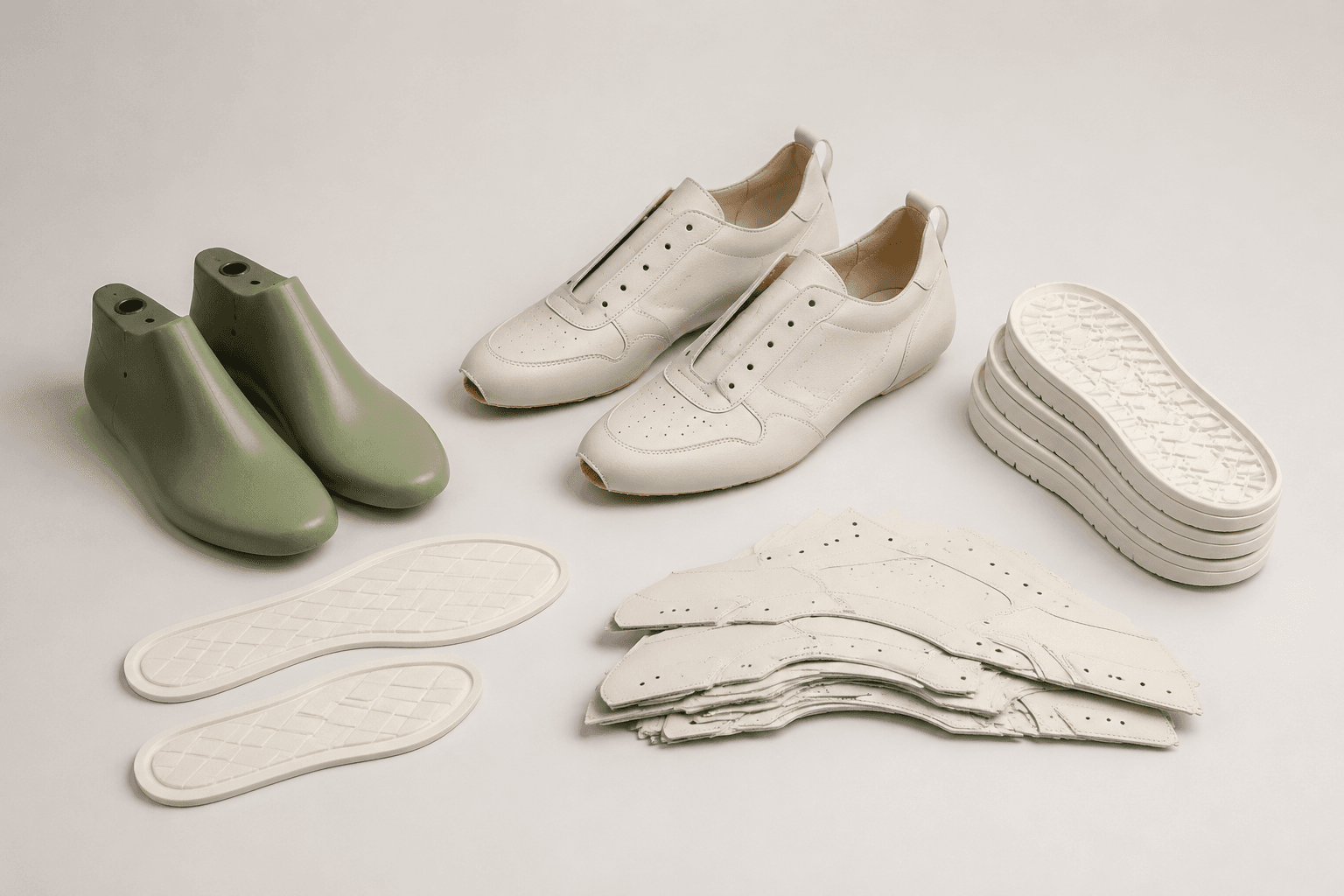
In bulk footwear sourcing, leather shoe construction is not a styling detail. It is a cost, lead-time, quality-risk, and positioning decision that affects tooling, labor content, return rates, and target retail margin. For importers buying from China, the practical choice is rarely about which construction is "best" in isolation. It is about which method fits the product brief, price architecture, and factory capability without creating avoidable defects or missed delivery windows.
The core trade-off is straightforward. Goodyear welt offers the strongest repair story and a premium market signal, but it carries higher labor input, longer production cycles, and stricter upper and bottom component tolerances. Blake stitch gives a lighter, sleeker shoe with less bottom bulk and faster assembly, but it is less forgiving in water resistance and depends heavily on precise inseam and outsole stitching control. Cemented shoes are the fastest and lowest-cost option for most commercial programs, yet long-term bond performance depends on adhesive system, surface preparation, and heat-aging control more than buyers often assume.
For sourcing managers and brand owners, the right comparison is not heritage versus modernity. It is factory process capability versus target FOB, MOQ, lead time, and end-use. A men’s leather oxford for EU specialty retail, a uniform derby for the Middle East, and an entry luxury private-label loafer for North America can all require different construction choices even when the upper leather and last shape look similar on the shelf.
In bulk sourcing, the best leather shoe construction is the one your factory can execute consistently at the target FOB, claim rate, and delivery window.
Start with the commercial trade-off, not the romance of construction
When evaluating leather shoe construction, buyers should first lock four variables: target FOB, annual volume by colorway, required wear life, and expected retail positioning. A factory can technically make the same upper pattern in goodyear welt, blake stitch, or cemented form, but the commercial result changes sharply. Bottom stock thickness, welt material, insole board specification, cork filling, shank selection, outsole attachment method, and finishing labor all move together.
In China, a realistic FOB spread for men’s leather dress shoes at medium volume can be significant. As a broad planning range, cemented construction may land around US$18-32/pair, Blake around US$26-42/pair, and Goodyear welt around US$38-70/pair, depending on leather grade, outsole material, country of export, and packaging. These are not quote substitutes, but they are useful for assortment planning. If the target retail needs a sub-3.5x landed-cost multiplier, Goodyear often drops out unless the brand has enough margin headroom.
MOQ also shifts with construction. Cemented programs are usually the most flexible because more factories can run them and line balancing is easier. Typical MOQ may be 300-600 pairs/style. Blake often sits around 300-500 pairs/style if the factory already has the machine setup and operator base. Goodyear usually needs stronger commitment, often 500-1,000 pairs/style, because bottom-making complexity, welt components, and skilled labor planning make small runs inefficient.
- If price ceiling is fixed, start with cemented and upgrade only if the product story requires it.
- If silhouette must be slim and flexible, Blake is usually easier than Goodyear.
- If repairability and premium positioning are mandatory, Goodyear should be considered early, not late.
Cost structure and MOQ: where each construction fits in a sourcing plan
Goodyear welt has the highest labor and component burden. You are adding a welt, rib or gemming solution depending on process, cork filling, more bottom preparation, and typically more finishing time. Upper lasting tolerance also becomes more visible because uneven hold affects welt appearance. On a Chinese production line, this means lower daily output per operator and a higher defect cost if the last, insole, or outsole dimensions drift.
Blake stitch sits in the middle. It reduces some material and labor steps versus Goodyear, but it requires dependable stitch-through control from insole to outsole. Needle breakage, stitch alignment, and outsole channel quality directly affect reject rate. The savings versus Goodyear are real, but not dramatic if you are using full leather soles and high-grade calf uppers.
Cemented shoes remain the volume workhorse because their cost structure is simpler. The bottleneck is not the construction concept but process discipline: roughing depth, primer compatibility, adhesive open time, pressing pressure, and curing conditions. Good cemented shoes can perform very well in commercial channels, but poor process control can create sole separation claims after one hot container transit or one summer sales season.
Typical MOQ and sampling expectations
For first development, many Chinese factories will sample one pair in 10-20 days for cemented, 15-25 days for Blake, and 21-35 days for Goodyear. If a new outsole mold is required, add roughly 12-20 days. Sample fees are often highest for Goodyear because handwork and bottom setup time are less reusable across projects.
For production MOQ, buyers should ask whether the MOQ is per style, per color, or per size run. In men’s leather dress shoes, a quoted MOQ of 500 pairs may still assume only two colorways and a standard size ratio. Non-standard wide fittings, half-size-heavy runs, or split shipments can raise the practical MOQ.
Comparison of leather shoe construction for bulk sourcing
| Dimension | Goodyear Welt | Blake Stitch | Cemented Shoes |
|---|---|---|---|
| Typical FOB range | US$38-70/pair | US$26-42/pair | US$18-32/pair |
| Typical MOQ | 500-1,000 pairs/style | 300-500 pairs/style | 300-600 pairs/style |
| Typical lead time | 60-90 days | 45-60 days | 35-50 days |
| Main strengths | Repairability, premium positioning, structure | Slim profile, flexibility, lighter bottom | Lowest cost, fastest throughput, widest factory base |
| Main risks | Higher defect cost, slower output, skilled labor dependence | Water ingress risk, stitch precision dependency | Adhesion failure if process control is weak |
Lead time and line capacity: the hidden sourcing difference
Lead time is where many bulk buyers underestimate construction impact. Cemented shoes can often move from material confirmation to shipment in 35-50 days under stable leather supply. Blake usually needs 45-60 days. Goodyear welt often requires 60-90 days, especially if the factory runs multiple hand-intensive orders in parallel or if outsole finishing is done in smaller specialist batches.
This matters because Chinese leather shoe factories are not all interchangeable. A plant built around cemented casuals may quote a Goodyear program, but operator depth, machine condition, and QC know-how may not support repeatability at scale. A sourcing manager should ask not just whether the factory can make the construction, but how many pairs per day they currently output in that construction and what percentage of their monthly capacity it represents.
Peak-season booking is another factor. Before major holiday deadlines or spring/fall shipping windows, Goodyear and Blake lines fill earlier because the skilled labor pool is narrower. Cemented lines have more surge flexibility. If your business relies on chase orders, replenishment, or retailer in-season refills, cemented has a structural advantage.
- 01Confirm daily output by construction, not by factory total capacity.
- 02Ask for current order mix: dress welted, stitch-down, cemented casual, or mixed.
- 03Check whether outsole and heel finishing are in-house or subcontracted.
- 04Build lead time with at least 7-10 days buffer for leather shade sorting and final inspection.
Performance in wear: durability, flexibility, and repairability
Goodyear welt is generally the strongest option for long service life in classic leather dress shoes. The layered bottom structure gives good shape retention, and resoling is easier for repair workshops familiar with welted shoes. For premium channels, that repair narrative has real value. However, welted construction also makes the shoe heavier and initially stiffer unless the insole, cork filling, and outsole design are tuned carefully.
Blake stitch produces a closer-cut sole profile and usually better out-of-box flexibility. That is why it works well for sleek loafers, dress derbies, and lighter city shoes. The trade-off is that stitch-through construction can transmit water more easily than a well-executed welted build, and repeated resoling is less forgiving depending on the insole condition and stitch path integrity.
Cemented shoes can range from poor to excellent depending on engineering. A cemented leather oxford with a proper shank, well-selected insole board, quality outsole, and controlled bonding process can meet the needs of a broad mid-market program. The weakness is not everyday flexibility but bond degradation under heat, moisture, or repeated flex if adhesive chemistry or surface preparation is wrong. For this reason, importers should review bond and flex test standards before confirming mass production.
Material specifications that influence performance
Do not compare construction in isolation from materials. For insock and comfort layers, common PU foam densities may range from 0.18-0.25 g/cm3 for lower-cost dress shoes and 0.25-0.35 g/cm3 for better resilience. Sock lining leather or microfiber often falls around 180-320 GSM depending on fiber content and finish. Outsole leather thickness on dress shoes may be around 3.5-5.0 mm, while rubber top pieces and forepart inserts vary by abrasion target and slip requirements.
The insole board is critical. Low-grade board can crack around the feather line or lose screw and tack retention. For welted or Blake programs, that can create structural issues faster than upper leather wear. Buyers should request the exact insole board spec, shank material, and outsole hardness range rather than approving only a finished sample.
Quality control and testing: what to check before shipment
For bulk orders, construction-specific QC points should be written into the purchase specification sheet. On Goodyear welt, inspect welt stitch consistency, welt join neatness, channel closing, outsole seat leveling, heel attachment security, and bottom symmetry. On Blake, inspect stitch density, outsole channel finishing, stitch lock integrity, and internal protrusion that may affect comfort. On cemented shoes, focus on roughing quality, glue line uniformity, toe and waist bond strength, and any signs of over-activation or poor pressing.
Relevant lab and factory tests should match market requirements. For Europe, EN ISO methods are common for upper, lining, outsole abrasion, flexing, and adhesion checks. For the US, ASTM or SATRA-referenced protocols are often requested by retailers. In practical terms, importers should ask for at least outsole adhesion, whole-shoe flexing, heel attachment strength, color fastness where applicable, and slip resistance if the category requires it.
As working benchmarks, many buyers ask for cemented sole adhesion results that are commercially robust after heat aging, not just fresh-condition pass results. Similarly, a dress shoe should survive repeated flex cycles without upper cracking, outsole delamination, or severe stitch failure. Exact pass levels vary by market and material package, but the principle is the same: test the risk points created by the chosen construction.
- Request pre-production confirmation of adhesive system: PU, chloroprene, or water-based combination.
- Check whether leather soles are conditioned for humidity before bottoming.
- For Blake, verify stitch tension settings across full size range, especially large sizes.
- For Goodyear, inspect cork fill consistency and shank positioning on cut-open samples if volume justifies it.
Which construction suits which product and channel
Goodyear welt is best suited to premium men’s dress shoes, heritage-inspired collections, and programs where the consumer understands and values repairability. It also helps when a brand needs a visible step-up line above cemented core products. That said, it is usually a poor fit for aggressive promotional calendars, low opening orders, or channels where end consumers will not pay for the construction story.
Blake stitch works well for refined silhouettes and brands targeting an elevated but not fully traditional position. It is particularly useful when the shoe must look narrow through the waist and closer to the foot. For private-label collections, Blake can create a tangible quality upgrade over cemented without the full weight, price, and lead-time burden of Goodyear.
Cemented shoes are the most scalable option for commercial bulk buying from China. They fit uniform programs, accessible luxury, department-store private label, and price-sensitive dress-casual assortments. For many importers, the correct approach is not to avoid cemented, but to specify it better: stronger outsole compounds, better insole boards, controlled adhesive process, and validated flex and bond performance.
Verdict: choose the construction that matches margin, volume, and end use
If the product must signal craftsmanship, support resoling, and sit in a premium tier with enough gross margin, goodyear welt is the strongest strategic choice. It is slower, more expensive, and less forgiving in production, but it creates a clear differentiation point when the brand and channel can monetize it.
If the priority is a cleaner profile, lighter feel, and a mid-to-premium offer with more accessible FOB and lead time, blake stitch is often the most balanced option. It works especially well for fashion-classic leather dress shoes where appearance and flexibility matter more than maximum water resistance or repeated heavy-duty resoling.
If the program needs speed, broad factory availability, lower MOQ pressure, and reliable commercial pricing, cemented shoes remain the practical default. For most bulk import projects from China, the winner is not the most prestigious construction. It is the one the chosen factory can execute repeatedly, test properly, and ship on time at the target claim rate. In real sourcing terms, that often means cemented for volume, Blake for selective upgrade, and Goodyear only where the price architecture and customer promise clearly justify it.
SoleForge manufactures leather & dress shoes under OEM and ODM for brands and importers worldwide. Request a quote with your tech pack or reference pair and we'll reply within one business day.