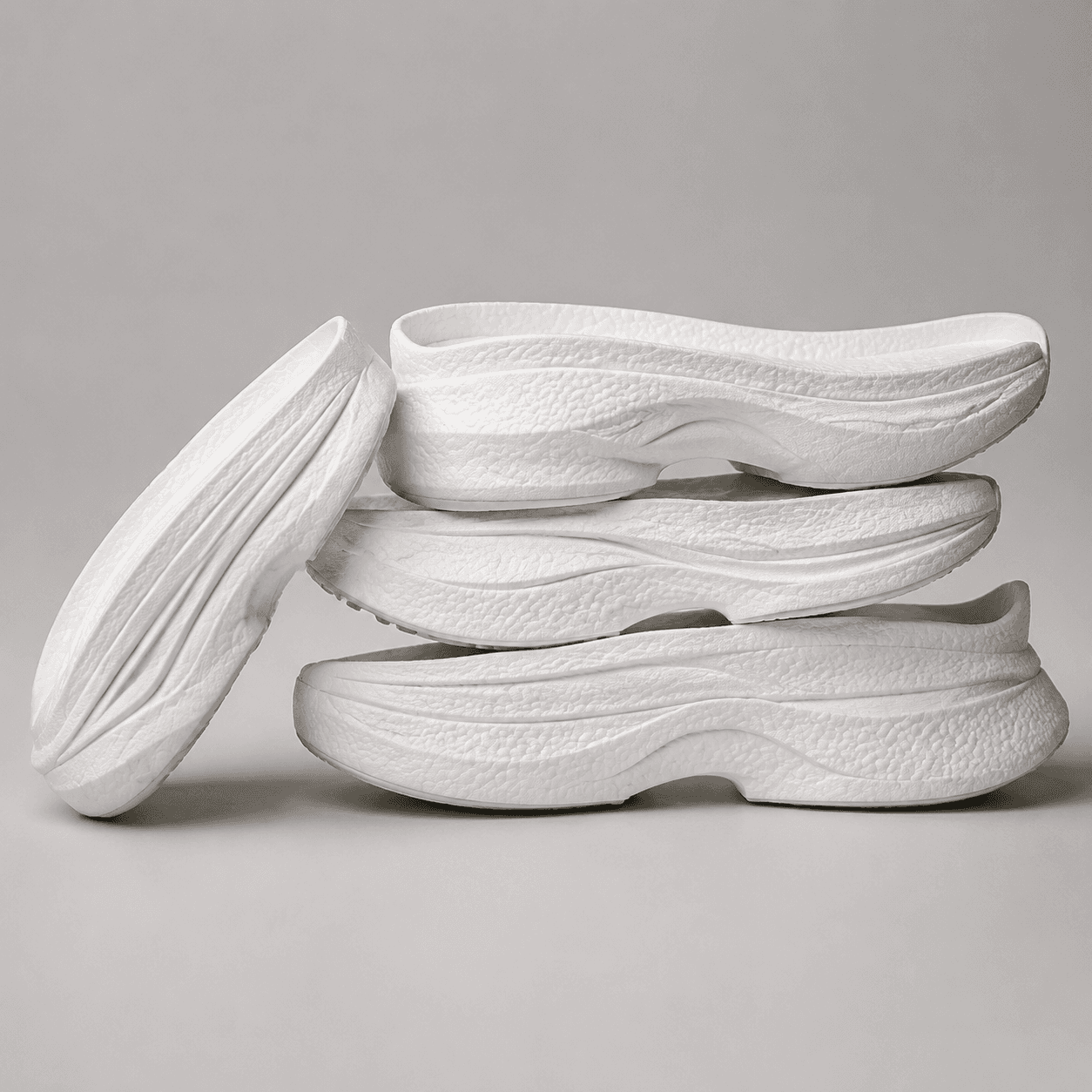
Choosing among shoe upper materials is a cost-control and risk-control decision before it is a styling decision. For bulk buyers, the upper changes FOB, material MOQ, fit consistency, defect rate, compliance testing and post-shipment claims. On a China factory floor, upper cost moves fast with yarn denier, GSM, lamination method, overlay map, stitch count, cutting yield and lasting difficulty.
The main commercial options in athletic and casual footwear are mesh upper shoes, knit footwear uppers and the synthetic shoe upper. All three can be engineered to a price, but they do not behave the same in wear, production stability or lab performance. A walking shoe, a school trainer and a running-inspired casual shoe may share one outsole mold, yet still need different upper constructions to avoid returns.
For sourcing managers, brand owners and importers buying footwear in bulk from China, sound footwear material selection means matching end use to factory reality. The right upper is the one that meets the wear target, test standard, delivery window and color split without pushing unnecessary cost into the BOM.
How shoe upper materials affect cost, performance and production
In cemented athletic and casual footwear, the upper package commonly accounts for 25% to 45% of FOB. In technical running, it can exceed that range. In school or value sport, it may sit lower, but it still drives a high share of labor minutes and complaint risk. Buyers often compare only the visible face material. The factory is costing the full package: shell, lining, foam, counter interface, toe puff interface, eyelet webbing, reinforcement films, stitching, print, binding and lasting allowance.
Upper performance is a system, not a swatch. Breathability depends on open area, backing, lining and foam blockage. Support depends on yarn structure, overlay placement, hot-melt film thickness, strobel stiffness and heel-counter interaction. Durability depends on abrasion, tear strength, seam slippage, bonding, hydrolysis stability and vamp flex over 30,000 to 100,000 cycles depending on category.
Material choice also changes your test plan. A low-cost mesh may pass color approval and still fail seam slippage under EN ISO 13936 or internal brand pull tests. A knit may feel good in the showroom and relax after heat setting and lasting, shifting fit by half a size. A PU synthetic may look clean in SMS and then crack after hydrolysis aging or Bally flex if the resin system is unstable.
What buyers should cost before approving the upper
Do not approve an upper based only on face-material price per meter. Ask for a package breakdown covering shell, lining, foam, overlays, hot-melt film, webbing, lace loop parts, print, binding and estimated waste. On mesh and synthetic cut-and-sew uppers, cutting loss is usually 8% to 18% depending on panel geometry. On knit, cut waste can be lower, but programming charge, yarn loss on color change and machine setup usually offset part of that saving.
As a commercial guide, a basic polyester mesh upper package with standard sandwich mesh, tricot lining and normal foam usually lands around $1.00 to $1.80 per pair. Engineered knit with stabilization films typically runs $1.80 to $3.50 per pair. Standard PU or microfiber-based synthetic packages usually fall between $1.20 and $2.40 per pair. Upper stitching and assembly labor commonly adds $0.60 to $1.80 per pair depending on seam count, welding steps and pattern complexity.
Lead time and MOQ realities in China supply chains
Standard mesh and standard synthetic move fastest because supplier depth is strong in Wenzhou, Jinjiang and Dongguan. Stock-supported mesh, tricot lining and basic PU can often be booked in 7 to 12 days. Custom dyed mesh, laminated constructions, embossed synthetic or branded transfer films usually need 15 to 25 days. Knit needs more planning. A standard knit structure may be ready in 15 to 25 days, while a custom engineered knit with RPET yarn, logo integration or zonal compression often needs 25 to 40 days before wear-test pairs are ready.
MOQ depends on material family and finish route. Common polyester mesh and standard PU synthetic are often 300 to 500 meters per color. Custom laminated mesh may require 800 to 1,000 meters. Knit suppliers often quote by pair quantity rather than meterage and may need 500 to 1,000 pairs per colorway for efficient setup. If the order has six or eight colors with low quantity per color, mesh or synthetic usually gives the safer sourcing path.
Mesh upper shoes: what they are, how they work, why they matter, when to use them
Mesh upper shoes use open or semi-open textile constructions, usually polyester and sometimes nylon, with or without backing to give shape, softness and sewability. In supplier terms, mesh is a family, not one item. It includes sandwich mesh, mono mesh, warp knit mesh, air mesh and engineered mesh. Each one changes airflow, body, printability, tear strength and bonding behavior.
Mesh works by creating ventilation through yarn spacing while keeping weight lower than most sheet synthetics. In commercial sport footwear, the mesh itself rarely carries all support. Shape usually comes from no-sew TPU film, stitched overlays, internal underlays, quarter reinforcements and tongue or collar foam package. In lower-price shoes, the lining and support pieces often do more structural work than the visible mesh.
Why it matters is simple: mesh gives the best breathability-to-cost ratio in many athletic and sport-casual shoes. It is widely available, easy to recolor and relatively easy to adjust in development. The downside is that poor-grade mesh can collapse after lasting, fray at the eyestay, show glue strike-through and fail at the toe bend or collar abrasion zone. A saving of $0.08 on the face material can become a claim problem after one season.
- Typical face-material GSM: 120 to 280 for open mesh; sandwich constructions often run 180 to 320 GSM equivalent
- Common upper package cost: about $1.00 to $1.80 per pair before outsole, sockliner and carton
- Common MOQ: 300 to 500 meters per color on standard polyester mesh; 800 meters or more on custom laminated mesh
- Typical lead time: 7 to 20 days depending on greige stock, dyeing queue and lamination
- Frequent tests: abrasion, seam slippage, tear strength, flexing, colorfastness to rubbing and perspiration
- Main risk points: toe burst, collar wear, glue strike-through, seam slippage, poor shape retention
Which mesh constructions are most practical for bulk programs
Sandwich mesh is still the easiest choice for volume programs. It uses two surfaces connected by spacer yarns, giving thickness and cushioning without many extra upper parts. It suits entry running, walking and value athleisure, especially when matched with 3 to 5 mm tongue foam and 5 to 8 mm collar foam at about 18 to 28 kg/m3 density. If the spacer structure is too dense, heat retention increases and the shoe loses one of mesh's main advantages.
Mono mesh is lighter and more breathable, but it has less body and usually needs support film or synthetic underlays in the quarter and eyestay. Warp knit mesh gives better dimensional stability and a cleaner face, which helps in sport-casual product with printed branding. For a cemented athletic shoe below roughly $8.00 FOB, polyester sandwich mesh with selective synthetic overlays is still one of the most stable constructions to industrialize at scale.
When mesh is the right choice
Use mesh when airflow, lower weight and commercial pricing are the first priorities. It works best in entry running, treadmill shoes, walking, warm-climate sport casual and kids athletic product where the brand wants an athletic look without knit-level setup cost. It is also the easiest upper direction for first-season launches because color changes and pattern adjustments are straightforward.
Do not rely on open, low-GSM mesh alone for rough school wear, hard lateral movement or outdoor abrasion. In those uses, return risk drops when you add a synthetic mudguard, stronger quarter reinforcement, toe print protection or a denser mesh construction.
Comparison of common upper directions for bulk footwear sourcing
| Upper type | Best use case | Typical material cost/pair | MOQ | Lead time | Main strength | Main risk |
|---|---|---|---|---|---|---|
| Mesh upper shoes | Entry running, walking, warm-weather sport casual | $1.00-$1.80 | 300-500 m/color | 7-20 days | Breathability and low weight at commercial cost | Abrasion, collapse and seam slippage on low-grade mesh |
| Knit footwear uppers | Athleisure, sock-fit casual, premium lightweight styles | $1.80-$3.50 | 500-1,000 pairs/colorway typical | 15-40 days | Comfort, premium look and zonal engineering | Stretch variation, fit inconsistency and longer development |
| Synthetic shoe upper | School, outdoor casual, structured sport and uniform programs | $1.20-$2.40 | 300-500 m/color | 10-25 days | Support, durability, easy cleaning and stable production | Heat retention and hydrolysis or cracking if resin quality is weak |
Knit footwear uppers: what they are, how they work, why they matter, when to use them
Knit footwear uppers are made from continuous yarn structures rather than cut woven or mesh panels. They may be flat knit, circular knit or engineered one-piece uppers with programmed zones for stretch, hold and ventilation. Most volume programs use polyester, RPET polyester or nylon, sometimes with spandex for recovery. Yarn denier and knitting gauge matter more than many buyers realize because they directly affect hand feel, stretch and visual coverage.
Knit works by building different functions into one upper. Dense zones hold the foot, open zones release heat, rib zones improve collar fit and reinforced zones support lacing. That can reduce seam count and improve step-in comfort. It also gives a cleaner, more premium look if the upper is stabilized correctly after knitting, heat setting and lasting.
Why it matters is that knit can increase perceived value and comfort, but it is less forgiving in production than mesh or synthetic. Stretch changes by yarn lot. Dye uptake can shift shade. Lasting tension changes throat opening and instep shape. Without enough film support, counter stiffness and eyestay reinforcement, a knit upper may look current in the sample room and lose fit in bulk.
- 01Confirm whether the supplier is using flat knit, circular knit or a true engineered one-piece knit.
- 02Freeze yarn content, denier, gauge and finish early; undocumented yarn substitution is a common source of bulk variation.
- 03Check elongation and recovery in both warp and weft directions or the knit equivalent machine directions.
- 04Review where internal hot-melt film, heel support and lace-zone reinforcement are needed.
- 05Wear-test fully lasted shoes after at least 24 hours rest because some knits relax after heat setting and assembly.
- 06Grade-check size extremes; knit fit drift usually shows first in small and large sizes.
Supplier-side cost and development issues in knit
Knit does not automatically save money. It may reduce cutting waste and some stitching, but machine programming, trial runs, yarn MOQ, heat setting and stabilization materials add cost. In simple volume styles, knit is often $0.40 to $1.20 per pair higher than a mesh-based upper package. If the buyer wants integrated logos, contrast structures, ventilation windows or multiple textures in one upper, development lead time and reject risk both increase.
Another common failure is underbuilding support. Knit needs stabilization at heel, eyestay and often toe spring transition. That can include 0.3 to 0.6 mm hot-melt film, fuse-backed nonwoven, internal synthetic support pieces or a stronger counter package. On men's sizes above EU 42, weak stabilization often causes throat spread and poor foot hold after repeated flex.
When knit is the right choice
Use knit when step-in comfort, premium visual and adaptive fit matter more than the lowest possible FOB. It suits athleisure, sock-fit constructions, travel casual, lifestyle sneakers and lightweight running-inspired shoes. It is also useful when the brand wants fewer internal seams touching the foot.
Do not choose knit just because it looks modern. For school, low-price walking or hard daily wear, reinforced mesh or synthetic is usually easier to control and often gives a lower claim rate. Knit also becomes inefficient when colorways are heavily fragmented below setup-friendly MOQ.
Synthetic shoe upper: what it is, how it works, why it matters, when to use it
A synthetic shoe upper usually means PU synthetic leather, microfiber, TPU-coated textile, PVC-free synthetic or another man-made sheet laminated to a fabric backing. In athletic and casual footwear, synthetics can be used as the full upper or as support overlays on mesh and knit. Typical thickness runs from 0.8 mm to 1.8 mm including backing, depending on category and price target.
Synthetic works by giving structure, scuff resistance and surface control. It can be embossed, perforated, screen printed, transfer printed or brushed to create matte, gloss or nubuck-like effects. Compared with open mesh, it gives stronger abrasion resistance and cleaner logo execution. Compared with knit, it gives more predictable grading, easier lasting and simpler mold-line control in production.
Why it matters is that synthetic remains one of the safest upper directions for repeat bulk orders. It is stable in cutting, stable in stitching and generally stable in fitting. The trade-off is lower natural breathability unless perforation, vent windows or moisture-managing lining are built in. The bigger material risk is resin quality. Poor-grade PU may crack, peel or hydrolyze in storage before the consumer even wears the shoe.
- Typical thickness: 0.8 to 1.8 mm including backing; school and uniform uppers often sit at 1.2 to 1.6 mm
- Common upper package cost: about $1.20 to $2.40 per pair for standard PU-based constructions
- Common MOQ: 300 to 500 meters per color; custom emboss, brushed finish or special topcoat may need 800 meters or more
- Typical lead time: 10 to 25 days depending on base, color, emboss and backing
- Frequent tests: hydrolysis, cold crack, flexing, coating adhesion, color migration and abrasion
- Main risk points: surface peeling, resin cracking, hydrolysis failure, delamination and low breathability
Microfiber versus standard PU synthetic
Microfiber usually gives better tensile strength, abrasion resistance and hand feel than standard PU synthetic. It costs more, but it often pays back in school, court-inspired, outdoor casual and uniform programs where cosmetic wear drives returns. Standard PU synthetic is still workable for fashion sneakers and value sport if the topcoat and backing are controlled.
For humid markets or long inventory cycles, hydrolysis resistance should be written into the material specification. Buyers commonly ask for hydrolysis testing to EN ISO 5423 or internal brand aging protocols, plus flex testing after aging. A low-grade PU may pass initial appearance review and then break down in a warehouse after months of heat and humidity.
When synthetic is the right choice
Use synthetic when structure, abrasion resistance, easy cleaning and visual consistency matter more than maximum airflow. It is often the safest option for school shoes, outdoor casual, court-inspired product, value training and repeat reorder programs. It is also practical when colorways are fragmented because the supplier base is broad and repeatability is good.
Avoid full synthetic uppers for warm-climate running unless ventilation is designed in from the beginning. Otherwise the shoe may test acceptable on weight but feel hot in actual wear.
Footwear material selection by end use, test standard and target FOB
Good footwear material selection starts with end use, not trend direction. First define wear frequency, surface, climate and expected life. Then define the cost ceiling. A discount-channel sport shoe does not need the same upper engineering as a true performance trainer, even if both sit on an EVA midsole with rubber pods.
Testing should be aligned before SMS or at latest before PP approval. For upper packages, buyers commonly require tensile and tear strength, seam slippage, Martindale or SATRA abrasion, Bally flexing, hydrolysis for PU-based materials, colorfastness to dry and wet rubbing, colorfastness to perspiration and upper-to-sole adhesion. Depending on market and brand protocol, you may also reference EN ISO methods, SATRA TM methods or ASTM-based internal protocols for flex, aging and physical performance. The important point is to freeze target values before bulk material booking.
Typical decision rules by category
For entry running and walking at roughly $9.00 to $12.00 FOB, mesh plus targeted synthetic support is usually the best balance of cost, airflow and line efficiency. For premium casual and athleisure, knit can justify itself if volume supports setup and if fit control is managed tightly. For school, outdoor casual and rough daily wear, synthetic or mesh-plus-synthetic usually outperforms open lightweight mesh on return rate.
In kids footwear, cosmetic durability matters almost as much as lab performance. A soft open mesh may pass internal material tests and still look damaged quickly at the toe and lateral quarter. In those cases, denser mesh, printed toe protection or synthetic mudguard coverage is usually the better commercial answer.
What to freeze before bulk production
Before placing the PO, freeze material code, yarn or resin content, GSM or thickness, backing type, overlay map, lining specification, foam density, color tolerance and required test level. Tongue and collar foam should also be locked. Common sporty upper foam densities are around 18 to 35 kg/m3 depending on softness and compression target. If these details are left open, substitution risk rises and fit can shift between sample and bulk.
Bulk approval should include at least one fully lasted and assembled wear-test pair built with production-intent materials. Swatches are not enough. Many upper failures only appear after heat setting, cement exposure, lasting pressure and flexing in a finished shoe.
Practical sourcing guidance for China bulk orders
The most efficient projects start with a clear buying brief: target use, target FOB, compliance level, quantity by color and requested ship window. With that information, a factory can recommend the right performance shoe materials and show where cost can be reduced without creating claim risk. Without it, development becomes trial-and-error and the final upper is often either overbuilt or underbuilt.
As a working range, sample development for standard mesh or synthetic styles commonly takes 10 to 20 days after material confirmation. Knit usually takes 15 to 30 days. Bulk production after PP approval and deposit is commonly 30 to 50 days for standard programs, longer in peak season or when the upper includes custom knit, reflective transfer, molded quarter parts or special hot-melt films. Orders below about 1,200 to 1,500 pairs per style-color usually do not get the best material pricing unless the factory can merge usage across several POs.
- 01Set end use, climate and expected wear level before asking the factory for upper options.
- 02Request two BOM directions: a commercial option and a lower-risk performance option.
- 03Approve upper materials by item code, GSM or thickness, backing and test target, not by visual name only.
- 04Check fit, vamp flex and collar hold on size extremes, especially on knit and low-GSM mesh.
- 05Reserve 5 to 10 buffer days for re-dye, color correction or replacement lots on custom materials.
- 06Avoid mixing too many upper technologies in a first order unless volume is high enough to absorb setup risk.
SoleForge manufactures athletic & running shoes and casual sneakers under OEM and ODM for brands and importers worldwide. Request a quote with your tech pack or reference pair and we'll reply within one business day.