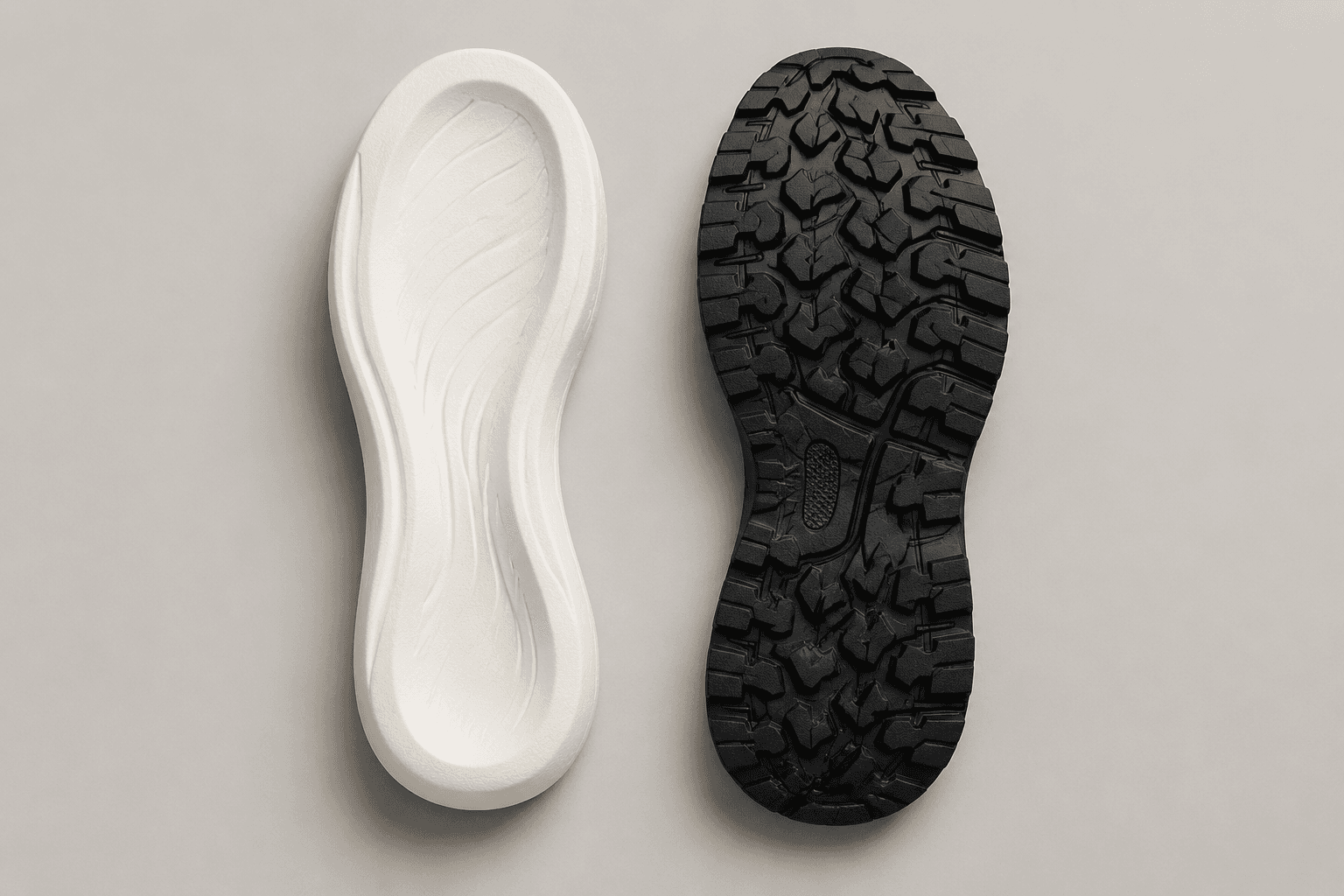
There is no single MOQ for footwear. A one-piece injected EVA slide, a vulcanized canvas shoe, and a cemented runner do not consume the same mold capacity, labor minutes, compound batches, or incoming materials. For China sourcing, shoe moq by type is the only practical way to forecast launch volume, FOB cost, and delivery risk.
From a factory standpoint, shoe moq is a cost-recovery threshold rather than a sales target. It must absorb outsole or footbed tooling, upper material booking, cutting loss, line changeover, carton minimums, and the reject risk that comes with short production runs. If a buyer stays on stock molds, standard boxes, one outsole color, and a balanced size ratio, the footwear minimum order can stay low. Add custom molds, split colors, branded hardware, or market-specific testing, and the floor moves up immediately.
For sourcing managers, importers, and brand owners, the goal is not the lowest MOQ printed on a quotation. The goal is the lowest volume that still gives stable bonding, consistent fit, compliant chemistry, and repeatable reorder pricing. The sections below break down shoe moq, low moq footwear options, and the cost blocks that drive the final number on a China factory offer.
In footwear sourcing, MOQ is not a sales slogan; it is the factory's method for spreading tooling, material minimums, labor loss, and compliance risk across each pair.
Why shoe MOQ changes by construction
Construction is the first filter because each category loads the factory differently. Injected EVA slippers use mold cavities, color masterbatch, cooling time, and shrinkage control. Vulcanized shoes add rubber prep, foxing application, and curing stability. Cemented sneakers require cutting, stitching, lasting, primer, adhesive activation, and sole pressing. Direct-injection PU safety shoes need mold scheduling and compound control. The same 500 pairs can be workable in one category and loss-making in another.
Component count is the second filter. A basic sandal may use outsole, strap material, buckle, sock, and carton. A sport shoe can easily run 18 to 28 components before packaging: mesh, lining, no-sew film, hot melt, eyelet stay, strobel board, heel counter, toe puff, insole board, sockliner, CMEVA midsole, rubber patches, lace, tongue label, transfer logo, back stay tape, woven label, and tissue stuffing. Every extra component introduces supplier minimums and defect risk, which pushes shoe moq upward.
Factories also separate development MOQ from repeat MOQ. First orders absorb pattern revision, wear-test adjustments, color confirmation, size grading verification, and short-lot purchases from mills or compound suppliers. Once fit, outsole, material spec, and shade standard are locked, repeat MOQ may drop by 20% to 35%, especially on sandals, cupsole casuals, and stock-bottom slides.
- Construction drives MOQ first: injected EVA, vulcanized, cemented, strobel, cupsole, direct-injection PU, or cold-cement sandal.
- Existing outsole molds usually cut MOQ and lead time; new molds, extra cavities, or custom logo inserts raise both.
- Upper material source matters: stock canvas, stock PU, and common sandwich mesh book lower than custom knit, embossed microfiber, or certified recycled content.
- Size spread affects line balance. A clean 36-40 or 41-45 range is easier than fragmented runs with edge sizes such as 35 or 46 only.
- Compliance scope changes factory exposure. EN ISO 20345, ASTM F2413, CPSIA, REACH, phthalate limits, and retailer RSLs all affect practical minimums.
- 01Confirm whether MOQ is quoted per style, per color, or per total order combination. In footwear, these are different costing models.
- 02Confirm the assumed size run. Some low MOQ offers only work with reduced sizes, broken assortments, or no size repeats at the edges.
Typical shoe moq by type
The right way to budget is by category, not by headline promise. Open injected footwear usually carries the lowest MOQ because the component count is low and line time is short. Vulcanized and cupsole casual shoes sit in the middle. Running, hiking, and safety constructions usually carry the highest MOQ because they combine more materials, more fit risk, and more testing exposure.
These ranges reflect export-oriented OEM or ODM production in China under normal commercial terms. A factory with idle capacity may accept lower volume in slow season, but buyers should not build a sourcing plan around exceptions. Use the following numbers as a working baseline for cost estimation and negotiation.
Injected EVA slides, slippers, and molded clogs
This is usually the easiest entry point for low moq footwear. With a stock mold, one-density construction, and standard color masterbatch, factories can often accept 300 to 600 pairs per color. If the buyer requires a new mold, custom texture grain, engraved logo cavity, marbled effect, or dual-density feel, MOQ normally rises to 1,000 to 1,500 pairs per color.
Material density drives cost directly. Light slides may run at 0.18 to 0.22 g/cm3 and 180 to 260 g/pair. Thicker comfort clogs or recovery sandals are more often 0.22 to 0.30 g/cm3 and 280 to 420 g/pair. Factories will also watch Shore C hardness, compression set, shrinkage consistency, and post-molding deformation because these affect reject rate on small runs.
PVC or TPR strap slippers and basic sandals
Basic slippers and simple sandals can often run at 500 to 1,200 pairs per style if outsole, strap material, and hardware are standard. The low end is realistic only when the factory uses stock strap colors, standard buckles, and common size runs. If the buyer wants a plated buckle, special TPR softness, gradient straps, or a unique footbed print, MOQ and unit cost both move up.
On these styles, the factory focuses on strap yield, outsole usage, buckle minimums, and assembly minutes. A plain PU strap at 0.9 to 1.1 mm with a standard foam backing is easy to source. A padded upper with 3 mm foam, edge binding, microfiber sock, and custom buckle plating adds separate supplier minimums that make short runs inefficient.
Canvas vulcanized shoes
Canvas vulcanized shoes generally run at 600 to 1,200 pairs per style, with 300 to 600 pairs per color as a practical floor when the outsole, foxing dimensions, and toe cap are already in the factory system. The upper may look simple, but the process is not. Rubber prep, upper positioning, sidewall cleanliness, and curing temperature all need stability or the factory will see toe spring variation, dirty foxing, or bonding failure.
Specification detail matters. Canvas is commonly 10 oz to 14 oz, while lining may be 130 to 180 GSM depending on price target and market. If the buyer adds washed uppers, sidewall printing, contrast foxing tape, or a custom toe-cap shape, the factory loses the advantage of shared materials and the shoe moq rises accordingly.
Casual cupsole sneakers
Cupsole sneakers in PU, microfiber, split leather, or action leather usually sit at 800 to 1,500 pairs per style. If the factory already has the cupsole mold and the buyer can stay on an existing last, MOQ remains manageable. A private sole shape, custom sidewall logo, sculpted heel insert, or exclusive bottom color usually creates a new tooling discussion.
The upper package is the biggest cost lever. Stock PU at 0.9 to 1.2 mm or microfiber at 1.2 to 1.6 mm can often be booked in smaller lots than custom grain or water-based laminated synthetic. Collar foam is commonly 6 to 10 mm, tongue foam 8 to 12 mm, and lining 120 to 180 GSM. Once the buyer pushes for premium hand feel, perforation programs, or multiple deboss details, sewing loss and inspection time both increase.
Running shoes and fashion sport shoes
This category typically starts at 1,200 to 3,000 pairs per style because component count is high and fit risk is real. A standard export running shoe may include sandwich mesh upper, no-sew overlays, hot-melt quarter support, strobel board, heel counter, toe puff, insole board, molded sockliner, CMEVA or phylon midsole, rubber traction patches, flat laces, and transfer logos. Many of these come from different upstream suppliers, each with a minimum booking quantity.
The sole package is where many buyers under-budget. A phylon or CMEVA midsole often runs around 0.20 to 0.25 g/cm3. Sockliner rebound targets may sit in the 35% to 45% range depending on category and price level. Rubber patches may require DIN abrasion performance or internal wear standards. If the shoe claims slip resistance, work use, trail use, or outdoor durability, the material package must be locked earlier, which usually raises the practical shoe moq.
Safety shoes and work footwear
Safety footwear carries some of the highest practical MOQ levels in export footwear. Even a plain-looking upper can include steel or composite toe cap, anti-puncture midsole, oil-resistant outsole, heat-resistant rubber, ESD package, and reflective components. Once the buyer requests alignment with EN ISO 20345 or ASTM F2413, the factory must control materials much more tightly than for casual footwear.
A repeat style on proven tooling can sometimes run at 800 to 1,200 pairs per style. A new style with fresh outsole molds, a new outsole compound, and compliance preparation will more often land at 1,500 to 3,000 pairs. The higher MOQ is not just about efficiency. It covers test preparation, traceability, component consistency, and the claim risk attached to occupational use.
Typical MOQ and cost drivers by footwear type
| Shoe type | Typical MOQ | Lead time | Typical FOB cost | Main cost drivers | Notes |
|---|---|---|---|---|---|
| Injected EVA slides / slippers / clogs | 300-1,500 prs per color | 25-35 days stock mold; 40-55 days new mold | US$2.80-8.50/pr | EVA density 0.18-0.30 g/cm3, pair weight, mold status, logo cavity, color batching | Most common low moq footwear category when stock molds are available |
| PVC / TPR slippers and simple sandals | 500-1,200 prs per style | 30-45 days | US$4.50-10.50/pr | Strap thickness 0.9-1.1 mm, buckle MOQ, outsole source, assembly time | Custom hardware or plated buckle usually raises MOQ and defect risk |
| Canvas vulcanized shoes | 600-1,200 prs per style | 35-50 days | US$5.50-12.50/pr | Canvas 10-14 oz, lining 130-180 GSM, rubber recipe, sidewall print, foxing details | Custom tape, washed upper, or new toe-cap geometry increases MOQ and lead time |
| Casual cupsole sneakers | 800-1,500 prs per style | 40-60 days | US$8.00-18.50/pr | Cupsole mold status, PU 0.9-1.2 mm or microfiber 1.2-1.6 mm, foam package, branding | Stock uppers and shared bottoms keep shoe moq lower |
| Running / fashion sport shoes | 1,200-3,000 prs per style | 50-75 days | US$11.00-30.00/pr | CMEVA or phylon density 0.20-0.25 g/cm3, rubber patches, overlays, molded sockliner, fit risk | High component count creates more short-lot exposure and testing cost |
| Safety / work shoes | 800-3,000 prs per style | 60-90 days | US$16.00-42.00/pr | Toe cap, puncture plate, oil-resistant outsole, EN ISO 20345 or ASTM F2413 alignment | Certification-sensitive categories need tighter material locking |
| Custom packaging add-on | No separate MOQ but affects total | Adds 3-10 days | US$0.25-1.20/pr add-on | Box board GSM, tissue, hangtag, barcode label, carton assortment | Short runs absorb packaging minimums poorly |
| Lab testing / compliance package | No direct MOQ but raises practical MOQ | Adds 5-15 days | US$300-2,000 per program | REACH, CPSIA, phthalate, adhesion, abrasion, slip, compression, impact | Higher compliance scope usually pushes footwear minimum order upward |
Cost drivers behind footwear minimum order
The visible MOQ is only the result. The real calculation sits in fixed setup cost, material lot size, labor efficiency, and quality exposure. These costs do not shrink in proportion when order size falls, so the factory either raises the FOB price or raises the minimum order to keep the job viable.
Tooling and development charges are the first pressure point. Outsole molds, footbed molds, logo plates, cutting dies, print screens, and embroidery programs cost nearly the same whether the bulk order is 300 pairs or 3,000 pairs. A small order simply carries more of that fixed cost per pair.
Material booking is the second pressure point. Suppliers sell PU, microfiber, mesh, foam, lining, and rubber compounds by standard lots, not by the exact cut quantity needed for a short run. If the order consumes only part of a lot, the factory must either hold dead stock or bury the loss in pair price. That is why a low shoe moq offer often comes with a noticeably higher FOB.
Labor is the third pressure point. Short runs reduce stitching efficiency, disrupt lasting balance, and slow packing throughput. The factory also loses quality rhythm because inspectors see fewer repeat operations before color or material changes. In practice, the supplier has two levers: accept a lower MOQ with a surcharge, or maintain a standard MOQ and protect the unit price.
- 01Separate fixed cost from variable cost during quotation review. Mold, setup, and lab fees can be negotiated differently from core material and labor.
- 02Freeze visible customization early. One fewer outsole color, one fewer logo process, or one standard carton can reduce both MOQ and lead time.
Tooling and mold economics
Existing outsoles cut both MOQ and lead time immediately. A new cupsole or athletic outsole mold often costs about US$2,000 to US$8,000 over the full size range, while a more complex dual-density or direct-injection mold can run higher. If the buyer pays tooling separately, the factory may support a lower first bulk order. If the factory must recover tooling through the pair price, it will usually ask for a larger volume commitment.
Shared molds help only if cavity condition, branding area, and reorder availability are confirmed in advance. A low first shoe moq has limited value if the mold cannot be reserved for the second PO or if the logo position does not fit the intended market presentation.
Material package and loss rate
Upper material consumption is affected by usable width, defect level, grain direction, and pattern nesting. Sandwich mesh, printed canvas, microfiber suede, and embossed PU all create different cutting losses. A straightforward upper may waste 8% to 12%. Placement graphics, mirrored grain, or heavy paneling can push loss to 15% to 25%, which matters a great deal on short runs.
Foam and lining specifications matter as well. Tongue and collar foam typically run from 4 mm to 12 mm, while textile lining often sits between 120 and 220 GSM depending on comfort target and category. Thicker foam improves hand feel, but it also raises sewing difficulty, compression inconsistency, and defect rate on small-volume production.
Testing and compliance
Compliance cost does not always appear as a formal MOQ, but it creates a practical one. REACH screening, CPSIA checks for children's footwear, phthalate testing, adhesion, abrasion, slip, hydrolysis review for PU, carton drop testing, and colorfastness all add fixed cost and extra calendar days. If the volume is too low, these charges make the project unattractive unless the FOB price increases.
For work and occupational categories, EN ISO 20345 and ASTM F2413 force tighter material locking. Toe cap source, puncture plate construction, outsole hardness, compression resistance, and impact performance cannot be changed casually after approval. That loss of flexibility is another reason certified categories tend to carry higher footwear minimum order levels.
How to negotiate lower MOQ without damaging quality
Low moq footwear is possible when the buyer removes variables instead of asking the factory to absorb every cost. The best MOQ negotiation is technical. A supplier can often support a smaller launch if the buyer accepts a stock outsole, one outsole color, standard carton, stock lining, and limited branding operations.
The most reliable method is staged commercialization. Use the first order to prove fit, sell-through, packaging execution, and return rate. Add the exclusive outsole, upgraded sockliner, or premium box only after the style has shown reorder potential.
- Use stock outsole molds or existing bottom units for the first bulk order.
- Keep launch colors to one or two commercial shades instead of spreading volume across many colorways.
- Choose stock upper materials with approved thickness, GSM, and color standards.
- Use standard box dimensions and avoid custom inserts, magnets, or heavy print coverage on the first run.
- Combine sister styles that share outsole, lining, strobel, eyelet, or hardware packages.
- Ask the factory to show the low-MOQ surcharge separately by setup, material, or packaging rather than hiding it in one inflated unit price.
Practical negotiation points to confirm
Ask whether MOQ can be combined across colorways that share the same outsole, lining, and packaging. In some factories, two upper colors can share one outsole production batch if the outsole color stays standard. Also ask whether men's and women's sizes can be combined if they belong to the same bottom tooling family.
If a supplier offers an unusually low MOQ, ask what has been simplified to make it work. The usual compromises are reduced size range, standard carton, simplified sockliner, stock shade variation, or no reserve for reorder materials. These are not always bad trade-offs, but they should be explicit before PI approval.
What buyers should lock before purchase order approval
A disciplined pre-production review improves both MOQ and reorder pricing because it reduces factory risk. When the tech pack is stable, the supplier can book materials accurately, reserve line time with less buffer, and quote repeat orders on a cleaner basis. That is the real factory meaning of shoe moq by type.
Before issuing the PO, buyers should lock the outsole status, last, size run, color count, packaging level, labeling requirement, and test plan. If any of these remain open, the MOQ shown on the quotation is only provisional. The smallest change in outsole color, box spec, foam package, or compliance scope can move both pair price and delivery date.
- 01Lock tech pack, outsole status, size range, color count, and packaging before asking for the final bulk MOQ.
- 02Match the test plan to the market claim before bulk material booking, especially for children's shoes, slip-resistant styles, and occupational footwear.
SoleForge manufactures leather & dress shoes and sandals & slippers under OEM and ODM for brands and importers worldwide. Request a quote with your tech pack or reference pair and we'll reply within one business day.