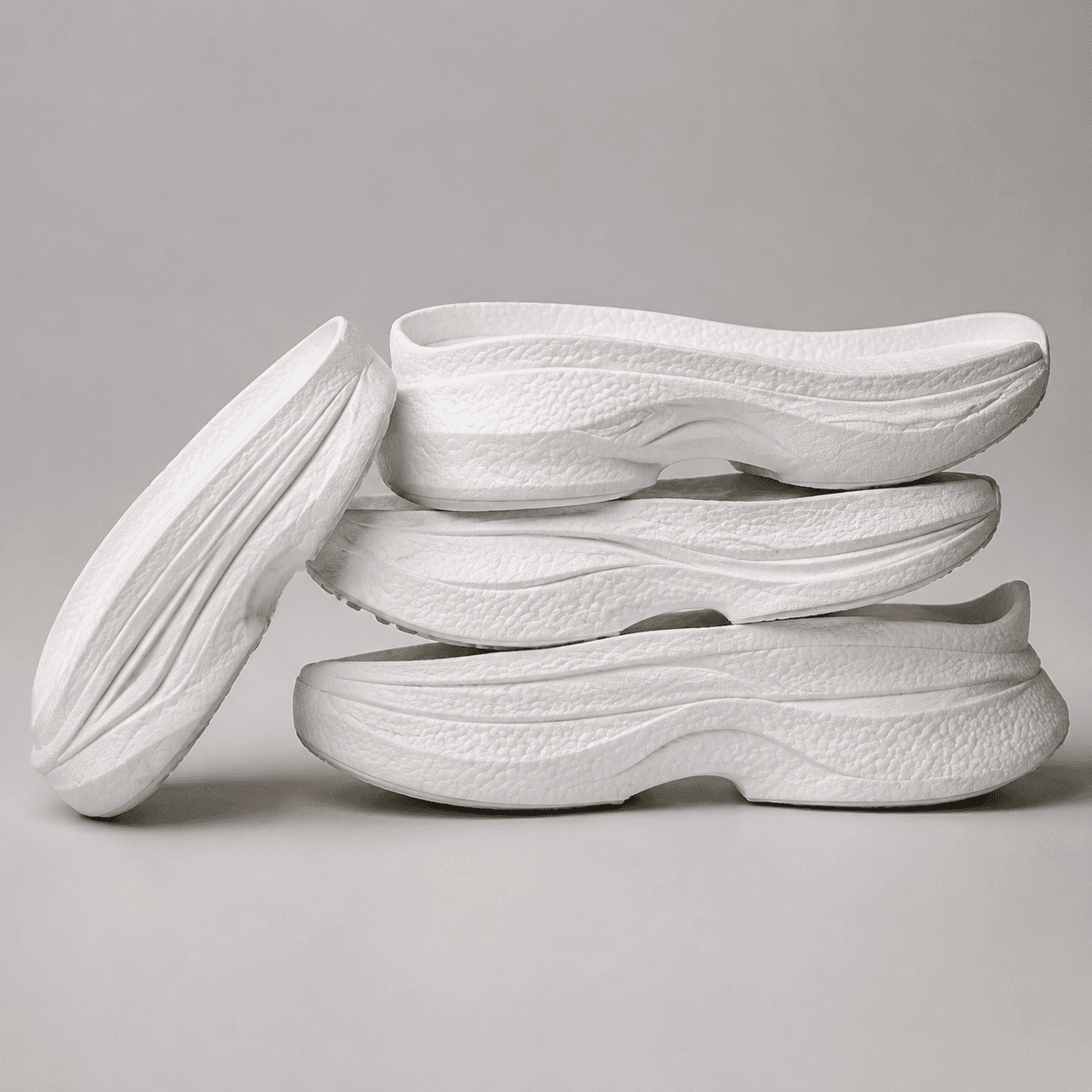
When footwear buyers compare outsole options, the real decision is not which material sounds better on a spec sheet. It is which bottom can hit target FOB, survive the intended wear cycle, pass the required tests, and run in bulk without avoidable rejects, rework or claims.
This practical guide covers outsole materials compared from a China factory perspective for sourcing managers, brand owners and importers. The focus is operational: how rubber, TPR, TPU and EVA behave in production, what MOQ and lead-time ranges are normal, what cost per pair to budget, and which EN ISO, ASTM or SATRA checks should be locked before bulk approval.
If you need a working shoe sole material guide, begin with end use, construction and target margin. A clean sales sample is not enough. In outsole sourcing, the claim risk usually comes later: abrasion loss at heel strike, bond failure after heat activation, hydrolysis in humid stock, shrinkage that throws off fit, or excess pair weight that quietly raises freight cost.
The best outsole is the one that meets wear target, FOB, lead time and production stability at the same time.
Set the outsole brief before asking for material options
Start with the wearing condition, not the tread drawing. A women’s fashion sneaker for indoor mall use, a men’s cold-weather casual, a kids’ school shoe and an injected beach clog can all carry similar-looking patterns while needing completely different bottom compounds. Buyers should define surface type, climate, expected daily wear, target retail band, allowed pair weight and intended shelf life before a factory recommends rubber, TPR, TPU or EVA.
Construction must be fixed early because it changes both material choice and production control. Cemented shoes can use molded rubber, TPR, TPU or EVA, but each needs a different roughing depth, primer system and activation window. Injected slippers and sandals usually favor EVA or TPR. Rubber cupsoles and foxing-style bottoms may suit vulcanized or cemented constructions. If the shoe uses a phylon or EVA midsole plus separate outsole pods, confirm whether the supplier is quoting outsole only, full bottom package, or bottom plus lasting board.
Budget should be set at outsole level before mold opening. For standard adult casual shoes bought in volume from China, common commercial ranges are about USD 0.70-1.30 per pair for direct-contact EVA, USD 1.00-1.85 for TPR, USD 1.60-3.20 for rubber, and USD 1.50-2.90 for TPU. These are ordinary FOB component ranges for black or standard colors. Clear TPU, anti-oil rubber, large-size cupsoles, dual-density bottoms or deep 3D logos can push cost higher by USD 0.20-0.80 per pair.
- Lock use case, climate and wear expectation before outsole quoting.
- Confirm construction method at tech-pack stage, not after sample review.
- Set target outsole cost in USD per pair before tooling approval.
- Define maximum acceptable pair weight in the largest size range.
Compare rubber, TPR, TPU and EVA by performance, cost and production risk
In rubber outsole vs TPR discussions, the main trade-off is still durability versus commercial efficiency. Rubber usually gives better abrasion control, stronger grip tuning and better heat stability in transport and storage. TPR usually gives lower cost, faster molding and cleaner fashion detailing at entry-to-mid price levels. The mistake is to treat all TPR as interchangeable. A low-cost TPR with too much extender oil or recycled content may pass visual inspection and still fail in wear, especially at heel corners and forepart flex points.
Rubber is still the safest choice for outdoor casuals, skate-inspired soles, uniform footwear, work-leaning city shoes and any program where wear life matters more than grams. Typical hardness is around Shore A 58-72. Specific gravity often falls around 1.05-1.25 g/cm3 depending on carbon black, silica, calcium loading and recipe. DIN abrasion targets vary by brand, but buyers often look for tighter loss values than they would accept on TPR or EVA. Practical MOQ after mold completion is commonly 1,200-3,000 pairs per color, with black easier than light colors. Bulk lead time for outsole production is usually 25-35 days after sample confirmation, longer in peak season.
TPR is widely used for women’s fashion, kids’ casual, men’s city casual and cost-sensitive molded bottoms. Typical hardness runs around Shore A 60-85, with density often near 0.90-1.10 g/cm3. It molds small logos and edge details well and can imitate rubber visually, especially in matte black, gum and dark brown. But the weak point is formulation drift. If the factory buys spot-market TPR pellets instead of a stable grade, buyers may see tackiness after container heat, edge whitening, inconsistent gloss, or wear that is too fast for concrete pavement. As a buying rule, never approve TPR on look and hand feel alone.
TPU outsole footwear is suitable when the product needs crisp tread geometry, a technical look, high flex resistance and better edge definition than TPR. Depending on design, hardness may run from high Shore A into Shore D grades. TPU can be excellent for sporty casual bottoms, transparent windows, logo carriers and wear zones that need cleaner definition. The buyer must confirm whether the grade is polyester-based or polyether-based. In humid storage, tropical markets or long warehouse dwell time, this matters because hydrolysis resistance differs. TPU outsole MOQs are often 1,000-2,500 pairs per color, but clear and translucent colors can require higher minimums because of purge loss and color-control difficulty.
EVA outsole shoes are chosen mainly for low weight, cushioning and favorable bottom cost. In sourcing, density is the first technical checkpoint. Commercial EVA foam for direct-ground-contact outsoles commonly runs about 0.22-0.45 g/cm3 depending on wear target. Very light EVA in the 0.18-0.25 g/cm3 range may feel attractive in a showroom but can lose shape, show high compression set and abrade too quickly on city pavement. EVA is appropriate for slippers, beach sandals, recovery clogs, hotel shoes and some athleisure bottoms, especially when paired with rubber pods in high-wear zones.
When rubber is worth the extra cost
Choose rubber when the channel expects a full season of wear, repeat pavement contact, better wet-dry traction or lower claim exposure on heel wear. On these programs, a heavier bottom is usually cheaper than a return. Rubber also gives the compound engineer more room to tune grip, hardness and abrasion together, though cure time and pair weight increase.
When EVA is commercially correct
Choose EVA when weight, comfort and carton efficiency are the leading priorities and the channel accepts moderate abrasion life. It is often the right answer for sandals, injected slippers and comfort-first casuals. It becomes the wrong answer when buyers try to force very low-density EVA into hard street use without pods, enough tread depth or a realistic wear-life expectation.
Audit supplier capability, tooling plan and commercial minimums
Many sourcing delays start because the buyer assumes the upper factory controls the outsole process directly. Often it does not. Some factories mold EVA or TPR in-house but subcontract rubber, TPU or transparent parts to specialist bottom suppliers in Wenzhou, Jinjiang or Guangdong. That changes who controls compound mixing, mold maintenance, color batching, size grading and corrective action if test results fail. Before approving the counter sample, identify the actual sole maker and whether the quote is from the shoe factory or the bottom factory.
Lead time must be split clearly. Simple EVA and TPR molds often take 10-15 days to open. Standard rubber and TPU molds usually need 14-21 days. Transparent TPU, insert molds, steel shanks, dual-density sets or complex cupsole sidewalls often need 21-30 days. After mold completion, first mold trial and outsole counter sample usually require another 5-7 days. If lab testing and revision are included, add 5-10 days. Once the outsole is signed off, normal bulk production is often 25-40 days depending on line loading and whether compound mixing is done daily or by batch lot.
MOQ should be confirmed by material, color and mold status. A shoe factory may accept a total order of 800 pairs, but the outsole supplier may still need 1,500-3,000 pairs per color for stable compounding and molding efficiency. Black rubber and black TPR are the easiest to run. Off-white, beige, gum and transparent colors are less forgiving. For small runs, ask whether the factory can use stock compounds, carry-over molds, common outsole blanks or mixed-size trial lots to avoid high development cost and dead stock.
- Identify the actual outsole factory before final sample approval.
- Break lead time into mold, trial, testing revision and bulk days.
- Confirm MOQ by color, compound and transparency requirement.
- Put mold ownership, storage fee and maintenance responsibility in writing.
Write a measurable outsole specification that production can actually follow
A reliable outsole spec must convert design language into numbers. Terms such as “soft touch,” “good grip,” “premium quality” or “light but durable” are not production standards. Before upper-bottom confirmation, define hardness, density or specific gravity, abrasion limit, flex target, slip requirement, bond strength, color tolerance, outsole weight and visual acceptance points. If the outsole includes flocking, fabric lamination or strobel-attached foam parts, add backing GSM, adhesive type and peel requirement as separate items.
For rubber, buyers usually specify Shore A hardness, specific gravity, DIN or ISO abrasion limit, and whether anti-slip performance is needed on ceramic tile, glycerol-contaminated tile or steel. For TPR, add heat-aging or hot-box review because lower-grade compounds can warp, soften or become tacky after container exposure at 50-60 degrees C. For TPU, confirm resin family, transparency standard, yellowing tolerance and hydrolysis requirement. For EVA, specify density, hardness test method, compression set and abrasion limit if the foam contacts the ground directly.
Testing should match the product category. Common checks include ASTM D2240 for hardness, ASTM D792 for specific gravity, ASTM D395 for compression set, ISO 4649 for abrasion and SATRA TM161 or equivalent for flexing. Slip testing may align to EN ISO 13287 where category and market require it. If the style is occupational or protective, the buyer should confirm whether the finished footwear must comply with a wider EN ISO requirement set rather than outsole-only physical tests. For insole boards, strobel materials or laminated bottom fabrics, backing weight may also need to be fixed, often in GSM, so the full bottom package remains stable through lasting and wear.
Bonding must be checked on complete shoes, not only on loose outsole test plaques. Rubber, TPR and TPU respond differently to roughing depth, halogenation, primer selection, cement solids and heat activation time. In many claim cases, outsole wear is blamed first, but the real failure is weak upper-bottom adhesion caused by process drift. Require peel or bond checks from pilot-run shoes made under bulk settings, including the actual activation temperature and line speed.
- 01Set numeric targets for hardness, density, abrasion and outsole weight.
- 02Choose EN ISO, ASTM or SATRA methods based on product risk.
- 03Approve production-intent compound, not hand-built prototype material.
- 04Run bond and flex checks on pilot shoes made on bulk settings.
Calculate total landed risk, not just outsole price per pair
The outsole invoice alone does not show the true cost of the bottom decision. Material choice affects pair weight, export carton efficiency, labor handling, bonding yield and claim exposure. A heavy rubber cupsole can add roughly 120-220 grams per pair versus a light EVA-based package, depending on size range and wall thickness. On large men’s sizes, that can reduce pairs per carton or push gross weight high enough to affect sea-freight planning and warehouse handling cost.
EVA usually wins on grams and comfort, but it becomes expensive if the market expects urban wear life that the foam cannot deliver. Saving USD 0.30-0.45 per pair on outsole material is irrelevant if the channel later produces a 1-2 percent claim rate for heel wear, collapse or delamination. TPR is often the middle path for commercial fashion programs: lighter and cheaper than rubber, more substantial-looking than EVA, and usually faster to mold. It only works well if the factory protects the compound spec and does not thin the outsole too aggressively to chase weight.
TPU can justify a higher bottom cost when the outsole itself carries visible design value. In sport-casual and premium fashion programs, transparent windows, sharp sidewall details and stable edge definition often support a higher retail price and lower appearance-related claims. In those cases, the better question is not whether TPU costs more than TPR. The better question is whether the extra USD 0.25-0.70 per pair supports sell-through, fewer rejects and a cleaner product position.
- Check pair weight in the largest size, not just sample size 37 or 42.
- Review freight impact of heavy rubber before final outsole approval.
- Compare outsole savings with likely channel return rate.
- Inspect heel strike and forepart wear zones before tread sign-off.
Control bulk production with a bottom-specific inspection plan
Once the material is selected, the buying work shifts to process discipline. The most common outsole defects in bulk are left-right color mismatch, hardness drift between lots, flash, short-shot molding, weak logo definition, EVA density variation, TPU gate marks, TPR gloss inconsistency and unstable bonding. These are routine factory-floor issues, not rare exceptions. They must be checked from mold trial through final inspection.
Ask the supplier to keep a sealed confirmation sample made from the approved production compound lot. Use it as the outsole master for all later checks. During production, compare output for color, shore reading, weight and visual finish against that master. For EVA, monitor density and shrinkage because measurement can look correct while foam feel and compression performance have already shifted. For TPU and TPR, watch for sink marks, transparency variation, gate blemish and edge collapse on thin walls.
Inspection should be staged. For first orders, review mold trial, pre-production sample, pilot run and final random inspection instead of relying only on end-of-line AQL. A practical control point is to cut 2-3 pairs per color from pilot run for bond, flex and abrasion confirmation before the line goes to full output. That cost is small compared with reworking packed cartons or sorting mixed-lot outsole defects after shipment booking.
Short bulk inspection checklist
For new outsole programs, use a bottom-focused checklist in addition to the normal footwear visual checklist. That is the fastest way to catch the production faults that most often slip past showroom approval.
Key takeaways
- Start outsole selection with use case, construction, target FOB and maximum pair weight.
- Rubber is usually the safest bulk-buy option where abrasion life, grip and lower claim risk matter most.
- TPR is cost-effective and flexible, but only if compound quality is controlled lot to lot.
- TPU outsole footwear suits premium casual and sport-casual programs needing sharper detail and stronger flex durability.
- EVA outsole shoes deliver low weight and comfort, but density and compression-set control are critical for market performance.
- For China sourcing, lock MOQ, lead time, test method, density, bond requirement and mold ownership before bulk confirmation.
SoleForge manufactures athletic & running shoes and casual sneakers under OEM and ODM for brands and importers worldwide. Request a quote with your tech pack or reference pair and we'll reply within one business day.