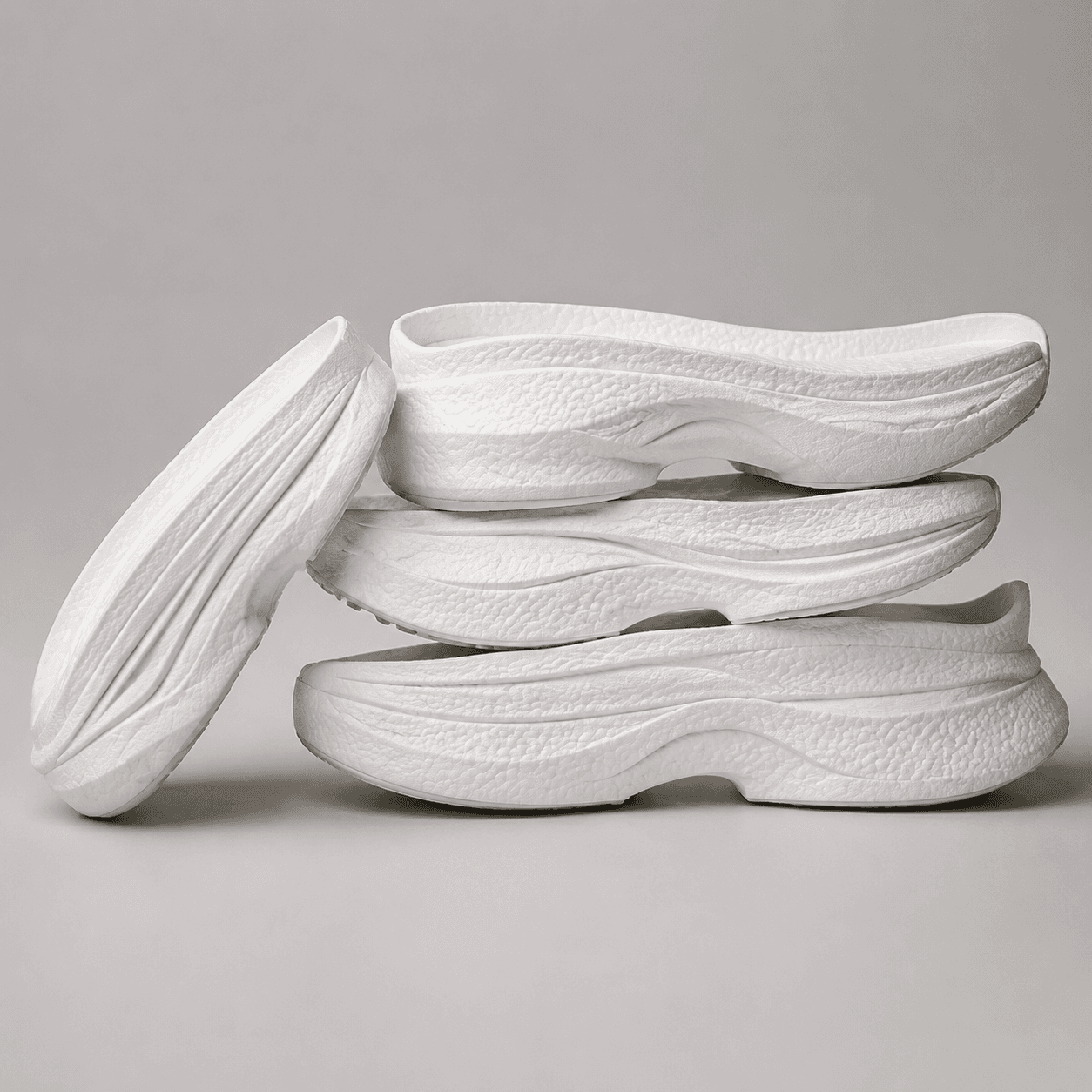
For China bulk footwear orders, PU vs TPU vs rubber outsole is a costing and risk decision, not a catalogue preference. The correct choice depends on shoe category, outsole weight, bonding route, test standard, and the claim rate the importer can tolerate after delivery. A 220 g injected PU nurse shoe, a 380 g molded rubber school shoe, and a TPU-framed athleisure shoe may all look acceptable in a sample room, but they behave differently after 60 days on concrete.
On the supplier side, weak outsole specifications create most delays. Buyers often write 'rubber sole', 'TPU bottom', or 'PU outsole' without density, Shore hardness, abrasion target, slip condition, or outsole grams per pair. Then three factories quote three different constructions. The cheapest price may simply mean more filler, thinner tread, fewer rubber contact zones, or no allowance for EN ISO or ASTM testing.
This specification and cost breakdown is written for sourcing managers, brand owners, and importers buying in bulk from China. It compares shoe outsole materials by production route, MOQ, tooling time, unit cost, and test risk so that quotations for PU, TPU, and rubber can be compared on the same basis.
The correct outsole is the bottom package that meets the wear map, test method, MOQ, lead time, and FOB target without hiding risk in the compound.
What to fix before asking a factory to quote outsoles
A footwear factory cannot quote an outsole correctly from material name alone. The starting point is the end use: school, service, kitchen, casual comfort, outdoor, safety, vulcanized sneaker, sandal, or athleisure. Each category has a different failure pattern. School shoes fail at abrasion and toe drag. Kitchen shoes fail on wet or oily slip. Light casual shoes fail when a soft outsole is used on abrasive pavement. Safety shoes must pass the full footwear standard, not only an internal wear test.
The second input is construction. A direct-injected PU bottom is priced differently from a cemented rubber outsole, even when the finished shoe has the same retail positioning. Injection removes separate outsole roughing, cementing, drying, pressing, and some trimming operations. Molded rubber adds compounding, preforming, curing, de-flashing, washing, primer, cement, and press time. TPU may require polished mold surfaces, tighter color control, and scrap allowance for flow marks on transparent parts.
The third input is outsole mass. On our floor, we do not compare only resin price per kilogram. We check outsole net weight by sample size and extrapolate across the size run. A 40 g increase per pair can change FOB more than a small resin price movement. For adult export shoes, a bottom package can run from below 180 g/pair on light PU casuals to more than 500 g/pair on deep-lug rubber outdoor styles.
- 01Send one bottom tech pack to all suppliers, including last reference, size run, outsole drawing, tread depth, color, target weight, and construction route.
- 02Define measurable values: density, Shore A hardness, abrasion limit, slip condition, flex cycles, low-temperature requirement, and any oil or heat resistance.
- 03Separate tooling charge, outsole component cost, bottom assembly labor, and final FOB in the quotation so material comparisons are not hidden.
- 04Ask for bulk-material confirmation, not only hand-made sample approval. Lab samples and production compound often differ if the spec is loose.
PU outsole: light, efficient, and sensitive to use conditions
PU is common in comfort casuals, clogs, nurse footwear, sandals, uniform shoes, and some dual-density safety constructions. For foamed footwear PU, practical density usually sits around 0.45 to 0.75 g/cm3. Compact PU layers can be higher. Typical outsole hardness is Shore A 55 to 75. A softer PU bottom improves step comfort but loses edge wear faster; a harder formula improves contact durability but can feel dead if the midsole geometry is poor.
The main commercial advantage of PU sole footwear is production efficiency. In direct injection, the upper is lasted and the PU is injected around it, forming the bottom and bond in one process. This reduces cement-room variation, especially on repeat uniform programs where the upper pattern is stable. For medium-volume orders, direct injection can save labor and improve consistency compared with a cemented construction using separate soles.
PU is not the best answer for every low-cost shoe. The weak points are abrasion under rough daily use and hydrolysis in hot, humid storage if the chemistry is poor. We see this most often when buyers use comfort PU for markets where consumers walk long distances on concrete or leave shoes in warehouses without climate control. PU should be specified with density, hardness, and aging requirements, not accepted as a generic light sole.
Typical PU sourcing ranges
For adult casual injected styles, bottom weight is commonly 180 to 320 g/pair for EU 36-45 or US equivalent size runs. Wedge clogs and platform casuals can exceed this. MOQ for direct-injected PU is usually 800 to 1,500 pairs per colorway. A factory may accept 600 pairs for a repeat mold and black color, but new tooling and split size runs normally push MOQ above 1,000 pairs.
New PU bottom molds usually need 12 to 18 days for first trial. Allow another 5 to 10 days if shrinkage, flash, or upper-seat fitting needs correction. Bulk lead time after size set, color chip, and wear-sample approval is normally 25 to 40 days. As a cost driver, basic mono-PU outsole or full injected bottom contribution often sits at $1.10 to $2.40/pair. Dual-density PU, anti-static inserts, shank systems, or decorative molded parts can move it to $1.80 to $3.20/pair.
Where PU works and where it needs help
PU works best where light weight and cushioning are more important than aggressive outsole life: hospital clogs, comfort slip-ons, service footwear, and casual shoes with moderate walking conditions. For harsher surfaces, a PU midsole with rubber forepart and heel patches is often a better specification. The importer keeps weight down while protecting the two highest-wear zones.
For humid-market programs, ask for hydrolysis or accelerated aging data and confirm storage assumptions. Also check strobel and insole materials in the bottom package. A common adult strobel cloth may be 120 to 180 GSM polyester, while heavier insole-board laminations can be 250 to 450 GSM. These are not outsole materials, but they affect lasting stability, injection seating, and bond consistency.
PU vs TPU vs rubber outsole: spec and cost breakdown for China bulk footwear
| Cost or spec driver | PU outsole typical range | TPU outsole typical range | Rubber outsole typical range | Supplier-side notes |
|---|---|---|---|---|
| Density | 0.45-0.75 g/cm3 foamed PU; compact skin higher | 1.10-1.25 g/cm3 | 1.05-1.30 g/cm3 | Density controls weight, cushioning, and material consumption |
| Hardness | Shore A 55-75 | Shore A 70-90 | Shore A 55-80 | Write tolerance into tech pack, usually plus or minus 3-5 Shore A |
| Typical adult outsole or bottom weight | 180-320 g/pair | 220-380 g/pair | 260-450 g/pair; deep lugs can be higher | Quote by base size and size run, not by one showroom sample |
| Component cost contribution | $1.10-$3.20/pair | $1.60-$4.00+/pair; clips $0.25-$0.80/pair | $1.40-$5.50/pair | Ranges exclude unusually complex uppers, special certification, and premium branded compounds |
| MOQ per colorway | 800-1,500 pairs | 1,000-1,500 pairs | 1,200-2,000 pairs | Repeat black soles may be lower; new molds and split sizes raise MOQ |
| New mold lead time | 12-18 days plus correction if needed | 14-20 days plus polish or vent correction | 12-25 days depending on lug and cupsole complexity | Add 3-10 days after first trial for correction and re-sampling |
| Bulk production lead time | 25-40 days | 30-45 days | 35-50 days | Count after approved size set, color, compound, and test requirement |
| Best fit | Comfort casual, clogs, nurse, uniform, light occupational | Athleisure, fashion sneaker, stabilizer frame, transparent detail | School, outdoor, vulcanized, kitchen, service, safety | Choose by category failure risk, not by material fashion |
| Main test focus | Hydrolysis, abrasion, bond, flex | Abrasion, flex, bond, color stability | Abrasion, slip, flex, oil or heat where required | Tie tests to EN ISO, ASTM, or buyer internal method before tooling |
| Main sourcing risk | Wrong density, hydrolysis, soft wear layer | Overweight design, high visible rejects, bonding mistakes | Filler-heavy compound, cure inconsistency, slip failure | Use bulk-compound PP samples and sealed golden samples |
TPU outsole benefits: definition, abrasion, and design control
TPU is chosen when the brand wants sharper molded lines, better dimensional stability, and stronger abrasion than standard foamed PU. It is common in athleisure, casual sneakers, heel clips, shanks, side frames, translucent outsoles, and fashion bottoms where the material is part of the design language. A TPU logo, rib, or perimeter cage keeps detail better than many lower-cost rubber compounds.
Typical footwear TPU density is about 1.10 to 1.25 g/cm3. Hardness often runs Shore A 70 to 90, though softer grades are available. Because TPU is denser than foamed PU, the pattern engineer must remove unnecessary wall thickness. A full TPU outsole with heavy side wrap can make a shoe feel bottom-heavy. A partial TPU stabilizer or contact layer can deliver the visual and structural benefit without adding 100 g/pair.
From a factory view, TPU outsole benefits include repeatable dimensions, clean surface finish, good flex behavior, and strong edge definition. It is also useful in combined constructions: TPU heel counter frames on EVA or phylon midsoles, TPU torsion pieces under sneakers, or clear TPU windows bonded to rubber pods. The cost is higher, but the control is better when tooling and color approval are handled properly.
- Good abrasion resistance for lifestyle and sports-inspired footwear
- Clean mold definition for logos, ribs, stabilizer frames, and transparent effects
- Stable dimensions, useful for parts that must align with phylon, EVA, or rubber pods
- Higher visible reject risk on clear, milky, white, and high-gloss TPU
- Usually not the best value for entry-price basic casual shoes
Typical TPU commercial ranges
For full TPU outsoles, MOQ is commonly 1,000 to 1,500 pairs per color. Transparent, translucent, glitter, or dual-color TPU may need higher practical MOQ because purge waste and color matching are more difficult. Tooling lead time is usually 14 to 20 days, with 3 to 7 extra days if venting, gate position, or polishing must be corrected after first shots.
Bulk production lead time is usually 30 to 45 days after approved color plaques, size set, and bond test. Standard TPU outsole cost contribution is often $1.60 to $3.50/pair. Complicated wrap-up bottoms, thick transparent walls, or multi-part assemblies can exceed $4.00/pair. Small TPU clips, shanks, or heel stabilizers are more economical, often $0.25 to $0.80/pair depending on size and finish.
TPU sourcing watchpoints
TPU is often over-specified because it looks technical in the showroom. If the retail price cannot support it, rubber patches on phylon or a simpler molded rubber outsole may achieve the same consumer result at lower FOB. TPU also needs careful bonding control. Surface treatment, primer selection, and open time must be confirmed on the actual midsole or upper material, not only on loose lab strips.
For heavy-duty workwear, kitchen slip resistance, or heat contact, TPU is not the default answer. Nitrile rubber or purpose-built rubber compounds usually carry less test risk under occupational requirements such as EN ISO 20345 or ASTM F2413 when the entire shoe construction is being certified.
Rubber outsole sourcing: durable, accepted, but easy to under-specify
Rubber is the widest outsole family in export footwear. It includes natural rubber blends, SBR, carbon-black compounds, gum rubber, vulcanized cupsoles, sheet rubber, molded rubber pods, and nitrile rubber for work or safety shoes. These should not be treated as one material. The filler level, cure time, polymer blend, and tread depth change wear, slip, flex, smell, color migration, and cost.
The reason importers still rely on rubber outsole sourcing is simple: rubber is trusted for traction and daily wear. It remains the safe choice for school shoes, outdoor footwear, vulcanized sneakers, chef shoes, service shoes, and many safety programs. Typical rubber density runs around 1.05 to 1.30 g/cm3, with Shore A 55 to 80 common in footwear. Deep outdoor lugs and oil-resistant compounds require more specific targets.
The sourcing risk is quality spread. Two suppliers may both quote 'rubber outsole' while one uses a balanced compound and the other increases calcium carbonate or recycled content to hit a lower price. The second outsole can look fine in black, especially in photos, but fail abrasion, flex cracking, or slip. Rubber should be approved by compound data, physical testing, and a sealed golden sample, not by wording.
Typical rubber cost and lead time
Molded rubber outsoles usually need 1,200 to 2,000 pairs per colorway for export orders. Deep-lug outdoor bottoms, oversized cupsoles, and multi-color rubber bottoms often require higher MOQ because cavity efficiency is lower and trimming is slower. Mold lead time is normally 12 to 18 days for simple flat bottoms and 18 to 25 days for technical lugs or cupsoles with sidewall texture.
Bulk lead time is usually 35 to 50 days after compound and size set approval. Rubber requires mixing, aging, preforming, molding or vulcanizing, trimming, washing, surface treatment, and bonding. Standard casual or school rubber outsoles often contribute $1.40 to $3.20/pair. Outdoor rubber, high-grip service compounds, or nitrile safety outsoles commonly run $2.50 to $5.50/pair before any EVA, phylon, or PU midsole is added.
Rubber specifications to write into the tech pack
State whether the outsole is full molded rubber, sheet rubber cut and pressed, vulcanized cupsole, rubber patch on phylon, or rubber contact pods on EVA. Then define Shore A hardness tolerance, target outsole grams, tread depth, color, abrasion method, slip condition, flex cycles, and any oil, fuel, heat, or low-temperature requirement. For chef and service footwear, 'anti-slip' is not enough. Wet ceramic tile, soapy water, oil-contaminated tile, and steel plate are different test surfaces.
For safety or occupational footwear, coordinate outsole selection with the certification plan. EN ISO 20345 and ASTM F2413 are full-shoe requirements, and the sole must work with toe cap, puncture plate, upper, lining, and construction method. If outsole slip is to be assessed under EN ISO 13287 conditions, confirm the exact surface and contaminant early, because changing compound after tooling wastes time.
Cost breakdown: where outsole price really moves
In an outsole material comparison, the label PU, TPU, or rubber is only the first layer. Unit cost changes with grams per pair, mold cavities, scrap rate, color complexity, bonding process, tread depth, surface finishing, testing allowance, and order quantity. A thin TPU stabilizer may cost less than a heavy dual-density PU bottom. A simple rubber patch outsole may cost less than a technical rubber cupsole with foxing, sidewall texture, and logo paint.
Buyers should insist on separate bottom-package costing. For a cemented sneaker, the bottom may include EVA or phylon midsole, rubber pods, TPU clip, primer, glue, press labor, and trimming. For direct-injected PU, the material and injection process are combined. If all of this is hidden inside one FOB figure, sourcing teams cannot tell whether a lower quote comes from genuine efficiency or from weaker outsole compound.
- 01Check net outsole weight by size, not only resin price. Ask for grams per pair in base size and grading estimate across the full size run.
- 02Check tooling plan and cavities. Poor cavity planning increases cycle cost and can create size shortages during bulk production.
- 03Check bonding requirements. Rubber, TPU, EVA, PU, leather, and coated textiles need different primers, roughing, drying times, and press settings.
- 04Check cosmetic operations. Painting sidewalls, polishing TPU, adding speckles, or cleaning white rubber can add more labor than the buyer expects.
Testing and approval standards to lock before mold opening
Testing must be agreed before tooling, not after sales samples. For abrasion, many buyers use DIN-based methods or internal standards aligned with SATRA-type testing. For slip, importers may require EN ISO 13287 conditions or their own retail protocol. For safety footwear, EN ISO 20345 or ASTM F2413-related compliance must be planned with the whole shoe, not treated as an outsole-only certificate.
A practical outsole specification should include Shore A hardness tolerance, usually plus or minus 3 to 5; density target for PU and weight-controlled programs; DIN abrasion or equivalent limit; flex cycle target; low-temperature crack requirement if the shoe is sold in cold markets; and chemical resistance if sold as occupational footwear. For PU, ask for hydrolysis or aging data. For rubber, ask for compound and abrasion confirmation. For TPU, ask for flex, color stability, and bond results.
Visual standards need the same discipline. White rubber shows dirt and bloom. Translucent TPU shows flow lines, gate marks, and contamination. Light PU shows skin variation and air marks. Approve a pre-production sample made from bulk compound, bulk color, and production mold settings. A hand-polished showroom sample is not enough for a 20,000-pair shipment.
- Hardness: Shore A target with tolerance, normally plus or minus 3 to 5
- Density: especially important for foamed PU, EVA/PU hybrids, and weight-controlled programs
- Abrasion: define method and limit before quotation
- Slip: define wet, dry, oily, ceramic, steel, or other surface condition
- Flex: specify cycle count and temperature if needed
- GSM: define strobel cloth, insole backer, or laminated support fabric where it affects bottom assembly
Category recommendations for importers
For comfort casuals, clogs, nurse footwear, and many uniform shoes, PU is usually the efficient choice when the walking environment is moderate and low weight matters. For athleisure, fashion runners, and branded casual sneakers where molded detail and clean parts are important, TPU is worth considering, especially as a frame, clip, shank, or visual contact layer. For school shoes, outdoor, chef shoes, vulcanized sneakers, and most rugged workwear, rubber remains the lower-risk choice because it handles abrasion and traction claims better.
The best commercial answer is often a hybrid bottom. A PU or phylon midsole with rubber heel and forepart patches reduces weight while protecting wear zones. A TPU heel frame can improve stability without making the entire outsole TPU. A rubber outsole can be paired with a PU midsole to improve comfort in work footwear. Importers should not force a single-material construction if the wear map of the shoe needs two functions.
When suppliers recommend different materials for the same sketch, bring the discussion back to numbers: target FOB, outsole weight, MOQ, tooling charge, lead time, abrasion limit, slip condition, and certification plan. Once these are fixed, the right material becomes much clearer. In my experience, most outsole disputes are not caused by bad factories; they are caused by vague outsole specifications approved too early.
SoleForge manufactures athletic & running shoes and safety & work shoes under OEM and ODM for brands and importers worldwide. Request a quote with your tech pack or reference pair and we'll reply within one business day.