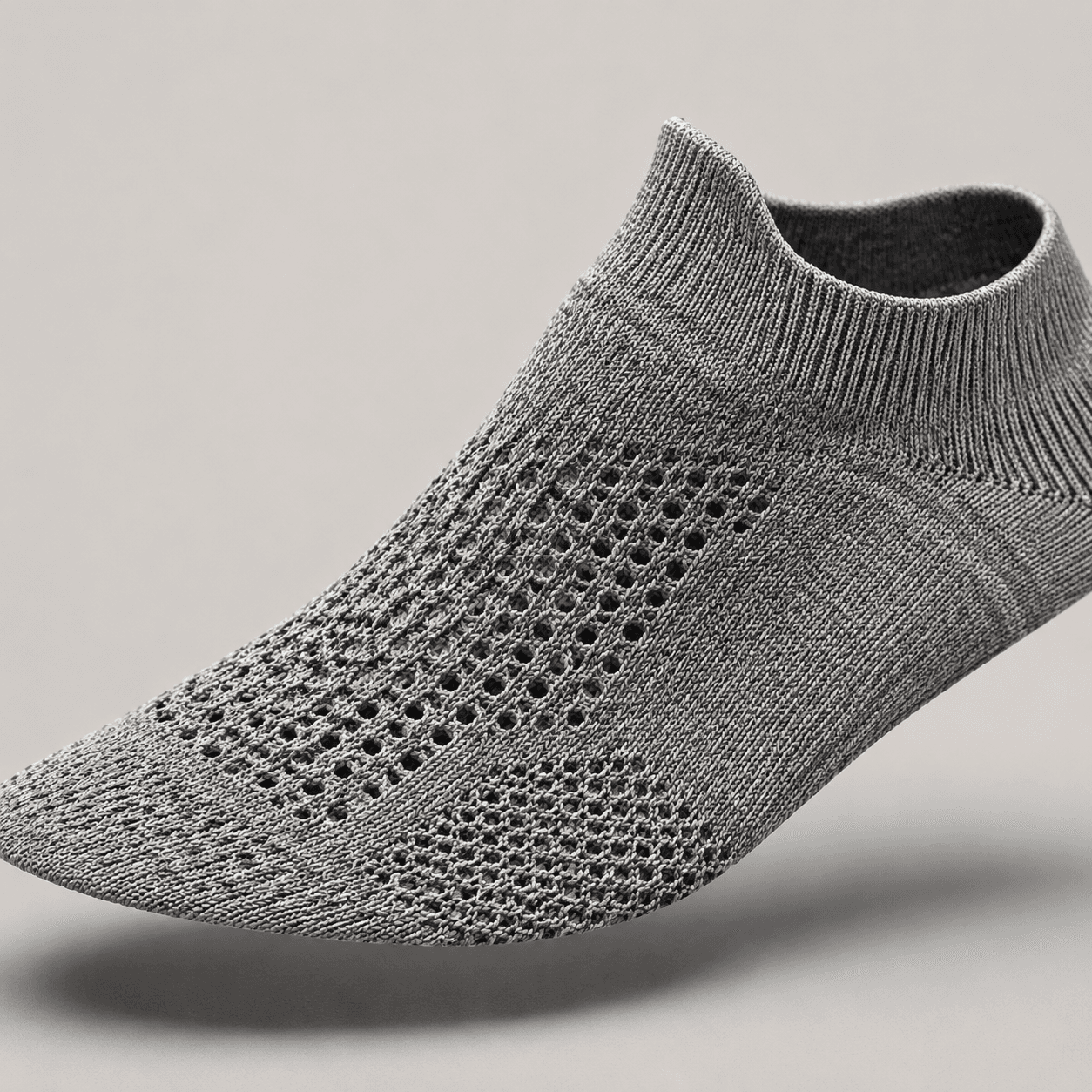
For bulk buyers, recycled materials in footwear are not a broad concept; they are a component-by-component sourcing decision. The commercial question is which parts can carry recycled input without creating excess reject rate, unstable lead time, or failed physical tests. In China production, the answer is usually straightforward for RPET textiles and trims, more limited for outsoles and midsoles, and highly dependent on color, density, and compound design.
The most workable recycled bill of materials for commercial sneakers usually starts with upper mesh or knit, lining, laces, webbing, strobel, sockliner topcloth, and packaging. The technical risk rises when recycled content moves into high-load parts such as a recycled rubber outsole, EVA midsole blend, or comfort foam where compression set and bond strength matter. A buyer asking for 30% recycled content across the pair will get a slower and less accurate quotation than a buyer who specifies exact recycled content by component.
This article is written from the supplier quotation side for sourcing managers, brand owners, and importers buying footwear in volume from China. It breaks down RPET shoe uppers, outsole compounds, foam parts, and other eco footwear materials with the details that affect FOB price: MOQ, lead-time days, US$/pair impact, GSM, density, Shore hardness, and EN ISO or ASTM checks that should be fixed at RFQ stage.
The most reliable recycled footwear program is usually the one with controlled component-level claims, not the one with the highest headline percentage.
Start with a component BOM, not a generic recycled claim
A factory cannot price recycled materials in footwear correctly from a request such as "eco sneaker" or "sustainable shoe components." The quotation needs a recycled-content map by component: upper, lining, tongue, lace, webbing, strobel, sockliner topcloth, foam, insole board, midsole, outsole, and packaging. Each material has a different waste factor, mill MOQ, approval timeline, and effect on assembly yield.
The cost difference also varies sharply by component. Upgrading a standard polyester sandwich mesh to RPET mesh often adds only US$0.08-0.18/pair. Changing lining and lace to RPET may add another US$0.04-0.10/pair. Moving to a documented recycled rubber outsole can add US$0.00-0.15/pair depending on regrind source, trial loss, and visual standard. By contrast, recycled carton board usually adds little cost and little technical risk, but it is a weak lever if the target is meaningful recycled shoe content rather than packaging compliance.
The RFQ should also define how recycled content will be measured. Most suppliers can declare recycled percentage by component. Far fewer will guarantee a total pair-weight percentage before final size range, outsole weight, and packaging are confirmed. If the buyer's internal team measures content by finished pair weight but the factory quotes by component declaration, claims and approvals will not match later.
- 01List each targeted recycled component and percentage, for example: upper knit 100% RPET yarn, lining 100% RPET, lace 100% RPET, outsole 12% post-industrial regrind, strobel 50% recycled polyester.
- 02State whether the requirement is factory material declaration only or third-party certified material flow. This changes source options, MOQ, and lead time immediately.
- 03Lock the test package before sample making: upper abrasion, seam strength, colorfastness, bond peel, outsole abrasion, flexing, hardness, compression set, and restricted substances as applicable.
- 04Approve appearance tolerance in writing. Recycled lots may show more white-tone variation, speckle, or minor surface inconsistency than virgin material.
RPET shoe uppers: the most scalable recycled option in bulk footwear
For most casual sneakers, RPET shoe uppers are the easiest entry point for recycled sneaker manufacturing. They run on standard cutting, stitching, lasting, and lamination processes with little or no machine change. China mills can supply RPET single mesh, sandwich mesh, circular knit, warp knit, engineered knit, lining, tape, and lace on normal commercial lead times, especially for black, white, grey, navy, and standard sports colors.
Typical material specs should be written clearly on the BOM. Single-layer knit uppers often run 120-180 GSM. Sandwich mesh is commonly 180-320 GSM depending on yarn denier and foam lamination. Engineered knit for one-piece uppers is usually 220-450 GSM. Air-mesh or warp-knit lining is commonly 130-220 GSM before foam, with finished thickness of 1.2-2.5 mm. Collar foam behind RPET lining is often 2.0-4.0 mm, while tongue foam may run 4.0-8.0 mm depending on category.
Price impact is now moderate on mainstream constructions. For a simple cemented casual sneaker, changing standard polyester upper plus lining to RPET versions often adds US$0.10-0.28/pair total at bulk level. For custom engineered knit with multiple yarn counts, jacquard zones, or dope-dyed yarn booking, the adder is more often US$0.25-0.60/pair. Mill MOQ for common RPET mesh is usually 800-1,500 meters/color. For custom knit uppers, yarn booking is often 300-500 kg/color or a style-level minimum based on machine setup.
Supplier-side risk points on RPET uppers
The risk on RPET uppers is rarely the recycled claim itself. The common failure points are seam slippage on open structures, lamination peel, heat-set distortion, and weak anchoring of hot-melt films or no-sew overlays. These issues become visible in vamps, eyestays, toe overlays, and tongue top lines where the upper sees both flexing and local heat during manufacturing.
If the style uses welded overlays or fused reinforcement films, the bonding stack must be tested on the actual production upper, not on a showroom swatch from a different lot. For cement shoes, the lasting margin may need roughing or primer adjustment if the RPET face finish is slick. On laminated uppers with 1.0-3.0 mm foam, buyers should request peel after heat aging and flexing, not initial peel only.
Lead time and test control for RPET textiles
Custom-color RPET mesh usually needs 4-7 days for lab dip and 5-8 days for strike-off or handloom approval. Lamination, backing, or finishing typically adds 3-7 days. Bulk material lead time after approval is normally 20-30 days for basic constructions and 30-40 days for custom engineered knit with booked yarn.
The standard test set should include colorfastness to rubbing and perspiration under EN ISO methods commonly used by footwear buyers, plus seam strength, upper abrasion, and peel strength for laminated or welded constructions. Some US programs use ASTM-based internal protocols instead. Where the upper carries transfer print or TPU film, include heat-aging peel and flex-peel in the approval package so the factory is not held to an undefined standard later.
Typical recycled component options for bulk footwear sourcing
| Component | Typical range | Notes |
|---|---|---|
| RPET upper mesh/knit | US$0.55-1.90/pair | 120-450 GSM depending on construction; MOQ usually 800-1,500 m/color for mesh or 300-500 kg/color yarn booking for custom knit; lead time 20-40 days. |
| RPET lining | US$0.18-0.48/pair | 130-220 GSM before foam; finished thickness 1.2-2.5 mm; check rubbing fastness, perspiration fastness, odor, and peel if foam-backed. |
| RPET webbing/laces/pullers | US$0.05-0.22/pair | Low technical risk; custom color trim MOQ often 3,000-5,000 pairs equivalent; standard black/white easier and faster. |
| Recycled strobel fabric | US$0.03-0.08/pair | Normally easy substitution; confirm stitch stability and tensile performance during lasting. |
| Sockliner with RPET topcloth | US$0.22-0.65/pair | Topcloth over EVA/PU/latex; EVA density often 0.12-0.20 g/cm3; verify peel, compression set, and odor. |
| Recycled EVA/PU footbed foam | US$0.30-0.95/pair | Check density tolerance, rebound, cell uniformity, and aged lamination peel; recycled blend may vary more than virgin foam. |
| Recycled insole board | US$0.10-0.24/pair | Typical thickness 1.8-2.2 mm for many casual shoes; confirm stiffness, moisture uptake, and lasting stability. |
| Recycled rubber outsole | US$0.85-2.30/pair | Common loading 5-20%; black/dark colors preferred; typical hardness 58-65 Shore A on casual RB; verify abrasion, flex, and bonding after aging. |
| Recycled EVA/phylon midsole blend | US$0.45-1.45/pair | Often 5-15% regrind in casual shoes; density commonly 0.18-0.25 g/cm3; confirm paint adhesion and molded edge quality. |
| Recycled packaging | US$0.12-0.40/pair | Includes recycled carton board, molded paper inserts, and reduced plastic packaging; simple to implement but separate from footwear material claim. |
| Development surcharge | US$150-600/style | Applies to custom knit strike-offs, outsole compound trials, extra lab checks, and recycled-content document handling. |
| Commercial MOQ / lead time | 1,200-1,800 pairs/color; 35-75 days | Repeat programs with stock materials are faster; first orders with custom recycled specs and certification checks need more buffer. |
Recycled rubber outsole: where recycled content becomes a compounding issue
A recycled rubber outsole is attractive because outsole weight is high, usually 280-420 g/pair on casual sneakers and 450 g/pair or more on heavy cupsoles or vulcanized silhouettes. But this is also where buyers most often overestimate how much recycled input can be added without affecting abrasion, tear, edge definition, and mold cleanliness. For standard black casual outsoles, a practical loading is usually 5-20%, with 10-15% the most repeatable commercial range.
The source of the recycled rubber matters as much as the percentage. Clean in-house regrind from the same compound family is easiest to control and lowest risk. External post-industrial granulate can work if it is sorted, screened, and used consistently by particle size. Post-consumer input is the most difficult for footwear outsoles because contamination, odor, and hardness variation are harder to stabilize batch to batch. Buyers should ask whether the quote is based on internal regrind, purchased post-industrial scrap, or another route.
Outsole construction also matters. A black cupsole wall, foxing strip, or solid molded RB bottom will generally tolerate recycled loading better than a light-color blown rubber forepart or a high-detail logo tread. In phylon-rubber constructions, the supplier should state whether the recycled content sits only in the ground-contact rubber insert or across the full bottom unit. Without that clarification, two factories may both claim recycled outsole content while supplying very different actual weight contributions.
- 01Set Shore A target and tolerance at quotation stage. For many casual rubber outsoles, 58-65 Shore A is a common working range, but the exact target depends on wear and flex profile.
- 02Confirm the abrasion method required by your market or brand manual. DIN-style abrasion is common on export programs; some US buyers use ASTM-based internal benchmarks.
- 03Approve a visual standard for speckle, flow lines, edge sharpness, and pinholes. Recycled compounds, especially on light shades, cannot be evaluated by virgin-material appearance standards without higher reject cost.
- 04Require bond testing after aging if the outsole is cemented to phylon, EVA, or upper. Recycled loading can change surface response to primer and adhesive.
Cost and lead-time impact of recycled outsole compounds
It is incorrect to assume recycled outsole content always lowers FOB. If the factory uses internal scrap, raw-material cost may improve slightly, but the saving is usually offset by grinding, screening, stricter blend control, and extra trial pressing. If the supplier buys documented recycled granulate, the raw material can be cost-neutral or even slightly higher than standard black compound once handling and trace paperwork are included.
On a commercial casual sneaker, the net price movement from adding controlled recycled content to the outsole is typically between -US$0.03 and +US$0.12/pair. The wide spread comes from reject rate and molding stability more than from the compound itself. High regrind loading can increase air traps, rough surface texture, weak logo clarity, and inconsistent edge definition, all of which push up sorting and remold cost.
A standard outsole color/compound approval may take 5-7 days. A new recycled compound often needs an extra 3-7 days for hardness tuning, mold-flow review, and a second trial if color or surface finish is not acceptable. For white, light grey, gum, or pastel outsoles, expect both lower allowable recycled loading and more color iteration than for black.
Lower-risk recycled shoe components that scale well
After RPET uppers, the easiest recycled additions are lining, webbing, laces, pull tabs, labels, strobel fabric, and sockliner topcloth. These are lower-load items, they fit existing supply chains, and they rarely create process instability if the base material is already standard in footwear use. For importers balancing recycled claims against on-time shipment, these are usually the best places to build out the BOM first.
Recycled strobel fabric in polyester is common and usually adds only US$0.01-0.03/pair. RPET laces and webbing are also straightforward, though custom trim colors often need 3,000-5,000 pair equivalent usage to run efficiently. RPET woven labels, tongue labels, and heel pullers are routine in sport casual factories. These items do not add much cost individually, but together they strengthen the recycled-material story without increasing defect risk.
Packaging should still be separated from footwear material costing. Recycled carton board, molded paper inserts, and downgauged polybags are simple to execute, but they should not be used to inflate the footwear recycled-content claim. Buyers should treat packaging as a separate compliance line in the quotation.
Sockliners, footbeds, insole board and recycled foam blends
Comfort components are easy to over-claim because the visual difference between virgin and recycled foam is small. In practice, these parts need tighter specification than upper textiles. Sockliners may use RPET topcloth over EVA, PU, latex, or blended foam. Typical EVA sockliner density for casual sneakers is around 0.12-0.20 g/cm3. PU footbeds are commonly higher depending on rebound and support target. The critical controls are compression set, odor, lamination peel, and topcloth crocking.
A recycled EVA blend can feel acceptable in hand but still vary in cell structure, resilience, or thickness tolerance once mass production starts. For this reason, suppliers should quote recycled foam with density range, hardness range where relevant, and compression-set expectation, not only with a recycled-content declaration. If the buyer only approves by touch, bulk risk is high.
Insole board with recycled cellulose or fiber content is widely available and generally commercial. The real concerns are stiffness, water absorption, nail or stitch holding where applicable, and lasting stability on pointed or high-spring lasts. A 1.8-2.2 mm insole board may look fine in sheet form and still crack or distort during lasting if the board recipe is weak. Approval should be based on lasted wear samples, not only the supplier spec sheet.
Midsole use of recycled content
Recycled content in EVA or phylon midsoles is possible, but the tolerance window is narrower than for uppers or trims. In value casual shoes, 5-15% regrind is a common practical range. Above that, density control, rebound, paint adhesion, and molded edge quality become less stable. Exposed midsoles with crisp sculpting lines are less forgiving than foxing-wrapped or fully painted constructions.
A supplier quoting recycled midsole foam should state target density, commonly around 0.18-0.25 g/cm3 for many casual phylon applications, plus hardness, compression, and bond behavior after aging if the part is laminated or painted. These are routine production controls and should not be treated as optional because the material is recycled.
MOQ planning for recycled sneaker manufacturing
In recycled sneaker manufacturing, MOQ is usually set by the least flexible material line, not by the shoe factory's standard minimum. A factory may accept a 1,000-pair order in principle, but if the RPET knit mill requires 500 kg yarn booking and the outsole supplier needs a full compound batch, the true economic MOQ will be higher. Buyers should ask which component is setting MOQ before they approve development.
For a straightforward casual sneaker using stock outsole molds, standard-color RPET mesh, common recycled trims, and no special certification flow, a workable MOQ is often 1,200-1,800 pairs/colorway. For styles using engineered knit uppers, custom certified yarn, color-matched recycled outsole compound, and special trim programs, the practical MOQ usually becomes 2,000-3,000 pairs/colorway. Below those levels, material surcharges and excess-waste charges become visible in FOB.
Development lead time with recycled materials is also slightly longer than standard. Material swatches, strike-offs, and first sample work generally take 20-35 days. Bulk production after confirmation is commonly 35-50 days for repeat programs and 55-75 days for first orders with new compound work or custom mill development. If third-party document checks are required, add that buffer before ex-factory planning, not after.
Testing and compliance should stay at normal footwear standards
Recycled input does not reduce the required physical standard of the finished shoe. The upper still needs to pass abrasion, seam strength, colorfastness, and peel where relevant. The outsole still needs hardness, abrasion, flexing, and bond checks. Foam parts still need density, compression set, and odor control. Buyers should specify whether the program will follow EN ISO, ASTM, or brand protocols based on those systems so the factory can align the test plan from development stage.
Restricted substances must be controlled exactly as in virgin-material programs. This is especially important for externally sourced recycled compounds, coated textiles, and mixed secondary material channels. A low raw-material cost is not commercially useful if the finished shoe creates re-test risk, claims exposure, or shipment delay. In practice, the stronger material suppliers are not the cheapest ones; they are the ones that can support both physical testing and traceable component declarations lot by lot.
How to compare supplier quotations accurately
Buyers should compare recycled-shoe quotations by component, not by headline claim. One factory may quote RPET lining, laces, and carton only. Another may quote RPET upper, RPET lining, recycled strobel, RPET webbing, and a 12% recycled outsole compound. Both may use the word recycled, but they are not equivalent on cost, claim strength, or sourcing complexity.
A clean comparison should show upper construction and GSM, lining thickness, outsole compound type and recycled loading, sockliner density, trim MOQ, packaging scope, development charge, mold-trial assumptions, and test scope. Without that level of breakdown, the cheapest FOB often means the recycled input sits mainly in low-value trims rather than in major footwear components.
For many importers, the most repeatable first program is not the highest recycled percentage. It is a balanced BOM: RPET upper or lining, recycled webbing and laces, recycled strobel or sockliner topcloth, and a dark-color recycled outsole at moderate loading. That combination normally gives a meaningful recycled-material story without driving avoidable defect cost or unstable lead time.
- Ask each supplier to identify recycled source type: in-house regrind, post-industrial external material, or post-consumer where applicable.
- Separate stock-material quotations from custom-material quotations. The cost and lead time are not comparable.
- Confirm whether development trial cost, lab testing, and document handling are included in FOB or charged separately.
- Approve tolerance for shade variation, hardness, thickness, and outsole speckle before bulk release.
SoleForge manufactures athletic & running shoes and casual sneakers under OEM and ODM for brands and importers worldwide. Request a quote with your tech pack or reference pair and we'll reply within one business day.