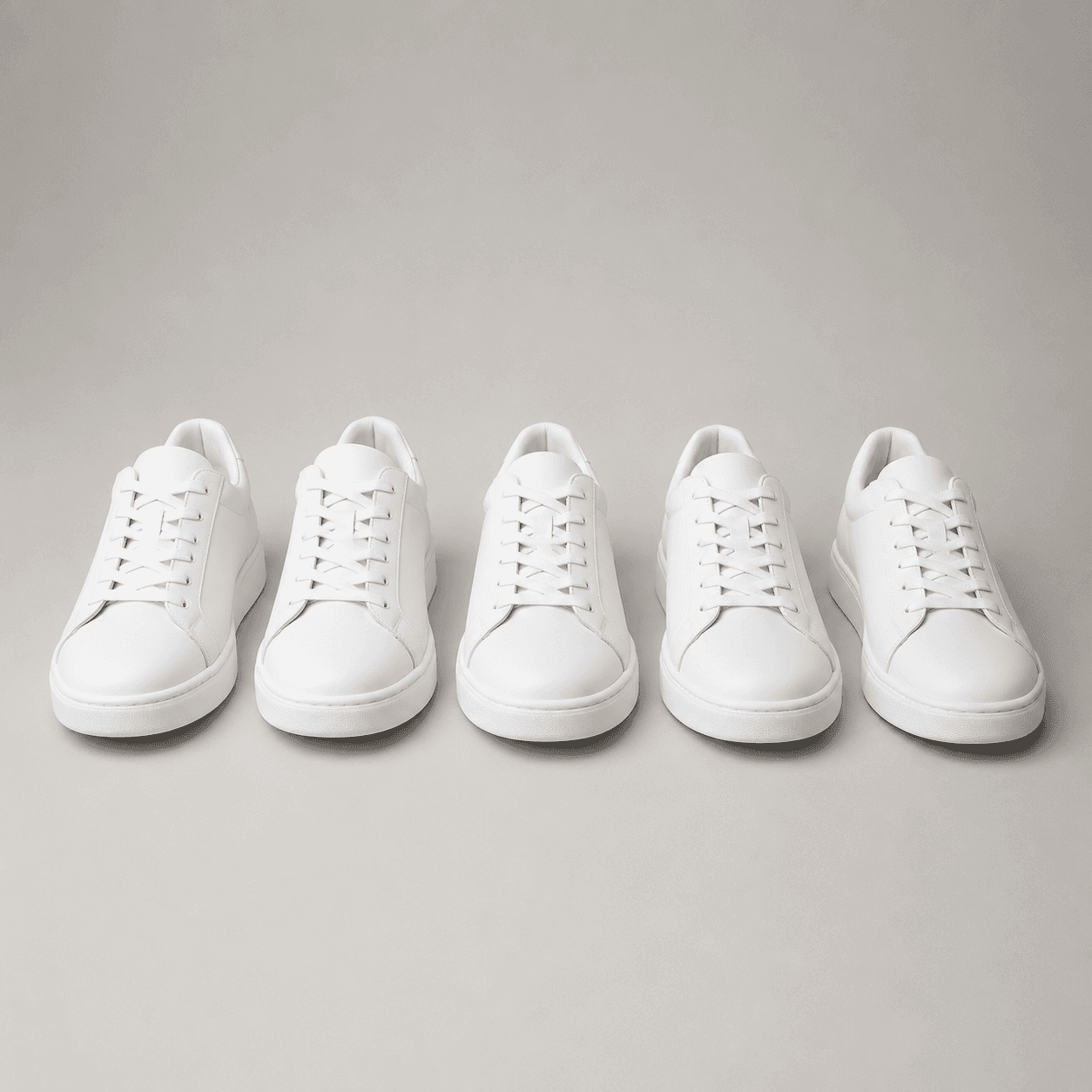
A usable footwear RFQ template lets a factory quote one defined product against one fixed commercial basis. In footwear, small gaps in the inquiry create large price swings. A vague upper callout like "PU" can move cost by $0.50-$1.80 per pair depending on thickness, backing, finish, and abrasion level. An unspecified outsole can shift another $0.70-$2.20 per pair if one supplier prices a stock TPR sole and another assumes a new phylon-rubber mold set.
For sourcing managers, brand owners, and importers buying from China, the RFQ stage is where cost accuracy and sample efficiency are decided. A factory cannot issue a dependable quote from photos, a target FOB, and a short material list. A proper custom footwear inquiry combines commercial assumptions with technical detail: size range, color split, outsole construction, upper specs, test standard, packaging method, and shipment window.
This guide explains what buyers should send factories, in order, so a shoe factory quotation request produces comparable pricing instead of soft estimates. The emphasis is supplier-side and specific: MOQ by color, sample lead time in days, tooling charges, foam density, GSM, EN ISO or ASTM references, and the exact information factories need to commit to a realistic $/pair.
A factory can estimate from a photo, but it can only quote accurately from a footwear RFQ with fixed technical and commercial assumptions.
Set the commercial baseline before asking for price
Most unusable quotations come from incomplete commercial instructions, not weak factories. When a buyer asks for "best price" without fixing incoterm, quantity, destination market, or delivery window, each supplier fills the gaps differently. One quotes FOB Xiamen, one quotes EXW, another builds in branded packaging and testing. The numbers look different, but they are not pricing the same job.
Start the shoe sourcing RFQ by fixing the quotation basis. State whether you want EXW, FOB Shenzhen, FOB Xiamen, or CIF to a named port. Give order volume by style, colorway, and size range. A 1,200-pair trial order split across three colors will not price like a 6,000-pair order in one color with a balanced size run. Factories buy materials, schedule lines, and allocate overhead from that split, not from total pairs alone.
State the target shipment month and acceptable tolerance in days. For example, if ex-factory must fall between 5 August and 15 August, the supplier may need to reserve a line and quote with less flexibility. If shipment can move within a 30-day window, the same factory may quote lower because it can consolidate material buying and production loading. This difference is real and should be visible at RFQ stage.
Buyers should also state whether the inquiry is for a launch order, replenishment program, or annual volume discussion. If a factory sees only 800 pairs with a new outsole mold and branded box, it may quote high or decline. If the same style is part of a 20,000-pair annual program with repeat colors, the economics change immediately.
- State incoterm and shipping basis clearly: `EXW`, `FOB`, or `CIF`.
- Give quantity by style, by color, and by size range, not total pairs only.
- Name destination market: EU, UK, US, Japan, or Middle East.
- State target ex-factory window, for example `45-60` days after approval.
- Require factories to list sample fees, mold cost, last cost, and packaging tooling separately.
Send a footwear tech pack that supports costing, not guesswork
The footwear tech pack is the core of the footwear RFQ template. If the pack is light on component detail, the factory must make costing assumptions on material grade, waste factor, labor steps, and yield. That usually creates one of two bad outcomes: an inflated quote with risk buffer, or a low quote that changes after the first sample review.
For uppers, specify panel by panel. Do not write "synthetic upper" or "mesh upper" and expect stable pricing. A costing team needs something like: vamp in 1.3-1.5 mm microfiber with nubuck finish; quarter in 1.1-1.3 mm PU on brushed knit backing; tongue in sandwich mesh 240-280 GSM; vamp lining in breathable mesh 130-160 GSM; collar foam 8 mm open-cell PU at 28-32 kg/m3; toe puff 1.2 mm hot-melt; heel counter 1.5 mm hot-melt sheet; binding in 0.8 mm synthetic; lace in flat polyester 110-120 cm. If leather is used, define article, thickness, finish, and whether chrome VI restrictions apply.
Bottom construction needs the same precision. "EVA outsole" is not a quoteable spec. State whether the shoe uses full EVA, phylon midsole with TPR outsole, rubber cupsole, dual-density PU, or EVA with rubber forepart and heel patches. Add density and hardness where relevant: phylon 0.22-0.25 g/cm3, rubber hardness 60-65 Shore A, sockliner PU foam 4-5 mm at 0.16-0.20 g/cm3, insole board 2.0 mm cellulosic or non-woven lasting board, strobel board type, and whether a shank is required. For safety or outdoor shoes, specify toe cap type, penetration plate type, and outsole compound family early.
If some materials are still open, define controlled quotation ranges. For example, microfiber 1.2-1.4 mm, mesh 220-260 GSM, collar foam 25-30 kg/m3, and outsole abrasion target within a stated band. A factory can cost a range. It cannot price accurately against undefined quality.
- List every major component separately: upper panels, lining, foam, reinforcement, sockliner, insole board, midsole, outsole, lace, hardware, and packaging.
- State measurable specs: thickness, density, hardness, GSM, backing, finish, and color standard.
- Show size range and fit base, such as `EU 36-41` or `US 7-13`.
- Attach outsole drawing, logo artwork, color references, and marked sample photos.
- Confirm construction method: cemented, strobel-cemented, vulcanized, injected, or board-lasted.
Define testing, compliance, and market restrictions before quotation
Testing is not a post-sample topic. In footwear, compliance can change upper material choice, adhesive system, outsole compound, trim sourcing, and lead time. If a buyer mentions retailer protocol only after development starts, the quote will move or the factory will absorb cost it never priced. Neither is workable for long-term sourcing.
Your custom footwear inquiry should identify the footwear category first: fashion casual, school shoe, kids' sneaker, outdoor boot, occupational footwear, or safety footwear. Then state the compliance basis. For consumer footwear this often means REACH-related chemical restrictions, CPSIA limits for the US, or a retailer RSL. For protective products, reference the exact standard, such as EN ISO 20345, EN ISO 20347, or ASTM F2413, and state whether toe impact, compression, slip, penetration resistance, anti-static, or fuel-oil resistance are required.
Performance tests should be listed by priority. Typical footwear RFQ items include outsole abrasion, sole bond strength, upper flexing, lining and tongue abrasion, color fastness to dry and wet rubbing, eyelet pull, lace tensile, zipper cycling, heel attachment, and carton drop performance. If the buyer expects outsole abrasion around 200-250 mm3, flexing to a certain cycle count, or bond-strength results after heat aging, say so. Otherwise the factory prices to its internal benchmark, which may be lower, higher, or simply different.
Inspection assumptions also belong in the RFQ. State whether bulk must pass AQL 2.5 major and AQL 4.0 minor, whether inline inspection is required, and whether third-party final inspection is buyer-paid or factory-included. These points affect labor allocation, rework allowance, and final packing control.
Testing details suppliers need in the RFQ
Factories quote more accurately when the test package is explicit, especially for kids' shoes, white uppers, occupational styles, waterproof constructions, and transfer-print logos.
Request MOQ, tooling, sample cost, and lead time as separate cost lines
One all-in quotation is not enough for footwear. Buyers need to see sample cost, tooling cost, and bulk unit price broken apart, because each is driven by different factors. Development samples are expensive per pair because materials are bought short, pattern rooms spend engineering hours, and stitching lines lose efficiency on one-off making. Bulk production cost depends on order size, color complexity, and how stable the process is after approval.
Ask for pricing by quantity tier. A practical request is FOB price at 1,200 pairs, 3,000 pairs, and 5,000 pairs per style, with the color split clearly stated. For standard cemented casual shoes using stock or near-stock outsoles, many China factories can work from 600-1,200 pairs per color. For cupsoles, complex molded bottoms, waterproof boots, or new private outsole molds, commercial MOQ often moves to 1,500-3,000 pairs per colorway. Technical MOQ and commercial MOQ should be stated separately because some factories can make less, but only at a noncompetitive $/pair.
Tooling needs line-by-line visibility. Request separate charges for outsole mold, last, logo metal trim mold, emboss plate, printed footbed screen, and custom packaging cylinder if used. Typical outsole mold lead time is around 25-35 days for a standard rubber or phylon mold set, though more complex dual-density or safety tooling can run longer. Buyers should also ask whether mold ownership transfers after payment and whether insert changes for logo, size plate, or tread modification create additional charges.
Lead time should be shown by phase, not as one summary number. For a custom casual sneaker, a normal path is 7-10 days for material confirmation, 10-14 days for first development sample, 7-10 days for revision sample, 25-35 days for new outsole mold, and 45-60 days for bulk production after pre-production approval and deposit. During peak season or before Lunar New Year, factories may quote 60-75 production days. Without phase detail, buyers cannot build a realistic launch calendar.
- 01Request unit price by volume tier and by stated color split.
- 02Ask factories to state technical MOQ and commercial MOQ separately.
- 03Break out sample fee, outsole mold, last charge, trim tooling, and packaging tooling.
- 04Require lead time by stage: material confirmation, development sample, revision, mold, and bulk production.
- 05Confirm the payment term used in the quote, such as `30/70`, `20/80`, or LC at sight.
Include packaging, labeling, and carton rules in the bulk shoe order specs
Packaging is part of footwear cost and should be treated as part of the product definition. A plain corrugated shoe box may add only modest cost, while a rigid color box with tissue, insert card, spare lace polybag, and silica gel can add $0.35-$1.20 per pair depending on print coverage, board grade, and volume. If packaging is omitted from the RFQ, the quote is incomplete by definition.
Your bulk shoe order specs should define pair packing method, shoe box construction, print finish, labeling positions, export carton requirements, and pallet rules if applicable. State whether each pair is packed in a standard shoe box, mailer, polybag, hanger pack, dust bag, or direct export carton. Give box board grade, dimensions, print colors, matte or gloss finish, and barcode format. If the importer limits carton gross weight to 15 kg or 18 kg, or requires a specific carton burst strength, add that too.
Labeling needs the same discipline as materials. Specify tongue label, woven size label, sock print, outsole size mark, carton shipping mark, country-of-origin statement, and any bilingual warning or care label. If the retailer uses a fixed shipping mark layout or barcode placement, attach it. Factories can quote standard packaging quickly. They cannot quote "branded box included" with any precision because board quality, print process, and pack-out method vary widely.
- Define pair packing: shoe box, polybag, dust bag, hanger, or direct master carton.
- Specify shoe box board grade, dimensions, print finish, and barcode label location.
- State if spare laces, stuffing paper, tissue wrap, or silica gel are required.
- Give export carton limits on weight, dimensions, and palletization if applicable.
Standardize the supplier response format so quotes stay comparable
A strong footwear RFQ template does not only tell factories what to price. It tells them how to return the quotation. If one supplier sends a one-page estimate, another sends a partial BOM, and a third replies with only a target FOB, the buyer loses time normalizing data and still cannot compare assumptions cleanly.
Require each supplier to confirm the same core fields: style description, construction, upper and outsole assumption, MOQ, unit price by quantity tier, sample fee, tooling cost, lead time in calendar days, payment term, test inclusion, packaging inclusion, and exclusions. Exclusions matter in footwear because factories often leave out third-party testing, size-set samples, outsole modifications, logo hardware development, carton artwork, or mold insert changes unless the RFQ asks directly.
It is also useful to ask for a short manufacturing-risk note with the quote. A capable factory should flag issues such as collar foam density too low for shape retention, microfiber too soft for the requested toe shape, white foxing likely to mark during transit, outsole lug depth too shallow for slip expectation, or a reflective transfer likely to crack under repeated vamp flex. These comments show whether the supplier understands execution or is quoting only to enter the bid.
Finally, request quotation validity, usually 15-30 days. Synthetic material, rubber compound, carton board, and freight-related local charges can move. A validity period keeps the shoe factory quotation request current and reduces later disputes over changed assumptions.
Minimum response fields every factory should return
If all suppliers answer in the same structure, sourcing teams can compare $/pair, MOQ, lead time, and risk without rebuilding each quotation manually.
Key takeaways
- A reliable footwear RFQ template combines commercial terms, technical specs, testing, packaging, and supplier response rules in one package.
- The footwear tech pack must define materials at component level with thickness, density, hardness, GSM, backing, finish, and construction method.
- Testing should be named before quotation, including EN ISO, ASTM, REACH, CPSIA, retailer RSL, and inspection assumptions.
- Buyers should request MOQ, sample fees, tooling, and unit price by volume tier as separate lines to keep quotes comparable.
- Packaging and labeling belong inside the bulk shoe order specs because they change both $/pair and lead time.
- Factories should be required to state exclusions, validity period, and manufacturing risks so hidden cost gaps are visible early.
SoleForge manufactures athletic & running shoes and casual sneakers under OEM and ODM for brands and importers worldwide. Request a quote with your tech pack or reference pair and we'll reply within one business day.