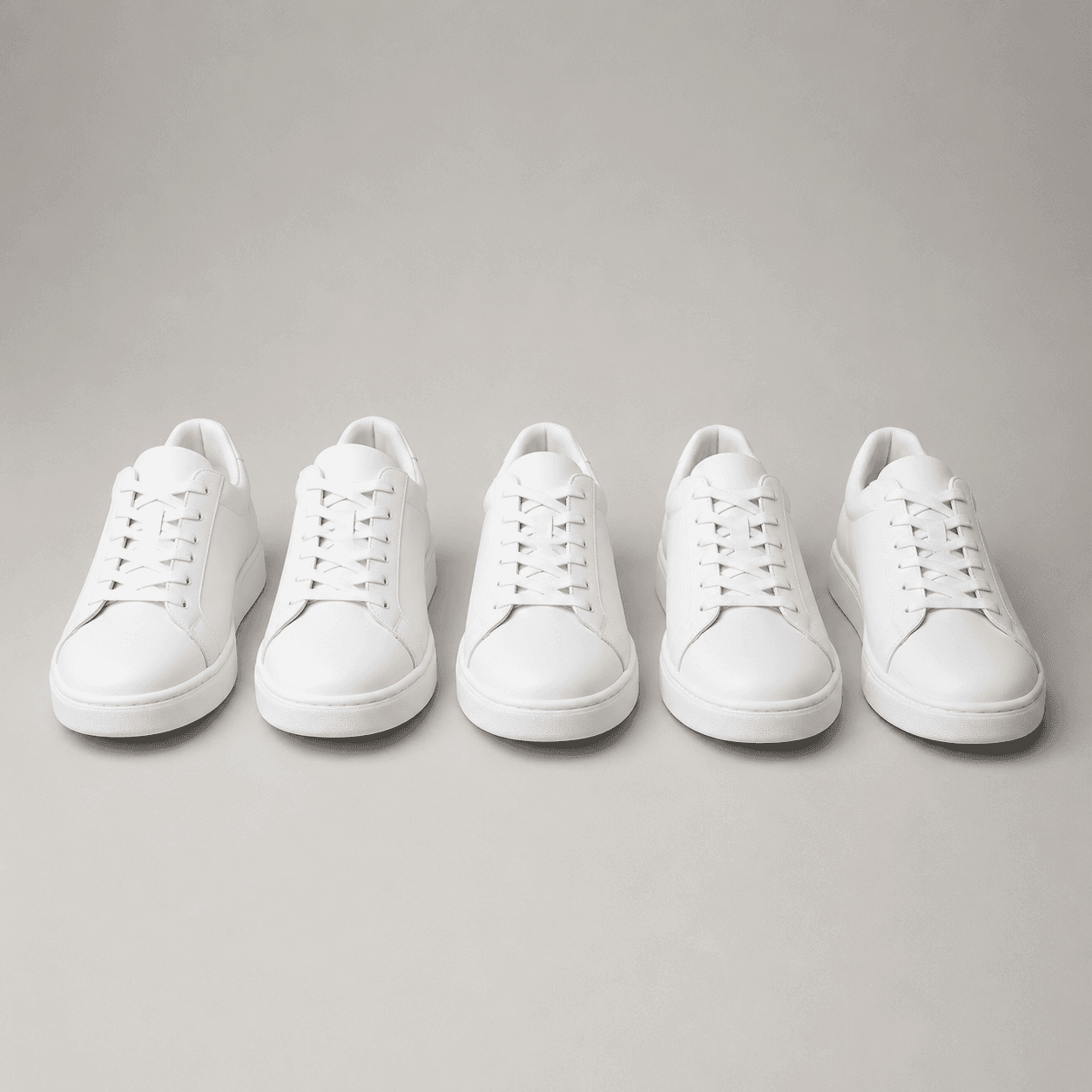
The central trade-off in the shoe manufacturing process is flexibility versus process control. A low-MOQ batch line can handle more colors, mixed materials, and late artwork changes, but it depends heavily on operator skill. A semi-automatic export line gives better control of lasting, bonding, pressing, and packing flow. A high-volume line reduces USD/pair only when the last, tooling, material formula, packaging, and order forecast are already stable.
For sourcing managers, brand owners, and importers buying footwear in bulk from China, the line choice affects MOQ, sample time, bulk lead time, mold cost, defect rate, testing budget, and shipment reliability. A 600-pair women’s fashion sneaker using a stock outsole should not be planned like a 50,000-pair injected EVA slide program. The visible footwear production steps may look similar, but the commercial risk sits in different operations.
This comparison follows the shoe factory process from cutting to packing and compares three practical routes: flexible batch production, semi-automatic cemented assembly, and high-volume molded or repeat-line production. The focus is supplier-side: cutting loss, GSM, foam density, Shore hardness, adhesive control, AQL, EN ISO/ASTM references, daily output, and where defects usually enter before export.
The right shoe factory process is not the fastest line; it is the line whose MOQ, tooling, labor balance, and QC controls match the order risk.
Shoe Line Production Process: Step by Step From Cutting to Packing
Most buyers ask how shoes are made. In production, the more useful question is which process route the supplier will use. A cemented sneaker normally passes through incoming material inspection, cutting, skiving, lamination, logo printing or embroidery, stitching, upper inspection, strobel or board attachment, toe and heel lasting, roughing, primer, cementing, drying tunnel, sole pressing, heat setting, cooling, cleaning, inspection, and packing. A molded EVA slide may skip stitching and lasting, but it needs tighter control of mold temperature, EVA formulation, shrinkage, density, and color migration.
The same design can behave differently on different lines. Manual cutting stitching lasting allows small corrections during production but creates more variation in edge distance, upper tension, and toe shape. A balanced shoe assembly line can hold visible alignment within about +/-2 mm when patterns, lasts, and jigs are correct. A high-volume injection or repeat cemented line can reduce labor cost by USD 0.40-1.50 per pair, but only after fit, molds, size grading, outsole hardness, packaging, and test standards are locked.
The comparison below treats line selection as a buying decision, not a factory tour. MOQ, lead time, tooling exposure, material booking, QC checkpoints, and claims risk should be decided before the purchase order, because once bulk cutting starts, changes become expensive.
Option 1: Flexible Batch Line for Low MOQ and Style Variety
Flexible batch production is common in Dongguan, Wenzhou, Quanzhou, Jinjiang, and smaller workshops supporting larger export factories. MOQ can start at 300-600 pairs per color when the buyer uses stock outsoles, standard laces, available mesh or PU, and normal shoe boxes. For custom PU embossing, dyed mesh, leather, logo hardware, molded rubber patches, or special cartons, a realistic MOQ is usually 800-1,200 pairs per style because component suppliers impose their own minimums.
Sample lead time is normally 7-15 days after artwork, last, outsole, and material confirmation. Bulk lead time is usually 35-55 days after deposit and approval of confirmation sample, size set, material card, and packaging file. Add 7-20 days for custom woven labels, imported waterproof membrane, special outsole color matching, or non-standard carton printing.
The advantage is adaptability. A buyer can run four colors, two lining options, mixed size ratios, and a debossed heel logo without opening a full outsole mold. Cutting may use clicker dies, CNC knife cutting for short runs, hand correction for leather defects, or laser cutting for synthetics that tolerate heat. Stitching teams can move between tongues, collars, straps, bindings, eyestays, and decorative rows with moderate downtime.
The limitation is process drift. Edge distance may move from 1.5 mm to 2.5 mm if stitching guides are weak. Collar foam can bunch if operators insert 3 mm foam manually without bundle checks. Toe shape can vary if toe puff activation temperature and lasting tension are not controlled. Typical defects include cement overflow, loose thread ends, uneven topline, shade mismatch, left-right asymmetry, and wrinkled lining.
This route is not the lowest FOB option. Compared with a mature repeat line, extra labor and rework often add USD 1.00-2.80 per pair on casual sneakers and USD 0.40-1.20 per pair on simple sandals. The right controls are a signed golden sample, approved swatch card, first-size fitting, stitching templates, cutting yield check, and inline inspection when 10-20% of uppers are completed.
- Best fit: new brand launches, fashion drops, test orders, mixed-color private label, and stock sole programs.
- Typical MOQ: 300-600 pairs per color for stock materials; 800-1,200 pairs per style when custom components are used.
- Main risk: inconsistent appearance and higher rework if cutting bundles, stitching jigs, and inline QC are loose.
Comparison of China Shoe Production Line Options
| Dimension | Flexible Batch Line | Semi-Automatic Assembly Line | High-Volume Line |
|---|---|---|---|
| Typical MOQ | 300-600 pairs per color with stock soles; 800-1,200 pairs for custom materials | 1,000-3,000 pairs per color for most export casual and sneaker programs | 10,000-50,000+ pairs per style for best cost leverage |
| Lead time after final approvals | 35-55 days; add 7-20 days for special trims, labels, or imported materials | 30-50 days when outsole, size set, packaging, and materials are confirmed | 25-45 days after tooling, pilot run, and material booking are stable |
| Cost profile | Higher labor and rework cost; often USD 1.00-2.80 per pair above repeat lines for sneakers | Balanced FOB cost; stable output around 800-1,500 pairs/day for many cemented sneaker lines | Lowest mature unit cost; may save USD 0.40-1.50 per pair after setup |
| Quality risk | Visual variation, stitching drift, shade mixing, uneven lasting | Adhesive control, line balancing, upper supply delays, pressing parameters | Large-scale repetition of any tooling, fit, color, or bonding mistake |
| Best buyer fit | New brands, market tests, fashion colors, low-MOQ private label | Importers with regular bulk orders and seasonal updates | Retail replenishment, injection EVA, molded slides, uniform footwear |
Option 2: Semi-Automatic Assembly Line for Balanced Export Orders
The semi-automatic line is the most practical option for many importers. It combines manual upper stitching with machine-assisted lasting, roughing, cementing, drying, sole pressing, heat setting, cooling, and finishing. It suits cemented sneakers, school shoes, sandals, children’s shoes, and vulcanized-look casual footwear where the buyer needs repeatable export quality but still changes colors or materials by season.
MOQ is commonly 1,000-3,000 pairs per color. A factory may accept less when the outsole, last, mesh, laces, insole, and carton are already in stock. Bulk lead time is usually 30-50 days after final approvals. A balanced cemented sneaker line can output about 800-1,500 pairs per day; simple sandals may run faster, while waterproof boots, padded collars, embroidery, and multi-layer uppers reduce throughput.
This route gives better process control because machine settings can be recorded. Lasting pressure, drying tunnel temperature, adhesive open time, sole press pressure, press time, and cooling time should be controlled by material type. A cemented rubber outsole may use PU adhesive and primer with tunnel settings around 50-70°C, but the correct window must follow the adhesive supplier’s technical data sheet. Rubber, EVA, TPU, PU, and TPR do not accept the same roughing depth or primer system.
Testing should be agreed before bulk starts. Bond strength can be checked using EN ISO 20344 footwear test principles or ASTM D903-style peel testing where relevant. Flex resistance, abrasion, colorfastness, component pull strength, and sole hardness should be assigned to factory lab or third-party lab before shipment. Casual rubber outsoles often fall around Shore A 55-70. Lightweight EVA midsoles may be around 0.18-0.28 g/cm3; firmer injected EVA sandals may require a different density, hardness, and compression set target.
The main risk is line balance. If stitching produces 700 pairs per day but lasting is planned for 1,200 pairs, shipment will slip even when outsole stock is ready. Buyers should ask for the route sheet, daily capacity by operation, planned inline inspection date, and pre-final inspection date before issuing the purchase order.
- Best fit: export sneakers, sandals, children’s shoes, school shoes, and repeatable private-label footwear.
- Typical MOQ: 1,000-3,000 pairs per color; lower only when materials and soles are already available.
- Main risk: adhesive failure, stitching bottlenecks, and missed delivery when capacity is overpromised.
Option 3: High-Volume Line for Stable Programs and Lower Unit Cost
A high-volume line is justified when the buyer has a repeat forecast, approved tooling, confirmed fit, and limited design changes. MOQ is usually 10,000-50,000 pairs per style for meaningful leverage, especially for injection EVA slides, molded sandals, school shoes, uniform footwear, and mass retail casuals. Tooling cost can range from USD 500 for simple logo inserts to USD 3,000-15,000+ for full outsole, midsole, or injection mold sets across a commercial size run.
The benefit is cost compression. Once operators are trained and the line is balanced, the supplier can negotiate better prices for mesh, PU synthetic, rubber compound, EVA pellets, laces, eyelets, footbeds, tissue, boxes, and export cartons. On mature programs, unit cost may drop USD 0.40-1.50 per pair versus a smaller semi-automatic order. For injection EVA, savings can be higher when cavity count, cycle time, shrinkage, and scrap rate are optimized.
The trade-off is rigidity. A logo position change after mold engraving, outsole hardness change after compound trial, or carton assortment change during packing can disrupt the schedule. High-volume production requires pre-production discipline: approved size grading, wear trial notes, color limit samples, barcode files, polybag warnings, carton marks, hangtag language, destination compliance, and shipment test plan.
Scale gives repeatability, not automatic quality. If the last creates heel slip, the toe spring is wrong, or the bond standard is weak, the factory can repeat that defect for thousands of pairs before final AQL inspection. Buyers should require pilot production, first 200-pair review, lot-based testing, and inline inspection before more than 30% of the order is completed.
- Best fit: retail replenishment, injection EVA slides, molded sandals, uniform footwear, and stable DTC volume.
- Typical MOQ: 10,000+ pairs per style for meaningful cost reduction; higher when mold amortization is expected.
- Main risk: expensive corrections after tooling, compound booking, outsole production, or bulk cutting.
Cutting: Where Material Yield and Pair Matching Are Decided
Cutting is the first major cost-control point in the shoe manufacturing process. The factory converts roll mesh, PU, microfiber, lining, felt, non-woven reinforcement, foam, leather, strobel board, insole board, and rubber sheet into components. Leather cutting must avoid scars, loose grain, belly stretch, and shade variation. Textile and synthetic cutting must control grain direction, print placement, lamination, pair matching, and panel distortion.
Cutting loss should be visible in the quotation. Mesh or PU synthetic often carries 8-15% loss. Genuine leather can run 20-35% depending on grade, panel size, and acceptance of natural marks. If the supplier quotes with unrealistic yield, the shortage usually appears later as material substitution, shade mixing, or a price increase request.
Specifications must be measurable. Upper mesh should state GSM, such as 220 GSM single-layer mesh versus 320 GSM sandwich mesh. Collar foam may be 3 mm at 28-35 kg/m3 density. Tongue foam may be 4-8 mm depending on comfort target. Toe puff and heel counter should include thickness, stiffness, and activation temperature. Footbed foam should state thickness, density, and compression recovery, not only hand feel.
- 01Check incoming material against signed swatches, thickness, GSM, color standard, roll width, and visible defects.
- 02Relax fabric or laminated materials where tension or shrinkage can affect cutting accuracy.
- 03Cut by die press, CNC knife, laser, or hand correction according to material, order size, and tolerance.
- 04Bundle components by size, color, pair, and operation ticket to prevent shade and size mixing.
- 05Inspect for burrs, delamination, wrong grain direction, missing reinforcement, and left-right mismatch.
Stitching: The Main Labor Bottleneck in Many Styles
Stitching often controls delivery more than sole stock. A simple slide strap may need only a few operations. A panelled sneaker with lining, padded tongue, collar foam, pull tab, embroidery, webbing loops, eyestay reinforcement, and strobel stitching can require 30-80 sewing operations per pair. If stitching falls behind, the lasting line waits.
The buyer should confirm stitch type, SPI, thread size, seam allowance, edge distance, and reinforcement. Many casual upper seams use 8-10 stitches per inch. Stress areas such as eyestays, elastic gussets, heel tabs, straps, and pull loops may need heavier thread, bar tack reinforcement, or pull testing. Decorative stitching still needs a tolerance; otherwise operators treat it as visual trim only.
Inline QC should happen before the upper is closed. Inspect vamp alignment, tongue centering, collar height, quarter symmetry, logo placement, skipped stitches, loose threads, lining wrinkles, and foam distribution. A twisted tongue or wrinkled lining becomes a comfort complaint even when the outside appearance passes. For children’s footwear, check small parts, sharp edges, and component attachment according to the buyer’s market requirements.
Lasting and Bottom Assembly: Where Fit Meets Bond Strength
Lasting shapes the upper on the last and fixes toe character, topline height, heel grip, and fit. Cemented shoes normally pass through toe lasting, side lasting, heel seat lasting, heat setting, and cooling before outsole attachment. Strobel construction is common in athletic and casual shoes because it improves flexibility. Board lasted construction is common in dress shoes, school shoes, and some work footwear where structure matters.
Bottom assembly is where many export claims start. Rubber, EVA, TPU, PU, and TPR require different roughing, cleaning, primer, cement, drying, and pressing conditions. Over-roughing weakens the outsole surface. Under-roughing leaves release agent or skin on the surface. Wrong adhesive open time can produce a shoe that looks acceptable during packing but fails after flexing or warehouse heat.
For higher-value orders, the supplier should record adhesive batch, primer type, tunnel temperature, humidity, pressing pressure, and press time. Bonding failures usually come from contamination, expired adhesive, insufficient roughing, wrong primer, low press pressure, or rushing the cooling stage. Peel testing before shipment costs less than outsole separation claims after delivery.
Cemented shoes offer design flexibility and moderate tooling cost. Vulcanized shoes give a rubber foxing appearance and strong sidewall identity but require curing control. Injection EVA or PU can reduce unit cost at high volume, but the buyer must control mold shrinkage, density, hardness, color migration, and deformation after demolding.
Cemented, Vulcanized, and Injection Routes Compared
For small and medium orders, cemented construction is usually the most flexible. Vulcanized production is stronger when the visual identity depends on rubber foxing, toe cap, and sidewall tape. Injection molding is strongest for stable high-volume programs, but mold ownership, cavity count, cycle time, compound formula, scrap allowance, and replacement mold cost must be agreed before price approval.
Finishing, Inspection, and Packing: The Last Cost Gate
After assembly, shoes move to finishing. Operators remove glue marks, trim threads, insert footbeds, lace shoes, add stuffing paper or toe supports, attach hangtags, check size labels, and pair left/right shoes by size and shade. Defects found here are expensive because most material and labor cost has already been consumed.
Final inspection commonly follows AQL sampling, often AQL 2.5 for major defects and 4.0 for minor defects, unless the buyer manual is stricter. Critical defects are normally not accepted. Major footwear defects include wrong size, open bonding, broken stitching, severe color mismatch, wrong logo, missing component, mold contamination, sharp object, or failed function. Minor defects include light glue marks, small thread ends, slight wrinkles, and minor shade variation within the approved limit.
Packing must be specified like a production operation. Confirm shoe box dimensions, box board GSM, carton ply, carton burst strength or edge crush requirement where used, carton gross weight, barcode grade, silica gel, tissue paper, hangtag position, polybag warning text, and size ratio. A weak carton may save USD 0.05-0.12 per pair but fail during ocean freight, warehouse stacking, or e-commerce handling.
The final 3-7 days before container loading are tight. Cleaning, rework, AQL inspection, carton sealing, warehouse staging, booking confirmation, and customs documents compete for time. Before Chinese New Year, Golden Week, and large retail delivery windows, carton supply and packing labor can become real bottlenecks.
Cost, Lead Time, and Quality Comparison for Bulk Buyers
A useful footwear quote separates upper material, lining, foam, outsole, mold amortization, labor, packaging, testing, inland logistics, and supplier margin. Two sneakers quoted at USD 8.20 and USD 9.10 per pair may not be equivalent. The higher price may include 320 GSM mesh instead of 220 GSM, denser collar foam, better rubber content, stronger cartons, third-party testing, and lower expected rework.
Lead time should be counted from final approval, not inquiry date. If the size set, color standard, outsole, logo artwork, packaging, carton marks, deposit, and test plan are not approved, the supplier cannot responsibly start bulk cutting. When buyers push factories to cut early, any later change becomes a cost dispute rather than a normal production adjustment.
The best route depends on the order profile. Low-MOQ fashion footwear needs flexible labor and strong visual QC. Regular export orders need a balanced semi-automatic line with process records. High-volume molded footwear needs tooling discipline, compound control, and lot traceability. The cheapest first quote is rarely the lowest landed risk.
Verdict: Choose the Line That Matches the Buying Risk
For test orders, new brands, and seasonal styles, a flexible batch line is usually the right starting point. The buyer pays a higher USD/pair but avoids excessive inventory and tooling exposure. The control focus should be material approval, cutting yield, stitching templates, and early inline inspection.
For most sourcing managers placing regular wholesale or private-label orders, the semi-automatic export line is the strongest default. It balances MOQ, lead time, cost, and repeatable quality. It also supports measurable controls for adhesive bonding, lasting shape, outsole pressing, and final AQL.
For stable retail programs and large repeat orders, high-volume production gives the lowest mature unit cost. It should be used only after fit, tooling, materials, packaging, and testing are proven. In footwear, scale does not solve an uncertain specification; it repeats it faster and makes each correction more expensive.
SoleForge manufactures athletic & running shoes and leather & dress shoes under OEM and ODM for brands and importers worldwide. Request a quote with your tech pack or reference pair and we'll reply within one business day.