For buyers already importing from China, the question is rarely whether Vietnam can make shoes. It can. The real question is how shoe manufacturers vietnam compare with China on the variables that move margin and delivery performance: MOQ, material ecosystem, outsole options, labor efficiency, testing discipline, tooling speed, and consolidation across multiple styles.
China still offers the deepest footwear supply chain, especially for fashion sneakers, casual shoes, molded components, packaging, and low-to-mid MOQ development. Vietnam, by contrast, is strongest where production stability, large-volume execution, and export-oriented factory systems matter most. Buyers shifting countries without understanding these differences often compare FOB price only and miss the larger cost stack: mold amortization, material waste, testing, inland logistics, and rework risk.
This comparison is written for sourcing managers, brand owners, and importers buying footwear in bulk. It focuses on how factories actually quote and produce: upper material choices, EVA and Phylon density ranges, rubber compound behavior, sewing line output, inspection gates, and compliance expectations under EN ISO and ASTM frameworks.
For bulk footwear, the best country is the one whose factory economics match your SKU count, construction, and annual volume.
What buyers mean when they compare China and Vietnam for footwear sourcing
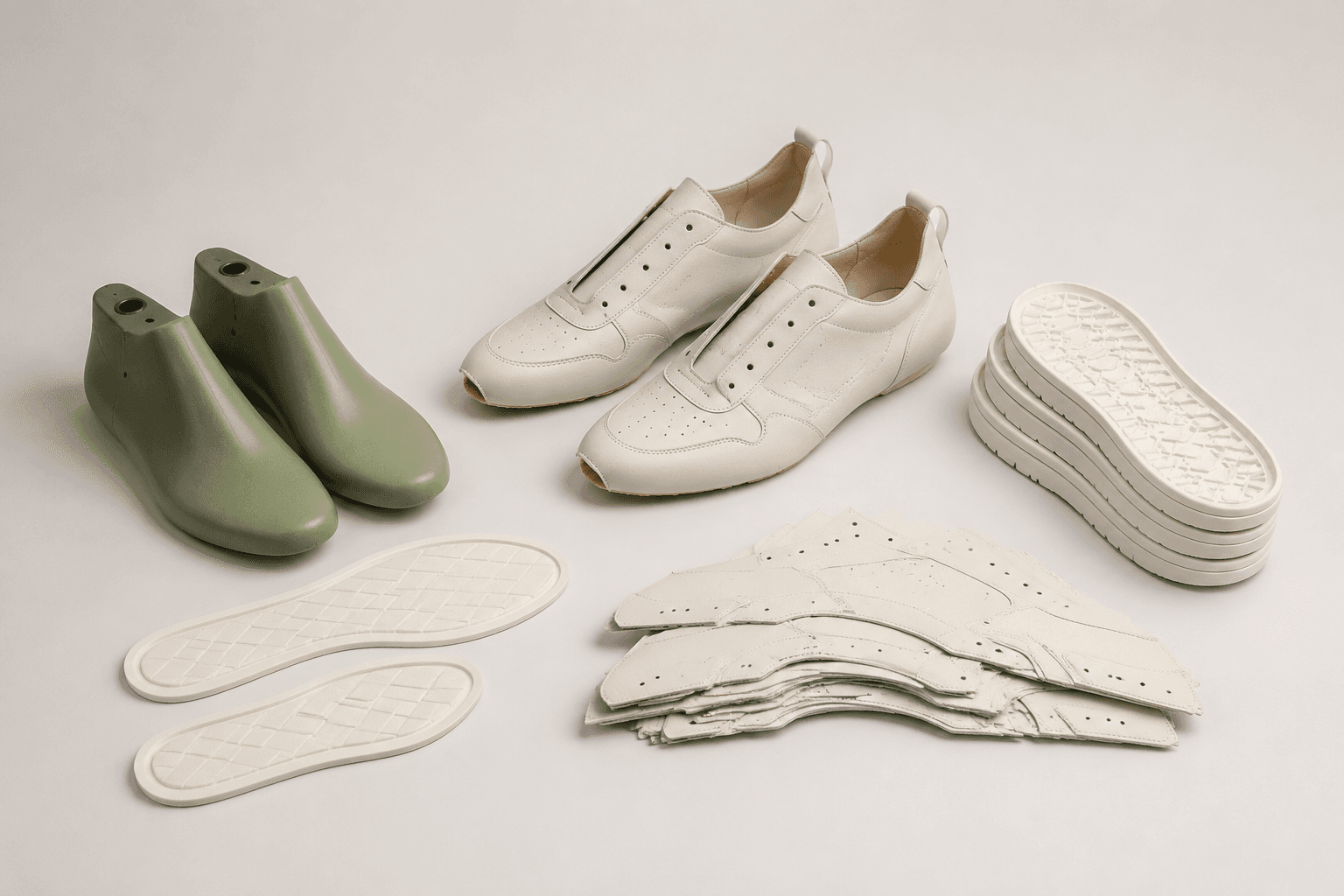
A buyer comparing China and Vietnam is not comparing countries in the abstract. They are comparing factory clusters, supplier depth, labor structure, and how quickly a product can move from tech pack to shipped pairs. In footwear, this includes pattern engineering, cutting, stitching, lasting, outsole pressing, cementing, vulcanization, finishing, packing, and third-party testing where required.
The comparison also changes by category. A canvas vulcanized shoe, a cemented fashion sneaker, an injected sandal, and a Goodyear-welted boot do not use the same supply base. A strong shoes china manufacturer may outperform Vietnam on trend-driven uppers and fast sample turns, while shoe manufacturers in vietnam may be more competitive on stable programs with larger repeat volumes and stricter buyer compliance routines.
- China is usually stronger in material variety, accessory sourcing, and rapid development cycles.
- Vietnam is usually stronger in large-scale line discipline and export-focused factory systems.
- The best footwear sourcing country depends on product type, annual volume, and tolerance for development complexity.
- FOB price alone is not enough; landed cost and execution risk matter more.
How factory capability should be defined
Capability in footwear is not just whether a factory has stitching lines. It should be defined by product-specific evidence: outsole process available, standard mold lead time, upper category experience, in-house lab scope, and actual monthly capacity in pairs by category. A factory saying it can produce 300,000 pairs per month means little if that capacity is concentrated in one process, such as stitched uppers, while outsole molding is outsourced.
For buyer evaluation, request style-level references: cemented runner with Phylon midsole and rubber bottom, cupsole court sneaker with stitched foxing, PVC rain boot, or leather work shoe with EN ISO 20347 or ASTM F2892 testing pathway. The more specific the capability statement, the more useful it is.
How the China footwear manufacturing system works
China's advantage is ecosystem density. In key footwear regions, outsole makers, foam suppliers, mesh mills, eyelet suppliers, box printers, insole converters, and testing labs sit within short trucking distance. That density reduces development friction. A buyer can revise upper GSM, switch lining foam from 4 mm to 6 mm, change strobel board spec, and often receive a revised sample in days rather than weeks.
For many importers, China remains the most flexible option for mixed orders across categories. A supplier can often consolidate fashion sneakers, kids' shoes, slippers, and packaging accessories under one management team even if some components are subcontracted. This matters when an importer wants to test multiple styles at 600 to 1,200 pairs per colorway rather than place a single high-volume line item.
- 01Buyer sends tech pack, last reference, target FOB, and compliance needs.
- 02Factory sources upper materials and outsole options from local partner suppliers.
- 03Pattern room builds first sample; upper and outsole revisions happen in parallel.
- 04Wear test and lab test are scheduled if needed for slip, abrasion, flex, bonding, or chemical compliance.
- 05Once fit and materials are approved, molds, dies, cutting markers, and line layout are finalized.
- 06Bulk production starts with material IQC, pilot run, inline inspection, and final random inspection.
Typical China MOQ, lead times, and pricing behavior
For non-branded commodity styles, many Chinese factories will quote MOQ at 600 to 1,200 pairs per style, sometimes split across 2 to 4 colors. For more complex athletic or molded products, practical MOQ often rises to 1,500 to 3,000 pairs per style because outsole molds, color compounding, and line setup costs need to be absorbed.
Sample lead time is often 7 to 21 days depending on whether standard lasts and stock outsoles are used. Bulk lead time after deposit and material confirmation is commonly 30 to 60 days for simple casuals and 45 to 75 days for more technical sneakers or seasonal peaks. Entry-level canvas shoes may quote at under $5 to $8 per pair FOB, while synthetic fashion sneakers can range from roughly $7 to $14, and better-built athletic-inspired styles with Phylon/rubber bottoms may run $11 to $22 depending on material and tooling.
Where China is especially strong
China is typically strongest in fast-fashion footwear, trend-sensitive women's shoes, casual sneakers, slippers, sandals, and projects needing multiple material substitutions during development. It is also strong when the buyer needs high accessory customization such as custom lace tips, debossed logos, transfer prints, private-label insoles, or mixed packaging formats across SKUs.
Technical control can also be very good in mature factories. Bonding tests, outsole hardness checks, color fastness, needle detection, carton drop tests, and AQL final inspections are standard in many export facilities. The key is screening for the right tier of supplier rather than assuming all factories operate the same way.
China vs Vietnam footwear sourcing comparison
| Factor | China | Vietnam |
|---|---|---|
| Typical MOQ | 600-1,200 pairs for simpler styles; 1,500-3,000 for complex custom shoes | 1,200-3,000 pairs common; 3,000-5,000 for more customized programs |
| Sample lead time | 7-21 days | 14-30 days |
| Bulk lead time | 30-60 days simple; 45-75 days technical | 45-75 days typical |
| Best fit | Fashion, casual, mixed SKUs, frequent revisions, packaging customization | Repeat programs, athletic/outdoor, sport sandals, stable volume |
| Supply chain depth | Very deep for uppers, outsoles, trims, packaging, and rapid substitutions | Strong but less dense; often more structured around planned sourcing |
| Cost behavior | Can reduce hidden cost through development speed and flexibility | Can be competitive on stable larger runs; less forgiving on small custom batches |
| Compliance and systems | Ranges widely by supplier tier; top export factories are strong | Often strong export-oriented process discipline |
How shoe manufacturers vietnam operate in practice
When buyers discuss shoe manufacturers vietnam, they are usually talking about larger export factories with disciplined production systems, often serving international brands in athletic, casual sport, outdoor, and sandal categories. Vietnam's footwear sector is heavily integrated into global export programs, which means many factories are structured around planned capacity, approved material vendors, and stable volume commitments rather than frequent low-volume experimentation.
This changes the sourcing dynamic. Buyers can get very good manufacturing consistency in Vietnam, but development may be less flexible than in China unless the factory specifically targets SME private-label programs. Many Vietnamese factories prefer confirmed annual forecasts, fewer style changes, and material packages that fit established production routines.
- Common sweet spot: repeat programs and medium-to-large order volumes.
- Often stronger on process discipline than on rapid style iteration.
- Frequently suited to sports, outdoor, sandal, and basic casual categories.
- Can be less accommodating on very low MOQ custom projects.
Typical Vietnam MOQ, lead times, and pricing behavior
For established export factories, MOQ is often higher than China. Buyers may see 1,200 to 3,000 pairs per style as a starting point, and 3,000 to 5,000 pairs is not unusual for custom outsoles, special color compounds, or multilayer technical uppers. Some trading-backed factories and smaller units offer lower MOQs, but their control over materials and scheduling can be narrower.
Sample lead time is commonly 14 to 30 days, especially if the factory needs to source specific components or align with nominated suppliers. Bulk lead time often runs 45 to 75 days, with longer windows during peak season or when imported materials are involved. FOB prices are not automatically lower than China. For labor-intensive uppers, Vietnam can be competitive, but for highly customized materials or broad component changes, total cost may rise because the surrounding supply base is less dense than in China.
Where shoe manufacturers in vietnam are strongest
Many shoe manufacturers in vietnam are strongest in athletic-inspired shoes, outdoor footwear, sport sandals, EVA-based constructions, and stable private-label programs where fit, assembly consistency, and compliance documentation matter. Buyers placing repeat lines of 20,000 to 100,000 pairs annually often value Vietnam's production discipline more than a marginal difference in first-cost.
Vietnam also tends to appeal to buyers who want a country-diversification strategy without moving into a far less mature footwear ecosystem. For importers already familiar with China, Vietnam is often the first alternative because the industrial base is proven, especially for export-oriented footwear.
China vs Vietnam on the cost stack: what really changes
The cost discussion should be separated into direct manufacturing cost and total sourcing cost. Direct manufacturing cost covers labor, upper and bottom materials, packaging, and factory overhead. Total sourcing cost adds molds, test charges, defects, delayed launch cost, replenishment speed, and container utilization.
In many projects, China wins on development economics even when Vietnam looks competitive on labor. That is because China can often reduce hidden cost through faster sample turns, lower small-batch material premiums, and easier changes to eyelets, webbing, labels, insock foam, or outsole compounds. Vietnam can win where production is standardized and the buyer commits enough volume to offset higher setup thresholds.
Technical comparison by product type
Product type is the fastest way to choose the right footwear sourcing country. Different constructions stress different parts of the supply chain. A buyer should map the construction first, then the country.
Casual sneakers and fashion footwear
China usually has the edge for casual sneakers, vulcanized shoes, cupsole fashion styles, and trend-driven collections with frequent material refreshes. Uppers may involve PU, microfiber, canvas from 8 oz to 14 oz, open mesh, sandwich mesh, suede split, and decorative trims that need flexible sourcing. Typical EVA sockliner densities may range from 0.11 to 0.18 g/cm3, while Phylon midsoles often target around 0.20 to 0.28 g/cm3 depending on compression and feel.
If the collection changes every season and style count is high, China is normally easier to manage. Buyers can split production among multiple specialized suppliers while still sourcing boxes, tissue, hangtags, and accessories from the same region.
Athletic, outdoor, and sport sandal programs
Vietnam is often very competitive for athletic-inspired and outdoor programs where line balancing, repeatability, and documentation are critical. On sport sandals, the factory's control over webbing cuts, edge finishing, EVA footbed density, and outsole rubber abrasion performance matters more than decorative flexibility. Buyers should ask for density specs, Shore A hardness targets, bond strength data, and SATRA or equivalent lab experience where relevant.
For these products, a disciplined bulk process can matter more than ultra-fast sample speed. If the outsole compound, tread design, and fit are already frozen, Vietnam can be a strong production platform.
Safety, occupational, and uniform footwear
Neither country should be selected casually for safety shoes. The question is factory certification pathway and test repeatability. If the product must align with EN ISO 20345, EN ISO 20347, ASTM F2413, or ASTM F2892 type requirements, ask whether the factory has recent test reports for slip resistance, impact, compression, puncture, upper tear, sole bond, and hydrolysis where applicable.
China has a broad range of safety footwear factories, from low-cost producers to highly competent export plants. Vietnam can also produce these categories, but the supplier pool is narrower. For buyers needing low-volume custom safety lines, China is usually easier. For larger stable orders with established constructions, either country can work if the test discipline is proven.
Why this matters to sourcing managers and brand owners
The wrong country choice creates avoidable friction. A buyer placing 800 pairs per color across 12 fashion SKUs may struggle in Vietnam because MOQ and development cadence are misaligned. A buyer placing a repeated 40,000-pair sport sandal program may overpay in management time if they keep changing Chinese factories instead of locking a stable Vietnamese partner.
This is also a margin issue. On a $12 FOB shoe, a $0.40 savings is less valuable than cutting one failed launch, one late vessel, or one excessive defect lot. Country selection should reduce total volatility, not just first-cost.
When to use China and when to use Vietnam
The practical choice is straightforward when the sourcing objective is clear. Buyers should match country to order profile, not trend.
- 01Use China when you need lower MOQ, faster development, broader material choice, or mixed-category consolidation.
- 02Use China when outsole tooling, packaging customization, and frequent upper revisions are central to the project.
- 03Use Vietnam when you have forecastable repeat volume, stable tech packs, and a product that fits established export lines.
- 04Use Vietnam when process discipline, capacity planning, and country diversification are more important than rapid style iteration.
- 05Use a dual-country strategy when your core volume is stable but your seasonal capsule collection changes quickly.
How to evaluate factories before shifting country
Do not shift country based on one quotation sheet. Ask both Chinese and Vietnamese suppliers to quote the same bill of materials, same packaging, same incoterm, same test standard, and same inspection protocol. Then compare not just FOB but mold cost, sample lead time, bulk lead time, payment terms, tolerance handling, and defect response process.
Run a factory audit focused on footwear realities: clicking yield control, stitching defect rate, adhesive room conditions, lasting consistency, outsole adhesion process, metal contamination control where needed, and final inspection records by size breakdown. For materials, confirm whether the factory can lock foam density, rubber hardness, fabric GSM, and color tolerance lot to lot.
- Ask for actual monthly capacity by construction, not just headline pair count.
- Request recent test reports relevant to your category.
- Check whether outsoles, insoles, and cartons are in-house or outsourced.
- Verify pilot-run approval steps before full production release.
- Confirm tolerance standards for color, weight, glue marks, and bond strength.
SoleForge manufactures athletic & running shoes and casual sneakers under OEM and ODM for brands and importers worldwide. Request a quote with your tech pack or reference pair and we'll reply within one business day.