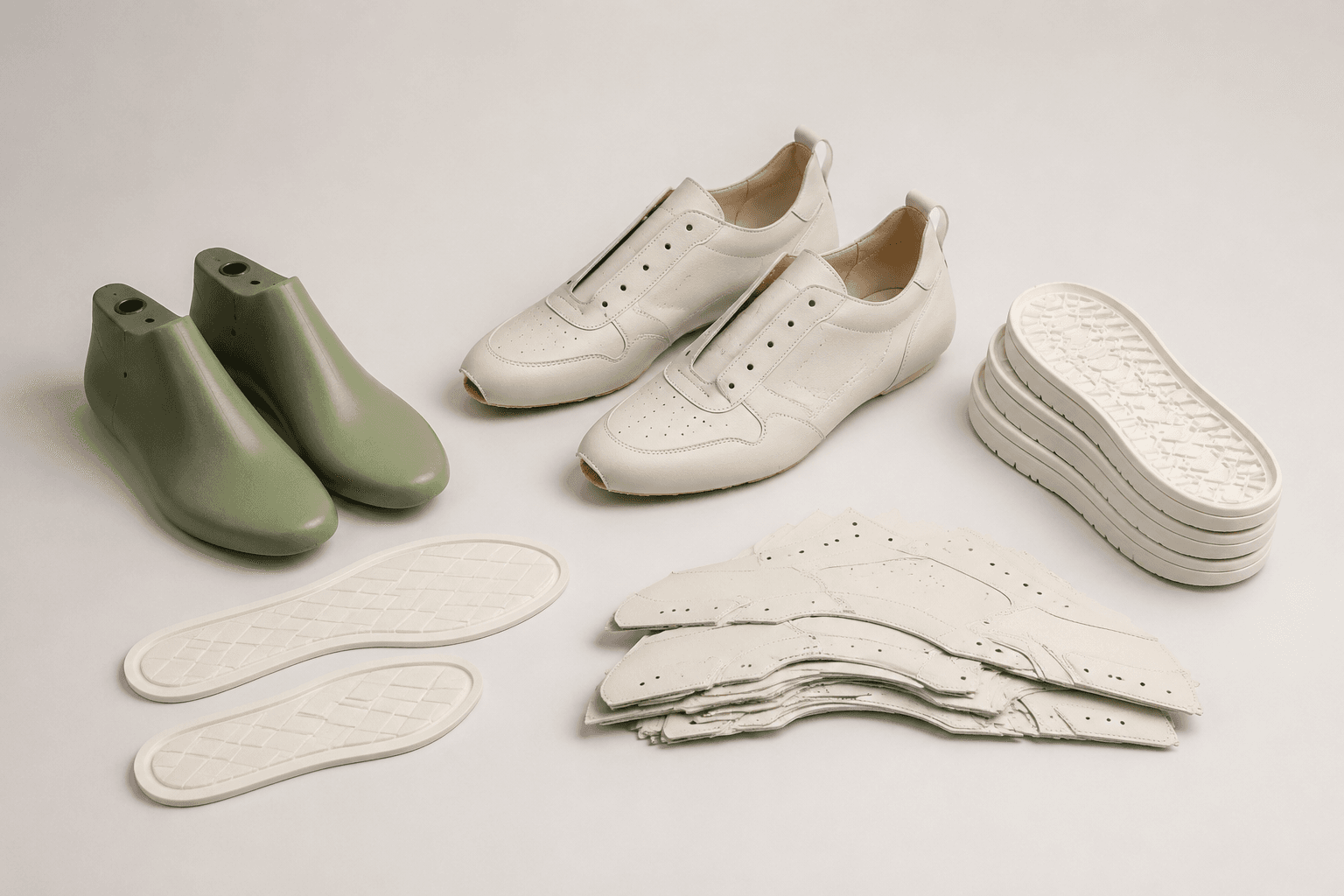
When buyers compare shoe outsole types, the decision is rarely about appearance alone. In bulk footwear sourcing, outsole selection affects FOB price, mold investment, minimum order quantity, production lead time, durability claims, slip performance, carton weight and even claim rates after shipment. For sourcing managers and brand owners buying from China, outsole material should be specified as a commercial and technical decision, not left as a factory default.
The four outsole materials most commonly compared in mass-market footwear are rubber, EVA, TPR and TPU. Each serves a different price band and product brief. A rubber outsole generally delivers the best abrasion and grip profile, but with higher compound cost and weight. EVA is the lightest and often the lowest-cost route for casual and injection-friendly constructions, though compression set and wear life must be controlled. A TPR sole sits in the middle for lifestyle and kids' footwear, while TPU is typically chosen for higher mechanical performance, cleaner detailing and specific sports or safety applications.
This article explains these shoe outsole types as a sourcing spec and cost breakdown. The focus is practical: typical hardness and density ranges, tooling and MOQ expectations, lead times in days, common EN ISO and ASTM tests, and where each outsole material fits commercially in bulk orders.
In footwear sourcing, the cheapest outsole quote is often the most expensive decision once wear claims, freight weight and mold risk are included.
How outsole material changes price, performance and production risk
Outsole cost is driven by more than raw material price per kilogram. Buyers need to account for compound type, part weight, mold cavitation, surface texture complexity, color count, logo depth, anti-slip pattern, scrap rate and whether the outsole is compression molded, injection molded or direct attached. A low quoted outsole can become expensive if the wear rate fails, the mold runs slowly, or the pair weight pushes up freight.
In China factories, outsole cost is usually quoted per pair based on size scale, average piece weight and annual volume. For adult casual shoes, outsole weight may range from 180 g/pair for lightweight EVA up to 700 g/pair or more for heavy lug rubber. Material volatility also differs: natural and synthetic rubber compounds move with petrochemical and commodity trends, while TPU is more sensitive to grade selection and hardness requirements.
From a risk perspective, outsole material also determines what claims are realistic. If a buyer wants strong wet slip performance, 30,000+ flex cycles, low-temperature crack resistance and abrasion targets suitable for workwear or hiking, an EVA bottom is usually not the correct starting point. If the target is a light athleisure shoe under a strict FOB ceiling, a heavy carbon rubber outsole may be over-engineered.
- 01Define end use first: casual lifestyle, running-inspired, outdoor, kids, safety, uniform or indoor.
- 02Set target FOB, pair weight and expected wear life before confirming outsole material.
- 03Confirm required test standards early, especially slip, abrasion, flexing and hydrolysis where relevant.
- 04Ask the factory to quote outsole cost separately from upper and midsole so cost-down options stay visible.
Rubber outsole: highest wear resistance in mainstream footwear
A rubber outsole remains the benchmark when buyers prioritize abrasion resistance, grip and outdoor credibility. In bulk production, this usually means a synthetic rubber or mixed compound rather than high-natural-rubber content alone. Common hardness sits around Shore A 55-75 depending on category. Softer compounds improve grip but can increase wear. Harder compounds extend life but may feel less compliant on smooth indoor surfaces.
For hiking shoes, vulcanized canvas styles, workwear and uniform footwear, rubber is often the safest specification because it is familiar, robust and broadly testable. Typical DIN abrasion values for decent compounds may fall roughly in the 120-200 mm3 range, though target values vary by category and test method used by the buyer's lab. Slip resistance can be tuned through both compound and tread geometry, and that tuning matters as much as the base polymer.
Cost is the main trade-off. Rubber outsoles are heavier, cycle times can be longer than simpler EVA solutions, and complex multi-part tooling increases mold cost quickly. For adult sizes, outsole cost can range widely from about $1.20 to $3.80/pair in standard commercial programs, and higher for technical hiking or branded compounds. MOQ is often 1,200-3,000 pairs per colorway for efficient molding, but some factories will support lower trial runs with a surcharge.
- Best for: hiking, workwear, vulcanized casual, school shoes, uniform, durable kids' styles
- Typical hardness: Shore A 55-75
- Typical pair weight: 350-700 g/pair adult, depending on lug depth and size set
- Typical mold lead time: 12-20 days for a new outsole mold after CAD confirmation
- Typical bulk production lead time: 30-45 days after material approval and deposit
Rubber cost drivers buyers should check
The first driver is compound formula. A basic black outsole with recycled filler content will price differently from a clean-color, non-marking, anti-slip compound. Non-marking rubber for indoor or court-inspired use generally costs more. Deep lugs, undercuts and sharp logo details also reduce mold efficiency and can raise reject rate.
The second driver is construction. A full rubber bottom on a cemented shoe is straightforward, but a rubber outsole combined with a separate EVA or PU midsole introduces bonding control, primer selection and additional labor. If the midsole is visible, the cosmetic reject threshold usually rises as well.
The third driver is testing. If your program requires EN ISO 20347 or ASTM F2913-style slip testing for occupational footwear, ask the factory what compound has passed before. A generic low-cost rubber recipe may not meet target coefficients on wet tile or glycerol-contaminated surfaces.
Shoe outsole types: bulk sourcing spec and cost comparison
| Outsole material | Typical range | Notes |
|---|---|---|
| Rubber outsole | $1.20-$3.80/pair; MOQ 1,200-3,000 prs/color; mold lead time 12-20 days; Shore A 55-75 | Best abrasion and outdoor credibility; heavier at 350-700 g/pair adult; suitable for hiking, workwear, school and durable casual |
| EVA outsole | $0.70-$1.80/pair; MOQ 1,000-2,500 prs/color; mold lead time 10-15 days; density 0.20-0.35 g/cm3 | Lightest option; lower abrasion resistance; ideal for slippers, sandals and lightweight athleisure; control compression set and wear |
| TPR sole | $0.90-$2.20/pair; MOQ 1,000-1,500 prs/color; mold lead time 10-18 days; Shore A 50-80 | Economical for casual and kids; good molding detail; verify slip, abrasion and cold flex by exact compound |
| TPU outsole | $1.80-$4.50/pair; MOQ 1,200-3,000 prs/color; mold lead time 14-25 days; Shore A to Shore D grades | Higher mechanical performance and sharp detailing; suitable for premium sport, technical casual and safety-related components |
| Rubber pods on EVA base | Add about $0.25-$0.80/pair vs all-EVA; extra bonding step; 3-7 added development days | Common cost-performance compromise for athleisure; improves heel and forepart wear without full rubber weight |
| Testing cost driver | Third-party lab commonly $150-$500/test set depending on scope | Typical checks include abrasion, hardness, flexing, slip resistance, bonding, density and aging |
| Tooling cost driver | Simple outsole mold about $800-$2,500; technical multi-part mold $3,000-$8,000+ | Driven by size run, cavities, undercuts, side textures, transparent windows and multi-color parts |
EVA outsole: lowest weight, fast commercial option, shorter wear life
EVA is used both as midsole foam and, in many commercial shoes, as exposed bottom material or integrated outsole. For buyers, that distinction matters. When EVA contacts the ground directly, it reduces weight and often cost, but usually sacrifices abrasion resistance versus rubber or TPU. Typical EVA density for outsole-use ranges around 0.20-0.35 g/cm3 depending on foaming level, rebound target and whether the part is injection or compression molded.
EVA is a practical choice for slippers, beach sandals, lightweight athleisure, house shoes and price-sensitive casual products where comfort-in-hand and low freight weight matter more than long-term wear. For adult footwear, the outsole or one-piece bottom cost can be as low as about $0.70-$1.80/pair in straightforward programs. Tooling is often simpler than for multi-part rubber constructions, and color matching in bright shades is easier.
The weakness is durability under repeated abrasion and compression. EVA bottoms can flatten over time, lose edge definition and show heel wear faster, especially on rough pavement. A buyer selling through value retail should be clear on expected wear life and complaint tolerance. If the product brief says 'running look' but the actual use is daily urban commuting, an all-EVA bottom can create avoidable returns.
- 01Use EVA outsole constructions when target pair weight is critical and expected wear is light to moderate.
- 02Add rubber pods at heel and forepart if the retail brief needs better abrasion without moving to a full rubber bottom.
- 03Specify density, hardness and compression set limits in the tech pack, not just color and shape.
EVA specifications that should not be left open
Factories may describe EVA simply as 'soft' or 'light,' which is not enough for commercial control. Buyers should request density, hardness range, and whether the material is standard EVA, modified EVA or blended for improved resilience. Shore C hardness is common for foamed parts. Compression set and shrinkage behavior should be checked during wear testing and after aging, especially for open-edge white bottoms where deformation is visible.
For quality control, ask for part weight tolerance per size, color migration risk if dark upper materials touch light EVA, and bonding method if rubber pads or foxing pieces are attached. EVA can deliver strong margin in low-to-mid price programs, but only when the use case is realistic.
TPR sole: flexible and economical for casual and kids' shoes
A TPR sole generally refers to thermoplastic rubber compounds molded with the visual feel of rubber but processed like a thermoplastic. In practical sourcing terms, TPR is used heavily in women's casual, kids' footwear, sandals, and some fashion sneakers because it balances appearance, flexibility and cost. It can provide a rubber-like look with cleaner molding and shorter processing cycles than some traditional rubber setups.
Typical TPR hardness may range from Shore A 50-80 depending on the formulation. Pair cost often falls around $0.90-$2.20 for standard adult fashion applications, making it competitive in mid-value programs. Tooling lead time is commonly around 10-18 days, and MOQ can start from 1,000-1,500 pairs per color for simple molds, though exact minimums depend on sole size run and line loading.
The commercial advantage is versatility. TPR can take detailed textures, translucent effects and fashion-driven sidewall designs well. The technical limitation is that not all TPR compounds perform equally in abrasion, cold flex or long-term aging. Lower-cost grades may harden, crack or become slippery if the formulation is not controlled.
- Best for: kids' casual, women's flats, sandals, fashion sneakers, value lifestyle shoes
- Typical pair weight: 250-500 g/pair adult
- Typical processing: injection molding
- Main watchpoints: oil exudation, low-temperature brittleness, inconsistent slip on smooth wet floors
When TPR is a better buy than rubber
TPR is often the smarter sourcing choice when the product is fashion-led, seasonally refreshed and not expected to deliver heavy outdoor wear. For a women's casual line selling at moderate retail, TPR can preserve the look of a substantial outsole without the same compound cost and weight as full rubber. It also supports more decorative mold features with less finishing labor.
However, buyers should not assume all TPR behaves like premium rubber. Ask for abrasion results, flex test data and slip performance from the exact grade proposed. If there is no approved historical formula at the factory, insist on wear trial confirmation before bulk approval.
TPU outsole: premium mechanical performance and precise detailing
TPU is selected when buyers need a higher-performance thermoplastic with strong abrasion resistance, crisp molding detail, good flex durability and a more technical aesthetic. In footwear, TPU is common in football outsole plates, trail running components, safety toe area support parts, high-wear inserts and premium casual bottoms where edge definition matters. Hardness varies broadly, often from Shore A into Shore D depending on application and whether the part is solid or expanded.
Compared with TPR, TPU usually costs more but offers better consistency in many demanding applications. For adult outsoles or substantial outsole components, the cost can range from about $1.80 to $4.50/pair, and higher if the design uses transparent grades, multi-density parts or complex technical geometry. Tooling can also be more expensive because gate design, shrinkage control and cosmetic standards are tighter.
Buyers should also evaluate hydrolysis resistance for humid markets and long storage cycles. Standard polyester-based TPU may not be ideal in every climate or warehouse condition. If the product will be sold in tropical regions or held in inventory for long periods, ask whether a polyether-based or hydrolysis-resistant grade is required.
Where TPU earns its higher cost
TPU makes sense when outsole failure would damage the brand position more than the added cost damages margin. It holds sharp logo lines, windows, cleat forms and support geometries better than many lower-cost materials. It also performs well in thin-wall or structured areas where a soft TPR may deform.
For importers developing premium athleisure, football, golf-inspired or safety-related styles, TPU can reduce cosmetic variation from pair to pair. The trade-off is higher resin cost, stricter process control and less room for aggressive cost-down without changing the aesthetic or performance.
Testing and compliance: what bulk buyers should ask for before PO release
Outsole material should be approved against the intended market and category standard, not just against a salesman sample. For Europe, relevant footwear testing may refer to EN ISO methods depending on use case, especially in occupational or safety-related categories. For the US, ASTM methods may apply to slip or performance claims. In commercial casual footwear, suppliers often rely on internal test protocols unless the buyer defines external laboratory requirements.
At minimum, buyers should consider abrasion resistance, flexing, hardness, bonding strength where applicable, slip resistance and color migration or yellowing for light-colored bottoms. For foamed or lightweight materials, compression set and density consistency are also important. If the outsole includes direct contact claims such as oil resistance, anti-slip or non-marking, those should be validated on the exact compound and tread design, not copied from another style.
A common sourcing mistake is approving upper materials and final silhouette first, then trying to force the outsole into an unsuitable price point. Outsole rework is slow and expensive because it touches molds, wear testing and pair balance. The cheaper approach is to align material, construction and test target during development stage.
- 01Request compound name or internal formula code on all lab reports so the tested material matches bulk.
- 02Approve outsole color chips and hardness range before cutting steel for the mold.
- 03Run flex and abrasion tests on confirmation samples, not only on first trial parts.
- 04For safety or occupational styles, confirm target EN ISO or ASTM clause numbers in writing before sample sign-off.
Commercial guidance: choosing the right outsole for bulk buying from China
For bulk programs, the right outsole is the one that meets the retail brief at the lowest total landed risk, not the lowest ex-factory material cost. Rubber is usually the safest choice for durability-led products. EVA is efficient for lightweight value product where wear expectations are limited. TPR supports fashion and kids' lines with balanced cost and molding freedom. TPU belongs in premium technical, sports-influenced or highly detailed outsole packages.
Factories in China will often propose substitutions to hit FOB targets. That is normal, but buyers should require side-by-side comparisons with pair weight, estimated outsole cost, mold fee, MOQ and test risk. If one option reduces cost by $0.18/pair but increases claim exposure or delays mold completion by two weeks, it may not be the real saving.
As a buying rule, specify outsole material in commercial language and engineering language together: material family, hardness, density where relevant, target tests, finish, color, average pair weight and approved use category. That is how sourcing teams keep development aligned with margin.
SoleForge manufactures safety & work shoes and athletic & running shoes under OEM and ODM for brands and importers worldwide. Request a quote with your tech pack or reference pair and we'll reply within one business day.