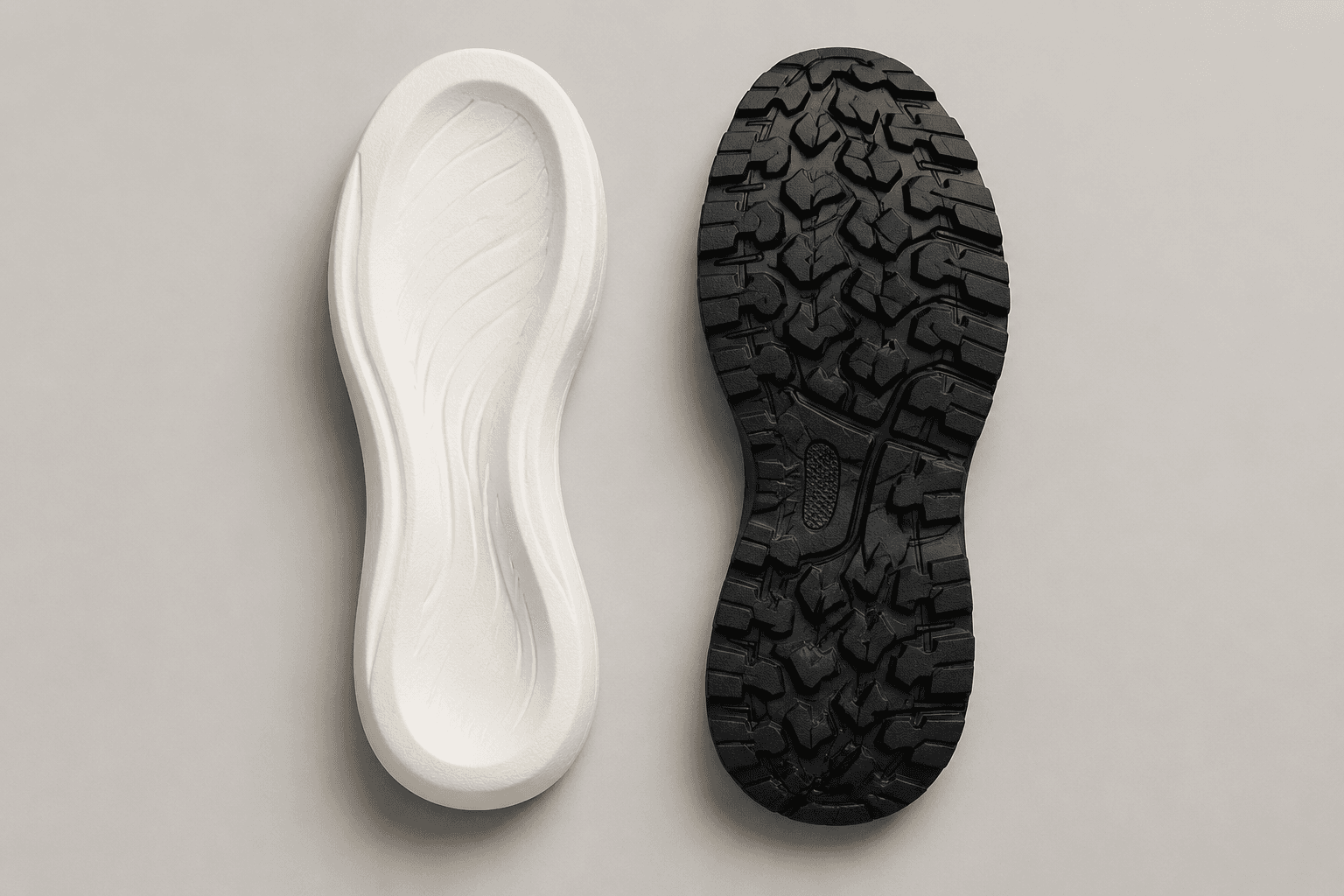
Bulk footwear buying always forces one trade-off: approve fast to protect vessel booking and ex-factory date, or approve late enough to remove fit, material, and construction risk. In China sourcing, that decision directly affects cost. One extra sample round may add 5 to 10 calendar days and USD 90 to USD 220 per pair, but one weak approval on a 6,000-pair order can lock in the wrong last fit, the wrong foam package, misaligned branding, or packaging that fails drop testing.
For sourcing managers, brand owners, and importers, shoe sample approval is the point where design intent becomes a production standard. The approved pair tells the factory exactly what to copy in bulk: upper material code, mesh GSM, synthetic thickness, collar foam density, strobel setup, outsole hardness, logo method, labeling, and carton specification. Once that approval is released, the factory usually starts bulk material booking, line planning, cutting schedules, and inline QC setup against that sample.
The comparison that matters is not sample versus no sample. It is which sample stage is strong enough to release bulk with controlled risk. A development sample is useful for proportion and look. A salesman sample is useful for presentation and market sign-off. A pre-production sample is usually the only stage that should authorize cutting on a new style, because it can verify the real BOM, confirmed colorway, actual process route, and the tolerances the line must hold.
In footwear sourcing, the sample that saves the most time is not the one approved fastest; it is the one that leaves the fewest assumptions for bulk.
The trade-off: faster approval versus lower bulk risk
Many buyers negotiate FOB down to the last USD 0.10 per pair, then approve a sample with open technical points. From the factory side, that is where avoidable claims begin. On a vulcanized canvas shoe, the damage may be limited to foxing height, sidewall color, or patch alignment. On a cemented runner with phylon midsole, rubber pods, welded film, and molded heel counter, weak approval can force upper recutting, mold polishing, compound adjustment, and shipment delay of 2 to 4 weeks.
The expensive part is not the sample charge itself. It is the ambiguity. If the buyer approves without confirming mesh GSM, synthetic thickness, collar foam density, insole board spec, sockliner hardness, outsole Shore A, labeling content, and packing method, production will fill the gaps with house standard materials or cost-down assumptions. That may still pass appearance review while failing wear, fit, or compliance after the order is already on the line.
Typical numbers are clear enough to justify stricter control. A custom outsole project often requires MOQ of 1,200 to 3,000 pairs per colorway. A fresh upper sample usually takes 7 to 12 days. Last correction or outsole mold adjustment can add 15 to 30 days. Sample cost is commonly USD 60 to USD 120 per pair for simple slippers or vulcanized canvas, and USD 120 to USD 280 per pair for cemented sport, outdoor, or injected constructions. Compared with a rejected 20-foot container or a retailer chargeback, disciplined shoe sample approval is usually the lower-cost decision.
- Custom cupsole or outsole mold MOQ commonly starts at 1,200 to 1,500 pairs per colorway
- Open-stock repeats may run below 800 pairs if outsole, last, upper material, and packing stay unchanged
- Upper remake after fit comments is often 7 to 12 days; outsole tooling correction is often 20 to 30 days
- Incorrect bulk approval on a new molded outsole program can create USD 3,000 to USD 8,000 in rework, tooling revision, or scrapped materials
Comparing the sample options before bulk release
Not every sample is meant to carry the same approval weight. In footwear production, each stage answers a different operational question. Buyers should compare them by what they can actually prove: shape, fit, material authenticity, process stability, packaging readiness, or compliance readiness.
Earlier samples save calendar time but depend on more substitutions. Later samples cost more and move slower, but they remove more uncertainty. The correct choice depends on whether the order is a repeat SKU, a new outsole program, a fit-sensitive category such as performance running or safety footwear, or a destination market with stricter test and labeling requirements.
Development sample versus salesman sample
A development sample is for direction, not final release. It helps confirm silhouette, panel proportion, topline shape, toe spring, sidewall profile, and logo scale. It is useful when the buyer is still deciding whether the runner should look more technical, whether the cupsole should appear slimmer, or whether the sandal upper needs stronger coverage. But development pairs often use substitute mesh, hand-cut overlays, temporary sockliners, or manual cementing that will not be repeated in line production. For that reason, development stage is too early for final shoe sample approval on most custom footwear.
A salesman sample usually looks cleaner. Stitching is more even, branding is more presentation-ready, and finishing is closer to commercial standard. It is suitable for line review and customer presentation. Still, factories often build salesman pairs with non-bulk trims, hand-adjusted lasting, substitute lace tips, or cosmetic finishing beyond normal line output. It can support commercial sign-off, but it should not automatically release bulk materials unless the style is a proven repeat with unchanged fit block and BOM.
Pre-production sample versus direct bulk approval
A pre-production sample is the most reliable checkpoint because it should match the confirmed BOM, approved color standard, real logo process, intended upper and outsole materials, and actual assembly route. In practice, that means the same mesh supplier, the same PU or microfiber code, the same EVA density, the same outsole rubber recipe, the same sockliner construction, and the same carton board grade intended for shipment. If the sample uses substitute backing, temporary lace, trial glue, or a different outsole compound, it is not a true pre-production reference.
Direct bulk approval is defensible only on stable repeat programs where last, outsole, upper material, artwork, labels, and pack-out remain unchanged. Even then, buyers still need to confirm care label text, legal marking, barcode, carton dimensions, color standard, and any updated compliance points such as REACH restricted substances, EN ISO slip resistance expectations, or ASTM-related category requirements for the destination market.
Comparison of footwear sample approval options before bulk
| Option | Best use | Main advantage | Main risk | Typical impact |
|---|---|---|---|---|
| Development sample | Confirm silhouette, upper panel balance, outsole proportion, and logo scale | Fastest early feedback with low tooling commitment | Usually built with substitute materials, manual operations, or temporary trims | 3 to 10 days, lower sample cost, high risk if used to approve bulk |
| Salesman sample | Range review, buyer presentation, and commercial sign-off | Cleaner appearance and better finishing for market review | May still differ from bulk trims, fit tuning, and real line workmanship | 7 to 14 days, medium sample cost, moderate risk if technical points stay open |
| Pre-production sample | Final gate before cutting, stitching, and assembly start | Closest match to real BOM, process route, color standard, and packaging | Adds one approval cycle and can delay ex-factory if comments come late | Usually 5 to 10 extra days, strongest bulk control, lowest avoidable claim risk |
| Direct bulk approval on repeat style | Stable repeats with no change to last, outsole, upper material, labels, artwork, or packing | Fastest route to material booking and line reservation | Any unnoticed drift in color, labeling, or workmanship goes directly into bulk | 0 to 3 days, lowest admin time, suitable only for controlled repeat programs |
The buyer's footwear sample checklist before approving bulk
A strong footwear sample checklist should cover five control areas: fit, material set, construction quality, branding and packaging, and compliance. If one of those is still open, the sample is not ready for bulk release. In footwear, appearance review is only the first screen. Many failures show up only in flexing, heat aging, fitting, or carton handling.
The checklist should be checked against the live tech pack, BOM, grading chart, and approved artwork file, not only against photos. Photos help confirm proportion, color blocking, logo placement, and outsole shape. They do not confirm internal length, upper thickness, collar recovery, bonding quality, or carton compression strength. A proper sample submission should include material swatches, size spec, outsole hardness reading, and any available in-house test data.
- 01Fit and sizing: confirm last code, internal length, width grading, toe allowance, heel grip, topline opening, and sockliner thickness. For adult closed shoes, many importers review one core size and one edge size before bulk.
- 02Upper materials: verify material code, thickness in mm, backing construction, surface finish, color lot, abrasion behavior, and GSM where relevant. Mesh at 280 GSM will not wear or hold shape like mesh at 180 GSM.
- 03Foam package: confirm tongue foam thickness, collar foam density, strobel foam if used, insole top cover, PU or EVA footbed hardness, and compression recovery after 24 hours. In sport shoes, collar foam often targets 45 to 55 kg/m3 and tongue foam 5 to 8 mm before lasting.
- 04Construction: review stitch density, seam allowance, lasting margin, cement line cleanliness, outsole alignment, heel counter rigidity, toe spring, and flex point. For cemented shoes, buyers should ask for upper-to-sole adhesion data after heat aging where available.
- 05Branding and packaging: check print edge sharpness, deboss depth, emboss consistency, transfer adhesion, woven label content, lace tip finish, pairing method, barcode accuracy, carton mark, tissue paper, and size sticker position.
- 06Compliance and testing: align the sample with destination requirements such as EN ISO or ASTM-related performance checks, restricted substances, color fastness, adhesion, slip resistance, odor, and carton transit performance before authorizing bulk.
Where measurable specs remove approval mistakes
The fastest way to strengthen shoe sample approval is to replace subjective comments with measurable limits. 'Make the sole softer' is too loose for a compound supplier. 'Outsole target Shore A 58 to 62' or 'EVA midsole target Asker C 48 to 52' is workable. The same applies to mesh weight, microfiber thickness, foam density, finished shoe weight, lace diameter, and logo position tolerance.
On a lightweight running shoe, a buyer may set sandwich mesh at 240 to 300 GSM, tongue foam at 6 to 8 mm before lasting, collar foam density at 45 to 55 kg/m3, strobel foam at 3 to 4 mm, rubber pod hardness at Shore A 60 to 65, and peel strength to the buyer's internal requirement after heat aging. On a vulcanized canvas shoe, the key values may instead be 10 oz to 12 oz canvas, foxing height tolerance within 1.5 mm, toe cap alignment, sulfur odor limit, and upper-to-rubber bond after oven aging.
For a PU fashion sneaker, the focus shifts again: synthetic upper thickness at 1.2 to 1.4 mm including backing, topline foam density, sockliner rebound, collar opening consistency, sidewall color tolerance, and edge paint rub resistance. A written numeric standard does not slow development. It shortens argument later, because merchandising, sample room, production, and QC all work to the same target.
- One additional pre-production round usually adds 5 to 10 days when main materials are already booked
- Casual rubber outsole hardness often sits around Shore A 55 to 65; heavier cupsoles may run 65 to 75 depending on wear target
- Common collar and tongue foam density range is about 40 to 60 kg/m3 depending on rebound and hand feel target
- Typical bulk tolerances discussed at approval include color shade, finished weight, outsole hardness, foxing height, and logo position by mm
Compliance and performance points buyers should not leave open
For export footwear, technical approval should also connect to the test basis. A sample may look correct and still fail the destination market because the material set or labeling was not frozen early enough. From the supplier side, the safest process is to align the pre-production sample with the intended compliance file before cutting. That includes chemical screening, performance expectations, and packaging details.
The exact standard depends on category and market, but common checkpoints include upper-to-sole adhesion, flexing resistance, color fastness to rubbing, abrasion behavior, slip resistance, odor, labeling, and restricted substances. Safety footwear and occupational styles usually require tighter alignment with EN ISO performance categories. Work, uniform, or specialty programs for North America may also reference ASTM-related requirements depending on product use. Even when a third-party lab test comes later, the sample should already reflect the materials that will be tested.
Packaging should be treated the same way. If the buyer changes carton board grade, dimensions, divider format, or barcode location after sample approval, the shipment risk shifts from product to logistics. A carton that passes visual review may still fail stacking, burst, or drop conditions in transit. That is why packaging approval should be part of the same footwear sample checklist, not a separate afterthought.
- Pre-production samples for compliance-sensitive orders should use the same bulk-intended upper, outsole, glue system, sockliner, and labels
- EN ISO references are common on occupational or safety-related footwear; ASTM references appear on some North American programs by use category
- Carton board grade, carton size, barcode placement, and pair packing method should be frozen before bulk if the booking window is tight
- Changing label content or country-of-origin marking after approval can delay shipment even when the shoe itself is acceptable
When fast approval is justified and when the order should stop
Fast approval is reasonable only when the program is a true repeat: same last, same outsole, same upper supplier, same material code, same branding method, and same pack-out. In that situation, moving directly from confirmation sample to production can help protect a 30 to 45 day ex-factory target and secure vessel space during peak season. Even on repeats, the buyer should still confirm current labels, color standard, and carton dimensions against the booking plan.
Buyers should stop the order when technical risk is still open. Common triggers are a new outsole mold, first use of recycled knit or new microfiber, first production on a new fit block, visible left-right upper mismatch, unstable heel counter, excessive toe collapse, uncertain cement line, pending chemical results, or packaging that still lacks final barcode or origin mark. A 7-day delay at approval stage is usually much cheaper than a full rework after materials are cut.
The key is to separate cosmetic tolerance from claim risk. A heel logo offset of 0.8 mm may be acceptable if the written limit is plus or minus 1.0 mm. Heel slippage, foam collapse, outsole hardness drift, or incorrect legal labeling are not tolerance issues. They are order-stop issues because they can fail inspection, wear test, or customs and retailer checks.
- Approve faster on repeat SKUs with stable fit history and no change to outsole, last, upper material, artwork, or packing
- Stop immediately on first production run with new tooling, new fit block, or new material supplier
- Hold if the color standard still fails light-box review such as D65 and TL84 comparison
- Hold if compliance file, carton spec, barcode data, or legal labeling remains incomplete
How final sample approval should be documented
Once the sample is accepted, the approval should be issued as a production instruction, not a casual email saying 'OK to proceed.' At minimum, the buyer should release a signed comment sheet, approved photos from standard views, final BOM, measurement chart, artwork file status, and full packaging specification. The physical pair should be sealed by both buyer and factory as the master reference for inline and final inspection.
On larger orders, the factory should link that approved pair to the internal production file, material issue list, cutting plan, QC checklist, and line briefing. Without that step, merchandising may work from one version while stitching or assembly works from another. This is a common failure point when late comments are agreed in chat but never transferred into the controlled file used on the line.
The approval should also state the approval level. Appearance approval, fit approval, and full production release are different decisions. A buyer may approve upper look and logo placement while still holding bulk pending REACH screening, slip testing, carton verification, or a wear test result. If that distinction is not written clearly, the factory may read the message as full bulk authorization and start irreversible processes too early.
- 01Record sample code, date, colorway, size, last code, outsole mold number, and sample version.
- 02Attach the final BOM and list any approved substitution by material code, thickness, GSM, density, or supplier.
- 03State tolerances for color, dimensions, finished weight, hardness, and logo position in measurable terms.
- 04Define which tests must pass before cutting, before lasting, or before shipment.
- 05Seal one counter sample at the factory and one at the buyer office or third-party QC location for inspection reference.
Verdict: the safest approval path before bulk
For most custom footwear programs, the best balance of speed, cost, and control is to treat the pre-production sample as the main gate before bulk release. A development sample is useful for shape and direction. A salesman sample is useful for commercial review. Neither stage, by itself, usually proves enough on fit, material authenticity, construction stability, packaging, and compliance to justify final shoe sample approval on a new style.
Direct bulk approval makes sense only on proven repeats where last, outsole, upper materials, branding, labels, and pack-out are unchanged and the factory has stable quality history. On new constructions, fresh tooling, technical uppers, or compliance-sensitive markets, the pre-production sample is still the cheaper checkpoint because it exposes real production risk before cutting and lasting begin.
The practical rule is simple: approve only what is measurable, documented, and repeatable on the line. If the sample looks good but foam density, mesh GSM, outsole hardness, label content, test basis, or carton spec is still open, it is not ready for bulk. Buyers who run a disciplined footwear sample checklist reduce claims, protect lead time, and give the factory a clear execution standard from cutting through final inspection.
SoleForge manufactures athletic & running shoes and leather & dress shoes under OEM and ODM for brands and importers worldwide. Request a quote with your tech pack or reference pair and we'll reply within one business day.