Buying wholesale canvas shoes is a margin decision, not a styling exercise. In vulcanized footwear, a quote that is $0.25 lower per pair can become the expensive option if the upper collapses after fitting, the foxing line runs uneven in bulk, or the outsole bond fails during inspection. On a 12,000 to 24,000-pair program, one avoidable claim can erase the savings from chasing the lowest FOB.
The real comparison is not basic versus premium. It is stock outsole versus custom mold, 280 GSM versus 410 GSM upper, 3 mm recycled foam versus 5 mm die-cut EVA at 0.20 g/cm3, and a 35-day repeat order versus a 65-day custom development cycle. A reliable canvas shoe supplier should quote those variables line by line, including MOQ, sample days, ex-factory days, and tolerance points.
This article compares the main sourcing routes for wholesale canvas shoes and bulk canvas sneakers from a supplier-side perspective. The focus is concrete: MOQ by style and color, sample and production lead times, FOB price ranges, upper and lining GSM, insole thickness and density, outsole hardness, and the EN ISO, ASTM, or buyer-protocol checks that typically decide whether a shipment passes.
In vulcanized sourcing, the lowest FOB often carries the highest repeat-order risk.
The core trade-off in vulcanized canvas sourcing
Vulcanized canvas shoes offer a useful balance of accessible tooling, broad styling range, and scalable production, but they punish vague specifications. A sample made with 10 oz canvas, a light toe cap, and a 3 mm insert can look acceptable in a showroom. In bulk, the same shoe may show quarter wrinkling, weak heel hold, foxing mismatch, or early compression if the material package is underbuilt.
That is why buyers usually end up choosing among three positions rather than one product type. Entry-level programs prioritize low FOB and stock components. Mid-range programs target repeat private label business with stronger comfort and cleaner finishing. Premium programs add heavier materials, tighter workmanship tolerance, and more compliance control. The right option depends on sales channel: discount retail, school and uniform, regional chain, online private label, or brand-led lifestyle.
The supplier-side rule is simple. If the shoe is for short-cycle value business, keep the construction standard and reduce trim complexity. If the line must reorder cleanly, survive retailer inspection, and hold consumer comfort over months rather than weeks, increase specification early. In vulcanized footwear, under-specification is usually more expensive than over-specification.
- Lowest FOB usually means lighter upper, lower insole recovery, and wider finish tolerance
- Mid-range specs often cut claim risk more effectively than post-shipment discounts
- Premium specs make sense only when the retail channel can absorb higher MOQ and longer development
Comparing entry-level, mid-range, and premium bulk canvas sneakers
The most useful way to compare bulk canvas sneakers is by construction package. Buyers should request a technical sheet listing upper material and GSM, lining weight, foxing height and thickness, outsole weight and Shore A hardness, toe cap gauge, insole thickness, foam density, eyelet material, and carton ratio. If those points are not fixed, two quotes are not directly comparable even when the sample photos look similar.
Entry-level vulcanized canvas shoes typically use 8 oz to 10 oz upper fabric, around 280 to 340 GSM, a lighter cotton or poly-cotton lining at 120 to 170 GSM, and a 2.5 to 3.0 mm latex or recycled foam insert. MOQ is normally 1,200 to 2,400 pairs per style, often with 300 to 600 pairs per color if the size spread stays commercial. FOB on a low-cut export style usually sits around $3.20 to $4.60 per pair in standard box packing.
Mid-range programs generally move to 10 oz to 12 oz upper canvas, around 340 to 410 GSM, lining at 170 to 230 GSM, a 4 to 6 mm insole package, and cleaner foxing and toe cap symmetry. EVA comfort layers are often specified at 0.18 to 0.22 g/cm3, depending on the target feel and cost ceiling. MOQ is usually 1,500 to 3,000 pairs per style, with FOB commonly landing between $4.80 and $6.90 per pair.
Premium vulcanized canvas programs usually require 12 oz to 14 oz upper canvas, roughly 410 to 475 GSM, upgraded counter support, stronger rubber compounds, better footbed recovery, and tighter tolerance on pairing, print registration, and color consistency. These projects often start at 2,400 to 5,000 pairs per style, especially when branded eyelets, washed uppers, outsole logos, or custom foxing prints are involved. FOB typically runs from $7.00 to $9.80 per pair, with special washes or custom bottoms pushing higher.
Which specifications move FOB fastest
In supplier costing, the biggest price drivers are rubber weight, upper GSM, mold status, and trim complexity. Moving from 320 GSM to 400 GSM canvas, increasing foxing thickness by 0.2 mm, changing from a stock tread to a new outsole mold, or upgrading from a 3 mm insert to a 5 mm die-cut EVA footbed can each add visible cost. Across a 10,000-pair booking, even a $0.12 increase becomes meaningful, so these variables should be separated clearly in the quote.
Small finishing upgrades accumulate quickly. Metal eyelets instead of painted eyelets, woven tongue labels, branded heel tapes, foxing print, washed upper treatment, and stronger individual boxes can together add $0.10 to $0.48 per pair depending on volume and process. A serious supplier should break out those additions rather than hide them inside a single all-in price.
Comparison of sourcing options for wholesale canvas shoes
| Option | Typical MOQ | Lead Time | FOB Price | Typical Specification |
|---|---|---|---|---|
| Entry-level stock-bottom vulcanized sneaker | 1,200-2,400 pairs/style | 30-45 days repeat; 35-50 days new upper | $3.20-$4.60/pair | 8-10 oz upper, 280-340 GSM, 120-170 GSM lining, 2.5-3.0 mm insert, standard foxing |
| Mid-range retail-ready canvas sneaker | 1,500-3,000 pairs/style | 40-55 days | $4.80-$6.90/pair | 10-12 oz upper, 340-410 GSM, 170-230 GSM lining, 4-6 mm insole, EVA 0.18-0.22 g/cm3 |
| Premium branded vulcanized program | 2,400-5,000 pairs/style | 50-70 days | $7.00-$9.80/pair | 12-14 oz upper, 410-475 GSM, upgraded counter and footbed, tighter pairing and finish tolerance |
| Semi-custom existing outsole program | 1,500-3,000 pairs/style | 40-55 days | $4.50-$7.20/pair | Stock bottom with custom upper print, labels, sockliner print, branded packaging and trim |
| Full custom mold program | 2,400-5,000 pairs/style | 55-75 days including development | $7.20-$10.50+/pair | Custom outsole mold, branded tread or foxing, unique last direction, higher tooling and test input |
MOQ and flexibility: stock outsole, semi-custom, or full custom
MOQ in wholesale canvas shoes is driven by outsole availability, color allocation, cutting efficiency, and line setup loss. If the buyer accepts an existing outsole mold, stock foxing dimensions, common eyelets, and mill-available canvas shades, the factory can usually work with lower entry volumes. In practice, 1,200 pairs per style is achievable for many export factories, and color splits of 300 to 500 pairs can work if the total order value justifies the setup.
Semi-custom programs are often the best commercial balance. The outsole remains standard, but the upper artwork, sockliner print, labels, packaging, and selected trims are customized. This route gives importers brand identity without paying immediately for new molds and long development. MOQ is typically 1,500 to 3,000 pairs per style, and sample development usually takes 10 to 15 days after artwork and size set confirmation.
Full custom programs change both cost and timing. New vulcanized outsole molds commonly cost $2,500 to $6,500 per mold family depending on sidewall detail, tread complexity, logo depth, and size range. MOQ usually rises to 2,400 to 5,000 pairs per style, and development commonly adds 15 to 25 days before bulk can begin. This route is justified when bottom identity matters to the brand or when repeat volume can amortize the tooling within two to four purchase cycles.
- Stock outsole program: MOQ 1,200-2,400 pairs/style, sample 7-12 days, bulk 30-45 days
- Semi-custom program: MOQ 1,500-3,000 pairs/style, sample 10-15 days, bulk 40-55 days
- Full custom mold program: MOQ 2,400-5,000 pairs/style, sample 20-30 days, bulk 50-70 days
- Orders below 1,000 pairs usually require stock colors, simplified packaging, and limited size curves to stay workable
Material specifications: where quality differences show up first
Most field complaints in canvas vulcanized shoes begin in four areas: upper distortion, bond failure at flex points, collapsed underfoot comfort, and visible inconsistency around toe cap or foxing. For that reason, purchase orders should define material values numerically. A proper upper callout might read 100% cotton 10 oz at 340 GSM or cotton-poly 12 oz at 410 GSM, with colorfastness requirements for dark shades or washed finishes.
Lining is often under-specified, yet it affects shape retention and wear feel. Basic programs may use 120 to 160 GSM lining, which can be acceptable for low-price channels but tends to wrinkle faster. Mid-range retail-ready shoes more often use 170 to 230 GSM lining to hold structure better. Lasting board is commonly 1.5 to 2.0 mm cellulose or nonwoven board, while comfort packages move from 3 mm inserts at entry level to 4 to 6 mm EVA, latex, or PU-based insoles in stronger programs.
Foam density should be fixed on the spec sheet, not left to sample feel. For EVA-based inserts, 0.18 to 0.22 g/cm3 is a common export range for basic to mid-range comfort; softer constructions may feel good initially but often lose recovery faster in wear. Buyers should also specify whether the footbed is die-cut, cemented, or loose-laid, because repeat-order feel can drift if the assembly method changes.
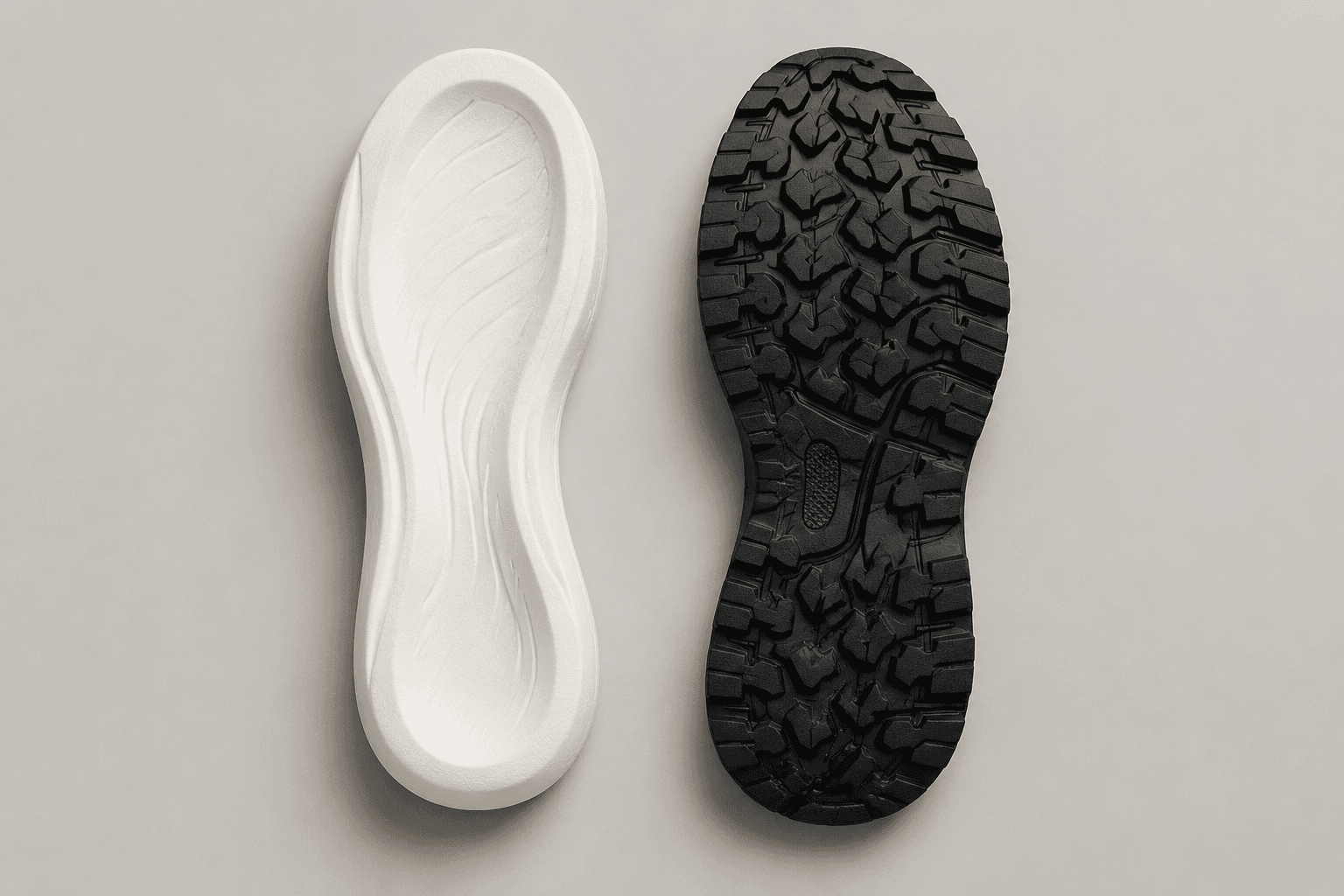
On the outsole side, buyers should clarify rubber type, finished weight, and hardness target. Shore A 55 to 65 is common for casual vulcanized bottoms, but the right choice depends on whether the market prioritizes flexibility, abrasion resistance, or shelf stability in hotter climates. Foxing thickness, sidewall cleanliness, toe cap symmetry, and heel patch positioning should be frozen through approved golden samples because those are frequent retailer rejection points.
Typical material package by price level
A basic low-cut style at $3.50 to $4.20 FOB often uses 280 to 320 GSM upper canvas, 120 to 150 GSM lining, a 2.5 to 3.0 mm comfort insert, and standard sulfur-vulcanized outsole construction. A retail-ready style at $5.20 to $6.20 FOB normally steps up to 360 to 400 GSM upper canvas, 180 to 220 GSM lining, a 4 to 5 mm die-cut insole, and cleaner sidewall finishing. At $7.20 and above, buyers generally expect 410 GSM plus upper weight, improved counter reinforcement, stronger heel shape retention, and tighter left-right pairing.
Lead time comparison: quotation speed is not shipment speed
Lead time is often presented too loosely in canvas footwear. A factory may quote 30 days, but that number may exclude artwork approval, lab dip confirmation, outsole color matching, fit revision, carton approval, and test sample preparation. Buyers should separate development days from production days and ask which inputs must be signed off before the ex-factory clock starts.
For repeat orders using approved materials, bulk production is often 30 to 40 days after deposit, size breakdown, and final packing confirmation. A new upper on an existing outsole usually needs 40 to 50 days. A fully customized vulcanized project with new mold work, revised fit, and branded packaging normally requires 55 to 75 days from confirmation to ex-factory. In peak windows before back-to-school and year-end shipping, adding 7 to 12 buffer days is prudent because rubber lines and vessel bookings tighten first.
From the supplier side, the true critical path is usually outsole color approval, print strike-off confirmation, raw material arrival, wear-test feedback where required, and final carton dimensions. Buyers who close those approvals quickly usually ship earlier than buyers who negotiate aggressively on FOB but hold decisions for a week on labels or packing.
Compliance and testing: where experienced suppliers reduce risk
A supplier shipping vulcanized canvas shoes into the EU, UK, and US should treat testing as part of the commercial offer. Most claims in this category come from adhesion failure, poor colorfastness, shade mismatch, chemical non-compliance, or unacceptable visual workmanship. Those are not random problems. They are usually the result of unspecified materials, uncontrolled incoming components, or a mismatch between tested samples and bulk materials.
On physical performance, buyers commonly check outsole adhesion, flex resistance, abrasion, stitching strength, eyelet pull, print durability, and colorfastness to rubbing. Depending on the customer, factories may work to EN ISO 20344 methods for footwear testing, ASTM F2913 where slip resistance is requested, or buyer-specific protocols that combine SATRA and internal criteria. The exact method matters less than whether the supplier can prepare correct test submissions and keep the same upper, ink, adhesive, and rubber blend in bulk that was approved in testing.
Chemical compliance should be confirmed before production, not after packing. In canvas vulcanized shoes, common restricted-substance concerns include azo dyes, lead, cadmium, phthalates, PCP, SCCP, and PAHs in rubber compounds, inks, coated trims, and adhesives. The weak point on low-cost programs is often not the canvas itself but the rubber oil, pigment, print ink, or decorative transfer.
At final inspection, many branded buyers work at AQL 2.5 major and 4.0 minor, with zero tolerance on critical defects such as wrong size marking, open seam, exposed sharp components, severe mold contamination, or failed bonding. Even in value channels, importers should define tolerance for foxing alignment, left-right pair match, print position, glue visibility, and outsole color difference because these points drive chargebacks more often than carton counts do.
- Ask for recent adhesion and flexing results on comparable vulcanized styles before booking
- Lock upper weight in oz and GSM on the PO rather than relying on sample comments
- Confirm whether ASTM F2913, EN ISO 20344, or buyer-specific testing applies before material purchase
- Control chemical risk at raw-material stage, especially for rubber, inks, and coated trims
Price comparison: FOB alone does not show total sourcing cost
A lower FOB only helps if the same specification, packing efficiency, and shipment performance can be repeated. In practice, two suppliers quoting the same-looking low-cut canvas shoe may differ by 40 to 80 GSM on the upper, 1 mm on the insole, and several grams on outsole weight. One offer at $3.85 may use a lighter canvas and lower-recovery insert than another at $4.25. The second option can still be the cheaper landed decision if it reduces defects, resampling, and customer deductions.
Carton efficiency is a real cost lever in bulk canvas sneakers. Depending on box size, master carton structure, and pair arrangement, a 40HQ can load roughly 8,800 pairs or as many as 9,600 pairs on a similar low-cut style. That difference materially changes freight cost per pair. The same is true for whether the order uses individual shoe boxes, polybags, display lids, tissue stuffing, or e-commerce protection.
Development charges should also be separated from unit FOB. Buyers should ask suppliers to state mold charges, sample fee policy, testing cost responsibility, packaging surcharges, and repeat-order price conditions. That prevents a common problem in which the first order is quoted aggressively and the second order increases because the tested material, outsole color, or branded trim was never properly locked.
A useful comparison sheet includes FOB, mold cost, sample lead time, bulk lead time, estimated packing quantity per container, expected inspection tolerance, and known compliance scope. That is the information importers need when selecting a supplier for steady margin, not just a low opening quote.
How to evaluate a canvas shoe supplier beyond the catalog
The supplier choice should match the buyer channel. Discount importers generally need quick quotation, stable stock materials, and shipment consolidation. Private label retailers need accurate sampling, repeatable fit, and cleaner trim consistency. School and uniform buyers need replenishment stability, reliable white rubber performance, and strong size consistency across reorder cycles.
A qualified canvas shoe supplier should answer operational questions directly. How many vulcanized lines run each month? What is daily output for low-cut versus high-cut styles? Which sewing and foxing operations are in-house? Which mills supply the main canvas weights? What is the normal variation tolerance on outsole color? How many days are needed to remake failed samples? What final inspection level is used internally before third-party inspection arrives?
In this category, process control is usually a better predictor than a wide catalog. Factories that control cutting accuracy, upper stitching, foxing application, curing time, and final pair matching are the factories that can support repeat business with less drift in fit, color, and workmanship.
- Ask for a size-set sample before bulk when changing last shape or insole package
- Confirm whether white foxing and white toe caps use the same rubber batch across the full order
- Check if the factory keeps approved upper swatches and outsole chips for repeat-order reference
- Review how the supplier handles rework when bonding or color matching fails in pre-final inspection
Verdict: which sourcing option is usually the right buy
If the target channel is promotional retail, discount chain, or short-season value business, entry-level wholesale canvas shoes on stock bottoms are usually the correct buy. Keep the upper simple, stay within proven canvas and rubber combinations, and avoid custom trims that raise cost without improving sell-through.
If the target is private label retail, regional chain supply, or evergreen reorder business, mid-range vulcanized canvas shoes are usually the best commercial decision. The step up to heavier canvas, 4 to 6 mm comfort construction, and cleaner foxing control often reduces complaint risk enough to justify the higher FOB.
If the objective is brand differentiation and higher retail positioning, premium or fully customized programs make sense only when the retail price, forecast, and reorder plan can absorb mold cost, higher MOQ, and longer lead time. In most sourcing situations, the right choice is not the cheapest quote. It is the specification package that ships on time, passes testing, fits consistently, and can be repeated without quality drift.
SoleForge manufactures casual sneakers under OEM and ODM for brands and importers worldwide. Request a quote with your tech pack or reference pair and we'll reply within one business day.