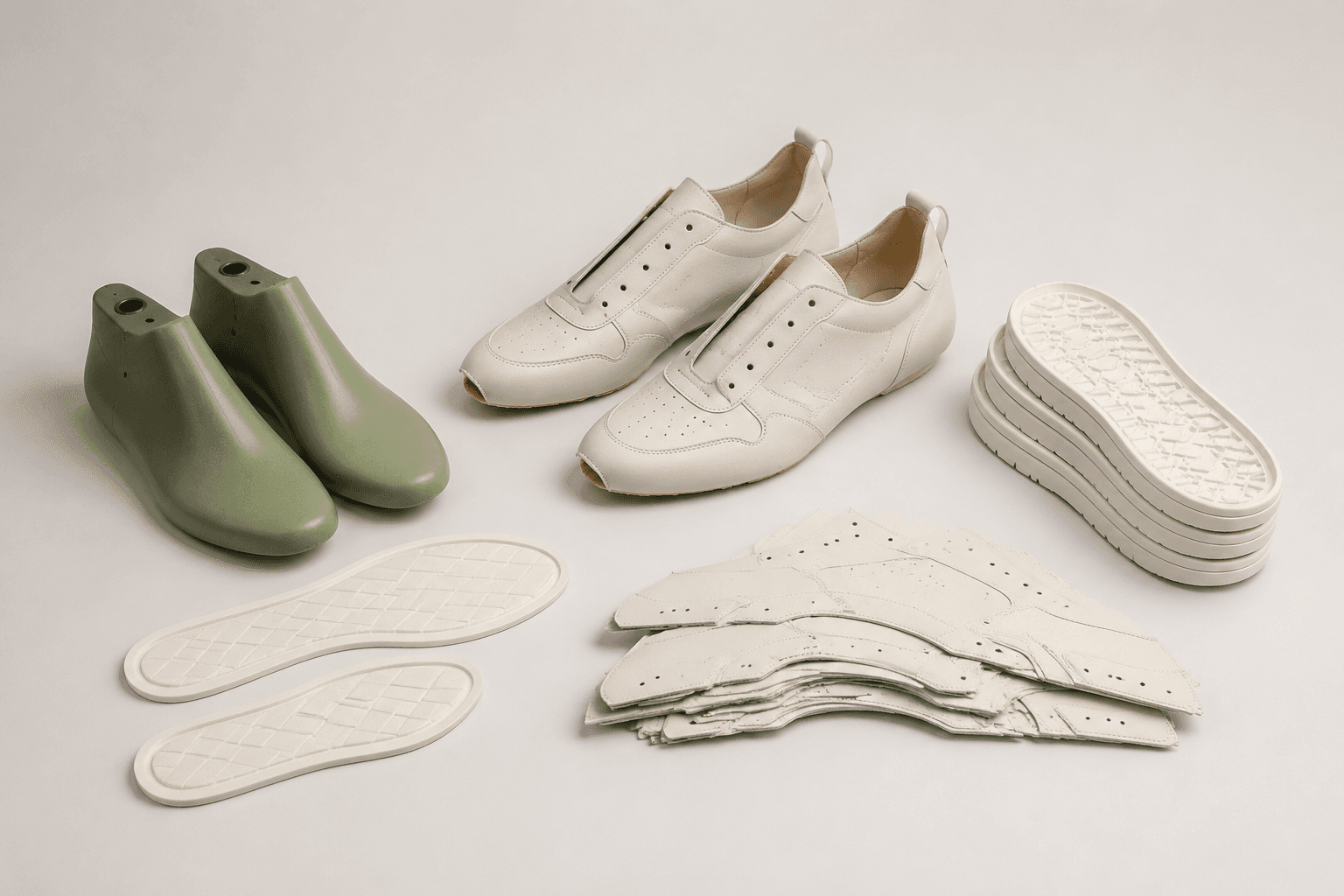
Buying wholesale shoes is not a single price negotiation; it is a specification exercise that determines margin, claim rate, and reorder stability. For a sourcing manager or shoe importer, the supplier quote only becomes meaningful after the construction, materials, packing standard, test method, and tolerance are locked. A canvas vulcanized sneaker at $6.80/pair and another at $8.10/pair may look similar in photos, but the difference often sits in outsole rubber content, upper GSM, eyelet grade, foam density, glue line control, carton drop resistance, and size consistency.
In China, most footwear wholesale programs are built around factory specialization. One plant may be strong in cemented runners with Phylon and rubber outsoles, another in strobel-knit athleisure, and another in injected EVA clogs or PVC rain boots. The right bulk shoe supplier is usually not the one with the lowest opening FOB, but the one whose tooling capability, line balance, material sourcing network, and QA discipline match your category and target market.
This guide breaks wholesale shoes sourcing into the actual cost drivers used by factories: upper, outsole, insole board, sockliner, reinforcement, labor content, packaging, testing, and logistics assumptions. It is written for buyers placing bulk orders from China who need concrete working ranges for MOQ, lead time, compliance, and landed cost risk.
Define the footwear category before asking for price
A workable RFQ for footwear wholesale starts with category clarity. 'Sneakers' is too broad. A factory needs to know whether you mean vulcanized canvas low-tops, cemented PU fashion sneakers, strobel-knit running shoes, cupsole casuals, or injected EVA recovery slides. Each construction uses different machinery, technicians, molds, adhesives, and yield assumptions.
The first commercial split is construction method. Common retail bulk programs from China include cemented shoes for lifestyle and running styles, vulcanized shoes for canvas and skate silhouettes, strobel construction for flexible athletic uppers, and injection for EVA clogs, sandals, and some safety or rain products. Construction drives labor minutes per pair and also defect mode. Cemented shoes need close control of primer, adhesive activation temperature, and bonding surface roughing. Vulcanized shoes need stable foxing tape placement, sulfur cure consistency, and clean sidewall finish.
A supplier-side quotation also depends on target testing regime. A fashion sneaker sold in one market may only require internal wear tests, while a work or protective line may need EN ISO 20345 or ASTM F2413 depending on toe protection, slip, puncture, and electrical properties. Even for non-safety products, buyers often set minimum peel strength, flex cycles, colorfastness, hydrolysis resistance, and migration limits for trims and coatings.
- 01State category, construction, and intended end use: example, 'men's cemented casual sneaker, everyday wear, EU market, non-safety'.
- 02Attach a tech pack or sample with upper material callout, outsole material, size range, target weight, packaging, and required tests.
Typical MOQ by construction
For most Chinese factories, practical MOQ is tied to outsole mold use and material color count. A simple canvas vulcanized style can start around 600-1,200 pairs per style across sizes if using stock outsole tooling and standard colors. Cemented sneakers usually run 800-1,500 pairs per style, with 300-500 pairs per color if the factory can combine materials. Injected EVA clogs often require 1,200-3,000 pairs because machine setup and color batching matter. Outdoor or safety shoes with many components and testing overhead may start at 1,200-2,400 pairs per style.
If a buyer wants custom outsole tooling, MOQ is only part of the issue; the tooling amortization must also be discussed. New outsole molds commonly add a one-time cost in the low thousands of USD depending on complexity, size range, and whether matching midsole molds are needed.
The main cost drivers in wholesale shoes
Footwear cost is highly componentized. The upper usually carries the highest visible material cost, but outsole compound, labor minutes, and packaging can shift the total more than buyers expect. Small spec changes often have an outsized FOB effect. Moving from a 1.2 mm PU upper to a microfiber with tighter grain and better hydrolysis resistance may add only $0.30-$0.70/pair, while switching from a stock TPR outsole to a custom rubber outsole with higher natural rubber content and deeper traction can add $0.80-$1.80/pair plus mold cost.
Factories price by standard consumption, yield loss, line efficiency, and reject allowance. This is why a clear BOM matters. For example, a mesh runner with 280-320 GSM sandwich mesh, 1.2-1.5 mm foam backing, hot-melt overlays, 45-50C EVA midsole, and 55-65 Shore A rubber pods has a different scrap pattern than a vulcanized canvas shoe using 10-12 oz upper fabric, toe cap rubber, foxing tape, and calendared outsole sheet.
For a shoe importer, the practical approach is to ask every bulk shoe supplier to quote on the same construction assumptions: FOB port, pair weight, box spec, carton count, test standard, and tolerance on color and size. Without that, one factory may be quoting thinner sockliner foam, lower rubber ratio, and plain polybag packing while another is including stronger cartons, barcode labels, and a branded tissue wrap.
- Upper material grade: PU, microfiber, leather split, knit, canvas, PVC, or synthetic leather
- Outsole material and hardness: TPR, rubber, EVA, Phylon, PVC, PU, TPU, or blends
- Midsole and sockliner density: commonly 0.12-0.20 g/cm³ for EVA foam depending on use
- Labor content: stitching complexity, number of eyelets, overlays, foxing, print, and handwork
- Packaging standard: individual box strength, insert cards, silica gel, tissue, and export carton spec
- Testing and compliance: bond strength, abrasion, flexing, slip resistance, restricted substance screening
Typical cost drivers in wholesale shoes from China
| Component / cost driver | Typical range | Notes |
|---|---|---|
| Upper material | $1.20-$4.50/pair | Canvas, mesh, PU, microfiber, or knit; cost depends on GSM, thickness, backing foam, and print/overlay count. |
| Outsole | $1.00-$3.80/pair | TPR and EVA on the lower end; rubber and complex cupsoles higher; custom molds extra. |
| Midsole / bottom unit | $0.50-$2.20/pair | Phylon, EVA, PU, or combined units; density and paint/finish add cost. |
| Sockliner / insole | $0.18-$0.90/pair | EVA or PU foam, commonly 3-8 mm; density and top cloth quality matter. |
| Insole board, toe puff, counter | $0.20-$0.75/pair | Often overlooked; weaker specs can reduce durability and shape retention. |
| Laces, eyelets, trims, branding | $0.15-$0.90/pair | Metal hardware, molded logos, heat transfers, and special aglets increase cost. |
| Labor | $1.20-$4.00/pair | Driven by construction method, stitching complexity, and line efficiency. |
| Packaging | $0.35-$1.20/pair | Shoe box, tissue, hangtag, silica gel, barcode, and export carton allocation. |
| Testing / compliance allocation | $0.05-$0.60/pair | Higher for small orders or certified categories requiring external lab work. |
| Development / tooling | $0.00-$2.50+/pair equivalent | Depends on amortization of outsole molds, logo molds, and first-fit sampling. |
| Typical MOQ | 600-3,000 pairs/style | Depends on construction, color count, and whether stock soles are used. |
| Typical lead time | 35-60 days bulk | Longer for custom materials, peak season, or safety/compliance programs. |
How to read supplier pricing by shoe type
Entry-level FOB China prices move with oil-derived materials, rubber markets, labor cost, and exchange rates, so no number should be treated as fixed. Still, realistic planning ranges are useful. Basic canvas vulcanized shoes can land around $4.50-$8.50/pair FOB for large-volume programs with stock components. Cemented casual sneakers often sit around $7.00-$14.00/pair depending on upper grade and outsole complexity. Lightweight knit runners with molded EVA or Phylon midsoles commonly run $8.50-$16.00/pair. EVA clogs and slides can be lower on labor but sensitive to resin grade and mold output, often around $3.20-$7.50/pair for straightforward programs.
Boots and protective footwear are a different discipline. Hiking or safety constructions using cemented or direct-injected methods, steel or composite toe caps, puncture-resistant midsoles, and oil/slip-resistant compounds can move quickly into the $16.00-$32.00/pair FOB range or higher. Here, the hidden cost is testing failure risk. If slip resistance or impact tests fail, the cheapest quote becomes the most expensive order.
The strongest factories will separate their quote into open material, labor, packaging, testing allocation, and margin rather than presenting a single unexplained FOB. That transparency helps when you need to engineer cost down without weakening the product.
Specification points that affect claim rate
Footwear returns usually come from a short list of causes: sole bonding failure, upper cracking, color transfer, broken eyelets, outsole wear, odor, size inconsistency, and packaging damage. Most of these can be reduced at spec stage. A supplier should know your minimum bond strength requirement, acceptable color difference standard, insole compression set target, and outsole abrasion target before bulk starts.
For athletic and casual categories, ask the factory to define foam density and hardness numerically, not descriptively. 'Soft EVA' means little. A better spec is 45-50C hardness with density target and tolerance. On textile uppers, request the fabric GSM, backing foam thickness, and tear strength. On synthetic leather, define thickness in mm, surface finish, and hydrolysis expectation if the item will sit in warm, humid warehouses.
Sizing is another frequent issue in footwear wholesale. Last shape, toe allowance, sockliner thickness, and upper padding all affect fit. A pre-production confirmation sample must be checked not only for appearance but also internal length, ball girth, collar opening, and weight by size. For ecommerce-heavy customers, poor fit consistency can destroy margin faster than almost any material issue.
- 01Approve materials with signed swatches and test references before cutting starts.
- 02Confirm size set samples in the full run range, especially on new lasts or wide/narrow fits.
- 03Lock carton marks, barcode format, and packing count before mass production to avoid repacking delays.
Common technical ranges buyers should request
Textile uppers for casual sneakers are often specified around 10-16 oz canvas or 220-350 GSM mesh/knit depending on end use. Foam backing on uppers may range around 1.0-3.0 mm. Sockliners are commonly EVA or PU foam around 3-8 mm, with density chosen according to rebound and compression target. Rubber outsoles often fall around 55-70 Shore A depending on wear and traction needs, while TPR may be softer for comfort but generally lower in abrasion performance than a well-formulated rubber compound.
Export cartons for shoes are typically specified by burst strength or edge crush standard rather than just dimensions. If your channel is long-haul ocean plus warehouse cross-docking, carton failure should be treated as a product cost issue, not a logistics issue.
Lead times, sampling, and production control
For a repeat style using known materials and stock outsole tooling, development can move quickly. Confirmation samples may take 7-14 days if all trims are available. New upper materials, custom color development, or logo hardware can extend this to 14-21 days. For first bulk orders, realistic ex-factory lead time is commonly 35-60 days after deposit, sample approval, and receipt of all packaging artwork. Complex boots or safety shoes can stretch to 60-90 days, especially if third-party testing is built into the shipment release process.
The buyer should separate sample lead time from material readiness. Many delays happen because the sample room uses substitute stock materials, then bulk has to wait for ordered compounds, fabric dyeing, or custom boxes. A disciplined factory issues a time-and-action calendar covering material booking, trial cutting, stitching start, lasting, assembly, packing, inline inspection, and final random inspection.
If the order spans multiple colors, ask which color will run first. Dark shades and whites often expose different manufacturing risks. White foxing, glue marks, color migration, and contamination control require stricter line discipline than black or navy shoes.
- Sample confirmation: 7-21 days depending on tooling and material availability
- Bulk production: 35-60 days for common casual programs; 60-90 days for complex or certified lines
- Peak season pressure: add 10-20 days around major export rush periods
- Reorder speed: often 25-40 days if outsole, upper, and packaging are unchanged
Quality control and compliance for shoe importers
A shoe importer should treat QC as a layered process, not only a final inspection. Inline checks catch mismatched panels, skewed foxing, poor stitching density, upper creasing, and adhesive overflow before the line multiplies the problem. Final inspection alone is too late for many footwear defects because rework can damage appearance or delay vessel cutoff.
At minimum, the QC plan should cover incoming materials, cutting and stitching inline, assembly inline, finished goods inspection, and carton drop or transport checks. For protective or occupational products, compliance records should be traceable to the exact batch used in production. If the order references EN ISO or ASTM methods, the factory must confirm whether testing is internal, external, pre-bulk, or shipment lot based.
Slip resistance, flexing, abrasion, pull-off strength, and colorfastness are the routine discussion points, but restricted substances should not be ignored. Synthetic uppers, prints, adhesives, foams, metal trims, and packaging inks can all create nonconformity risk if material approvals are loose.
Factory questions worth asking
Ask what percentage of outsole and upper materials are stock versus custom ordered. Ask whether outsole compounds are mixed in-house or bought as finished components. Ask how the plant controls left-right shade variation, glue activation temperature, and fit consistency by size. Also ask whether the same line handles both domestic and export products; export-dedicated lines are often more disciplined on packaging and documentation.
Negotiating with a bulk shoe supplier without damaging quality
Cost reduction works best when it removes unnecessary complexity rather than core performance. If your target FOB is too high, first review the outsole design, material overlap count, logo applications, and packing extras. Reducing one print process, changing from custom molded eyelets to standard hardware, or increasing carton efficiency can save real money without making the shoe visibly cheaper.
The most dangerous area to cut is hidden material quality. Lowering rubber content, reducing adhesive grade, using weaker toe puff or counter, or thinning the insole board may produce a clean inspection sample but weak field performance. A responsible supplier will tell you where a saving is cosmetic and where it affects wear life.
Volume leverage should also be used correctly. Combining colorways into one material purchase, committing to rolling forecasts, or standardizing outsole units across several uppers often gives a better result than forcing an unrealistic one-time FOB cut.
SoleForge manufactures casual sneakers and athletic & running shoes under OEM and ODM for brands and importers worldwide. Request a quote with your tech pack or reference pair and we'll reply within one business day.