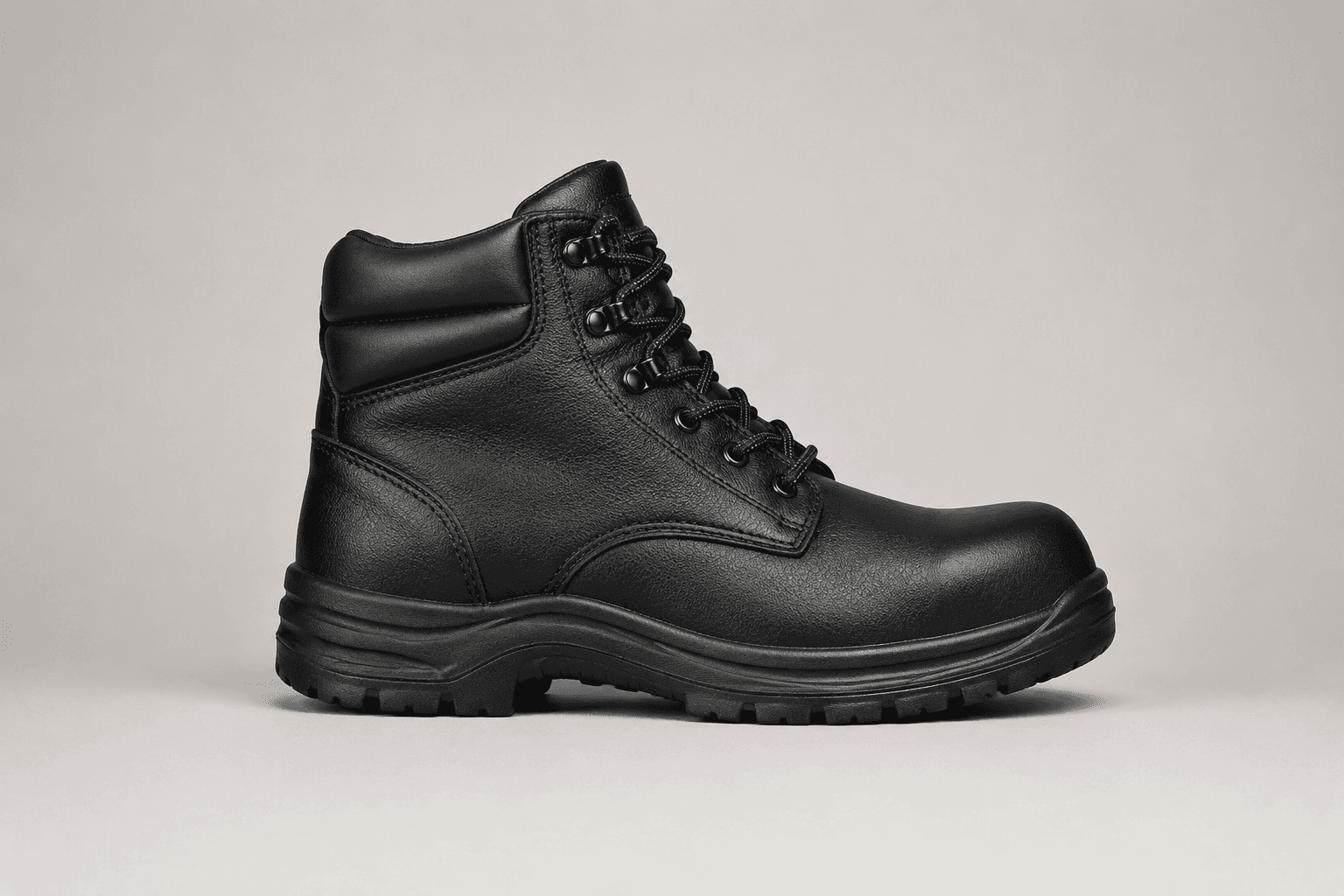
Selling safety footwear means selling a claim — that the shoe protects the wearer to a recognized standard. If you can't back that claim with the right rating and a current test report, you can't compete in tenders or pass distributor audits. This guide demystifies the two standards that govern most of the world's safety footwear: Europe's EN ISO 20345 and North America's ASTM F2413.
EN ISO 20345: the European standard
EN ISO 20345 is the European standard for safety footwear. Its defining requirement is a toe cap that withstands a 200-joule impact and a 15 kN compression. On top of that baseline, footwear is classified by added protections, summarized in safety classes.
| Class | What it adds |
|---|---|
| SB | Basic: 200J toe cap |
| S1 | Toe cap + antistatic + energy-absorbing heel + oil-resistant outsole |
| S1P | S1 + puncture-resistant midsole |
| S2 | S1 + water penetration resistance of the upper |
| S3 | S2 + puncture resistance + cleated outsole |
Additional markings cover slip resistance (SRA/SRB/SRC), heat-resistant outsoles (HRO), metatarsal protection (M), and electrical hazard properties. You spec the class that matches the hazards of the wearer's environment.
ASTM F2413: the North American standard
In the US and Canada, ASTM F2413 governs protective footwear. It uses a coded marking that states the standard year, gender, impact (I) and compression (C) ratings (typically 75), and any additional protections such as metatarsal (Mt), conductive (Cd), electrical hazard (EH), static dissipative (SD), or puncture resistance (PR).
Steel toe vs. composite toe
- Steel toe: proven, economical, meets impact/compression — but conductive and heavier.
- Composite toe: non-metallic, lighter, thermally neutral, and metal-detector friendly — ideal for airports, electrical work, and cold environments.
- Both can meet the relevant standard; the choice depends on the workplace.
How to spec compliant safety shoes
- 01Identify the hazards: impact, slip, puncture, electrical, heat, chemicals.
- 02Map them to a class (e.g. S3 for outdoor construction) or ASTM code.
- 03Choose toe type (steel or composite) and midsole protection.
- 04Confirm the factory tests to the standard and provides current reports.
SoleForge manufactures certified safety and work shoes to EN ISO 20345 and ASTM F2413, and supplies workwear and PPE distributors with private-label ranges backed by SGS/ITS testing.
A safety shoe without a current test report is just a heavy shoe. The certificate is the product.
Need a compliant safety range for your market? Request a quote with your target standard and we'll spec it to pass.