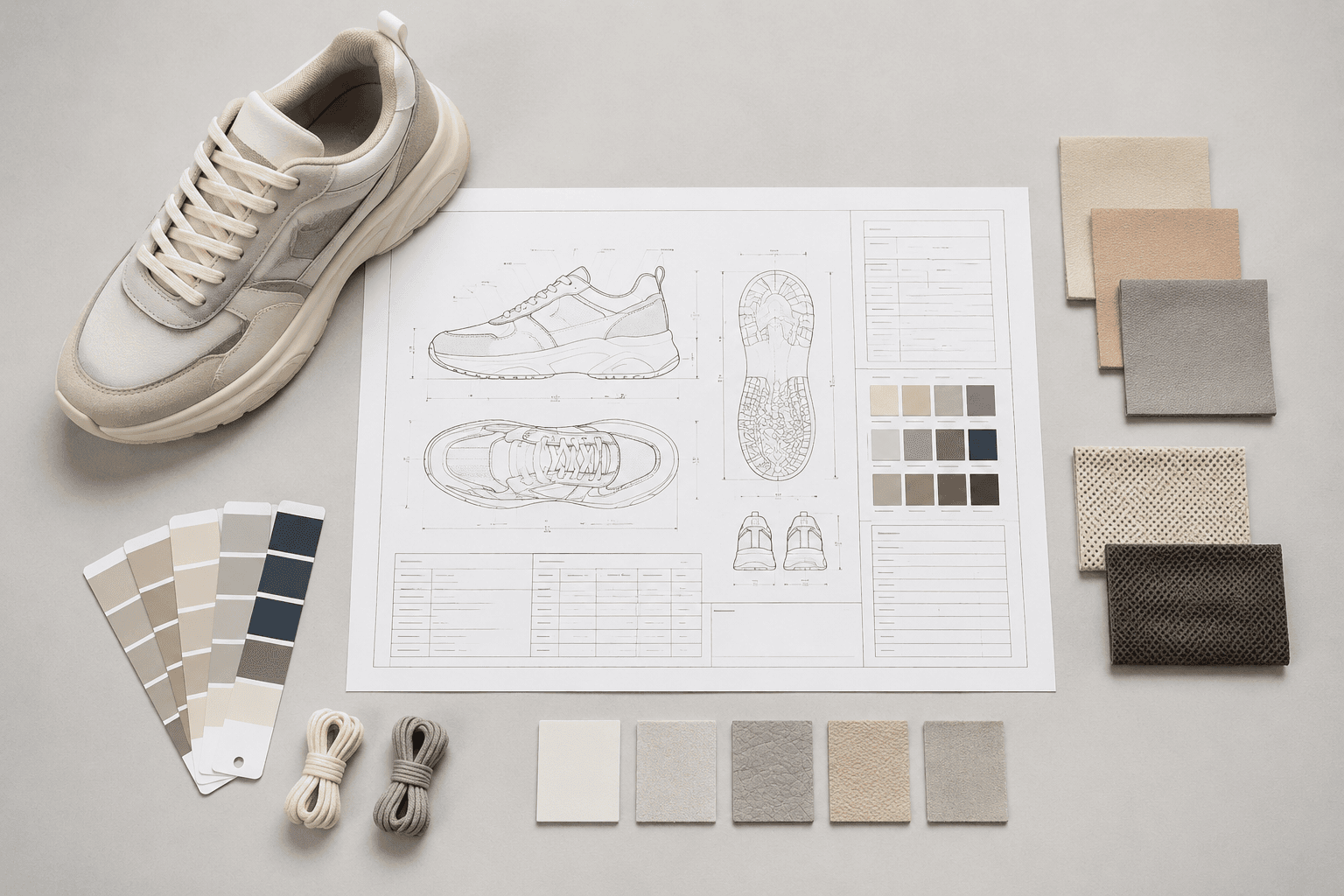
Choosing the wrong footwear manufacturer is an expensive mistake that often only reveals itself at the worst possible time — when bulk arrives late, off-color, or failing a fit test you can no longer fix. The right partner, on the other hand, becomes a quiet competitive advantage: faster development, healthier margins, and product your customers trust. This guide gives procurement managers and brand owners a structured way to evaluate footwear factories before money changes hands.
1. Match capability to your category
Footwear is not one industry — it is several. A factory that excels at vulcanized canvas sneakers may have no business making welted leather dress shoes or certified safety boots. The single most common sourcing error is asking a factory to build outside its core competence. Before anything else, confirm the factory routinely produces your construction type at the quality tier you sell at.
- Ask which constructions they run daily: cement/cold-cement, vulcanized, injection (DIP/IP), Strobel, or Goodyear welt.
- Request reference styles in your exact category — not a generic catalog.
- Confirm in-house vs. outsourced steps (tooling, lasts, outsole molding).
If you sell across categories, a full-category manufacturer can simplify your supply base. See how SoleForge covers athletic footwear, casual sneakers, and safety shoes under one quality system.
2. Test development, not just price
Anyone can quote a price. The factories worth keeping are the ones that improve your brief — proposing a lighter outsole compound, a better last for fit, or a construction that holds the look while shaving cost. Evaluate the development team directly: send a real (small) project and judge the sample, the questions they ask, and how they communicate trade-offs.
Green flags in development
- They ask about your target retail price and wear scenario, not just the BOM.
- They return a buildable tech pack and costed BOM, not only a sample.
- They flag risks (fit, durability, cost) before you do.
3. Understand MOQ and how it scales
Minimum order quantity shapes your whole launch strategy. A high MOQ forces you to bet capital on unproven styles; a workable one lets you test, learn, and reorder. Ask for MOQ per style and per color, and how it changes with construction complexity. Our own approach is covered in the footwear MOQ guide.
4. Verify compliance and testing
If you import into regulated markets or sell safety footwear, compliance is non-negotiable. Confirm the factory holds current social and quality audits and can produce material and physical test reports for your destination market.
| Area | What to ask for |
|---|---|
| Social compliance | BSCI / Sedex / SMETA audit report |
| Quality system | ISO 9001 certificate |
| Material safety | REACH / CPSIA / restricted-substance reports |
| Physical testing | SGS / ITS / Bureau Veritas (slip, flex, bond strength) |
5. Watch for the red flags
- Prices far below the market — usually a sign of corner-cutting on materials.
- No willingness to sign an NDA or provide references.
- Vague, shifting lead times and no inspection process.
- A 'yes' to everything — capable factories know their limits.
The cheapest quote and the cheapest total cost are rarely the same number. Rework, delays, and returns are where margin quietly disappears.
Putting it together
Score candidates on capability fit, development strength, MOQ flexibility, compliance, and communication — then weight communication heavily, because you'll live with it on every order. When you're ready to test a partner with a real project, request a quote with your tech pack or reference pair, or explore our customization and OEM services first.