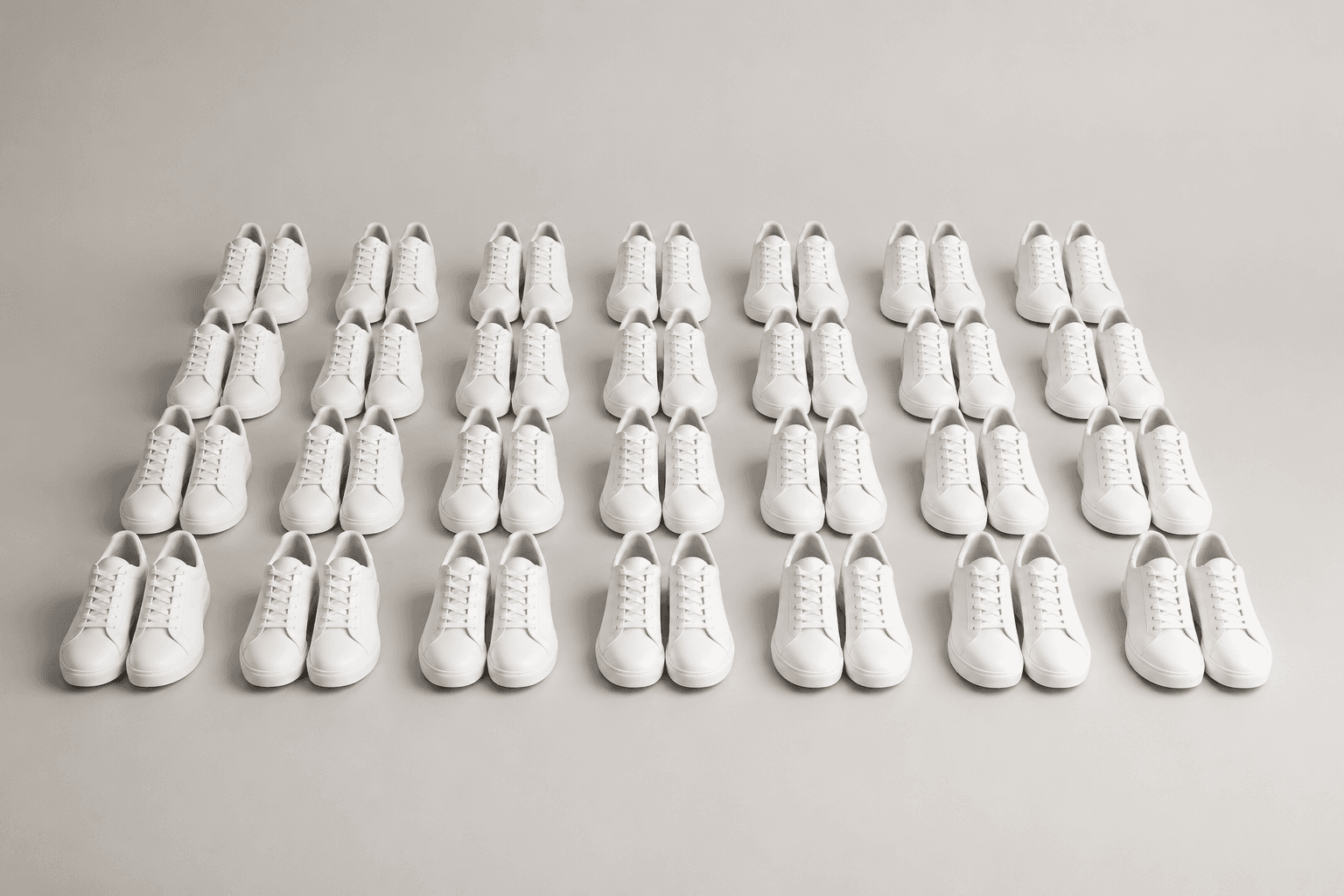
Minimum order quantity (MOQ) is one of the first numbers a footwear buyer asks for — and one of the most misunderstood. MOQ isn't an arbitrary gate; it reflects the real economics of tooling, materials, and line setup. Understanding what drives it helps you negotiate smarter and structure a launch you can actually afford.
Why MOQs exist at all
Producing footwear requires fixed setup costs that don't shrink with order size: cutting dies, outsole molds, line changeovers, and minimum material purchases from component suppliers. Below a certain quantity, those fixed costs make the per-pair price uneconomical for both sides. MOQ is the point where production becomes efficient enough to quote a fair price.
What drives the number up or down
| Factor | Effect on MOQ |
|---|---|
| Outsole tooling | Custom molds raise MOQ; stock soles lower it |
| Color count | Each color is effectively its own MOQ |
| Material orders | Specialty leathers/knits have their own minimums |
| Construction | Complex constructions need longer, costlier setup |
| Branding | Custom components (labels, insoles) add minimums |
This is why MOQ is almost always quoted per style and per color, not just per order. Five colors of one sneaker is five MOQs, because each color needs its own materials, line setup, and grading run.
Typical footwear MOQs
Across the industry, footwear MOQs commonly land between 300 and 1,200 pairs per style and color depending on construction and how much is customized. Our standard MOQ is 500 pairs per style and color — low enough for emerging brands to launch a multi-SKU line without drowning in inventory. See the products this applies to across our full footwear range.
How to launch without over-committing
- 01Use stock or shared outsole tooling for your first run to avoid custom-mold minimums.
- 02Limit your launch to your two or three strongest colors, then expand on reorder.
- 03Lean on customization that doesn't add component minimums (e.g. printed branding vs. fully custom molded parts).
- 04Validate demand on a tight assortment, then scale into container economics once a style proves itself.
Our customization and private-label services are built around this staged approach, so you can start branded but lean and grow into bigger runs.
MOQ vs. unit price: the trade-off
Larger orders unlock lower unit prices because fixed costs spread across more pairs. The art is balancing a price you like against inventory risk you can stomach. For a new style, paying slightly more per pair at a lower quantity is usually cheaper than the alternative: a warehouse of a color that didn't sell.
The cheapest pair you'll ever buy is the one you actually sell. Right-size the first order to demand, not to the price break.
Want a real MOQ and price for your specific style and color plan? Send us your project and we'll quote it transparently.